
21 Games to Play While High With Friends
21 Games to Play While High With Friends
Good games to play while high with friends have a clear starting point, simple turns, and an easy way to stop. Twenty Questions works with no supplies, Drawing Telephone turns a few sheets of paper into a group activity, and familiar card games give two or three people something to settle into.
This guide includes 21 games you can play at home, with suggested group sizes, supplies, rules, and examples. Choose something that fits the people in the room and how they actually feel. Everyone can join in sober, and passing or sitting out is always fine.
For a wider range of activities, our guide to 50 things to do while high also covers music, movies, creative projects, and quiet time.
Games to play while high with no supplies
These games work from the couch. The group sizes below fit these casual versions. If your friends already know a version, agree on which rules to use before starting.
1. Twenty Questions
Players: 2-8. Supplies: None.
One person secretly chooses an ordinary object. Everyone else shares a limit of 20 yes-or-no questions to identify it. Take turns asking, count aloud, and include direct guesses in the total. The chooser reveals the answer when someone gets it or the group reaches 20, then the next person chooses.
Try it: For a toaster, questions might narrow down whether it fits on a counter, uses electricity, and belongs in a kitchen. Start with objects everyone recognizes.
2. Categories
Players: 3-8. Supplies: None.
Choose a category, then go around the room naming one different example each. Work together to reach ten answers without repeating one. Anyone can pass; if the group gets stuck, choose a new category. Complete three categories for a short game.
Try it: Things that would be inconvenient to find in your shoe, terrible names for a luxury hotel, or animals that would make demanding roommates. Agree whether you want real answers or invented ones.
3. One-Sentence Story
Players: 3-8. Supplies: None.
Build a story one sentence at a time. Each person must continue what has already happened instead of starting over. Go around the group twice, with the final player supplying an ending. There is no winner; the finished story is the result.
Opening line: "The landlord said the apartment came with a ghost, but nobody mentioned that it played the saxophone." Keep the cast small enough to remember.
4. Seated Charades
Players: 3-8. Supplies: None.
One person silently acts out an everyday activity using facial expressions and comfortable hand gestures while seated. The others get five guesses collectively. Reveal the answer after a correct guess or the fifth attempt, then rotate actors. Finish when everyone who wants a turn has had one.
Try it: Untangling headphones, discovering your coffee is cold, or trying to remember why you entered a room. Use imaginary props and keep the movement small.
5. Ridiculous Invention Pitch
Players: 3-8. Supplies: None.
Two friends each name an ordinary object. The next player combines them into an imaginary invention and gives a short sales pitch: its name, its purpose, and one unnecessary feature. Listeners may each ask one question before the next pitch. Stop after everyone has had a turn.
Try it: An umbrella plus a toaster becomes a breakfast canopy that protects your toast from rain. Award imaginary praise for the most committed explanation.
6. Secret Word Rule
Players: 3-8. Supplies: None.
One person chooses a simple spelling rule and gives two words that fit and two that do not. Other players take turns suggesting words; the host says whether each fits. Anyone can propose the rule on their turn. Reveal it after a correct guess or after each guesser has offered two words, then change hosts.
Try it: Coffee and apple qualify, but tea and pear do not. The rule is consecutive repeated letters. Use common words and pronounce their spellings if needed.
Drawing and paper games for friends
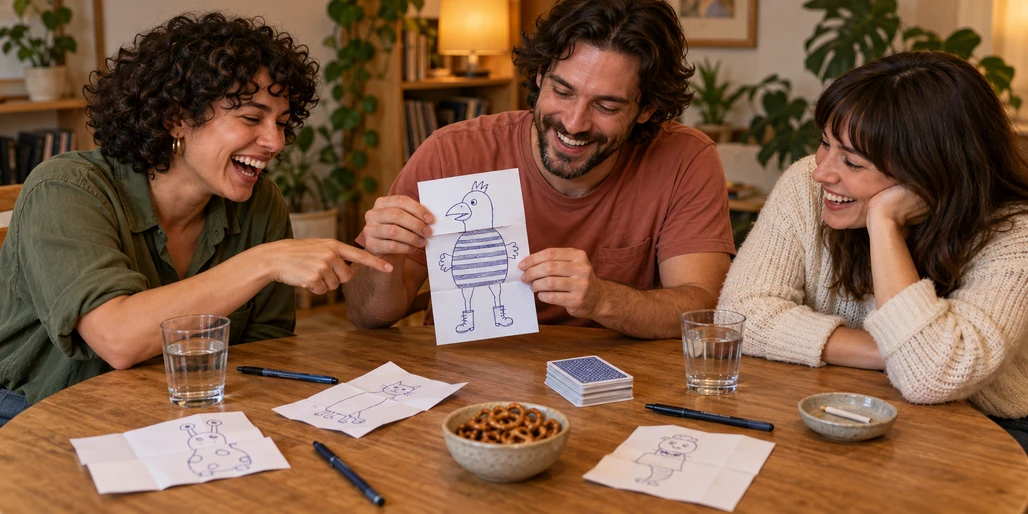
A few sheets of paper open up games with something to reveal at the end. Ordinary pens are enough. Nobody needs drawing experience.
7. Drawing Telephone
Players: 4-8. Supplies: One sheet of paper and a pen per person.
- Everyone writes a short scene at the top of their sheet, such as "a pigeon checking into a hotel," then passes it left.
- The next person draws the scene below the words, folds the words out of sight while leaving the drawing visible, and passes left.
- The next person writes what they think the drawing shows, then hides the drawing and leaves only their new description visible.
- Continue alternating drawings and descriptions until each sheet returns to its original owner. Unfold and compare the beginning with the ending.
Leave enough space for the number of players. The changes along the way are the point, so save explanations until the reveal.
8. Continuous-Line Guessing
Players: 2-8. Supplies: Paper and a pen.
The artist secretly chooses a recognizable object and draws it without lifting the pen. Retracing a line is allowed; letters and written labels are not. When the drawing is finished, the group gets three guesses collectively before the artist reveals the answer.
Try it: A teapot, bicycle, or pineapple. Rotate artists until everyone has had a turn. Choose the next object before looking at the previous drawing to keep the ideas varied.
9. Folded Creatures
Players: 3-6. Supplies: One sheet of paper and a pen per person.
Fold each sheet into three horizontal panels. Everyone draws a head in the top panel, leaving two small neck marks across the fold. Hide the head and pass left. The next person uses those marks to draw a body, leaves connection marks, hides it, and passes again. The third person adds legs.
Unfold all the creatures together and give each one a name and a deeply unsuitable job. One completed creature per sheet finishes the round.
10. Caption Contest
Players: 3-8. Supplies: Paper and pens.
A rotating host draws a simple scene for everyone to see. Each other player writes a caption on a separate slip. The host collects and shuffles the slips, reads them aloud, and picks a favorite before the writers identify themselves. Change hosts and continue for one hosting turn each.
Try it: A cat inspecting an empty calendar or two houseplants waiting for an elevator. Keep the subject fictional so nobody becomes the unwilling target of the joke.
11. Secret Ranking
Players: 3-8. Supplies: Paper and pens.
The host names five items and a ranking criterion, then secretly writes their order. Everyone else sees the unordered list and works together to predict the host's ranking. Reveal both lists and give the group one point for each exact position matched, out of five. Rotate hosts.
Try it: Rank a dragon, raccoon, penguin, octopus, and tortoise from easiest to hardest imaginary roommate. Rank things or fictional situations, not the people playing.
12. Describe the Drawing
Players: 2 per pair; several pairs can play together. Supplies: Paper and pens.
One partner privately draws a simple picture using shapes and lines. They give five instructions describing position and shape while the other partner draws without seeing the original. Do not name the finished object. After the fifth instruction, compare pictures and swap roles.
Try it: "Draw a large circle. Put a small triangle above it." A player who would rather observe can join a pair and rotate in later.
13. Dots and Boxes
Players: 2. Supplies: Paper and a pen.
Draw four rows of four evenly spaced dots. Take turns connecting two neighboring dots with one horizontal or vertical line. No diagonals. Whoever completes the fourth side of a small square puts their initial inside it and takes another turn.
Continue until all nine boxes are claimed. The player with more boxes wins. Keep the first grid small; you can draw a larger one if both people want another round.
Card games to play while high
Use a standard 52-card deck with the jokers removed. Read the chosen rules together first, and keep any points purely for fun. The simpler house variations below are identified where they differ from a published ruleset.
14. Go Fish
Players: 2-5. Supplies: A deck of cards.
Deal seven cards each for two or three players, or five each for four or five. Put the remaining cards face down. Start left of the dealer. On your turn, ask one player for a rank you already hold, such as queens. They give you every card of that rank or tell you to draw one from the pile.
If you receive the requested rank, including by drawing it, continue asking. Otherwise, play moves left. Lay down any four-of-a-kind sets. If your hand empties, draw on your next turn if cards remain; otherwise, sit out. With an empty draw pile, an unsuccessful request simply ends your turn.
Finish when all 13 sets are collected; most sets wins. These basics follow Bicycle's Go Fish rules.
15. Crazy Eights: one-card-draw version
Players: 2-5. Supplies: A deck of cards.
Deal five cards each and turn one remaining card face up beside the draw pile. If it is an eight, put it back in the middle and turn another. Starting left of the dealer and moving clockwise, play a card matching the top card's suit or rank. An eight can be played on any turn; its player names the suit the next player must match, unless they play another eight.
Our house rule: If you cannot play, draw one card. Play it if possible; otherwise, pass. If the draw pile empties, shuffle the discards except the top card into a new pile. If nobody can play or draw for a full circuit, the fewest remaining cards wins, with ties shared. Otherwise, the first empty hand wins.
This uses the matching and wild-card principles in Bicycle's Crazy Eights rules, with simplified drawing and no running point totals.
16. Concentration with a small grid
Players: 2-4. Supplies: Sixteen cards arranged as eight pairs of matching ranks.
Choose eight different ranks and take exactly two cards of each. Shuffle those 16 cards and lay them face down in a four-by-four grid. On a turn, reveal two cards. Matching ranks become a collected pair and earn another turn; mismatches go face down in their original spots, and play passes left.
End when all eight pairs are found. Most pairs wins, with ties shared. For a cooperative version, help each other locate the pairs and skip individual scores.
17. Higher or Lower, together
Players: 2-6. Supplies: A deck of cards.
Shuffle and reveal one card. As a group, predict whether the next card will rank higher or lower, then turn it over. Use ace as low, followed by 2 through 10, jack, queen, and king. A correct prediction adds one to your shared streak; an incorrect one resets it. Equal ranks leave the streak unchanged.
Every revealed card becomes the new comparison card. Play through the deck once and see how long a streak you build. There are no bets, forfeits, or individual losers.
Music and screen games for a night at home
These use media you already have access to. Set up the screen or playlist before starting, and keep the volume comfortable enough for conversation.
18. Guess the Song Intro
Players: 3-8. Supplies: A phone or music player.
One person chooses a song the group has a reasonable chance of knowing, plays about five seconds, and pauses. Starting on the chooser's left, each listener gets one guess until someone identifies the title. Award that person one point, reveal an unguessed title, and rotate choosers.
Finish after each person has selected two songs. Pick a shared theme, such as movie soundtracks or songs everyone heard at school, to avoid turning it into one person's specialist quiz.
19. Silent Scene Voice-Over
Players: 3-6. Supplies: A video player and a short scene.
Choose a scene with two visible characters, mute it, and give two volunteers one character each. Play about 30 seconds while they invent new dialogue around the characters' expressions. A third volunteer can narrate. Pause at the end and switch performers for another scene.
Try it: Turn a dramatic confrontation into an argument over who finished the hummus. Keep the scene familiar and light, and stop when the group is ready to move on.
20. Guess the Zoomed-In Photo
Players: 2-8. Supplies: A phone and a photo its owner is comfortable sharing.
The host chooses a photo of an ordinary object and zooms in until only a detail is visible. Each other player gets one guess. If nobody identifies it, zoom out and give everyone another attempt. After three views, reveal the full image and pass hosting duties to the next willing player.
Try it: A close detail of a knitted sleeve, houseplant leaf, or cereal box. Choose the photo privately first so you do not scroll through personal pictures in front of the group.
21. Movie Bingo
Players: 2-8. Supplies: A movie, paper, and pens.
Before pressing play, agree on nine things that might happen, such as a door knock, a ringing phone, or someone checking a watch. Each person arranges those nine predictions differently in a three-by-three grid, with no free square.
Mark a square only when its event happens on screen after play begins. The first completed row, column, or diagonal wins; simultaneous finishes tie. End the round there or finish watching without scoring. If the movie ends first, compare how many squares everyone marked.
Which game fits your group?
Use this comparison if you have narrowed the options but still cannot choose. Pick the kind of participation your group wants: guessing, drawing, performing, or quietly taking turns.
| Your setup | Start with | What it asks of players |
|---|---|---|
| Two people and a pen | Dots and Boxes | Take turns drawing one line and watch for completed squares. |
| A group that wants a reveal | Drawing Telephone | Alternate drawing and interpreting a picture. |
| No supplies and little interest in scoring | Categories | Offer one idea or pass; work toward a shared total. |
| Friends who enjoy performing | Ridiculous Invention Pitch | Explain an imaginary product and answer questions. |
| A deck of cards and familiar rules | Go Fish | Ask for matching ranks and collect sets. |
| A quieter, collaborative table | Cooperative Concentration | Help one another remember where matching cards are. |
| Friends with shared music taste | Guess the Song Intro | Listen to a short clip and identify it. |
Play one demonstration round before keeping score. If explaining the rules takes more effort than anyone wants to give, switch games or take a break.
Set up a comfortable game night
Gather supplies, prepare ordinary snacks, and agree on transportation beforehand. Keep the table clear enough for cards and drawings. Let people observe, pass, or leave a round without an explanation, and ask before sharing photos or recordings.
Do not make smoking, taking a gummy, drinking alcohol, or finishing a product part of winning or losing. Cannabis can impair coordination and decision-making, and using it with alcohol can increase impairment, according to the CDC's cannabis and driving guidance. Arrange a sober ride, and do not use someone's game performance as a driving test.
Keep hemp-derived THC edibles, including products such as Green Nursery's Delta-9 + CBD Cannabliss Gummies, in their labeled packaging and locked away from children and pets, separate from ordinary snacks. The CDC's edible-cannabis guidance explains secure storage and the risk of taking too much before delayed effects become apparent.
If someone has taken an edible, the number of rounds played does not tell them whether its full effects have arrived. Our guide to edible onset and timing explains why taking more too soon can be a problem.
If someone becomes uncomfortable, stop the activity and involve a trusted sober person. Our guide to what to do when someone feels too high provides more context. For suspected poisoning in the United States, contact Poison Control at 1-800-222-1222. Call 911 for collapse, a seizure, breathing trouble, or inability to wake the person.
Frequently asked questions
What are good games to play while high with two people?
Twenty Questions, Dots and Boxes, Describe the Drawing, and Go Fish all work with two. Choose a guessing game for conversation, a drawing game for a funny comparison, or cards when you want familiar turns. Start with a short round and see whether both people want to continue.
What can we play without cards, a console, or an app?
Try Categories, One-Sentence Story, Seated Charades, or Ridiculous Invention Pitch. They require no purchased game or download. Agree on the format first so everyone knows when a turn or round ends.
Which games work for a group of six?
Drawing Telephone, Folded Creatures, Caption Contest, and Secret Ranking can include six people without dividing the room into separate games. Drawing Telephone and Folded Creatures let everyone work at the same time, while the other two use a rotating host.
What if someone does not like competition?
Choose One-Sentence Story, Folded Creatures, or the cooperative version of Concentration. Higher or Lower also gives the whole group a shared result. Skip individual rankings and let anyone watch instead of taking a turn.
Can sober friends play these games?
Yes. None of the rules requires cannabis or hemp-derived THC, and nobody needs to match another person's consumption. Choose topics and music the group shares, and keep the social invitation separate from any offer of a product.
Should we change the rules if someone cannot keep up?
Ask what would help. You can play a demonstration round, leave instructions visible, remove a timer, or switch to a game with fewer steps. If someone feels unwell or increasingly confused, stop playing and get appropriate support rather than treating it as a game problem.
Do these games need a particular strain or THC serving?
No. This is a game guide, not a strain or dosing recommendation. Pick the activity based on the people, available supplies, and willingness to participate. Taking more THC is not a way to fix a game that nobody is enjoying.
Popular Products
Check out these customer favorites.