
How to Sober Up From Weed: What to Do When You Feel Too High
Cannabis Safety and Responsible-Use Guide
What to Do When You Feel Too High: How to Sober Up From Weed Safely
Realizing that you consumed more THC than expected can be frightening. Your heart may feel fast, time may seem distorted, your thoughts may repeat, or you may feel dizzy, nauseated, sleepy, confused, or unusually anxious.
The first priority is not finding a trick that will instantly make you sober. It is making your surroundings safer, stopping further consumption, reducing stimulation, and letting a sober person know what happened.
There is no proven instant method for switching off a cannabis high. Time is the main factor that allows the effects to pass. However, supportive steps can make the experience safer and more manageable while you wait.
Quick Answer: What Should You Do When You Feel Too High?
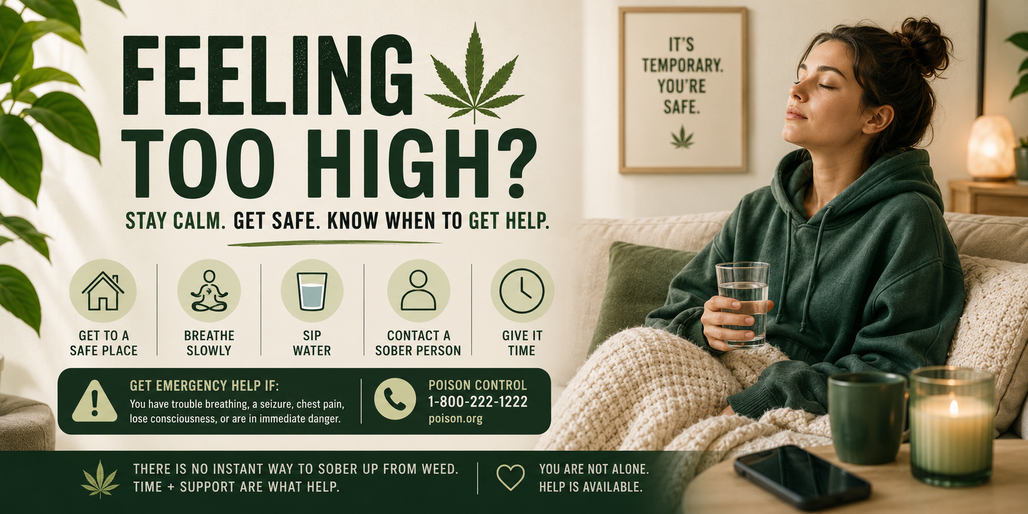
Stop consuming more THC, go to a calm and familiar place, sit somewhere safe, breathe slowly, sip water, and contact a trusted sober person. Do not drive, mix substances, take additional cannabis, or rely on an unproven remedy. Keep the product package nearby so you can identify what was taken.
Time is the primary factor that reduces a cannabis high. Seek emergency help for collapse, seizure, breathing trouble, inability to wake the person, serious injury, severe chest pain, or other alarming symptoms.
Can You Sober Up From Weed Fast?
No reliable method can instantly remove THC from your body or immediately end intoxication. Searches for “how to get unhigh fast,” “how to stop being high fast,” and “the fastest way to get unhigh” often lead to home remedies, but those remedies should not be treated as proven antidotes.
The body needs time to process THC. Quiet surroundings, reassurance, normal breathing, hydration for comfort, and sober support may make the experience easier to tolerate, but they do not instantly remove impairment.
Feeling calmer is not the same as being sober
You may feel less anxious before your coordination, attention, judgment, perception, or reaction time has fully returned. Do not drive or operate equipment based only on how calm you feel.
Eight Steps to Take When You’re Too High
1. Stop consuming more
Put away the flower, vape, gummy, beverage, or other product. Do not take another serving because you are unsure whether the first one has fully worked.
Avoid alcohol and other intoxicants. Do not take an additional substance in an attempt to cancel out the THC.
2. Move somewhere safe and familiar
Choose a quiet room, comfortable chair, couch, or bed. Lower bright lights and unnecessary noise. Clear the nearby floor so you are less likely to trip.
Stay away from traffic, water, stairs, rooftops, balconies, cooking equipment, machinery, and unfamiliar public settings.
3. Sit or lie somewhere secure
Dizziness and poor coordination can increase fall risk. Sit down instead of pacing around. If you feel faint or unsteady, do not take a hot shower or stand somewhere slippery.
4. Breathe slowly and normally
Try a gentle rhythm: breathe in comfortably, then let your exhale last slightly longer. Do not force extremely deep breaths or hold your breath for long periods.
Breathing does not remove THC. It is simply a grounding technique that may help you focus on something steady while the effects pass.
5. Sip water
Small sips may help with dry mouth and comfort. Water does not flush THC out immediately, and drinking excessive amounts is unnecessary.
6. Reduce stimulation
Lower the screen brightness, leave crowded rooms, stop scrolling through frightening symptoms, and choose calm, familiar media if silence feels uncomfortable.
A familiar show, quiet instrumental music, or a simple conversation with someone you trust may feel easier than a fast, intense, or unfamiliar environment.
7. Contact a sober person
Tell them:
- What product you used
- The cannabinoid listed, if known
- How much you consumed
- When you consumed it
- Whether alcohol, medication, or another substance was involved
- What symptoms you are currently experiencing
Ask the person to stay with you or remain available by phone. Do not rely on an impaired person to drive or supervise the situation.
8. Give it time and monitor symptoms
Do not repeatedly test yourself by standing up, walking outside, driving, or taking more THC. Stay in the safe setting and notice whether symptoms are stable, improving, or getting worse.
If you are unsure whether the symptoms require medical attention, contact Poison Control for case-specific guidance.
What Does “Greening Out” Mean?
“Greening out” is an informal term for an unpleasant reaction after consuming more cannabis or THC than someone can comfortably tolerate. It is not a formal medical diagnosis.
More precise terms include THC intoxication, cannabis overconsumption, or adverse cannabis effects.
Possible green-out symptoms
- Anxiety, fear, or panic
- Racing or repetitive thoughts
- Paranoia
- Altered time perception
- Dizziness or poor coordination
- Nausea or vomiting
- Sweating, shakiness, or a pale appearance
- Sleepiness or heavy sedation
- Rapid heart rate or increased awareness of the heartbeat
- Confusion
- Altered perception or hallucinations
Poison Control describes acute cannabis toxicity as potentially involving excessive sedation, loss of coordination, rapid heart rate, and other changes. Symptoms and severity depend on the product, amount, individual, and whether other substances were involved.
When Is Being Too High a Medical Emergency?
Many uncomfortable cannabis experiences improve with time and supportive care. However, do not assume that every severe symptom is “just weed,” especially when the product or dose is uncertain.
Call 911 immediately if someone:
- Collapses
- Has a seizure
- Has severe trouble breathing
- Cannot be awakened
- Has a serious fall or injury
- Has severe or persistent chest pain
- Displays extremely confused, violent, or dangerous behavior
- Is at immediate risk of harming themselves or another person
Contact Poison Control or a medical professional when:
- You do not know what product or cannabinoid was taken.
- You are unsure how much was consumed.
- A child may have consumed THC.
- Someone is repeatedly vomiting or cannot keep fluids down.
- Symptoms are worsening rather than stabilizing.
- Cannabis was combined with alcohol, medication, or another drug.
- The product may contain an unfamiliar synthetic or converted cannabinoid.
- The person has an underlying medical condition that increases concern.
Do not give food, water, medication, or another substance to someone who is unconscious, cannot swallow normally, or cannot be awakened.
Children can experience serious adverse effects after accidentally consuming THC edibles. The FDA warns that candy-like THC foods can be mistaken for ordinary snacks.
What to Do When You’re Too High From Edibles
Edibles are a common reason people unexpectedly consume too much THC. Unlike inhaled cannabis, edibles have a delayed onset. The effects may not be obvious right away, leading someone to take another serving before the first has peaked.
The CDC says edible intoxicating effects may take 30 minutes to two hours to appear and may last longer than expected. Peer-reviewed research also identifies delayed onset as one of the primary differences between inhaled and ingested cannabis.
If you need to sober up from an edible:
- Do not take another serving.
- Write down the product, milligrams, and time consumed.
- Keep the packaging and ingredients nearby.
- Stay home or in another familiar, controlled setting.
- Cancel plans that require driving, travel, cooking, work, or supervision of others.
- Contact a trusted sober person.
- Monitor symptoms and use Poison Control when needed.
A sativa, indica, hybrid, hemp-derived, or “legal” label does not make an edible immune to overconsumption. The amount of THC per serving and the number of servings consumed matter more than broad marketing categories.
What to Do If You’re Too High From Smoking or Vaping
Inhaled cannabis generally begins acting faster than an edible. This may make it easier to recognize that you have reached your limit, but it does not guarantee a short or predictable experience.
- Stop smoking or vaping immediately.
- Put away the product and device.
- Sit in a comfortable, well-ventilated place.
- Do not wander outside alone if you are dizzy or confused.
- Do not drive.
- Do not take an edible to “balance” the inhaled product.
- Ask a sober person to remain nearby if symptoms feel intense.
Seek medical guidance if you develop significant breathing symptoms, chest pain, severe confusion, or another symptom that does not seem consistent with an ordinary cannabis experience.
Does Eating Help When You’re Too High?
A light, familiar snack may feel comforting, particularly if you have not eaten. However, there is not strong evidence that food immediately reverses THC intoxication.
Only eat when you are awake, able to swallow normally, and not actively vomiting. Avoid preparing food with sharp knives, hot pans, or open flames while impaired.
Does Drinking Water Make You Less High?
No. Water does not remove THC or instantly make someone sober. Small sips can help with dry mouth and general comfort, but excessive water is not a detox treatment.
Do Black Pepper, Lemon, CBD, Coffee, or a Shower Help You Get Unhigh?
Social media frequently recommends home remedies for people trying to stop being high. Some may feel comforting or grounding, but none should be treated as a dependable antidote.
| Common Suggestion | More Accurate Explanation |
|---|---|
| Black pepper | It is a widely shared folk remedy, but it has not been established as a reliable reversal for THC intoxication. |
| Lemon or citrus | The taste or scent may feel grounding, but citrus does not neutralize THC in the body. |
| CBD | Do not treat CBD as an emergency reversal agent. Adding another cannabinoid can complicate the situation, and effects are not reliably predictable. |
| Coffee or caffeine | Caffeine does not make someone sober and may worsen jitteriness, anxiety, or awareness of a rapid heartbeat. |
| Cold shower | A shower does not remove THC. It can also increase fall risk when someone is dizzy or poorly coordinated. |
| Exercise | Exercise does not rapidly clear intoxication and may worsen dizziness, rapid heart rate, or anxiety. |
| Food | A snack can be comforting but does not instantly stop a high. |
| Sleep | Rest may help pass time, but a severely affected person should not simply be left alone and unmonitored. |
| Ibuprofen | Ibuprofen is not an approved THC reversal medication and should not be taken solely to “get unhigh.” |
FDA materials note that no antidote or reversal agent has been approved for THC intoxication. Care is based on symptoms, safety, monitoring, and medical support when necessary.
How Long Does It Take to Get Unhigh?
There is no single countdown that applies to everyone. How long it takes to come down from a high depends on:
- The product format
- The amount of THC consumed
- The concentration or potency
- Whether the product was eaten, inhaled, or combined with another format
- Tolerance and previous experience
- Recent food intake
- Metabolism and individual biology
- Medication, alcohol, or other substances
- The accuracy of the product label
Inhaled cannabis usually has a faster onset. Edibles generally begin later and may last much longer. A clinical review notes that edible effects can peak hours after ingestion and may persist for many hours.
Residual tiredness, slowed concentration, or impaired judgment may remain after the most noticeable high has faded. Do not decide that you are safe to drive based on a general timer or because you feel calmer.
How to Help a Friend Who Is Too High
What to do
- Stay calm and speak in short, clear sentences.
- Move them away from crowds, traffic, water, stairs, and other hazards.
- Ask what they consumed, how much, and when.
- Keep the packaging or label.
- Help them sit somewhere safe.
- Reassure them without dismissing their symptoms.
- Monitor breathing, responsiveness, and whether symptoms worsen.
- Contact Poison Control or emergency services when appropriate.
What not to do
- Do not laugh at, embarrass, or film them.
- Do not tell them they are “being dramatic.”
- Do not force them to walk around.
- Do not let an impaired person drive them.
- Do not give them more cannabis, alcohol, caffeine, medication, or an unproven remedy.
- Do not leave them alone when symptoms are severe.
- Do not assume every alarming symptom is harmless.
Why Did I Get Too High?
Common reasons include:
- Taking more THC than intended
- Taking another edible serving too early
- Trying a stronger product or concentrate
- Misreading milligrams per serving
- Confusing one piece with one serving
- Having a low or recently reduced tolerance
- Combining THC with alcohol or another substance
- Using several formats together
- Unexpected cannabinoids in the product
- Inaccurate or unclear labeling
- Individual sensitivity
- Using a product in an unfamiliar or overstimulating setting
Hemp-derived THC can still be intoxicating. The word “hemp” describes a legal and agricultural category; it does not automatically mean that a product is non-intoxicating or mild.
How to Prevent Feeling Too High Next Time
Prevention begins with understanding what is actually in the product rather than relying only on terms such as hemp, sativa, indica, legal, full-spectrum, or premium.
- Read the THC milligrams per serving.
- Confirm how many pieces or units equal one serving.
- Check the total servings in the package.
- Review whether CBD or other cannabinoids are included.
- Avoid mixing several cannabinoid products or formats.
- Do not combine THC with alcohol or other intoxicants.
- Use products only in a familiar, safe setting.
- Arrange transportation before consuming.
- Record the product, serving, time, and personal response.
- Review the batch-specific certificate of analysis.
- Avoid products with unclear potency or missing lab information.
- Store the product securely as soon as you are finished.
A COA cannot predict exactly how a product will affect you, but it may help verify its cannabinoid content, batch identity, testing date, and included contaminant panels. Review Green Nursery’s lab results and certificates of analysis when comparing products.
Additional educational resources include:
When Repeated Overconsumption May Signal a Bigger Problem
One uncomfortable experience can result from a mistake or unfamiliar product. Repeatedly losing control of the amount used may deserve closer attention.
Possible warning signs include:
- Frequently using more cannabis than intended
- Trying but being unable to reduce or stop use
- Continuing despite recurring negative experiences
- Needing increasingly large amounts
- Using in dangerous settings
- Interference with work, school, finances, or relationships
- Giving up important activities in favor of cannabis use
- Regularly needing another person’s help after consuming
The CDC provides information about cannabis-use disorder and its warning signs. A qualified healthcare professional can help assess recurring concerns without relying on judgment or stigma.
Frequently Asked Questions About Getting Unhigh
What should I do when I feel too high?
Stop consuming more THC, move somewhere safe and quiet, sit down, breathe slowly, sip water, and contact a sober person. Keep the package nearby and seek expert help if symptoms are severe or worsening.
How can I sober up from weed?
There is no proven instant method. The body needs time to process THC. A calm setting, sober support, normal breathing, and symptom monitoring can make the experience safer while the effects pass.
How do I get less high?
You cannot immediately remove THC, but you can reduce stimulation and risk. Stop consuming more, sit somewhere familiar, lower noise and lighting, and ask a sober person to stay available.
How do I stop being high?
Time is the main factor. Avoid driving, alcohol, caffeine, additional cannabis, and unproven remedies while you wait for the effects to decline.
What is the fastest way to get unhigh?
No method has been proven to instantly end THC intoxication. The safest response is supportive care, a controlled environment, sober supervision, and medical guidance when necessary.
How long does it take to get unhigh?
It varies according to dose, product format, tolerance, metabolism, food intake, and other substances. Edibles generally begin later and can last longer than inhaled cannabis.
What should I do if I’m too high from an edible?
Do not take another serving. Record the milligrams and time consumed, keep the packaging, stay in a safe familiar place, and contact a sober person. Use Poison Control if you are uncertain about the dose or symptoms.
Does drinking water make you less high?
No. Water does not remove THC or instantly reduce intoxication. Small sips may help with dry mouth and comfort.
Does eating make you less high?
Food does not instantly reverse THC. A familiar snack may be comfortable when someone is fully awake, able to swallow, and not vomiting.
Does black pepper sober you up?
Black pepper is a commonly shared folk remedy, but it should not be treated as a proven antidote or dependable way to end a high.
Can CBD reduce a THC high?
Do not rely on CBD as an emergency reversal. Its effects are not predictable enough to treat it as an antidote, and adding another cannabinoid can complicate the situation.
Can ibuprofen make you unhigh?
No approved evidence supports taking ibuprofen solely to reverse THC intoxication. Do not add medication unless it is normally appropriate for you and recommended by a qualified professional.
Should I sleep when I’m too high?
Rest may be reasonable for someone who is awake, responsive, breathing normally, and experiencing mild, stable symptoms. A person who cannot be awakened, is breathing abnormally, or has severe symptoms needs emergency help rather than being left to sleep.
How do I help someone come down from a high?
Remain calm, move them away from hazards, ask what they consumed, keep the packaging, help them sit safely, and monitor responsiveness. Contact Poison Control or emergency services when appropriate.
Can hemp-derived THC make you too high?
Yes. Hemp-derived Delta-9 THC, Delta-8 THC, heated THCA, and other intoxicating cannabinoids can produce strong effects depending on dose, formulation, and individual sensitivity.
Final Takeaway: Safety First, Then Give It Time
There is no proven trick that will instantly make someone unhigh. The safest response is to stop consuming more, reduce stimulation, move away from hazards, involve a sober person, and allow time for the effects to pass.
Use Poison Control when you need individualized guidance, and call emergency services for collapse, seizure, breathing trouble, inability to wake the person, serious injury, or another immediate danger.
Once you are fully sober and safe, return to our complete guide to things to do while high for familiar, lower-risk activity ideas organized by mood, setting, and company.
Popular Products
Check out these customer favorites.