
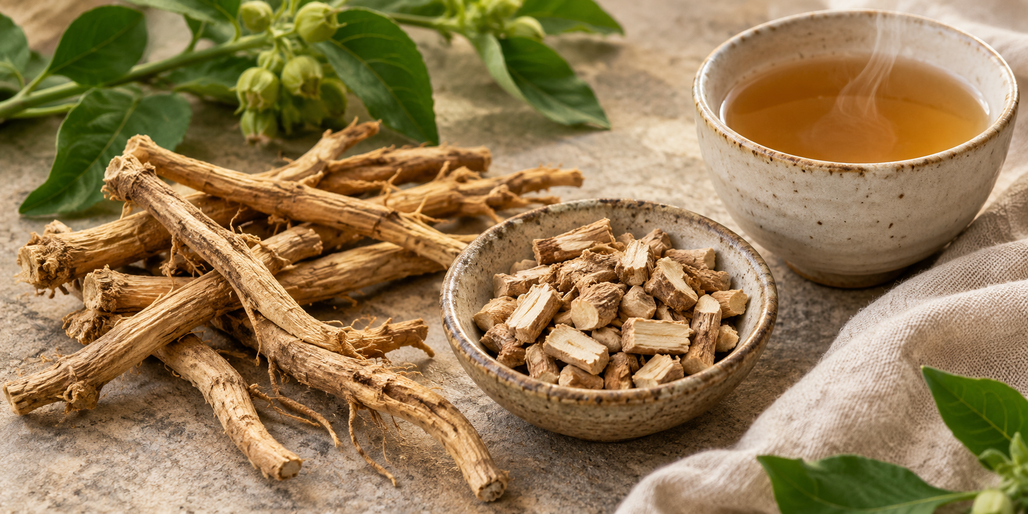
Ashwagandha Root: Benefits, Uses, Dosage, and Safety
Ashwagandha Root: Benefits, Uses, Dosage, and Safety
Ashwagandha root is a traditional Ayurvedic botanical best known today for its potential role in stress and sleep support. Some preparations have shown benefits in human studies, but the research largely involves extracts. A cup of loose-root tea cannot be assumed to deliver the same effects or dose. The National Center for Complementary and Integrative Health describes promising findings alongside important limits and safety concerns.
This guide covers the plant's history, common uses, preparation, dosage differences, and precautions. For context on comparing herbs and understanding supplement claims, start with our guide to herbal supplements, uses, and safety.
What is ashwagandha root?
Ashwagandha is Withania somnifera, an evergreen shrub found in parts of India, Africa, and the Middle East. Its history in Ayurvedic medicine spans thousands of years, according to NCCIH's botanical overview. The root is the plant part discussed here, although some modern supplements also contain leaf extracts.
Traditionally, it has been used as a restorative tonic. You may see it called Indian ginseng, but it is not a member of the ginseng family. The NIH Office of Dietary Supplements also describes its use in Unani medicine and its reputation as an adaptogen, a loosely defined term for substances thought to help people adapt to stress.
That history helps explain its popularity. Traditional use and the word “adaptogen,” however, do not establish how well a particular product works or whether it is appropriate for you.
What are the potential benefits of ashwagandha root?
Stress support
Stress is one of the better-studied uses. An NIH review of the evidence describes several small trials reporting improvements in perceived stress. Preparations and doses differed, and many studies lasted only six to eight weeks. These findings support further research without establishing a predictable response to every ashwagandha product.
Stress and an anxiety disorder are also different questions. NCCIH considers the evidence for anxiety unclear. Persistent symptoms deserve assessment rather than relying on an herb to replace treatment.
Sleep quality
A 2021 systematic review of five randomized trials found a small overall improvement in sleep with ashwagandha extracts compared with placebo. Results were more pronounced in participants with insomnia and in studies lasting at least eight weeks. The authors also emphasized the need for more long-term safety information.
These were studies of specific extracts. They do not show that homemade root tea works as an immediate sleep aid.
Other commonly advertised uses
Claims about athletic performance, memory, fertility, and hormones need more qualification. NCCIH reports limited evidence concerning testosterone and sperm quality, and insufficient evidence for many other promoted uses. Broad promises about “balancing hormones” or transforming performance go beyond what this evidence can establish.
Ashwagandha root vs. powder vs. extract
Green Nursery's ashwagandha root listing describes dried cut root. Understanding that form makes it easier to interpret directions and compare it with products discussed in studies.
| Form | What it contains | What to check |
|---|---|---|
| Cut root | Dried pieces of root, often prepared as a decoction. | Serving weight, water amount, and simmering directions. |
| Root powder | Root ground into a powder. | Whether the label specifies plain root powder or an extract powder. |
| Extract | A preparation made by extracting selected plant constituents. | Plant parts, amount per serving, and any stated standardization. |
The NIH guide to botanical preparations explains why teas, tinctures, and extracts differ in strength. Equal weights of different forms are not interchangeable, and the word “standardized” alone does not guarantee quality or effectiveness.
Ashwagandha dosage and tea preparation
There is no single dose that applies to every preparation. For example, an eight-week adult sleep trial summarized by NIH used two 300 mg capsules daily of a particular root extract standardized to more than 5% withanolides. That is a description of the research, not a serving recommendation for cut root, tea, or a different extract.
The cited research does not establish a measured loose-root tea dose equivalent to those capsules. Do not convert extract milligrams into teaspoons of root. Follow directions for the exact product; if the serving amount or preparation instructions are missing, ask the supplier before use.
How is ashwagandha root tea prepared?
Dense roots are often prepared as a decoction: water is brought to a boil, then gently simmered with the botanical. This differs from briefly steeping a delicate leaf. The method is explained in NIH's preparation guide.
- Confirm the product's serving weight, water quantity, and preparation time.
- Measure the root as directed. If instructions give grams, use a scale instead of assuming a spoon holds a fixed weight.
- Prepare the decoction according to those directions, then strain out the root pieces.
Expect an earthy, bitter flavor. Honey or a splash of milk can adjust the taste if those ingredients suit your diet. Increasing the amount of root or reducing the water to make a stronger drink is not a reliable way to reproduce a clinical-study extract.
Side effects, interactions, and who should avoid it
Possible side effects include drowsiness, stomach upset, diarrhea, and vomiting. NCCIH's safety guidance also identifies groups who should avoid ashwagandha or obtain medical advice before considering it:
- Pregnancy and breastfeeding: avoid use.
- Thyroid or autoimmune disorders: ashwagandha is not recommended.
- Upcoming surgery: discuss supplement use with the surgical team.
- Hormone-sensitive prostate cancer: avoid use.
Medication interactions may involve sedatives, seizure medicines, thyroid hormones, immunosuppressants, and medicines for diabetes or high blood pressure. Bring the actual product label to a pharmacist or clinician for review. These interaction concerns are also covered in NCCIH's guidance.
Rare liver injuries have been reported. NIH's LiverTox review advises avoiding ashwagandha with cirrhosis or advanced chronic liver disease. If you have another liver condition, seek medical advice first. Stop using the product and obtain prompt medical care if you develop yellowing skin or eyes, particularly with itching or unusual fatigue.
If you feel sleepy or less alert, do not drive or operate machinery. Keep a record of the product, amount, and any symptoms so a health professional can assess what happened.
Is ashwagandha legal?
As of September 19, 2026, ashwagandha is marketed in the United States in dietary supplements, as described by NCCIH. This does not mean every formulation or advertising claim is lawful.
The FDA explains that supplements are not approved before sale and that manufacturers remain responsible for safety and compliant labeling. Products marketed to treat or cure disease are subject to drug regulation. Availability therefore does not establish FDA approval or proven medical benefit.
When ordering internationally or traveling, check the destination's current food, medicine, and customs requirements for the exact product. U.S. availability does not establish permission to import it elsewhere.
Frequently asked questions
How long does ashwagandha take to work?
Think in terms of the study period rather than a guaranteed onset. The sleep research reviewed above assessed repeated use over weeks. It does not establish when you will notice an effect, or that a first cup of root tea will produce one.
Does ashwagandha root contain caffeine?
Plain ashwagandha root is caffeine-free, as noted in Green Nursery's product description. A blended tea or supplement may include other ingredients, so check the whole label if avoiding caffeine matters to you.
Can you take ashwagandha every day?
Daily use in a short study does not establish the safety of indefinite use. NCCIH says safety information mainly covers up to three months. Discuss the intended duration with your clinician, particularly if you take medication.
Can you combine ashwagandha with CBD or cannabis?
Research on ashwagandha alone cannot establish the safety of a combination. Have a pharmacist review both products and your medicines before combining them. Ashwagandha's potential for drowsiness and medication interactions, described by NCCIH, makes that review especially relevant.
Is organic ashwagandha automatically safer?
No. An organic claim concerns production standards; it does not establish that a supplement is suitable for your health conditions or medicines. The FDA distinguishes organic regulation from supplement safety responsibilities. Check ingredient identity, serving directions, and any available testing documentation too.
Popular Products
Check out these customer favorites.