
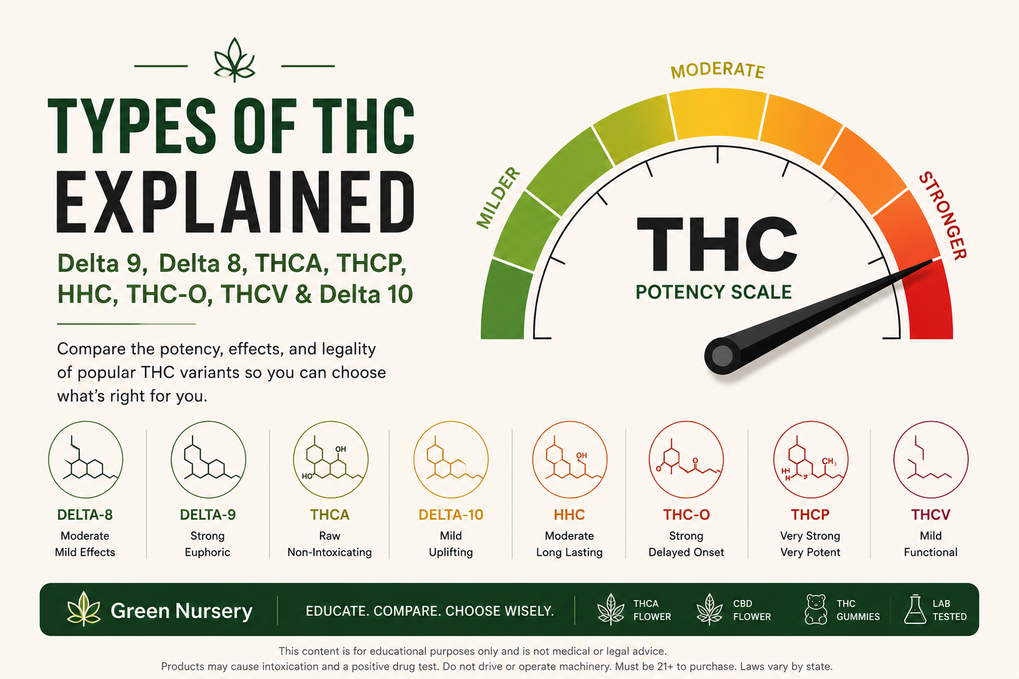
Types of THC Explained: Delta 9, Delta 8, THCA, THCP, HHC, THC-O, THCV & Delta 10
Cannabinoid Education Guide
Types of THC Explained: Delta 9, Delta 8, THCA, THCP, HHC, THC-O, THCV, and Delta 10
THC is not just one compound. When people talk about “THC,” they are usually referring to delta-9 THC, the primary intoxicating cannabinoid associated with marijuana. But the hemp and cannabis market now includes many related cannabinoids, including delta-8 THC, THCA, THCP, HHC, THC-O, THCV, and delta-10 THC.
Some occur naturally in the cannabis plant. Some appear only in tiny amounts and are usually concentrated or converted for retail products. Some are intoxicating, some are not intoxicating until heated, and some sit in a legal gray area that changes from state to state. This guide explains the major types of THC, how they compare, what “strongest” really means, and why lab reports matter before buying any hemp-derived THC product.
If you are comparing Green Nursery products, start with our hemp-derived THC products, THCA hemp flower, or CBD hemp flower collections. If you are new to CBD-rich flower, you may also want to read our guide to CBD buds and hemp flower.
Updated July 2026: This article has been updated with clearer potency comparisons, better THCA and total THC explanations, COA guidance, and current federal compliance context. This article is educational only and is not legal, medical, or safety advice. Hemp and cannabinoid laws vary by state and can change quickly.
Quick Answer: Which Type of THC Is Strongest?
The strongest type of THC depends on what you mean by “strongest.” Delta-9 THC is the standard reference point because it is the best-known intoxicating form of THC. THCA is not intoxicating in raw form, but when heated through smoking, vaping, or baking, it converts into delta-9 THC. THCP has shown much higher CB1 receptor affinity than delta-9 THC in laboratory research, but that does not automatically mean every THCP product will feel stronger or be safer. Real-world effects depend on dose, purity, product type, tolerance, and lab verification.
The simplest potency breakdown
- Delta 9 THC: The baseline for classic THC intoxication.
- THCA: Non-intoxicating raw, but converts into delta-9 THC when heated.
- THCP: Potentially very potent by receptor affinity, but research and product quality vary.
- Delta 8 THC: Often described as milder than delta-9 THC.
- Delta 10 THC: Usually described as milder and more uplifting than delta-9 THC.
- HHC: Often described as between delta-8 and delta-9, though product-to-product variation is high.
- THC-O: A converted acetate form with delayed onset concerns and complicated legal status.
- THCV: A distinct cannabinoid often described as lighter or more functional at common doses.
The best way to compare THC products is not by name alone. Always review the certificate of analysis, serving size, total milligrams per package, delta-9 THC content, THCA content, and any contaminant testing available.
Before Comparing THC Types, Learn These Terms
Cannabinoid labels can be confusing because similar-looking names may describe very different compounds. A product labeled THCA flower is not the same thing as a delta-8 gummy. THCP is not the same as THC-O. Delta-9 THC and delta-8 THC are related, but they are not identical.
Cannabinoid
A cannabinoid is a naturally occurring or derived compound that interacts with the body’s endocannabinoid system. THC and CBD are cannabinoids, but so are CBG, CBC, CBN, THCV, and many others.
Isomer
Isomers have the same molecular formula but different structures. Delta-8 THC and delta-9 THC are isomers. Their double bond appears in a different position, which helps explain why their effects can feel different.
Acid precursor
Some cannabinoids begin in acidic form. THCA is the acidic precursor to delta-9 THC. CBDA is the acidic precursor to CBD. Heat removes a carboxyl group in a process called decarboxylation, changing THCA into delta-9 THC.
Homolog
A homolog is a related compound with a structural difference, such as a longer or shorter alkyl side chain. THCP is a homolog of THC with a longer side chain than delta-9 THC, which is part of why researchers are interested in its receptor binding.
Converted or semi-synthetic cannabinoid
Some retail cannabinoids are commonly made by converting hemp-derived CBD or other cannabinoids through chemical processing. This is common with delta-8 THC, delta-10 THC, HHC, and THC-O products. Because conversion can create byproducts or impurities, third-party testing is especially important.
Types of THC Compared
| Cannabinoid | What It Is | Common Intoxication Level | Common Product Types | What to Check Before Buying |
|---|---|---|---|---|
| Delta 9 THC | The main intoxicating THC associated with cannabis | Strong baseline THC effect | Gummies, edibles, beverages, flower, vapes | Milligrams per serving, delta-9 THC percentage, state legality, COA |
| Delta 8 THC | An isomer of delta-9 THC, usually made from hemp-derived CBD | Often milder than delta-9 THC | Gummies, vapes, tinctures, capsules | Conversion purity, residual solvents, delta-9 THC, state restrictions |
| THCA | The raw acidic precursor to delta-9 THC | Raw: not intoxicating; heated: converts into delta-9 THC | THCA flower, concentrates, raw cannabis products | THCA percentage, delta-9 THC, total THC, state rules |
| THCP | A rare THC homolog with high CB1 receptor affinity in lab research | Potentially very potent, but product effects vary | Gummies, vapes, infused products | Actual THCP amount, purity, third-party testing, serving size |
| HHC | A hydrogenated THC analog | Often described as delta-8-like to delta-9-like | Gummies, vapes, carts, edibles | Isomer profile, conversion testing, residual solvents, state legality |
| THC-O | An acetate ester of THC made through chemical conversion | Often described as delayed and heavy, but data are limited | Vapes, gummies, tinctures, infused products | Legal risk, conversion chemistry, purity, delayed onset warning |
| THCV | A naturally occurring THC-related cannabinoid with a shorter side chain | Often lighter and less intoxicating at common doses | Vapes, gummies, tinctures, specialty flower | Actual THCV content, other cannabinoids, COA, product type |
| Delta 10 THC | A THC isomer usually created through conversion | Usually milder than delta-9 THC | Vapes, gummies, infused products | Purity, conversion byproducts, delta-9 THC, state restrictions |
Delta 9 THC
Delta-9 THC is the form of THC most people mean when they simply say “THC.” It is the primary intoxicating cannabinoid in marijuana and the reference point used to compare other THC variants. Delta-9 THC interacts strongly with CB1 receptors in the brain and nervous system, which is why it is associated with euphoria, altered perception, increased appetite, relaxation, and impairment.
Hemp-derived delta-9 THC products exist because federal hemp law focuses on delta-9 THC concentration by dry weight. This is why a larger edible, such as a gummy, can sometimes contain a measurable milligram dose of hemp-derived delta-9 THC while still staying under the federal 0.3% delta-9 THC dry-weight threshold. State laws may set additional restrictions, including age limits, serving-size caps, package limits, or outright bans.
Delta 9 THC strength
Delta-9 THC is the baseline. If a product says delta-8 is “half as strong” or THCP is “stronger than THC,” delta-9 THC is usually the comparison point.
Delta 9 THC buying notes
- Check the milligrams of delta-9 THC per serving.
- Review the total milligrams per package.
- Read the COA for delta-9 THC content and batch information.
- Confirm whether your state allows hemp-derived delta-9 THC edibles.
- Start with a low serving, especially if you are new to THC.
Green Nursery carries hemp-derived THC products, including Delta 9 THC gummies and other hemp-derived THC products.
Delta 8 THC
Delta-8 THC is a close relative of delta-9 THC. It occurs naturally in cannabis only in small amounts, so most delta-8 products are made by converting hemp-derived CBD into delta-8 THC. This conversion process is one reason lab testing is so important. A good delta-8 COA should verify potency and screen for unwanted contaminants or conversion residues when available.
Many consumers describe delta-8 THC as milder, smoother, or less intense than delta-9 THC. That does not mean it is non-intoxicating. Delta-8 can still impair judgment, coordination, reaction time, and attention. It can also be too strong when taken in high doses or when a person mistakes it for a non-intoxicating CBD product.
Delta 8 THC strength
Delta-8 THC is usually described as less potent than delta-9 THC at the same milligram dose, but individual response varies. Edible delta-8 products can still feel strong because oral THC products are processed differently by the body and may take longer to peak.
Delta 8 THC safety and compliance notes
- Delta-8 products have not been evaluated or approved by the FDA for safe use.
- Some delta-8 products may be mislabeled or confused with CBD products.
- Converted cannabinoid products should include strong lab testing.
- State laws vary widely, and some states restrict or ban delta-8 THC.
If you are comparing delta-8 products, review the serving size, potency, ingredient panel, and COA before purchasing. Green Nursery’s Delta 8 gummies page is a useful place to compare product details when available.
THCA
THCA stands for tetrahydrocannabinolic acid. It is the acidic precursor to delta-9 THC found in raw cannabis and hemp flower. In its raw form, THCA is not the same as delta-9 THC and is not considered intoxicating in the same way. The key difference is heat.
When THCA is heated through smoking, vaping, dabbing, or baking, it decarboxylates into delta-9 THC. That conversion is why THCA flower can feel similar to traditional THC flower once used with heat. Raw THCA and heated THCA are very different consumer experiences.
Why total THC matters
THCA creates a compliance question because a flower product may have low delta-9 THC before heating but a high amount of THCA. Many testing and regulatory discussions use “total THC” math to estimate potential delta-9 THC after decarboxylation:
Total THC = delta-9 THC + (THCA × 0.877)
The 0.877 factor accounts for the molecular weight change that happens when THCA loses its carboxyl group during decarboxylation. This is why shoppers should look at both delta-9 THC and THCA on a COA, not just one number.
THCA strength
Raw THCA is not stronger than delta-9 THC from an intoxication standpoint. Heated THCA becomes delta-9 THC, so high-THCA flower can produce delta-9-like effects when smoked or vaped.
THCA buying notes
- Review delta-9 THC, THCA, and total THC on the COA.
- Check your state’s rules before buying THCA flower.
- Understand that heating THCA changes the experience.
- Do not assume federal hemp compliance automatically means a product is allowed in every state.
To learn more, browse Green Nursery’s THCA hemp flower collection or read our related guide, How THCA Transforms Into THC.
THCP
THCP stands for tetrahydrocannabiphorol. It is a naturally occurring cannabinoid that was identified in cannabis in small amounts. THCP is sometimes incorrectly labeled online as “THC perhexyl,” but the more accurate name is tetrahydrocannabiphorol.
THCP is structurally similar to delta-9 THC, but it has a longer alkyl side chain. Laboratory research has suggested that THCP may bind to CB1 receptors with much higher affinity than delta-9 THC. This is why THCP is often discussed as one of the potentially strongest THC-related cannabinoids.
THCP strength
THCP may be very potent, but receptor affinity is not the same thing as a predictable consumer experience. A product’s actual strength depends on the amount of THCP used, the presence of delta-9 THC or other cannabinoids, the delivery method, the user’s tolerance, and the product’s purity.
THCP buying notes
- Look for the actual milligrams of THCP per serving.
- Avoid products that use vague “proprietary cannabinoid blend” language without clear testing.
- Review the COA for cannabinoids and contaminants.
- Be cautious with first use because THCP may feel much stronger than expected.
Because THCP research is still limited compared with delta-9 THC, shoppers should avoid exaggerated claims and prioritize batch-specific lab testing.
HHC
HHC stands for hexahydrocannabinol. It is a hydrogenated analog of THC, meaning its chemical structure has been changed by adding hydrogen. HHC can occur naturally in very small amounts, but most retail HHC products are made through conversion.
Consumers often describe HHC as stronger than delta-8 THC but not always as intense as delta-9 THC. Some also report that it lasts longer. These descriptions are subjective, and HHC products can vary significantly depending on formulation and purity.
HHC strength
HHC is difficult to rank because different HHC products may contain different ratios of active and less-active HHC isomers. Two products labeled “HHC” may not feel the same.
HHC buying notes
- Look for full-panel COAs, especially for converted products.
- Check for residual solvent and contaminant testing when available.
- Review the serving size carefully.
- Confirm your state’s current rules before purchasing.
THC-O
THC-O, or THC-O-acetate, is an acetate ester of THC. Unlike delta-9 THC or THCA, THC-O is not typically discussed as a naturally abundant plant cannabinoid. It is made through chemical conversion, which makes its legal and safety profile more complicated.
THC-O is often described anecdotally as delayed, heavy, or more intense than delta-9 THC. The delayed onset is important. When an edible or converted cannabinoid product takes longer to work, some people take more too soon and end up with a stronger experience than intended.
THC-O strength
THC-O is often marketed as stronger than delta-9 THC, but high-quality human research is limited. Product quality, dose, and conversion purity matter more than marketing claims.
THC-O legality and caution
THC-O has had a complicated federal legal discussion. DEA has stated that delta-8 THC-O and delta-9 THC-O do not occur naturally in the cannabis plant and are controlled substances under its interpretation. Court decisions and state laws have added further complexity. Because of this, consumers should treat THC-O as a higher-risk legal category and check current local rules before purchasing or using it.
- Do not treat THC-O like CBD.
- Do not take additional servings before waiting for full onset.
- Review the COA carefully for potency and contaminants.
- Avoid products without clear manufacturer transparency.
THCV
THCV stands for tetrahydrocannabivarin. It is a naturally occurring cannabinoid found in some cannabis and hemp cultivars. Structurally, THCV has a shorter side chain than delta-9 THC, which contributes to its different effect profile.
THCV is often described as clearer, lighter, or more functional than traditional THC, especially at lower amounts. It is not simply “weaker THC.” It is a distinct cannabinoid with its own profile, and the final experience depends on dose, other cannabinoids, terpenes, and product format.
THCV strength
THCV is typically not the cannabinoid people choose when they are looking for the strongest intoxication. It is more often sought by people interested in a different type of cannabinoid experience.
THCV buying notes
- Check whether the COA lists a meaningful amount of THCV.
- Look at the full cannabinoid profile, not just the front label.
- Be skeptical of broad wellness claims that are not supported by product testing or research.
Delta 10 THC
Delta-10 THC is another THC isomer that is usually created through conversion rather than extracted directly in meaningful amounts from the plant. Like delta-8 THC, delta-10 THC is commonly made from hemp-derived CBD or related inputs.
Consumers often describe delta-10 as milder than delta-9 THC and sometimes more uplifting than delta-8 THC. Research is still limited, so these descriptions should be treated as consumer reports rather than settled science.
Delta 10 THC strength
Delta-10 THC is generally considered less potent than delta-9 THC at similar milligram amounts. However, product formulations vary, and some delta-10 products also include delta-8, delta-9, HHC, or other cannabinoids.
Delta 10 THC buying notes
- Look for a COA that confirms delta-10 content.
- Check whether other cannabinoids are included.
- Review residual solvent and contaminant testing when available.
- Confirm whether delta-10 products are allowed in your state.
How to Read a THC Product COA
A certificate of analysis, or COA, is one of the most important documents for any hemp-derived THC product. The product name tells you what the company wants to highlight. The COA tells you what the lab found in that batch.
COAs matter even more for converted cannabinoids such as delta-8 THC, delta-10 THC, HHC, and THC-O. Conversion chemistry can create byproducts, impurities, or inconsistent potency if the product is not made and tested carefully.
| COA Item | Why It Matters | What to Look For |
|---|---|---|
| Batch number | Connects the lab report to the exact product batch. | A batch number that matches the product page or packaging. |
| Testing date | Shows how recent the lab report is. | Current testing for the batch being sold. |
| Delta-9 THC | Key number for federal hemp threshold and intoxication. | Delta-9 THC amount by weight and/or milligrams per serving. |
| THCA | Important for flower and products that may convert when heated. | THCA percentage and total THC calculation when available. |
| Total THC | Estimates potential THC after THCA conversion. | Delta-9 THC + THCA × 0.877. |
| Minor cannabinoids | Shows whether the product contains CBD, CBG, CBN, CBC, THCV, or others. | A full cannabinoid panel rather than only one headline number. |
| Terpenes | Helps explain aroma and flavor, especially for flower and vapes. | Terpene names and percentages when provided. |
| Contaminants | Helps evaluate product cleanliness. | Pesticides, heavy metals, microbials, mycotoxins, and residual solvents when available. |
COA rule of thumb
If a hemp-derived THC product does not provide a clear, batch-specific COA, do not rely on the label alone. This is especially important for vapes, edibles, concentrates, and products made with converted cannabinoids.
Green Nursery emphasizes transparent shopping through third-party lab testing, product details, and clear cannabinoid information. When comparing products, review available lab reports, serving sizes, and state shipping restrictions before ordering.
Federal and State Legality: Why THC Rules Are Complicated
Federal hemp law and state hemp law are not always the same. At the federal level, hemp is generally defined as cannabis and cannabis derivatives containing no more than 0.3% delta-9 THC on a dry-weight basis. USDA hemp production rules also use total THC testing for hemp crops, which includes delta-9 THC plus THCA after applying the 0.877 conversion factor.
Retail hemp products are more complicated. Some states follow the federal delta-9 THC threshold closely. Others regulate total THC, ban or restrict intoxicating hemp-derived cannabinoids, limit milligrams per serving, require age verification, restrict product formats, or prohibit certain converted cannabinoids.
Important legal distinctions
- Hemp: Cannabis that meets federal hemp definitions, generally based on delta-9 THC concentration.
- Marijuana: Cannabis that exceeds the federal hemp THC threshold and remains federally controlled unless laws change.
- THCA flower: May be federally discussed under delta-9 THC limits, but many states focus on total THC or regulate high-THCA products separately.
- Converted cannabinoids: Delta-8, delta-10, HHC, and THC-O may face special state restrictions even when hemp-derived.
- Rescheduling: Federal marijuana rescheduling discussions do not automatically legalize hemp-derived intoxicating products or change every state law.
As of July 2026, federal marijuana rescheduling remains an active rulemaking and hearing issue. Any final change would need to be reviewed carefully because rescheduling marijuana is not the same thing as federally legalizing all cannabis products or resolving the hemp-derived cannabinoid market.
Compliance reminder
This article is not legal advice. Always check your state and local laws before buying THCA flower, delta-8 THC, delta-9 THC edibles, HHC, THCP, THC-O, delta-10 THC, or any other hemp-derived cannabinoid product.
Responsible Use Tips for Hemp-Derived THC Products
Even when a THC product is hemp-derived, it can still be intoxicating. Treat hemp-derived THC products with the same caution you would use for any product that may affect attention, coordination, perception, or reaction time.
- Start low: Begin with a low serving, especially with edibles.
- Wait long enough: Edibles can take longer to peak than inhaled products.
- Do not drive: Do not drive, operate equipment, or make important decisions while impaired.
- Store securely: Keep all THC products away from children, pets, and anyone who may mistake them for ordinary food.
- Check for drug testing risk: CBD, delta-8, delta-9, THCA, HHC, and other cannabinoid products may create a positive THC drug test.
- Avoid mixing substances: Combining THC with alcohol, medications, or other substances can increase risk.
- Review labels and COAs: Know the cannabinoid content before using any product.
Where to Start with Green Nursery
The right product category depends on what you are trying to compare. If you want a classic hemp-derived edible, review Delta 9 THC gummies. If you are comparing milder THC-style edibles, look at Delta 8 gummies. If you are interested in flower that contains THCA before heating, browse THCA hemp flower.
If you want the flavor and aroma of hemp flower with a CBD-rich profile instead of a high-THC experience, compare options in the CBD hemp flower collection or explore CBG flower.
FAQ: Types of THC, Potency, THCA, and Delta 8
What is the strongest type of THC?
Delta-9 THC is the standard reference point for THC potency. THCP may have much higher receptor affinity in laboratory studies, but product strength depends on actual dose, purity, formulation, and user tolerance. THCA can produce delta-9-like effects when heated because it converts into delta-9 THC.
Is THCA stronger than delta-9 THC?
Raw THCA is not stronger than delta-9 THC because it is not intoxicating in the same way. When THCA is heated, it converts into delta-9 THC. At that point, the effect depends on how much THCA converted and how much delta-9 THC is ultimately consumed.
Is THCA stronger than delta-8 THC?
Raw THCA is not intoxicating like delta-8 THC. However, heated THCA converts into delta-9 THC, which is generally considered stronger than delta-8 THC. So the answer depends on whether the THCA is raw or heated.
Is delta-9 THC stronger than delta-8 THC?
Yes, delta-9 THC is generally considered stronger than delta-8 THC at similar milligram amounts. Delta-8 can still be intoxicating, especially in edibles or higher servings.
Is delta-10 THC stronger than delta-8 THC?
Delta-10 THC is usually described as mild and uplifting, while delta-8 THC is often described as slightly more relaxing. Some people find delta-8 stronger than delta-10, but product formulation matters.
Is HHC stronger than delta-8 THC?
Many consumers describe HHC as stronger than delta-8 THC but not always as strong as delta-9 THC. However, HHC products vary because they may contain different isomer ratios and different supporting cannabinoids.
Is THC-O legal?
THC-O has a complicated legal status. DEA has stated that delta-8 THC-O and delta-9 THC-O do not occur naturally in cannabis and are controlled under its interpretation. Court decisions and state laws have added complexity. Check current local law before buying or using THC-O.
Will hemp-derived THC show up on a drug test?
It can. Drug tests usually look for THC metabolites, not the exact product type you used. Delta-8, delta-9, THCA, HHC, THC-O, and even some full-spectrum CBD products may create a positive THC result.
What does total THC mean?
Total THC estimates the amount of THC that could be present after THCA converts into delta-9 THC. A common formula is delta-9 THC plus THCA multiplied by 0.877.
What should I check before buying any THC product?
Check the COA, serving size, total milligrams, delta-9 THC content, THCA content, total THC, contaminant testing, ingredients, state restrictions, and whether the product comes from a transparent seller.
Final Thoughts: “Strongest THC” Is Not the Only Question
The strongest THC product is not automatically the best choice. Delta-9 THC remains the main benchmark for classic THC effects. THCA becomes delta-9 THC when heated. THCP may be highly potent, but research and product quality vary. Delta-8 and delta-10 are often milder. HHC can vary widely. THC-O carries extra legal and safety concerns. THCV has a different profile altogether.
A smarter way to shop is to ask better questions: What cannabinoid is actually in the product? How many milligrams are in each serving? Is there a batch-specific COA? Does the lab report show delta-9 THC, THCA, total THC, and contaminant testing? Is the product allowed in your state?
To compare products, browse Green Nursery’s hemp-derived THC collection, THCA flower, CBD hemp flower, and CBG flower. Read product labels carefully, review lab reports, and choose the cannabinoid profile that best fits your tolerance, goals, and local laws.
Popular Products
Check out these customer favorites.