
What Are Terpenes? Cannabis & Hemp Aroma Guide
What Are Terpenes? A Practical Guide to Cannabis and Hemp Aroma
Terpenes are compounds made by many plants, including cannabis and hemp. Many are volatile and aromatic, helping create familiar citrus, pine, floral, herbal, earthy, and peppery notes. Plants can also use terpene compounds in defense, attraction, and signaling. In cannabis, terpenes are produced largely in glandular trichomes alongside cannabinoids—but terpenes are not THC, CBD, or other cannabinoids, and they do not reveal a product’s potency.
A batch-specific terpene profile can describe which measured terpenes are present and in what amounts. It may help you compare aroma and composition. It cannot, by itself, guarantee quality, safety, freshness, legality, drug-test outcomes, or a particular physical or mental effect.
This guide explains what terpenes do in plants, what an aroma chart can and cannot tell you, and how to read a terpene panel without getting pulled into marketing hype.
What are terpenes?
In chemistry, terpenes are a large class of compounds assembled from five-carbon building blocks called isoprene units. In everyday plant and cannabis discussions, the word usually refers to volatile compounds associated with fragrance and flavor. A peer-reviewed overview of terpenes in Cannabis sativa explains their biosynthesis, variation, and biological context.
“Aromatic” has two meanings. In ordinary language, it describes a noticeable scent. In chemistry, aromaticity describes an electron structure and does not simply mean “smells strong.” Cannabis writing usually uses the sensory meaning.
You may also see terpene and terpenoid used interchangeably. More precisely, terpenoid often refers to an oxygenated or otherwise modified terpene derivative, though popular writing does not always preserve that distinction.
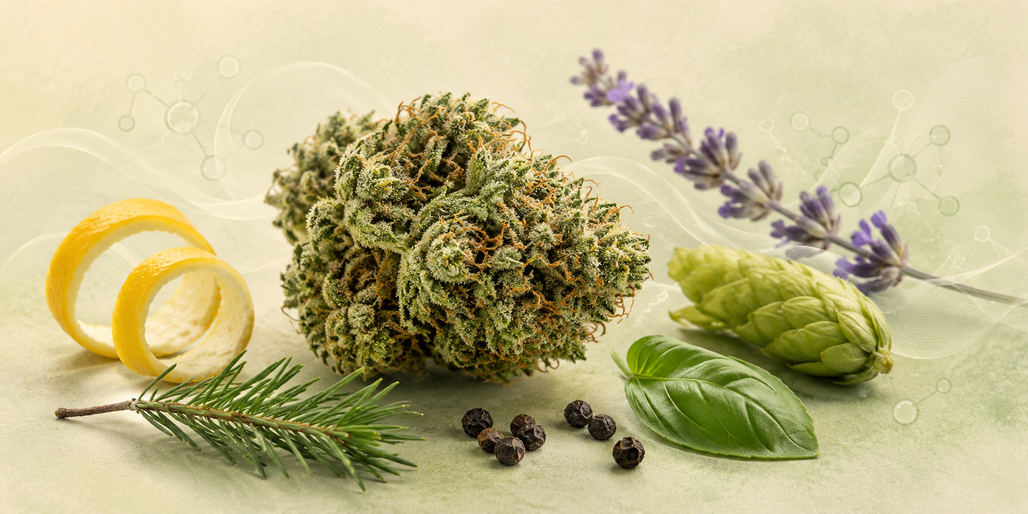
Terpenes occur far beyond cannabis. Citrus peel, pine, lavender, hops, black pepper, basil, mint, and many other plants produce them.
Why do plants make terpenes?
Plants produce terpenoid compounds as part of their growth and ecological relationships. Depending on the compound, species, tissue, and situation, they may contribute to defense against herbivores or pathogens, attract pollinators or other beneficial organisms, or participate in environmental signaling. A review of why plants produce so many terpenoid compounds emphasizes their diversity and varied ecological functions.
Do not assign every role to every terpene. Plant biosynthesis and aroma are well documented; predictions about a person’s experience from one dominant terpene are not.
Where are terpenes found in cannabis and hemp?
In cannabis flowers, many terpenes and cannabinoids are produced and stored largely in glandular trichomes, the resin-producing structures concentrated on floral tissues. Research identifying cannabis terpene synthases in glandular trichomes explains their role in the plant’s chemical profile.
Terpenes and cannabinoids may share the same general plant structures, but they belong to different compound families. A terpene result does not tell you how much THC, CBD, CBG, or another cannabinoid is present. That information belongs in a separate cannabinoid or potency panel.
“Cannabis terpenes” and “hemp terpenes” do not name unique chemical categories. Under the current federal program, hemp is a legally defined category of Cannabis sativa based on cannabinoid criteria, while state and tribal rules may add requirements. See the USDA hemp production program for current program information. Myrcene or limonene does not become a different molecule merely because it came from legally defined hemp.
Genetics, cultivation, plant development, harvest, curing, processing, storage, and batch differences can all shape a profile. One study of 32 seed sources found substantial variation within and between plants carrying the same cultivar label—one reason to trust batch chemistry more than strain-name folklore.
For wider product context, Green Nursery’s guide to CBD buds and hemp flower explains flower categories, cannabinoid content, and labeling.
What gives cannabis and hemp flower their smell?
Terpenes contribute to the citrus, pine, floral, herbal, earthy, woody, and spicy notes used to describe cannabis and hemp flower. But aroma comes from a mixture, and low-abundance compounds can have an outsized sensory impact.
A 2023 chemical and sensory study found that minor nonterpenoid volatile compounds correlated strongly with distinctive sweet and savory cannabis aromas. Separate research identified volatile sulfur compounds associated with pungent, skunk-like notes. These findings do not make terpenes irrelevant; they show why a terpene list cannot fully reconstruct what a person smells.
Aroma is also not a substitute for testing. A strong scent does not prove that flower is fresh, contaminant-free, potent, compliant with current law, or correctly labeled. A faint scent can reflect storage or volatile loss, but smell alone cannot diagnose the cause.
Common terpenes found in cannabis and hemp
The table below is an aroma-and-context guide, not an effects chart. Its names and broad scent associations reflect the cannabis terpene literature, but real aroma depends on concentration, ratios, other volatile compounds, product form, and the person smelling it.
| Terpene | Common aroma shorthand | Also found in | How to read the row |
|---|---|---|---|
| Myrcene | Earthy, herbal, musky | Hops, lemongrass, mango | An aroma association, not a promised sedating effect |
| Limonene | Citrus peel | Citrus rinds and other plants | Its presence does not mean the product will feel “uplifting” |
| Alpha- and beta-pinene | Pine, resinous | Pine and many herbs | A sensory description, not a focus or memory guarantee |
| Beta-caryophyllene | Peppery, spicy, woody | Black pepper, cloves, hops | Chemically notable, but not a treatment claim |
| Linalool | Floral, lavender-like | Lavender and many flowers and herbs | Aroma shorthand, not an anxiety or sleep claim |
| Humulene | Woody, earthy, hoppy | Hops and other plants | Compare the measured amount and batch, not folklore |
| Terpinolene | Herbal, floral, fresh, sometimes citrusy | Tea tree, nutmeg, lilac, and other plants | Descriptions can shift with the mixture and concentration |
| Ocimene | Sweet, herbal, floral | Mint, basil, and other plants | One part of a complex volatile mixture |
How to use this chart: Treat each row as vocabulary for describing aroma. Do not turn a scent association into a promise about mood, sleep, pain, energy, focus, or any other outcome.
Terpenes vs. cannabinoids: what is the difference?
Terpenes and cannabinoids can appear on the same certificate of analysis, but they answer different questions.
| Question | Terpenes | Cannabinoids |
|---|---|---|
| What are they? | A broad class of plant compounds often associated with aroma | Compounds that interact with cannabinoid-related biological systems |
| Common examples | Myrcene, limonene, pinene, beta-caryophyllene, linalool | THC, CBD, CBG, CBC |
| Do they show THC potency? | No | A cannabinoid panel can report THC and related compounds |
| Are they intoxicating like THC? | Terpenes are not THC and do not establish intoxication | Delta-9 THC is the primary intoxicating cannabinoid in cannabis |
| Where might they appear on a COA? | An optional terpene panel, often listing individual compounds and a total | A potency or cannabinoid-profile panel |
Terpenes do not “contain” THC or CBD; they are separate compounds. A cannabis or hemp product may still contain measurable cannabinoids, so the word “terpenes” does not make a product drug-test safe. Always read the cannabinoid panel separately.
Do terpenes affect the cannabis experience?
Terpenes contribute to aroma and sensory character, and individual compounds are being studied in biological systems. No dependable rule converts a dominant terpene, strain name, scent, or total percentage into a predictable experience for every person.
| Evidence level | What can reasonably be said |
|---|---|
| Established | Terpenes contribute to aroma and sensory character. Their plant biosynthesis and ecological roles are well documented. |
| Emerging | Individual compounds are being studied in laboratory, animal, and limited human settings. Results apply to the tested compound, dose, route, and population. |
| Not established | A strain name, dominant terpene, aroma label, or total terpene percentage cannot reliably predict how every person will feel or support a condition-specific recommendation. |
The “entourage effect” is a hypothesis that cannabis constituents may interact to alter biological or subjective outcomes. It is not a guarantee that every terpene directs every cannabinoid effect. In one receptor study, five common terpenoids did not directly activate or modulate CB1 or CB2 signaling under the tested conditions, apart from a possible weak beta-caryophyllene interaction with CB2. The proposed effect could not be explained by direct action at those receptors in that model. This narrows one mechanism; it does not prove terpenes never matter through any pathway.
Human evidence is emerging but limited. A 2024 double-blind crossover study tested vaporized D-limonene with THC in 20 healthy adults who intermittently used cannabis. Some combinations reduced self-reported THC-induced anxiety measures. But the D-limonene and THC study used isolated compounds, controlled vaporized doses, a small population, and a narrow outcome. It does not show that citrus-smelling flower, another product form, or a retail product will treat anxiety or produce a predictable experience.
Aroma and a laboratory profile can help compare batches. They are not a prescription, diagnosis, or reliable mood selector.
How to read a terpene profile on a lab report
A terpene profile lists measured compounds and concentrations for one sample. Not every COA includes one, and methods differ. One published method validated gas chromatography with flame-ionization detection for ten major terpenes; laboratories need not test the same compounds with the same method or limits. It illustrates why terpene values depend on a defined analytical procedure.
- Match the product and batch. Confirm that the product name and batch or lot number on the report match the package.
- Check the laboratory and date. Identify who performed the test and when the sample was analyzed.
- Find the terpene panel. If there is no terpene section, do not assume “not listed” means zero.
- Read the unit. Results may use percent by weight or another concentration unit. Do not compare numbers reported in unlike units.
- Review the individual compounds. Look at the measured list and order, not only a “dominant terpene” badge.
- Distinguish result terms. “Not detected,” “below the reporting limit,” and “not tested” can mean different things. Use the report’s definitions.
- Read cannabinoids separately. THC, CBD, and related potency information belong in the cannabinoid panel.
- Compare cautiously. Laboratories, product matrices, sample preparation, reporting limits, and time since testing can differ.
NIST’s cannabis laboratory program aims to improve measurement comparability and competence. Its cannabis laboratory quality-assurance resources explain why methods and quality systems matter without certifying a commercial laboratory or result.
For potency, contaminants, units, and report terminology, continue with Green Nursery’s guide to reading a CBD flower lab report. Match the product to Green Nursery’s COA directory, and review why third-party testing matters for more on scope and batch matching.
How storage can change aroma and terpene composition
Terpenes are volatile, so a flower’s composition can change with age and handling. A peer-reviewed experiment documents the loss of native terpenes during storage, but it does not establish one shelf life for every flower, container, or climate.
Heat, light, oxygen, time, repeated opening, processing, and packaging can influence a volatile profile. Follow the label. Generally, keep packaged flower sealed, away from excess heat and direct light, and out of reach of children and pets. Avoid improvised additives and unsupported humidity tricks.
A fading aroma may be consistent with volatile loss, but smell cannot rule out mold, contamination, or other degradation. If a package is damaged, the product looks abnormal, or its identity cannot be confirmed, a strong scent is not a reason to overlook those concerns.
A practical way to compare flower without chasing hype
- Start with the product type and applicable rules. Do not rely on a strain name to establish cannabinoid content or legal status.
- Match the package to a current, batch-specific COA. A report for another lot cannot describe the exact product in hand.
- Read cannabinoid and terpene panels separately. One describes potency-related compounds; the other describes measured volatile composition.
- Use aroma language for sensory preferences. Do not treat citrus, pine, floral, or earthy labels as medical or emotional forecasts.
- Compare like with like. Use the same units and, where possible, comparable laboratory methods and product forms.
- Check the surrounding evidence. Consider the test date, packaging, storage instructions, and visible signs of damage or contamination.
- Reject promises the evidence cannot support. Be wary of disease-treatment, guaranteed-effect, universally legal, or drug-test-safe claims.
If you have reviewed the evidence and want to compare current options by batch rather than by hype, browse Green Nursery’s CBD flower selection and check the corresponding laboratory information before making a decision.
Frequently asked questions
What are terpenes in simple terms?
Terpenes are plant-made compounds often associated with scent. In cannabis and hemp, they help shape aromas such as citrus, pine, floral, earthy, herbal, and peppery notes, but they are only part of the total volatile mixture.
Are terpenes the same as cannabinoids?
No. Terpenes and cannabinoids are different compound families. THC, CBD, CBG, and CBC are cannabinoids; myrcene, limonene, pinene, beta-caryophyllene, and linalool are terpenes or terpenoid compounds commonly discussed with cannabis.
Do terpenes get you high?
Terpenes are not intoxicating in the way delta-9 THC is. A terpene panel does not establish THC potency or predict intoxication. The complete product may still contain intoxicating cannabinoids, so read its cannabinoid panel and labeling.
Do terpenes contain THC or CBD?
No. A terpene molecule does not “contain” THC or CBD; these are separate compounds. A terpene ingredient or cannabis product can still be mixed with or occur alongside cannabinoids, so the full formulation and laboratory report matter.
Can terpenes make a drug test positive?
Terpenes themselves are not THC. However, a cannabis or hemp product containing terpenes may also contain THC or related cannabinoids, and testing policies and assays vary. No cannabis or hemp product should be assumed drug-test safe solely because its marketing emphasizes terpenes or CBD.
Are hemp terpenes different from cannabis terpenes?
The same named terpene has the same chemical identity whether it is sourced from legally defined hemp, other cannabis, or another plant. What differs is the source material, purity, mixture, concentration, processing, and the complete product composition. “Hemp-derived” does not by itself prove safety, legality, or an absence of cannabinoids.
What is a terpene profile?
A terpene profile is a measured list or concentration panel for a particular sample. It may show individual compounds, units, reporting limits, and a total. Because it is batch- and method-specific, it should not be treated as a universal description of every product carrying the same name.
Is a higher terpene percentage better?
Not necessarily. There is no universal ideal percentage across products, people, laboratories, or methods. A higher number does not prove freshness, purity, safety, potency, or that the aroma will be more appealing to you.
Can terpenes predict indica, sativa, or a specific effect?
Not reliably. A terpene profile can add chemical detail that a broad label does not, but neither a dominant terpene nor an indica/sativa name guarantees a specific experience. Dose, cannabinoids, product form, individual response, and context can all matter.
Are terpenes safe?
There is no useful blanket answer. Safety depends on the compound’s identity and purity, concentration, exposure route, formulation, other ingredients, and individual factors such as allergies or sensitivities. Botanical origin does not automatically establish safety, and inhalation can present risks that do not apply to smelling a plant.
Why can two batches of the same strain smell different?
Genetics within a named cultivar may vary, and cultivation, harvest timing, curing, processing, storage, age, and other volatile compounds can change the final aroma. That is why a current batch report and direct sensory comparison are more informative than a strain name alone.
Popular Products
Check out these customer favorites.