
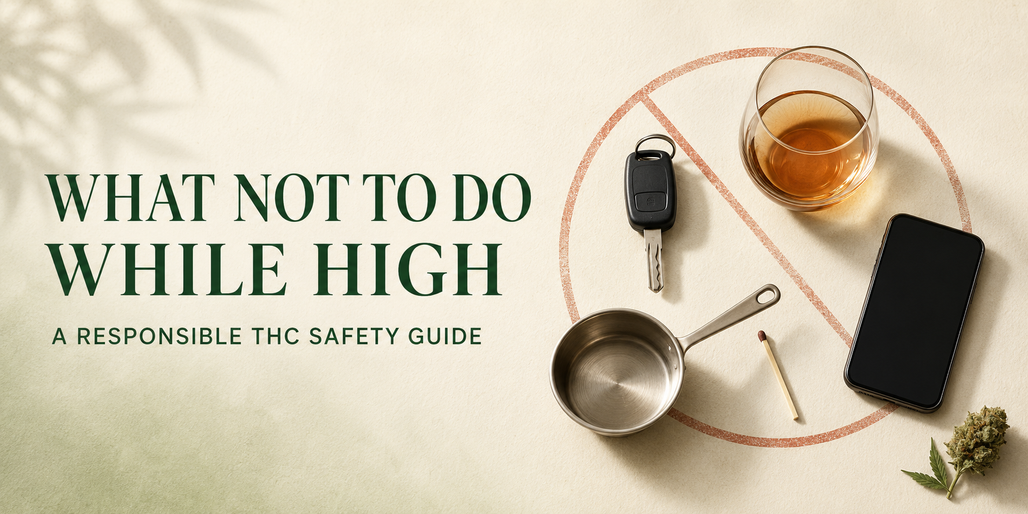
What Not to Do While High: 18 Risks to Avoid
Responsible Adult THC Activity Guide
What Not to Do While High: 18 Risks to Avoid
Knowing what not to do while high is less about following an arbitrary list and more about recognizing consequences. If an activity involves driving, water, heights, heat, blades, machinery, caregiving, consent, money or a decision that cannot easily be reversed, wait until you are sober.
Cannabis can affect attention, memory, coordination, reaction time, movement, time perception and judgment. Someone may feel calm or experienced and still be impaired in ways that matter during a sudden problem.
If you are looking for low-pressure alternatives, visit 50 Things to Do While High: Alone or With Friends.
Safety and legal information reviewed: July 25, 2026
Why cannabis impairment matters
Recent cannabis use can affect thinking, attention, memory, coordination, movement and time perception, according to the Centers for Disease Control and Prevention. Those changes can matter even when an activity feels routine.
Impairment also varies. Two people can consume the same labeled serving and respond differently. Effects may depend on the THC amount, product format, previous experience, food intake, individual biology, other medications and whether alcohol or another substance was used.
Product names are not reliable safety categories. A product labeled hemp-derived, sativa, indica, uplifting or mild may still be intoxicating. Delta-9 THC, Delta-8 THC and THC formed when THCA is heated can all impair a person.
Our Types of THC Explained guide covers the differences among these cannabinoids.
A fast way to decide whether an activity should wait
Before starting something, ask these questions:
- Does it require fast reactions or precise coordination?
- Could one distracted moment cause a serious injury?
- Does it involve traffic, water, heights, heat, blades, electricity or machinery?
- Am I responsible for another person’s safety?
- Does it involve consent, conflict or emotional pressure?
- Could it affect my finances, employment, housing or legal responsibilities?
- Can the choice be reversed tomorrow?
- Would I be comfortable explaining the decision after I am sober?
If the activity fails one of these tests, postpone it or ask a capable, sober person to take responsibility.
| Avoid while impaired | Lower-risk alternative |
|---|---|
| Driving to get food | Prepare food beforehand or arrange delivery without driving |
| Cooking with flames, hot oil or sharp knives | Choose prepared snacks or something that does not require heating |
| Swimming, boating or using a hot tub alone | Stay on dry ground in a familiar private setting |
| Heavy lifting or unfamiliar exercise | Use gentle, familiar floor-level stretching if you feel steady |
| Sending an emotional message | Write a private draft and review it sober |
| Making a major purchase | Add it to a list or cart and reconsider it the next day |
| Exploring an unfamiliar area | Stay home or remain in a familiar, controlled environment |
Transportation risks to avoid while high
1. Do not drive
Driving requires constant attention, coordination, perception and rapid decisions. Cannabis can slow reaction time, affect coordination and distort perception. The CDC’s cannabis and driving guidance recommends arranging a sober driver or another safe transportation option.
Driving while impaired is illegal throughout the United States, including in states where adult cannabis use is permitted. The National Highway Traffic Safety Administration states that a drug’s legal status does not make impaired driving legal or safe.
Do not rely on coffee, cold air, food or a shower to make yourself ready to drive. These are not proven ways to reverse THC impairment.
2. Do not ride with an impaired driver
A driver saying, “I do this all the time,” is not a safety plan. Take the keys, arrange a sober driver, stay where you are or use a transportation service that does not require anyone in the group to drive.
3. Do not cycle, use an electric scooter or operate a boat
A bicycle, scooter, motorcycle, ATV, golf cart or boat still requires balance, awareness and quick reactions. These vehicles can expose both the operator and other people to traffic, water, falls and legal consequences.
Do not combine impairment with machinery, fire, water or heights
4. Do not operate machinery or power tools
Wait until sober before using industrial equipment, lawn equipment, woodworking tools, shop machinery, sewing machinery, vehicle lifts or other powered equipment. Familiarity does not remove the risk created by delayed reactions or a missed step.
Workplace impairment can also create consequences for coworkers, customers and employers. The National Institute for Occupational Safety and Health notes that cannabis impairment can vary with THC concentration, route of use, experience and tolerance.
5. Do not handle firearms or other weapons
Firearms, knives intended as weapons, bows and similar equipment should remain secured while anyone is impaired. These activities require reliable judgment, coordination and strict safety procedures.
6. Do not cook with open flames, hot oil or complicated equipment
Frying, grilling, deep-frying and using a gas flame combine heat with timing and attention. Sharp knives, boiling water and hot pans add additional injury risks.
Prepare food before consuming THC. Ready-to-eat snacks, pre-cut food and simple cold meals are easier alternatives. Confirm that a snack does not contain more THC before eating it.
7. Do not swim or enter open water
Avoid pools, lakes, rivers, oceans and other water activities while impaired. Do not assume strong swimming ability compensates for altered coordination, perception, fatigue or panic.
Hot tubs also combine water, slippery surfaces and heat. If you feel dizzy, unsteady or unusually sleepy, stay out of the water.
8. Do not climb or spend time near unprotected heights
Avoid ladders, rooftops, cliffs, steep trails, fire escapes and ledges. A photography idea, view or shortcut is not worth the fall risk. Stay in a familiar area with secure railings and stable walking surfaces.
9. Do not attempt intense or unfamiliar exercise
Heavy free weights, gym machines, box jumps, inversions, balance drills and new exercises require attention and body awareness. Cycling, climbing and water-based workouts add environmental risks.
If you feel steady and want to move, familiar floor-level stretching may be a more manageable option. Stop if you feel dizzy, anxious, weak or uncoordinated.
Avoid mixing substances or repeatedly taking more THC
10. Do not casually combine cannabis and alcohol
Using cannabis and alcohol together can increase impairment. The CDC’s cannabis health guidance specifically identifies simultaneous use of multiple substances as an impairment concern.
Do not add alcohol because the cannabis experience feels weak, uncomfortable or different from what you expected. Adding another intoxicant can make the situation harder to evaluate.
11. Do not mix THC with sedating medications or unfamiliar substances without professional guidance
Prescription medications, over-the-counter sleep products and other substances may affect alertness or coordination. A product being available without a prescription does not mean a combination is predictable.
Ask a healthcare professional or pharmacist about possible interactions before consuming THC, especially if a medication carries drowsiness, dizziness or driving warnings.
12. Do not take more because an edible has not worked immediately
Edibles have a delayed and variable onset. The CDC notes that intoxicating effects from edible cannabis may take 30 minutes to two hours to appear and may last longer than expected.
Record the serving and time, then allow the product to develop according to its directions. Do not copy another person’s serving. Tolerance and response vary, and one person’s usual amount may be overwhelming for someone else.
For a more complete explanation of labels, servings and delayed onset, read Buying THC Edibles Online: A Safer Shopping Guide.
13. Do not try to “cancel” the high with another cannabinoid or internet remedy
Pepper, caffeine, a cold shower, food and CBD are sometimes promoted online as instant THC reversal methods. None should be treated as a guaranteed antidote.
If the experience is uncomfortable, stop consuming more substances and move to a quiet, familiar environment. Get help based on the person’s actual symptoms rather than relying on a home remedy.
Protect other people while you are impaired
14. Do not become the only responsible caregiver
Do not supervise children or act as the only capable caregiver for someone who depends on you while impaired. Another sober adult should be responsible for transportation, medication, food preparation and emergency decisions.
Pet care also requires judgment. Avoid driving a pet to a park, walking near traffic, handling an unfamiliar animal or giving any cannabis product to a pet. If an urgent situation develops, contact a sober person or veterinary professional rather than driving yourself.
15. Do not leave THC products unsecured or unlabeled
Gummies, chocolates and beverages can resemble ordinary food. Store them in their original, clearly labeled, child-resistant packaging inside a locked location that children and pets cannot access.
The FDA warns that accidental ingestion of THC foods can cause serious adverse events in children. Do not place THC gummies in an ordinary candy container or leave an infused beverage in an unmarked cup.
16. Do not pressure anyone to consume or ignore consent
No one should be pressured to take a larger serving, try an unfamiliar product or continue after saying no. A person should be able to decline without having to defend the decision.
The same principle applies to physical and sexual activity. Consent must be clear, voluntary and ongoing. If intoxication creates uncertainty about someone’s ability to understand or communicate a choice, stop and wait.
17. Do not start a serious confrontation
Avoid turning a casual evening into a relationship ultimatum, workplace dispute or forced confession. Memory, perception and emotional reactions may be altered.
Write down the topic if it feels important. Discuss it later when everyone involved is sober and able to respond clearly.
Delay financial, legal and public decisions
18. Do not make decisions with lasting consequences
Wait until sober before:
- Signing a contract or legal document
- Making a major purchase or investment
- Gambling or placing high-stakes bets
- Submitting important work
- Sending a resignation or workplace complaint
- Changing medication use without professional guidance
- Permanently deleting files or photographs
- Posting private information publicly
- Sending emotionally charged messages
- Agreeing to travel or plans you cannot easily cancel
You do not have to discard every idea you have while high. Record it as a note, save the draft or leave the item in your cart. Review it later before turning it into an action.
What to prepare before consuming THC
Many problems are easier to prevent before impairment begins. Use this checklist:
- Finish all driving and arrange sober transportation.
- Complete caregiving and safety-sensitive responsibilities.
- Prepare simple food and water.
- Choose a familiar, legal and comfortable setting.
- Charge your phone and keep emergency contacts available.
- Review the THC amount per serving and total package contents.
- Check whether the product contains more than one intoxicating cannabinoid.
- Keep the original package available for identification.
- Secure the remaining product away from children and pets.
- Tell a trusted person if you are trying an unfamiliar product.
- Avoid consuming if you may need to drive or respond to an emergency later.
A batch-specific certificate of analysis can help confirm the cannabinoids associated with a product. Review available Green Nursery COAs and laboratory reports before use.
What to do if you feel too high
An unexpectedly strong experience can be uncomfortable, especially after an edible or a product with an unclear serving size.
- Stop consuming cannabis, alcohol and other intoxicating substances.
- Move to a quiet, familiar, low-stimulation location.
- Sit or lie somewhere safe where you cannot fall.
- Use slow, comfortable breathing without extreme breath holding.
- Sip water without forcing yourself to drink excessive amounts.
- Contact a trusted sober person and explain what you consumed and when.
- Keep the product package nearby so its ingredients can be identified.
In the United States, contact Poison Control online or call 1-800-222-1222 for individualized guidance.
Call 911 for an emergency, including trouble breathing, a seizure, collapse, loss of consciousness, inability to awaken, a serious injury or an immediate threat to safety. Do not drive yourself or the affected person if you are impaired.
Frequently asked questions about what not to do while high
Can I drive after waiting a few hours?
There is no universal waiting period that guarantees someone is no longer impaired. Product format, THC amount, individual response and other substances can all affect duration. Do not drive while you feel impaired or uncertain.
Can I cook while high?
Avoid open flames, hot oil, sharp knives and complicated equipment. Prepare food beforehand or choose a simple ready-to-eat option.
Can I take a shower while high?
A short, comfortably warm shower may be manageable for some adults who feel steady, but avoid very hot water and do not lock the door. Stay out of the shower if you feel dizzy, faint, confused or uncoordinated.
Can I exercise while high?
Avoid heavy lifting, gym machinery, cycling, swimming, climbing, balance challenges and unfamiliar exercises. If you feel steady, familiar floor-level stretching is a lower-risk choice.
Can I go for a walk while high?
If you are noticeably impaired, stay in a familiar private setting. A short familiar route away from traffic may be more manageable with a trusted sober companion, but do not cross busy roads, explore unfamiliar trails or walk in extreme weather.
Can I work while high?
Do not perform safety-sensitive work or tasks affecting customers, coworkers, finances, machinery or legal responsibilities. Workplace rules may prohibit cannabis use or impairment even where personal cannabis use is otherwise permitted.
Is it safe to mix cannabis and alcohol?
The combination can increase impairment. Avoid casually combining them, especially before transportation, water activities or other situations requiring coordination and judgment.
Will CBD cancel a THC high?
Do not rely on CBD as a guaranteed reversal method. Stop consuming more substances, move somewhere safe and seek appropriate help based on the symptoms.
Should I let someone “sleep it off”?
Do not leave the person alone if you are concerned about their condition. Call 911 if the person cannot be awakened, has trouble breathing, collapses, has a seizure or shows another emergency warning sign. Poison Control can provide guidance for non-emergency exposure concerns.
What is the single most important thing not to do while high?
Do not drive. Arrange transportation before consuming and prevent an impaired friend from getting behind the wheel.
Final takeaway: What not to do while high
What not to do while high comes down to consequences. Avoid vehicles, machinery, weapons, flames, deep water, heights, caregiving, substance mixing and decisions that affect your health, money, employment, relationships or legal responsibilities.
Choose something familiar, low-pressure and easy to stop. Prepare the setting before consuming, secure the remaining product and arrange transportation in advance.
For safer activity ideas that fit different moods and settings, return to 50 Things to Do While High: Alone or With Friends.
Popular Products
Check out these customer favorites.