
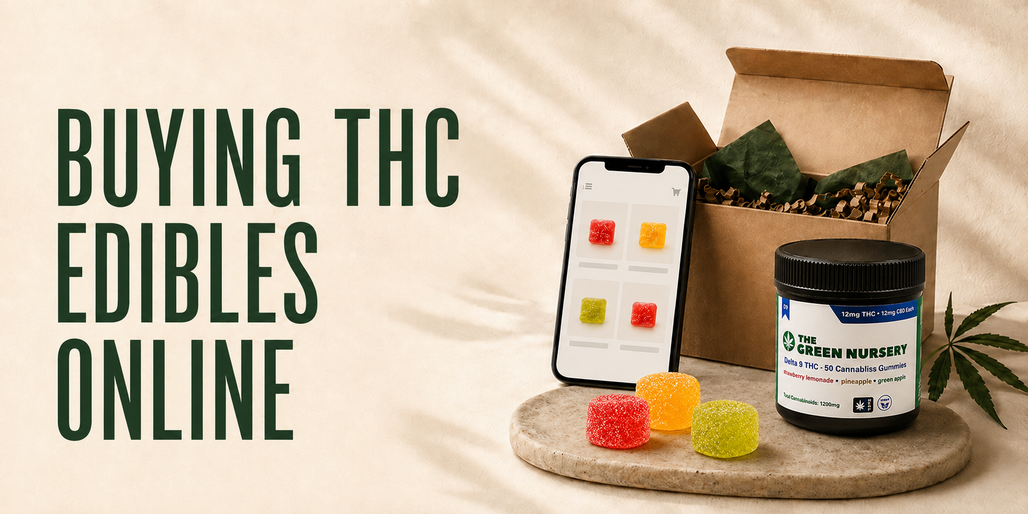
Buying THC Edibles Online: A Safer Shopping Guide
THC Edible Shopping and Product-Testing Guide
Buying THC Edibles Online: A Complete Shopping Guide
Buying THC edibles online requires more than choosing a flavor and adding it to your cart. A careful shopper should identify the type of THC, compare milligrams per serving and package, review a batch-specific certificate of analysis, check the ingredients and confirm that the product can be sold and shipped to the destination.
This guide focuses on pre-made THC foods and beverages, including gummies, chocolates, candies, baked products and infused drinks. For help comparing THC with CBD, CBG, CBN, THCA and other cannabinoids, begin with Green Nursery’s complete cannabinoid shopping guide.
What Counts as a THC Edible?
A THC edible is a food or beverage formulated with tetrahydrocannabinol or a THC-related cannabinoid. Gummies are the most familiar example, but the category also includes chocolates, caramels, hard candies, baked products, drink mixes and infused beverages.
“Edible” describes the product format, not its legal classification, strength or cannabinoid source. Two gummies that look nearly identical could contain different forms of THC, come from different regulatory systems and deliver very different amounts per piece.
Tinctures, capsules and softgels are also swallowed, but they are usually treated as separate product formats. This guide concentrates on foods and beverages that consumers commonly describe as THC edibles.
Buying THC Edibles Online Starts With Identifying the Market
The phrase “buy THC edibles online” can describe two different transactions. Understanding which one you are considering is the first shopping decision.
| Sales channel | Typical transaction | What to verify |
|---|---|---|
| Online hemp retailer | An order for hemp-derived gummies or other edibles is shipped to an eligible address. | State restrictions, cannabinoid source, production method, package potency, COA and current federal hemp rules. |
| State-licensed cannabis dispensary | An order is placed online for pickup or authorized local delivery within a state cannabis program. | Retail license, age or medical eligibility, local delivery area, state serving limits and required testing. |
A state-licensed marijuana dispensary is not the same as a nationwide hemp website. Marijuana remains federally controlled as of this article’s review date, even where state law permits adult-use or medical sales. An online dispensary menu therefore does not normally authorize interstate shipment of marijuana products.
Green Nursery is an online hemp retailer rather than a state-licensed marijuana dispensary. Shoppers can compare the current hemp-derived THC collection, but product and destination eligibility must still be checked before ordering.
Step 1: Identify the Type of THC
Do not shop from the word “THC” alone. The product page and package should identify the cannabinoid precisely. If they do not, there is no reliable way to compare the product’s expected intoxication, testing needs or legal status.
| Label description | What it generally means | What to check |
|---|---|---|
| Delta-9 THC | The primary intoxicating THC associated with cannabis. | Milligrams per piece, total package amount, source, COA and destination law. |
| Hemp-derived Delta-9 | Delta-9 THC marketed under the federal hemp definition rather than a state marijuana program. | Current federal requirements, state restrictions and the separate FDA rules affecting food in interstate commerce. |
| Delta-8 THC | An intoxicating THC isomer. Commercial amounts are commonly produced by converting hemp-derived CBD. | Conversion-related testing, residual solvents, byproducts, potency and state restrictions. |
| THC plus CBD | A blend containing separate amounts of THC and cannabidiol. | Milligrams of each cannabinoid, not just a ratio such as 1:1. |
| Full-spectrum hemp | A marketing term suggesting multiple hemp compounds are present. | The actual cannabinoid panel. “Full-spectrum” does not establish potency, safety or legality. |
| Proprietary cannabinoid blend | A mixture whose exact composition may not be obvious. | A complete milligram breakdown and matching lab report. Avoid products that hide active amounts behind a blend total. |
Delta-8 THC deserves additional scrutiny. The FDA reports that concentrated Delta-8 is commonly manufactured from CBD and has raised concerns about inconsistent formulations, adverse events and potentially harmful manufacturing byproducts. Review the agency’s Delta-8 THC consumer information before comparing these products.
For a broader comparison, see Green Nursery’s guide to the different types of THC.
Step 2: Read the Milligrams Per Piece, Serving and Package
Potency adjectives are not useful measurement standards. Terms such as “strong,” “maximum strength,” “microdose” and “extra strength” can mean different things from one brand to another. Compare the actual milligrams instead.
A complete edible label should answer four questions:
- How many milligrams of each active cannabinoid are in one piece?
- How many pieces make up one labeled serving?
- How many pieces are in the container?
- How many total milligrams of each cannabinoid are in the package?
A label that advertises “500 mg” without identifying the cannabinoid or explaining whether that number applies to one piece or the whole package is incomplete. The same is true when a product promotes a 1:1 ratio without stating the separate milligrams of THC and CBD.
Choose a Product That Can Be Measured Clearly
People differ considerably in their response to oral THC. Experience, individual sensitivity, recent food intake, medications, alcohol and product formulation can all influence the experience. Higher potency is not evidence of higher quality.
New or THC-sensitive shoppers should avoid products that make it difficult to identify or divide a serving. A lower-milligram, clearly labeled product offers more control than an edible that places a large amount of THC into one indivisible piece. This is responsible-use guidance, not a personalized dosing recommendation.
Step 3: Check the THC Edible’s Certificate of Analysis
A certificate of analysis, or COA, is a laboratory report for a tested sample. It should support the product label, not replace a complete product description.
Open the report before ordering and compare it with the package or product page. Green Nursery publishes available documents in its COA and lab-results directory.
What a Useful Edible COA Should Show
| COA detail | Why it matters |
|---|---|
| Product and batch identity | The product name, batch or lot number should match the item being sold. A generic report for a different flavor or batch is not batch-specific evidence. |
| Laboratory identity | The report should identify the laboratory and provide enough information to verify it. Accreditation can indicate laboratory competence within a defined scope, but it is not a blanket safety guarantee. |
| Collection and test dates | Dates help determine whether the report applies to a current production run rather than an old formulation. |
| Cannabinoid potency | The measured amounts should reasonably support the stated THC and CBD content. |
| Measurement units | Results may appear as milligrams per unit, milligrams per gram or a percentage. Confirm that the units can be compared with the package label. |
| Contaminant panels | Depending on the product and production method, relevant panels may include pesticides, heavy metals, residual solvents, microbes and mycotoxins. |
| Status and reporting limits | “ND” usually means not detected above the laboratory’s reporting limit; it does not necessarily mean absolute zero. |
For converted cannabinoids such as commercial Delta-8 THC, a potency-only report is especially limited. Look for broader contaminant testing and avoid sellers that will not explain what the product contains or how its testing applies to the current batch.
Step 4: Compare THC Edible Formats and Ingredients
The best format is the one that provides clear labeling, appropriate ingredients and a practical way to measure the intended serving. Flavor and texture matter, but they should come after cannabinoid identity, potency and testing.
| Format | Useful features | Shopping questions |
|---|---|---|
| Gummies | Individual pieces can make serving information easy to understand. | How many milligrams are in each gummy? Is one gummy one serving? Does it use gelatin or pectin? Are allergens identified? |
| Chocolate | Clearly marked squares may help identify portions. | Does the cannabinoid content apply to one square or the full bar? Could hot-weather shipping cause melting or uneven redistribution? |
| Infused beverages | A bottle or can may provide a clearly stated total. | Is the container one serving or several? Does the label instruct the consumer to shake it? How should an opened multi-serving bottle be stored? |
| Hard candies and caramels | Individually wrapped pieces can support portion and storage control. | Is each piece identical in potency? Are individual wrappers labeled or distinguishable from ordinary candy? |
| Baked products | They may appeal to shoppers who prefer familiar food formats. | Is the entire item one serving? How was serving uniformity evaluated? What is the shelf life and allergen profile? |
Read the Ordinary Food Label Too
THC does not make the rest of the ingredient list irrelevant. Check for:
- Major food allergens and cross-contact statements
- Gelatin, pectin or other dietary-preference concerns
- Sugar, sugar alcohols and ingredients that may cause digestive discomfort
- Artificial colors, flavors or preservatives you prefer to avoid
- Storage directions and best-by information
- Whether the package is resealable and child-resistant
Avoid copycat products designed to resemble familiar children’s candy or snack brands. The FDA has specifically warned about accidental ingestion of THC foods packaged to imitate popular products.
Step 5: Evaluate the Online Seller, Not Just the Edible
A polished package cannot compensate for an anonymous retailer, missing tests or unclear policies. A trustworthy online store should make it possible to understand what is being sold and who is responsible for the transaction.
Positive Retailer Signals
- A real business name and accessible contact information
- Clear age-gating and adult-use policies
- Complete ingredient, serving and package-potency information
- Batch-specific laboratory reports that open before checkout
- A current shipping-restrictions policy
- Reasonable processing, return and damaged-order information
- No promises to cure disease or guarantee a particular effect
- No attempt to disguise an intoxicating product as ordinary candy
Online THC Edible Red Flags
- The product says only “THC” without naming the cannabinoid.
- A large milligram number appears without a per-piece breakdown.
- The QR code leads to a homepage rather than the relevant report.
- The COA belongs to a different product, flavor or batch.
- Only potency is reported for a converted cannabinoid product.
- The seller claims that online availability proves nationwide legality.
- The marketing promises guaranteed sleep, pain relief, anxiety relief or other medical outcomes.
- The retailer encourages bypassing age, shipping or destination restrictions.
Step 6: Understand Whether THC Edibles Can Be Sold or Shipped to You
THC-edible legality is not determined by one label claim. At least four legal layers may matter: the federal Controlled Substances Act, federal food law, state hemp rules and state-licensed cannabis laws.
Current Federal Hemp Definition
At the time of this review, federal law generally defines hemp using a limit of no more than 0.3% Delta-9 THC on a dry-weight basis. This concentration-based definition is why a comparatively heavy gummy can contain a measurable milligram amount of hemp-derived Delta-9 THC while being marketed as hemp.
That does not settle every legal question. States may prohibit intoxicating hemp products, restrict particular cannabinoids, impose serving or package limits, require registration or limit sales to adults.
The FDA Food-Law Issue
The Farm Bill definition is not a federal approval of THC as a food ingredient. The FDA states that introducing food with added THC or CBD into interstate commerce is prohibited under the Federal Food, Drug, and Cosmetic Act. The agency also does not treat ordinary retail THC gummies as FDA-approved medicines.
Federal Hemp Change Scheduled for November 12, 2026
Section 781 of Public Law 119-37 is scheduled to change the federal hemp definition 365 days after the law’s November 12, 2025 enactment.
The scheduled definition uses total tetrahydrocannabinols, including THCA, and excludes certain synthesized cannabinoids. It also excludes final hemp-derived cannabinoid products containing more than 0.4 milligrams per container of combined total THC and other cannabinoids determined to have similar effects.
In practical terms, that container limit appears incompatible with typical multi-milligram intoxicating hemp edibles. Unless the law is amended or its implementation changes, many products currently marketed as hemp-derived THC edibles may no longer fit the federal hemp definition after November 12, 2026.
Marijuana and State-Licensed Dispensaries
The DEA still lists marijuana as a Schedule I controlled substance as of the review date. A rescheduling proceeding is underway, but a proposal or hearing does not change the law by itself. Readers can review the DEA’s current drug-scheduling information and marijuana-rescheduling docket.
State-licensed dispensaries operate under their state’s cannabis program. Online ordering generally supports authorized local delivery or pickup within that market; it should not be confused with interstate shipment from a hemp retailer.
Step 7: Check Shipping, Delivery and Storage Conditions
Before paying, enter the actual destination state and ZIP code. A retailer’s ability to display a product does not prove that it can be shipped to your address.
Review the retailer’s current policy for:
- Product-specific state restrictions
- Age or signature requirements
- Processing and estimated transit times
- Heat-sensitive products such as chocolate
- Lost, damaged or melted orders
- Returns of food or opened cannabinoid products
- Whether the destination address can securely receive the package
Green Nursery lists current fulfillment information and known category restrictions on its shipping and delivery policy. Restrictions can change, so check the policy again when placing a future order.
Plan for Responsible Use Before the Package Arrives
THC edibles can be intoxicating even when they are made from hemp. “Hemp-derived” should never be interpreted as “non-intoxicating.”
The CDC reports that edible effects can take 30 minutes to two hours to appear and may last longer than expected. Taking more because the first serving does not feel immediate can lead to an unpleasant or potentially serious experience.
Buying THC Edibles Online: Final Shopping Checklist
Before completing an order, confirm each of the following:
- The exact cannabinoid is named.
- Milligrams are stated per piece, per serving and per package.
- THC and CBD amounts are listed separately when both are present.
- The product’s batch or lot matches a current COA.
- The COA reports relevant potency and contaminant panels.
- The ingredient and allergen information is complete.
- The package is resealable, clearly labeled and designed to reduce accidental access.
- The seller provides contact, shipping and return information.
- The product is eligible for sale and shipment to the destination.
- You have a safe storage location and no plans to drive or perform hazardous work after use.
Once those questions are answered, shoppers can compare available Delta-9 THC gummies by cannabinoid content, serving size, ingredients and current laboratory information.
Frequently Asked Questions About Buying THC Edibles Online
Can you legally buy THC edibles online?
Sometimes, depending on the product, its cannabinoid source and manufacturing method, the sales channel and the destination. State-licensed marijuana edibles are generally ordered online for authorized local pickup or delivery. Hemp-derived THC edibles may be offered for shipment, but state restrictions and federal food-law concerns still apply.
Are hemp-derived THC edibles the same as marijuana edibles?
They can contain the same Delta-9 THC molecule, but they are sold under different legal and regulatory frameworks. Hemp-derived products are marketed under federal and state hemp rules, while marijuana edibles are sold through state-licensed cannabis programs. Testing, serving limits, packaging and availability may differ.
What should I check before buying THC gummies online?
Check the cannabinoid type, milligrams per gummy, total package potency, ingredients, allergens, batch number, COA, seller identity and destination restrictions. Avoid vague labels and laboratory reports that do not match the product.
How many milligrams should a THC gummy contain?
There is no single amount appropriate for everyone. Individual sensitivity and experience vary substantially. From a shopping perspective, choose a clearly labeled product that allows the serving to be understood and controlled. Higher potency does not mean higher quality.
How long do THC edibles take to work?
The CDC advises that intoxicating effects from edibles can take approximately 30 minutes to two hours to appear. Timing and duration vary with the product, amount, food intake, medications, alcohol and individual factors. Do not take more simply because the effect is not immediate.
What should a THC edible COA show?
A useful COA should identify the product and batch, laboratory, test dates, cannabinoid potency, units and relevant contaminant results. The report should reasonably support the label. A potency-only report does not address every quality concern.
Do THC gummies ship to every state?
No. Some states prohibit or restrict specific cannabinoids, intoxicating hemp products or particular product formats. Retailers may also adopt shipping restrictions that are more conservative than the law requires. Check the current destination policy at checkout.
Are Delta-8 gummies the same as Delta-9 gummies?
No. Delta-8 and Delta-9 are different THC isomers, although both can be intoxicating. Commercial Delta-8 is commonly manufactured by converting CBD, creating additional testing considerations. Their legal status can also differ by state.
Will hemp-derived THC edibles cause a positive drug test?
They can. Drug tests generally look for THC-related metabolites rather than confirming whether the THC came from hemp or marijuana. No retailer can guarantee that a THC edible will produce a negative test.
Does “lab tested” mean a THC edible is safe?
No. Laboratory testing can provide valuable information about the submitted sample, but its value depends on the batch match, methods, analytes and reporting limits. A COA does not prove that every possible hazard was tested or that every piece contains exactly the same amount.
What happens to hemp-derived THC edibles in November 2026?
Federal hemp-definition changes are scheduled to take effect on November 12, 2026. The new provisions include a total-THC standard, restrictions on synthesized cannabinoids and a 0.4-milligram combined limit for certain cannabinoids in a final container. Unless amended, these provisions appear likely to remove many current intoxicating edibles from the federal hemp definition.
Choose THC Edibles With Evidence, Not Hype
Buying THC edibles online is easier when you separate the decision into verifiable parts: cannabinoid identity, milligrams, ingredients, batch testing, seller transparency, shipping eligibility and responsible storage.
Do not treat high potency, attractive packaging or a “hemp-derived” claim as proof of quality or universal legality. The strongest purchase is one you can understand before it arrives and store responsibly afterward.
For the next step, use Green Nursery’s cannabinoid shopping guide to compare THC edibles with flower, oils, vapes and other cannabinoid formats.
Popular Products
Check out these customer favorites.