
30 Things to Draw While High, Even If You Can't Draw
Cannabis culture and creative activities
30 Things to Draw While High, Even If You Can't Draw
Last updated:
Looking for things to draw while high? Start with something small and give it one strange detail: a pebble with an attitude, a house inside a teacup, or a weather forecast for your thoughts. A pen, some paper, and a specific prompt are enough to begin.
The hardest part can be the blank page. You sit down to draw, decide you should make something impressive, and somehow end up looking at other people's art instead. These 30 prompts give you a first mark to make and somewhere to take it. Crooked lines are welcome.
Choose an easy doodle, an imaginary world, a pattern, a little story, or something to draw with friends. Every idea works sober, too. For activities beyond the sketchbook, explore our 50 things to do while high.
What do you feel like making?
You do not need to work through the list in order. Choose a starting point that matches the kind of attention you want to give it.
| You want... | Start with | The first mark |
|---|---|---|
| Something almost impossible to get wrong | Pebbles with personalities | Six uneven ovals |
| A drawing with an immediate joke | A houseplant running a meeting | A flowerpot behind a desk |
| A pattern you can keep adding to | A melting checkerboard | Several wavy lines |
| A small world to get absorbed in | A teacup apartment | A cup with a large handle |
| An idea with a little personal meaning | An album cover for this room | A square frame |
| Something to compare with friends | Same shape, different drawing | The same squiggle on each page |
Easy things to draw while high
Use these when you want a clear beginning. Ordinary paper and one pen are enough; color is optional.
1. Pebbles with personalities
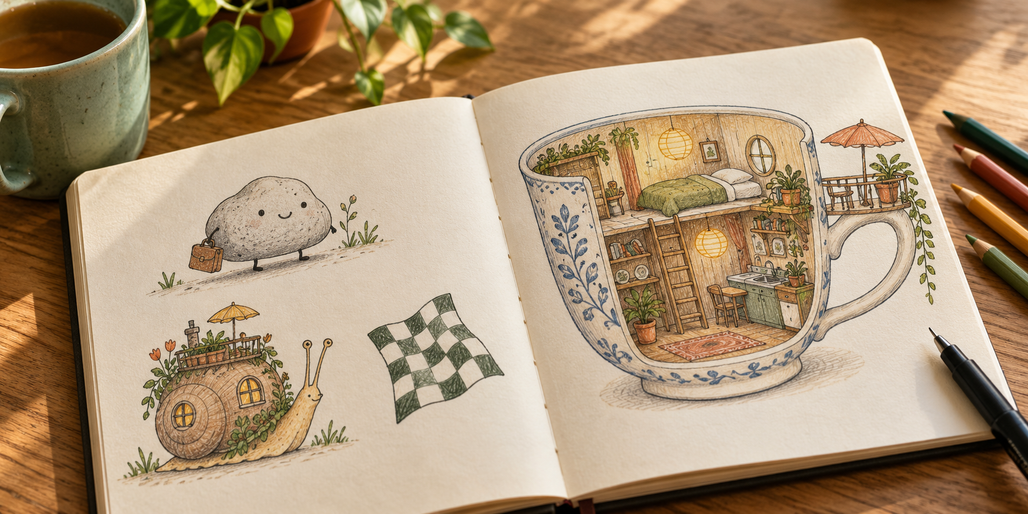
Draw six uneven ovals and give each one a different expression using only eyes, eyebrows, and a mouth. One is suspicious. One has just remembered an embarrassing email. One is delighted to be a rock. Add a single accessory to your favorite and decide what it does all day.
2. A mug in one continuous line
Put a mug in front of you and draw it without lifting your pen. Travel around the rim, down the sides, and through the handle; retracing is allowed. When you finish, add a title underneath. If the proportions wandered, perhaps you have drawn a mug designed for someone with unusually ambitious coffee plans.
3. A creature hiding in a scribble
Make one loose, looping scribble. Turn the paper until part of it suggests a head, wing, tail, or foot. Add only the details needed to reveal the creature. Leave the rest of the tangle visible, then name the species and the completely ordinary thing it is afraid of.
4. Your shoe without looking at the page
Look at a shoe and slowly follow its outline with your eyes while drawing the outline on paper. Keep your gaze on the shoe until you finish. This is a blind contour exercise; the distorted result is part of the exercise. Look down, then circle the detail that came out most surprisingly recognizable.
5. An animal built from three kinds of marks
Choose three ingredients, such as circles, triangles, and zigzags. Build an animal using only those marks, repeated as often as you want. Circles might become a body, triangles might become ears, and zigzags might become fur. Make a second animal with the same ingredients but very different proportions.
6. One window, four kinds of weather
Draw four small window frames. Put a different sky behind each: heavy rain, bright sun, a gentle snowfall, and something impossible. Maybe the fourth window looks out on falling chairs. Keep the frames identical so the changing weather does most of the storytelling.
Everyday things made strange
Start with a familiar object, then change its job, size, or surroundings. One unexpected detail can carry the whole drawing.
7. Where your missing socks go on vacation
Draw a sock shape reclining on a beach chair. Add a tiny suitcase, a drink umbrella, and a second sock somewhere in the distance. Decide whether this is a resort, a retirement community, or a witness-protection program. The sock's expression should explain how it feels about returning to your laundry basket.
8. A houseplant running a meeting
Draw a flowerpot behind a rectangular desk. Give the plant a pointer and a chart about a very specific concern: uneven sunlight, inconsistent watering, or the cat. Add two smaller plants as employees. You can build the whole scene from pots, stems, leaves, and a few deeply unimpressed faces.
9. An apartment inside a teacup
Draw a large cup as though one side has been removed, revealing the rooms inside. Add a bed, a lamp, and stairs leading to the rim. Turn the handle into a balcony or climbing garden. Include one tiny resident so the furniture and the cup feel enormous by comparison.
10. A vending machine that sells weather
Begin with a tall rectangle and several smaller windows. Fill the compartments with a thunderstorm, a pocket of fog, bottled sunshine, and a very small blizzard. Draw the selection buttons and the collection tray. Add one handwritten sign explaining which weather is currently out of stock.
11. A snail with an unnecessarily fancy home
Draw a long curved body, two feelers, and a large shell. Replace part of the shell with windows, a balcony, or a rooftop garden. Give the snail one extravagance it absolutely does not need, such as a satellite dish. Finish with a mailbox bearing an overly formal house name.
12. A household object in a future museum
Pick something nearby, such as a remote, stapler, or potato masher. Draw it on a pedestal beneath a dramatic spotlight. Write a museum label explaining what future archaeologists wrongly believe it did. A television remote might become a ceremonial instrument used to summon sports.
Patterns and imaginary places
These prompts give you something to build gradually. Stop at a small patch or keep expanding across the page.
13. A contour-map island
Draw an irregular closed shape, then surround it with larger shapes that loosely follow its edges. Treat those nested lines as hills on an imaginary island. Add a shoreline, one path, and a tiny landmark. Name the landmark before deciding whether anyone has ever managed to reach it.
14. A melting checkerboard
Draw several wavy lines from top to bottom, then cross them with another set running sideways. Color alternating spaces where the grid allows. Let the squares stretch, bulge, and sag. Make one corner appear to drip off the page, or leave a single rigid square that refuses to melt.
15. A city built on a sleeping animal
Sketch the simple outline of a curled-up cat, dog, or invented creature. Add little buildings along its back, bridges over its paws, and a park near its tail. Keep the eyes closed. The city's main planning problem is what happens when its entire landscape decides to roll over.
16. A word made from different materials
Write a short word in large outlined letters. Make each letter look like a different material: brick, wool, wood, water, or crumpled foil. Use small repeated marks to suggest the surfaces. Try writing COZY with letters that look completely uncomfortable, or LOUD with very quiet textures.
17. A doorway into another doorway
Draw a tall doorframe, then a smaller one inside it, and continue inward. Make each doorway belong to a different place: a cottage, a submarine, a spaceship, a garden wall. Put one small object beyond the final door. Let that object become the reason someone would travel through them all.
18. A garden with one invented rule
Draw three stems and decide on a rule for everything that grows there. Every leaf could be a key, every flower could contain an eye, or every branch could end in a tiny staircase. Repeat the rule across several plants, varying their heights and shapes. Give your botanical discovery a wonderfully unhelpful name.
Drawing prompts with a story behind them
A drawing can communicate an idea with a handful of lines. Use labels, arrows, and speech bubbles whenever they help.
19. An album cover for the room you are in
Draw a square and choose three details that capture the room: the lamp, a half-empty glass, a slumped cushion. Arrange them as the cover of an imaginary album. Invent the artist name and title. Is this room making ambient music, a dramatic breakup record, or surprisingly aggressive jazz?
20. A tiny inconvenience as an epic adventure
Divide the page into three panels. In the first, a character notices a small problem, such as a pea rolling under the fridge. In the second, treat the problem like a legendary quest. In the third, reveal a ridiculous solution. Stick figures are enough if the sequence is clear.
21. Your pet's secret second job
Start with the simplest version of your pet you can manage, then add a workplace and one job-related prop. Perhaps the cat inspects hotel pillows or the dog negotiates international cheese agreements. If you do not have a pet, invent one. Add a name badge with an absurdly specific title.
22. A landscape made from your favorite snack
Choose one snack and turn its shapes into scenery. Pretzels become bridges, popcorn becomes a mountain range, and a sandwich becomes an apartment block. Add a small traveler with a backpack. Decide what counts as bad weather in this landscape and show it approaching from one side.
23. A weather forecast for your thoughts
Draw a simple forecast map for an imaginary place. Use weather symbols for whatever is occupying your mind: scattered ideas, a slow-moving deadline, or a sudden burst of enthusiasm. Keep it light if you prefer, with a 90 percent chance of forgetting why you entered the kitchen. Accuracy is optional.
24. Postcards from a town that should not exist
Divide your page into four rectangles. Draw attractions from one invented town: its landmark, local restaurant, public transport, and famous annual event. Choose a rule that connects them, such as everything being underwater or built for extremely tall residents. Write a short postcard message beneath your favorite scene.
Things to draw while high with friends
These are casual formats you can adapt to the people at the table. Anyone can pass, draw separately, or join sober. Ask before photographing or sharing someone else's work.
25. Same shape, completely different drawing
For two or more people: Copy the same odd shape onto everyone's paper, such as a bent rectangle with a loop attached. Each person turns it into something without looking at the others' pages. Reveal the drawings together. Compare which part became a head, doorway, handle, or something nobody anticipated.
26. A folded creature with a surprise reveal
For three people per sheet: Fold paper into three horizontal panels. Draw a head in the top panel, extend two neck lines slightly into the next panel, and fold the head out of sight. The next person adds a torso and connection marks; the last adds the lower body. Unfold and name your creature.
This is a simple version of Exquisite Corpse, the collaborative drawing game played by Surrealist artists. Try a second round in which every section must include a household object.
27. A shared map, one landmark at a time
For two or more people: Draw a coastline across a large sheet. Take turns adding one place and a path connecting it to somewhere already drawn. The first person might add a lighthouse; the next adds a bakery accessible only by tunnel. Finish after everyone adds three places, then name the country.
28. Two words that have no business meeting
For two or more people: Everyone writes an object and a location on separate scraps of paper. Keep two piles, then draw one from each and illustrate the combination. A toaster at an opera or an umbrella in a dentist's waiting room gives you a scene. Add one detail that makes the pairing feel oddly normal.
29. A friend as an imaginary building
For two or more willing participants: Each person chooses a friend who wants to take part and draws a building inspired by their interests. A music lover might become a record shop with enormous windows. A dedicated cook might become a tower of kitchens. Explain the details afterward, keeping the interpretation affectionate.
30. A shared comic with one recurring object
For two to six people: Draw six panels and choose an ordinary object that must appear in every one, such as a yellow umbrella. Take turns adding a panel that continues the story. Stop when all six are filled. Give the comic a title together, then read it from beginning to end.
If your group wants more structured rounds, our games to play while high with friends includes Drawing Telephone, guessing games, and other paper-and-pen options.
Make another drawing prompt in three steps
Combine an ordinary subject + an unexpected situation + one drawing limit. The limit gives you a clear way to begin.
- Subject: A houseplant. Situation: Its first day at a new job. Limit: Use only five colors.
- Subject: A shoe. Situation: It has become a holiday home. Limit: Include three tiny rooms.
- Subject: A cloud. Situation: It is waiting for a bus. Limit: Tell the story in three panels.
You can also turn an answer from our funny and thoughtful questions to ask friends into a picture. Choose an imaginary scenario, answer it aloud, and draw the detail everyone keeps coming back to.
Keep the drawing setup simple
Gather paper, a pen or pencil, and a firm surface. Add a few colored pencils if you already have them. Good lighting and some elbow room are more useful here than a large collection of supplies. Keep this to ordinary drawing materials; save blades, hot tools, and solvent-based projects for when you are unimpaired.
If hemp-derived THC edibles are part of the evening, keep products such as Green Nursery's Delta-9 + CBD Cannabliss Gummies in their labeled packaging, separate from ordinary snacks and locked away from children and pets. The CDC's guidance on edible cannabis explains secure storage and delayed effects. Finishing a page is not a reason to take more.
If the activity stops being enjoyable, put the drawing down. You can keep an unfinished page, change prompts, or do something else. Nobody needs to complete a challenge to justify the evening.
Frequently asked questions
What should I draw while high if I have no drawing skills?
Start with pebbles, scribble creatures, or animals made from a few simple shapes. These prompts do not depend on realistic proportions. Give yourself one small part of the page, make the first shape, and add a feature that makes you curious about what comes next.
What are easy trippy things to draw?
Try the melting checkerboard, nested doorways, contour-map island, or a city built on a sleeping animal. Repeated lines, changes in scale, and unexpected combinations can create a surreal picture without complicated shading. You can make these drawings with a single pen.
Does cannabis actually make you more creative?
Do not count on it. In two experiments by researchers Heng, Barnes, and Yam, cannabis use did not improve creativity as assessed by independent raters, although it was associated with more favorable evaluations of ideas through increased joviality. The tasks studied idea generation, not the full experience of making art, so they do not settle every question about drawing. They also do not support promising that getting high will produce better work.
Do I need a particular strain or hemp product for these prompts?
No. None of the exercises depends on a strain, cannabinoid, or serving size. Choose a prompt based on what you want to draw. Using THC is not a requirement for enjoying the activity or taking part with friends.
Can I use a tablet instead of paper?
Yes. Most prompts work in a drawing app you already know. Start with one familiar brush and a blank canvas. The folded-creature exercise is easiest on paper, while the other solo prompts transfer readily to a screen. Save a copy before making major changes.
How do I stop restarting because the drawing looks bad?
Try a small rule: finish one version before starting another. Shrink the drawing to a postcard-sized area and give it a clear endpoint, such as one character plus one prop. You can redraw it later. For now, let the awkward part become a feature of the picture.
What if I feel too high or uncomfortable to draw?
Stop the activity and do not consume more. Contact a trusted sober person and use our guide to what to do when you feel too high for further guidance. Drawing is not a treatment or a test of whether you are safe to drive. For suspected poisoning in the United States, call Poison Control at 1-800-222-1222; call 911 in an emergency, as directed by the CDC.
Popular Products
Check out these customer favorites.