
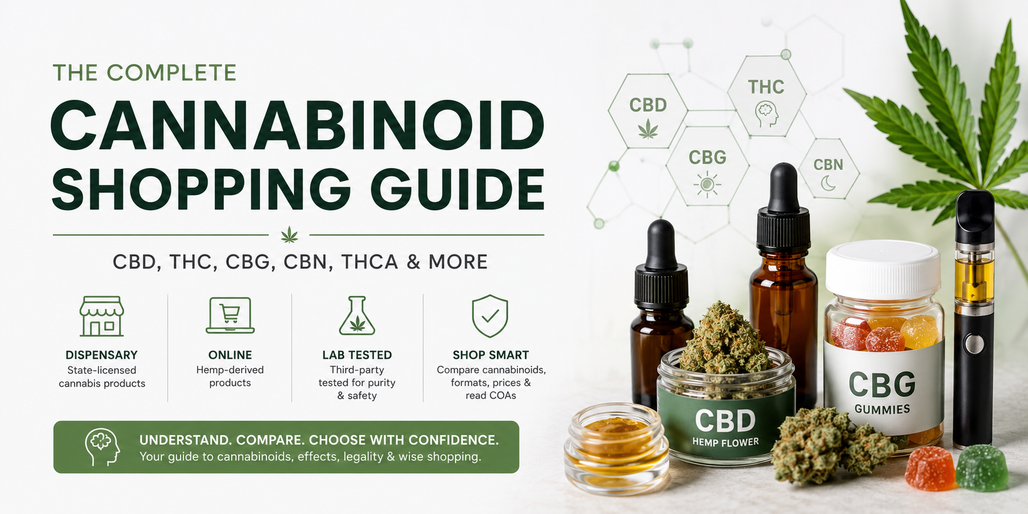
Cannabinoid Shopping Guide: CBD, THC, CBG, CBN, THCA and More
Cannabinoid Education, Shopping and Product-Testing Guide
The Complete Cannabinoid Shopping Guide: CBD, THC, CBG, CBN, THCA and More
Shopping for cannabinoids is no longer as simple as choosing between CBD and THC. Products may now feature THCA, CBG, CBN, CBC, Delta-8 THC, Delta-9 THC, THCV, THCP, HHC and other compounds across flower, gummies, oils, capsules, vapes, concentrates, beverages and topicals.
The same cannabinoid may also appear in two very different retail systems. One product may be sold through a state-licensed cannabis dispensary, while another is offered by an online hemp retailer and shipped under a different interpretation of federal and state law.
This cannabinoid shopping guide explains what the most commercially relevant cannabinoids are, whether they are generally considered intoxicating, where shoppers commonly encounter them, what testing matters and how marketing psychology can shape buying decisions.
It does not attempt to catalog every trace cannabinoid identified in the plant. Instead, it focuses on compounds that consumers are likely to see on current product labels and teaches a framework for evaluating unfamiliar ones.
For a broader explanation of how flower, vapes, concentrates, edibles, oils and topicals deliver cannabinoids differently, begin with Green Nursery’s complete guide to cannabis consumption methods .
Quick Answer: Where Can You Buy Different Cannabinoids?
CBD, CBG and some CBN products are commonly available through both online hemp retailers and state-licensed dispensaries. Delta-9 THC, THCA flower and high-THC concentrates are central categories in licensed dispensaries, but hemp-derived versions of some THC products are also marketed online where state law permits.
Delta-8 THC, Delta-10 THC, HHC and other converted or semi-synthetic cannabinoids are more strongly associated with the online hemp, smoke-shop and vape-shop markets. They may be absent from licensed dispensaries or specifically restricted by state cannabis regulators.
Availability is not the same as legality, safety or regulatory approval. Before purchasing, confirm the product’s sales channel, ingredients, cannabinoid amounts, manufacturing category, destination-state rules and batch-specific laboratory report.
The Fastest Way to Understand the Market
Licensed dispensary: Usually the main source for products regulated under a state marijuana or medical-cannabis program.
Online hemp retailer: Usually sells products represented as hemp-derived and eligible for shipment, subject to changing federal, state and local restrictions.
Pharmacy: Dispenses specific FDA-approved cannabinoid medicines rather than ordinary retail CBD, THC or hemp products.
Before You Shop: Five Categories Determine What You Are Actually Buying
Cannabis marketing often places a large acronym on the front of a package and leaves the shopper to assume the rest. A more accurate product comparison separates five categories.
1. The Cannabinoid
This is the chemical compound named on the label, such as CBD, CBG, CBN, Delta-9 THC, THCA or HHC.
2. The Source Classification
The product may be derived from federally defined hemp, marijuana regulated through a state program, an isolated cannabinoid ingredient or a cannabinoid manufactured through chemical conversion.
Hemp and marijuana are not completely different plant species. They are legal classifications applied to cannabis according to cannabinoid concentration and applicable law.
The USDA Domestic Hemp Production Program explains the federal hemp framework. USDA production compliance testing also considers the potential conversion of THCA when measuring total THC in a crop.
3. The Manufacturing Method
A cannabinoid may be:
- Present naturally in flower
- Extracted and concentrated from plant material
- Distilled or isolated
- Converted from another cannabinoid
- Produced through a semi-synthetic process
- Blended with additional cannabinoids, terpenes or ingredients
A molecule existing naturally in trace amounts does not prove that the commercial ingredient was directly extracted from a plant in meaningful quantities.
4. The Finished Product Format
Flower, gummies, tinctures, capsules, beverages, vapes and topicals do not deliver cannabinoids in the same way. The route changes onset, duration, measurement, metabolism, impairment risk and accidental-exposure concerns.
5. The Sales Channel
A state dispensary, online hemp retailer, pharmacy, smoke shop and unlicensed seller are different systems. They can differ in licensing, product tracking, testing requirements, shipping rules, recalls and accountability.
“Hemp-Derived” Does Not Mean Non-Intoxicating
Hemp-derived CBD is generally marketed as non-intoxicating. Hemp-derived Delta-9 THC, Delta-8 THC, HHC and heated THCA products may be intoxicating. Evaluate the actual cannabinoid and serving rather than relying on the word “hemp.”
Legal Dispensary vs. Online Cannabinoid Products
“Dispensary” and “online store” are not opposite product formats. They are sales channels operating under different rules.
State-Licensed Adult-Use Dispensary
An adult-use dispensary sells products authorized by a state cannabis program to eligible adults. Common products include Delta-9-THC flower, THCA-rich flower, concentrates, vapes, edibles and blends containing CBD, CBG or CBN.
Required testing, warning symbols, package limits and tracking differ by state. State licensing provides a defined regulatory system, but it does not establish that every product claim is clinically proven or that every batch is identical.
State Medical-Cannabis Dispensary
Medical dispensaries operate under state-specific eligibility and product rules. Access may require patient registration, a healthcare-practitioner certification or another form of state authorization.
Federal treatment of medical marijuana changed in April 2026. The Department of Justice announced that FDA-approved marijuana products and products regulated under qualifying state medical-marijuana licenses were placed in Schedule III . The action retained federal controls and did not convert all cannabis products into ordinary over-the-counter goods.
Online Ordering From a Local Dispensary
Some dispensaries allow customers to browse and place an order online for in-state pickup or licensed local delivery. The website is an ordering interface; the product remains within that state’s cannabis system.
Online Hemp Retailer
Online hemp retailers sell products represented as compliant with the federal hemp framework and applicable state rules. Typical categories include CBD, CBG, CBN blends, hemp-derived Delta-9 edibles, THCA flower and, in some jurisdictions, Delta-8 THC or other emerging cannabinoids.
The U.S. Postal Service permits qualifying hemp and hemp-derived products in domestic mail when the mailer complies with applicable laws and maintains supporting records. This does not override destination-state restrictions.
Smoke Shop, Vape Shop or Convenience Store
These retailers may carry hemp-market intoxicants such as Delta-8 THC, HHC or multi-cannabinoid vapes. They are not automatically licensed cannabis dispensaries, even when products use cannabis imagery or dispensary-style displays.
Pharmacy
Pharmacies dispense FDA-approved cannabinoid drug products under their approved conditions and prescription requirements. These products should not be treated as interchangeable with retail hemp oils, dispensary flower or cannabinoid gummies.
Unlicensed or Informal Seller
An informal seller may provide no dependable chain of custody, batch identity, recall process, laboratory verification or accountable manufacturer. A low price or personal recommendation cannot replace those protections.
| Channel | Common Categories | Main Advantage | Main Limitation |
|---|---|---|---|
| Licensed adult-use dispensary | Delta-9 THC, THCA, CBD, CBG, CBN, flower, concentrates and edibles | State licensing, tracking and testing requirements | Access and product rules stop at state boundaries |
| Medical dispensary | State-approved medical cannabis products | Medical-program oversight | Eligibility and product rules vary |
| Online hemp retailer | CBD, CBG, CBN, hemp Delta-9, THCA and jurisdiction-dependent intoxicants | Convenient comparison and domestic shipping where permitted | Changing state laws and uneven product oversight |
| Pharmacy | FDA-approved cannabinoid medications | Standardized approved drug products | Prescription and approved-use requirements |
| Smoke or vape shop | Delta-8, HHC and other hemp-market products in some states | Local convenience | Not necessarily subject to dispensary-level controls |
| Informal seller | Unverified products | No meaningful regulatory advantage | Uncertain contents, testing and accountability |
Cannabinoid Shopping Comparison Chart
The table below describes common retail patterns rather than universal rules. Products and laws differ among jurisdictions.
| Cannabinoid | Generally Intoxicating? | Licensed-Dispensary Availability | Online Hemp-Market Availability | Main Shopping Caution |
|---|---|---|---|---|
| CBD | Not generally impairing | Common | Common | THC content, interactions and label accuracy |
| CBDA | Not generally considered intoxicating | Occasional | Occasional | Raw-product stability and unsupported claims |
| CBG | Not generally considered intoxicating | Increasingly common | Common | Verify the actual CBG amount in blends |
| CBGA | Not generally considered intoxicating | Limited | Limited | Fewer standardized retail products |
| CBN | Not usually marketed as strongly intoxicating by itself | Common in blends | Common in blends | Nighttime claims and added THC or melatonin |
| CBC | Not generally considered intoxicating | Limited or blended | Mostly blends | Often present in small promotional amounts |
| Delta-9 THC | Yes | Core category | Available in some hemp-derived edibles where permitted | Serving size, impairment and state restrictions |
| THCA | Not strongly intoxicating before heating; converts toward THC with heat | Common in flower and concentrates | Commonly marketed online, but legally contested | Total THC, heating and rapidly changing laws |
| Delta-8 THC | Yes | Limited or excluded in many systems | Common in some states | Conversion byproducts, labeling and state bans |
| Delta-10 THC | Potentially intoxicating | Uncommon | Niche availability | Limited human evidence and production impurities |
| THCV | Product- and amount-dependent | Limited but growing | Specialty products | “Diet” and appetite claims may exceed evidence |
| CBDV | Not generally considered intoxicating | Rare | Rare or specialty | Limited consumer research |
| THCP | Potentially strongly active | Rare | Often sold in multi-cannabinoid blends | Very limited human data and label-verification concerns |
| HHC | Yes or potentially yes | Generally uncommon | Available in some jurisdictions | Semi-synthetic status, inconsistent concentration and changing law |
| THC-O acetate | Potentially intoxicating | Generally absent | Less commonly sold following legal and safety scrutiny | Do not treat it as an ordinary natural plant cannabinoid |
CBD and CBDA: The Largest Non-Intoxicating Retail Category
What Is CBD?
Cannabidiol, or CBD, is one of the best-known cannabinoids in cannabis. The CDC describes CBD as non-impairing , meaning it does not produce the conventional high associated with THC.
CBD can still cause side effects, interact with medications and appear in products containing measurable THC. A CBD label should not be treated as a guarantee of zero impairment risk, zero THC or zero drug-testing risk.
Where Is CBD Sold?
CBD is widely available through online hemp retailers, dispensaries and some general wellness stores. Common formats include:
- Hemp flower and pre-rolls
- Oils and tinctures
- Gummies and capsules
- Topicals
- Beverages
- Multi-cannabinoid formulas
Shoppers can compare CBD formats or review Green Nursery’s CBD flower collection alongside the appropriate laboratory reports.
CBD Isolate, Broad Spectrum and Full Spectrum
CBD isolate is highly refined around CBD. Broad-spectrum products generally aim to retain multiple compounds while reducing or removing THC. Full-spectrum products retain a broader cannabinoid profile and may include trace THC.
Those terms are not enough by themselves. Compare:
- CBD per serving
- Total CBD in the package
- Reported Delta-9 THC and THCA
- Other cannabinoids
- Ingredients
- Batch-specific testing
What Is CBDA?
Cannabidiolic acid, or CBDA, is an acidic precursor found naturally in raw cannabis material. Heat and time can convert CBDA toward CBD.
CBDA may appear in raw oils, minimally heated extracts or flower reports. The presence of CBDA does not prove that a product has an established medical use.
Best CBD Shopping Question
Do not ask only, “How much CBD is in the bottle?” Ask how much is in one serving, how much THC is present, what other ingredients are included and whether the tested batch matches the product.
CBG and CBGA: How to Evaluate “Focus” and Daytime Marketing
What Is CBG?
Cannabigerol, or CBG, is a minor cannabinoid that is generally not considered intoxicating. It appears in specially bred flower, tinctures, gummies, capsules and CBD-CBG blends.
CBG is available through online hemp retailers and increasingly appears in licensed-dispensary products.
Green Nursery shoppers can explore CBG flower as a plant-based example and compare its cannabinoid profile with CBD flower.
What Is CBGA?
CBGA is the acidic precursor associated with the plant’s production of several cannabinoid pathways. Retail CBGA products remain less common than CBD, CBG or CBN products.
Does CBG Guarantee Focus or Energy?
No. CBG is frequently placed in “focus,” “clarity,” “daytime” or “energy” products, but those labels are not guaranteed outcomes.
A CBG gummy may also contain CBD, caffeine, THC, adaptogenic ingredients or vitamins. The perceived experience cannot automatically be attributed to CBG alone.
What to Check
- Milligrams of CBG per serving
- Whether CBG is the primary cannabinoid or a minor addition
- CBD, THC and other cannabinoid amounts
- Stimulants or botanical ingredients
- Whether the COA verifies the advertised ratio
CBN and the Psychology of Nighttime Products
Cannabinol, or CBN, is commonly sold in nighttime gummies, tinctures and capsules. The packaging often uses purple, dark blue, moon, star or pillow imagery to establish a sleep-related expectation before the product is consumed.
Earlier reviews cautioned that strong claims about CBN as a uniquely sedating cannabinoid were not well supported. A more recent randomized study found that a particular 20-milligram CBN intervention reduced nighttime awakenings and overall sleep disturbance relative to placebo, but one formulation and study cannot establish that every CBN product treats insomnia.
Readers can review the randomized CBN study alongside a review separating historical evidence from CBN sleep marketing .
A CBN Product Is Often Not CBN-Only
A product advertised as a “CBN sleep gummy” may contain:
- CBN
- CBD
- Delta-9 THC
- Melatonin
- L-theanine
- Chamomile or other botanicals
Any of these ingredients, the serving amount, bedtime routine and expectation could influence the consumer’s experience.
Read the Whole Active-Ingredient Panel
A package can visually emphasize CBN even when THC, CBD or melatonin is present in an equal or larger functional amount. Compare each ingredient rather than assigning the entire formula to the most novel acronym.
CBC, CBDV and Other Non-Intoxicating Minor Cannabinoids
CBC
Cannabichromene, or CBC, is generally described as a non-intoxicating minor cannabinoid. It most often appears within full-spectrum extracts and multi-cannabinoid blends rather than as a stand-alone retail product.
CBDV
Cannabidivarin, or CBDV, is structurally related to CBD and is generally not marketed as intoxicating. Consumer products remain uncommon, and research is not sufficient to support broad treatment claims.
How Rare-Cannabinoid Marketing Works
A rare ingredient can create a premium impression even when it appears in a very small amount. Shoppers should compare:
- How prominently the cannabinoid appears on the front label
- Its actual milligrams per serving
- Its total milligrams per package
- Its ratio to CBD or THC
- Whether the laboratory quantified it above the reporting limit
A product is not necessarily meaningfully different merely because a long list of minor cannabinoids appears in marketing copy.
Delta-9 THC: Dispensary Cannabis and Hemp-Derived Edibles
Delta-9 THC is the cannabinoid most strongly associated with the intoxicating effects of conventional marijuana products.
Where Is Delta-9 THC Sold?
State-licensed dispensaries commonly sell Delta-9-rich flower, concentrates, vape products, edibles and beverages. Hemp-derived Delta-9 products are also sold online in some jurisdictions, especially gummies and beverages formulated around a dry-weight interpretation of the federal hemp threshold.
Green Nursery offers hemp-derived Delta-9 gummy options with product-specific serving information and available laboratory reports.
Why Product Weight Matters in Hemp Edibles
A small percentage of Delta-9 THC can still equal a meaningful number of milligrams when the finished gummy or food weighs several grams. This is why a percentage-based hemp claim does not tell a shopper whether one serving will be mildly or strongly intoxicating.
Compare the Serving, Not the Candy Size
Review:
- Delta-9 THC per piece
- Number of pieces per serving
- Total servings in the package
- CBD or other cannabinoids
- Whether the container is resealable and child resistant
- Destination-state restrictions
Edibles have a delayed and variable onset. Taking another serving before the first has developed is a common pattern behind overconsumption.
THCA: Common in Dispensaries and Legally Contested Online
Tetrahydrocannabinolic acid, or THCA, is a major acidic cannabinoid found in raw cannabis flower. THCA does not produce the same conventional intoxicating effect as Delta-9 THC before heating, but heat converts it toward Delta-9 THC through decarboxylation.
Green Nursery’s guide to how THCA transforms into THC explains this conversion in greater detail.
Where Is THCA Sold?
THCA is common in state-licensed dispensary flower and concentrates because most raw high-THC cannabis begins with substantial THCA.
THCA flower is also marketed through online hemp retailers when the product is represented as meeting applicable Delta-9 THC limits before sale. This area remains legally disputed and subject to state restrictions.
Shoppers can review available THCA flower as an online hemp-market example and compare each product with its laboratory report.
Why the Law Is More Complicated Than “Below 0.3%”
USDA crop-production testing considers the potential conversion of THCA when calculating total THC. Finished-product interpretations, state controlled-substance laws, state hemp rules and cannabis-program regulations may apply different standards.
Green Nursery’s guide to current hemp THC limits provides additional compliance context.
Online Availability Is Not a Nationwide Legal Guarantee
Some states restrict THCA flower, smokable hemp, total THC or particular product formats. Check the rules that apply to the purchase location, destination and intended use.
Delta-8 THC and Delta-10 THC
Delta-8 THC
Delta-8 THC is psychoactive and can be intoxicating. Although it can occur naturally in cannabis in small quantities, much of the commercial supply is produced by converting another cannabinoid, commonly CBD.
The FDA states that Delta-8 THC products have not been evaluated or approved for safe use and highlights concerns involving variable formulations, inaccurate labels, inconsistent concentrations and manufacturing methods.
Where Is Delta-8 Sold?
Delta-8 is mainly associated with online hemp retailers, smoke shops and vape shops in jurisdictions where it remains permitted. Many states regulate, restrict or prohibit it separately.
It may be uncommon or excluded from state-licensed marijuana dispensaries because state cannabis agencies can limit permitted cannabinoid inputs and conversion methods.
Delta-10 THC
Delta-10 THC appears in a smaller online niche and is often included in blends rather than stand-alone products. Human evidence is limited, and product purity can be difficult to evaluate using a narrow cannabinoid test.
Testing Priorities
- Delta-8 or Delta-10 concentration
- Delta-9 THC and other isomers
- Residual solvents
- Acids, reagents or conversion byproducts where the laboratory can assess them
- Heavy metals and pesticides
- Complete ingredient disclosure
THCV and the Risk of “Diet Weed” Marketing
Tetrahydrocannabivarin, or THCV, is a distinct cannabinoid with a shorter side chain than Delta-9 THC. It should not be reduced to the phrase “diet weed.”
THCV appears in selected dispensary strains, specialty extracts, gummies and online cannabinoid blends. Its effects may depend on amount, formulation and the presence of THC or other cannabinoids.
Why the Marketing Is Problematic
Retail claims may connect THCV to appetite suppression, weight loss, metabolism or energy. Those statements can move far beyond the available evidence and may create inappropriate expectations.
Avoid choosing a product because it promises:
- Guaranteed weight loss
- Appetite elimination
- Diabetes treatment
- Metabolic correction
- A stimulant-like effect without risk
A cannabinoid product should not be used as a substitute for medical evaluation, nutrition support or evidence-based treatment.
THCP, HHC and Emerging Intoxicating Cannabinoids
THCP
THCP was identified as a naturally occurring phytocannabinoid in research published in 2019. Laboratory and animal findings showed strong cannabinoid-receptor activity, but those findings do not establish a simple human rule such as “THCP is exactly 30 times stronger than THC.”
The original THCP research should be understood as early pharmacological evidence, not a retail dosing guide.
Commercial THCP usually appears in multi-cannabinoid vape or edible blends. The actual ingredient amount may be extremely small, and standard cannabinoid panels may not fully characterize every component.
HHC
Hexahydrocannabinol, or HHC, is commonly described as a hydrogenated or semi-synthetic cannabinoid product. It is sold online and through smoke or vape shops in some jurisdictions but remains uncommon in many conventional dispensary systems.
A 2025 analysis of commercial HHC products found extreme variation in measured HHC content. A 2026 review of semi-synthetic cannabinoids concluded that major gaps remain concerning pharmacology, toxicology, metabolism and long-term effects.
Review the commercial HHC product analysis and the review of semi-synthetic cannabinoids for scientific context.
Main Concerns With Emerging Products
- Limited human evidence
- Changing legal classifications
- Very small advertised amounts
- Unverified potency comparisons
- Incomplete analytical methods
- Unexpected isomers or byproducts
- Blends that make it difficult to attribute an effect
Natural, Converted, Semi-Synthetic and Synthetic Cannabinoids
These terms are frequently used imprecisely. A useful framework separates four categories.
1. Naturally Occurring Phytocannabinoid
A cannabinoid detected in the cannabis plant, such as CBD, CBG, THC or THCP.
2. Directly Extracted Cannabinoid
A cannabinoid concentrated from plant material through extraction and refinement.
3. Converted or Semi-Synthetic Cannabinoid
A cannabinoid created or substantially increased by chemically transforming another cannabinoid. The starting material may be plant-derived even though the finished molecule was produced through conversion.
4. Fully Synthetic Cannabinoid-Receptor Drug
A laboratory-created compound that may not occur naturally in cannabis. Illicit products sold as “Spice” or “K2” can contain synthetic receptor agonists with risk profiles that should not be treated as equivalent to cannabis flower.
Natural Occurrence Does Not Describe Commercial Production
A seller may truthfully state that a cannabinoid occurs naturally in cannabis while omitting that the ingredient in the package was manufactured through conversion because the plant contains too little for economical direct extraction.
What About THC-O Acetate?
THC-O acetate is a modified cannabinoid product rather than an ordinary plant constituent comparable to CBD or THC. It should not be marketed simply as another natural hemp cannabinoid.
Shoppers should be especially cautious when a product uses phrases such as “legal psychedelic,” “three times stronger,” “next-generation THC” or “federally legal high” without clear legal analysis and comprehensive testing.
Prescription Cannabinoid Medicines Are a Separate Category
The FDA has approved specific cannabinoid-related medications, including a purified CBD drug for particular seizure disorders. Approval applies to the defined medicine, manufacturing standard, formulation, dose and indication.
A pharmacy product should not be compared with an online CBD oil merely because both contain cannabidiol. Prescription drugs undergo a different approval, quality and labeling process.
The Psychology of How People Shop for Cannabis
Cannabinoid shopping combines chemistry, law, personal expectation, branding and price. That creates a difficult decision environment in which shoppers may rely on mental shortcuts.
Research on cannabis purchasing has found that potency, product information, price, quality, access, trust and retailer characteristics can all influence decisions. Packaging and cannabinoid labels can also change product appeal and health perceptions.
See published studies on cannabis purchase attributes , retailer selection , edible packaging preferences and cannabinoid label effects .
The shopper types below are a practical framework, not a clinical classification. One person may use several strategies during the same purchase.
Six Common Cannabis Shopper Mindsets
1. The Outcome Shopper
This shopper begins with a desired result such as sleep, relaxation, focus, energy, creativity or social ease.
The vulnerability is assuming that a package category guarantees the outcome. “Sleep,” “chill,” “focus” and “uplift” are often marketing frameworks rather than standardized pharmacological classifications.
2. The Potency Shopper
This shopper sorts by the highest THC percentage or largest milligram number.
Potency is attractive because it is simple, visible and easy to rank. It can also create the impression that a higher number provides better quality or value.
Higher potency may instead increase impairment, tolerance and the likelihood of an unpleasant experience. Quality also depends on formulation, freshness, ingredients, contaminants, route and label accuracy.
3. The Cannabinoid Shopper
This shopper arrives looking specifically for CBG, CBN, THCV or another acronym.
Scientific-sounding names can make a product feel precise or advanced. A featured cannabinoid may nevertheless appear in a very small amount, while CBD or THC provides most of the formula.
4. The Format Shopper
This shopper begins with a preferred form: gummies, flower, vape, oil, capsule or topical.
Format preferences often reflect convenience, familiarity, discretion, smoke avoidance, desired onset or ease of measurement. This approach can be useful as long as the shopper still reads the cannabinoid and serving information.
5. The Brand-and-Trust Shopper
This shopper relies on a familiar brand, retailer, review, friend, budtender, influencer or package aesthetic.
Trust reduces decision fatigue, but loyalty should not replace checking the current batch. Formulations, suppliers and testing can change.
6. The Deal Shopper
This shopper prioritizes discounts, bulk packages, loyalty rewards, price per gram or price per milligram.
Price matters, but a low cost can reflect aging inventory, low amounts of the featured cannabinoid, limited testing or a formulation that does not match the shopper’s needs.
How Packaging, Labels and Cognitive Biases Shape Cannabis Decisions
Choice Overload
Long menus filled with acronyms, ratios, strain names, flavors and formats can produce decision fatigue. Shoppers may then choose the first familiar brand or highest number instead of comparing the most relevant information.
Potency Anchoring
The first prominent number becomes the reference point. A shopper who sees “30% THC” first may judge every lower-potency product as inferior even when potency is not the primary goal.
Novelty Bias
A newly marketed cannabinoid may seem more advanced or effective because it is unfamiliar. Newness does not establish better evidence, manufacturing or safety.
Naturalness Bias
Words such as “plant-based,” “hemp-derived” and “natural” can make a product feel minimally processed. The finished cannabinoid may still have been converted, distilled, reformulated or blended.
Price-Quality Heuristic
Some shoppers assume that the highest-priced product is cleanest or most effective. Others assume that the largest milligram count is always the best bargain. Neither shortcut evaluates the complete product.
Social Proof
Reviews, bestseller badges and budtender recommendations reduce uncertainty. They also reflect other people’s preferences, tolerances and incentives rather than objective suitability for every shopper.
Expectancy and Color
Dark colors, moons and lavender imagery encourage nighttime expectations. Yellow, orange and bright green designs imply energy or daytime use. Clinical white packaging can imply pharmaceutical legitimacy even when the product has not been medically approved.
Scarcity and Product Drops
Limited releases, timers and “almost sold out” messages create urgency. Urgency reduces the time a shopper spends reading the label, COA or shipping restrictions.
Researchers are developing simulated online cannabis stores to study how product order, presentation and point-of-sale marketing affect consumer decisions. This reflects the growing importance of digital choice architecture in cannabinoid shopping.
Review the online cannabis-store research paradigm for additional context.
A Better Cannabinoid Shopping Decision Process
Step 1: Decide Whether Intoxication Is Acceptable
Choose among:
- Intoxication is not wanted
- Trace THC is acceptable, but a high is not wanted
- A measured intoxicating product is acceptable
- The level of intoxication is uncertain
Anyone subject to drug testing should understand that a non-intoxicating goal does not guarantee a negative test.
Step 2: Select the Delivery Route
- Inhaled: rapid onset, less precise inhaled amount and lung exposure
- Swallowed: delayed onset, longer duration and clearer unit servings
- Oromucosal: mouth-held oils, sprays or films with mixed absorption patterns
- Topical: applied to skin and not automatically systemic
- Transdermal: purpose-built skin delivery intended to cross the barrier
Step 3: Choose the Legal Channel
Determine whether the product belongs in:
- A state-licensed adult-use dispensary
- A medical-cannabis program
- An online hemp retailer
- A pharmacy
Avoid treating a smoke shop as a dispensary unless it actually holds the relevant state cannabis license.
Step 4: Compare the Actual Serving
Find:
- Milligrams of every featured cannabinoid per serving
- Number of units in one serving
- Servings per package
- Total package cannabinoid content
- Other active ingredients
Step 5: Verify the Batch
The product identifier, lot or batch should match its COA. A general brand report or a report for the source flower does not necessarily represent the finished edible, vape or blend.
Step 6: Classify Every Claim
Ask whether each statement is:
- A measurable laboratory fact
- A legal representation
- A traditional-use statement
- A consumer anecdote
- A marketing category
- An approved medical claim
These categories do not carry equal evidentiary weight.
How to Compare Cannabinoid Price and Potency
Price per Serving
Divide the product price by the number of labeled servings.
A $40 package containing 20 servings costs $2 per serving.
Price per Milligram of the Featured Cannabinoid
Divide the product price by the total verified milligrams of the cannabinoid you are comparing.
A $40 product containing 400 total milligrams of verified CBD costs $0.10 per milligram of CBD.
Price per Milligram of a Minor Cannabinoid
This calculation is especially helpful for CBG, CBN or THCV blends. A product with 500 milligrams of total cannabinoids may contain only 25 milligrams of the cannabinoid emphasized on the front.
Why Cost per Milligram Is Not the Whole Decision
Price calculations do not evaluate:
- Label accuracy
- Contaminants
- Bioavailability
- Route of administration
- Ingredients
- Legal status
- Batch freshness
- Whether the product fits the intended use
How to Read a Multi-Cannabinoid Product Label
Consider a hypothetical gummy containing:
- 25 milligrams of CBD
- 5 milligrams of CBN
- 2.5 milligrams of Delta-9 THC
- 1 milligram of melatonin
This should not be evaluated only as a “CBN gummy.”
The CBD is present in the largest amount. Delta-9 THC can cause impairment. Melatonin adds another active ingredient associated with sleep. The formula, timing, individual sensitivity and expectation could all contribute to the experience.
Front Label vs. Information Panel
The front label is designed to attract attention. The information panel and COA should answer:
- How much of each cannabinoid is in one serving?
- How many pieces equal one serving?
- Is the amount measured or described only as a proprietary blend?
- What non-cannabinoid active ingredients are included?
- Does the laboratory result agree with the label?
How to Evaluate a Cannabinoid Certificate of Analysis
A certificate of analysis, or COA, is a laboratory report for a particular sample or batch. It can provide more useful product information than strain names, effect categories or package imagery.
Green Nursery publishes available cannabinoid certificates of analysis so shoppers can compare product and batch information.
1. Product and Batch Identity
The product name, lot and batch should correspond to the package. Do not assume that a report for CBD distillate verifies every gummy made with that ingredient.
2. Testing Date
A current report is generally more informative than one produced years before the finished batch was manufactured.
3. Units
Results may appear as:
- Percentage by weight
- Milligrams per gram
- Milligrams per milliliter
- Milligrams per unit
- Total milligrams per package
Confirm that the laboratory units can be meaningfully compared with the label.
4. Complete Cannabinoid Panel
Review Delta-9 THC, THCA, CBD, CBDA and every featured minor or emerging cannabinoid.
For THCP, HHC, Delta-8 or other specialized products, verify that the laboratory is capable of distinguishing the advertised compound from related isomers.
5. Residual Solvents and Processing Chemicals
These panels are especially relevant to extracts, converted cannabinoids, vapes and concentrates.
6. Pesticides, Heavy Metals and Microbial Contaminants
Relevant panels depend on the source material and format. Inhaled products, foods and topicals may create different quality-control priorities.
7. Ingredients Not Shown by a Basic Potency Test
A cannabinoid potency panel does not automatically test for:
- Every flavor
- Every carrier oil
- Vitamin E acetate
- Botanical additives
- Synthetic dyes
- Every reaction byproduct
- Device-related metal exposure
Read Green Nursery’s guide to third-party testing and introduction to cannabinoid lab reports for a more detailed testing walkthrough.
Cannabinoid COA Checklist
- Product and batch match the package
- Testing date is visible
- Laboratory identity is disclosed
- Units can be compared with the label
- Every advertised cannabinoid is quantified
- Delta-9 THC and THCA are included
- Relevant contaminant panels are included
- Residual-solvent testing appears where applicable
- No unexplained gap exists between the label and report
Cannabinoid Marketing Red Flags
Treat the following claims cautiously:
- “Guaranteed sleep”
- “No anxiety”
- “Diet weed”
- “Burns fat”
- “Legal in all 50 states”
- “Stronger than THC” without defining the comparison
- “Pharmaceutical grade” without a relevant standard
- “100% safe”
- “Natural” without manufacturing disclosure
- “Lab tested” without an accessible report
- “Full spectrum” without a verified cannabinoid profile
- “Zero THC” without a suitable detection limit
- “No drug-test risk”
- “Doctor recommended” without meaningful context
Additional Warning Signs
- No batch number
- No manufacturer contact information
- No serving size
- Cannabinoid totals that do not add up
- Copycat candy or snack branding
- Products attractive to children
- Unknown ingredients described only as a proprietary blend
- A QR code that leads to a generic or unrelated report
- Claims that state law does not matter
Frequently Asked Questions About Cannabinoid Shopping
What are the main cannabinoids shoppers can buy?
Common retail cannabinoids include CBD, CBDA, CBG, CBN, CBC, Delta-9 THC, THCA, Delta-8 THC, Delta-10 THC and THCV. Specialty products may also contain CBDV, THCP, HHC or other emerging compounds.
Which cannabinoids are intoxicating?
Delta-9 THC and Delta-8 THC are intoxicating. HHC, Delta-10 THC and THCP products may also be intoxicating. THCA is not strongly intoxicating before heating but converts toward Delta-9 THC when heated. CBD, CBG and CBC are not generally considered intoxicating.
Which cannabinoids are commonly sold online?
Online hemp retailers commonly sell CBD, CBG, CBN blends, hemp-derived Delta-9 edibles and THCA products where permitted. Delta-8 THC, HHC and similar products are also sold online in some jurisdictions but face substantial state restrictions.
Which cannabinoids usually require a dispensary?
Conventional high-THC marijuana flower, concentrates and edibles are generally sold through state-licensed dispensaries. The precise access rules depend on the state and whether the program is medical or adult use.
Is an online hemp store the same as a dispensary?
No. An online hemp retailer operates within the hemp-product market and applicable shipping laws. A dispensary operates under a state marijuana or medical-cannabis license. Testing, tracking, products and geographic limits differ.
Is THCA legal to buy online?
THCA flower is marketed online under certain interpretations of hemp law, but its status is contested and state dependent. Some jurisdictions apply total-THC limits or specifically restrict THCA flower and smokable hemp.
Is Delta-8 THC legal?
Delta-8 law varies by jurisdiction. Some states permit regulated sales, some restrict it to cannabis systems and others prohibit it. Online availability does not establish legality in the buyer’s state.
Are dispensary products safer than online products?
Licensed dispensaries operate under state testing and tracking requirements, while online hemp oversight varies. Neither sales channel eliminates every risk. Compare the finished product, batch report, ingredients, manufacturer and applicable regulatory requirements.
Does a higher THC percentage mean better cannabis?
No. THC percentage measures one part of the product. Freshness, formulation, terpene profile, contaminants, route, serving control and personal tolerance also matter.
Which cannabinoid should a beginner choose?
There is no universal beginner cannabinoid. Start by deciding whether intoxication is acceptable, selecting an appropriate route, reviewing the entire serving and avoiding complex blends that are difficult to interpret.
Can CBD, CBG or CBN cause a positive drug test?
The named cannabinoids may not be the target of a standard THC test, but products can contain Delta-9 THC, THCA or contamination. Full-spectrum products and flower can create drug-testing risk.
Does “hemp-derived” mean the product cannot get you high?
No. Hemp-derived Delta-9 THC, Delta-8 THC, HHC and heated THCA products may be intoxicating. Hemp describes a legal source classification, not a guaranteed experience.
How can shoppers tell whether a cannabinoid is converted?
Review the ingredient and manufacturing disclosures, ask the seller, examine the COA and consider whether the cannabinoid naturally occurs in commercially extractable quantities. A label may not always disclose the conversion process clearly.
What does “lab tested” actually mean?
It means a sample was analyzed, but the phrase does not reveal what was tested, which batch was sampled or whether the product passed a complete safety panel. Read the actual report.
Can a dispensary ship marijuana to another state?
Ordinary state adult-use legality does not create a general right to ship marijuana across state lines. Online dispensary ordering typically means in-state pickup or delivery through the state system.
Use the Product, Process and Sales Channel—not Just the Acronym
The cannabinoid market encourages shoppers to make decisions from a few large letters on the front of a package. That approach leaves out the information that often matters most.
A better shopping decision asks:
- Which cannabinoids are actually present?
- How many milligrams are in one serving?
- Is intoxication likely?
- Was the compound extracted, converted or blended?
- Is the product sold through a dispensary, pharmacy or online hemp market?
- Is it permitted at the destination?
- Does the batch-specific COA support the label?
- Which marketing expectation is the package trying to create?
No cannabinoid is universally best. The useful comparison is between complete products, including their route, serving, ingredients, manufacturing history, testing and legal channel.
Continue with Green Nursery’s guide to cannabis delivery methods , browse available cannabinoid product categories and verify the corresponding laboratory reports and COAs before making a product decision.
Popular Products
Check out these customer favorites.