
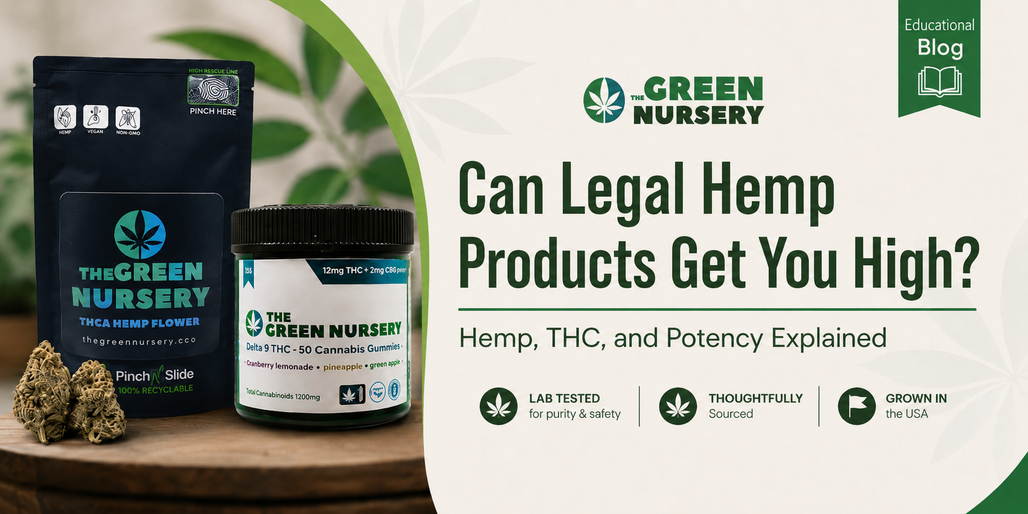
Can Legal Hemp Products Get You High? Hemp, THC, and Potency Explained
Can Legal Hemp Products Get You High? Hemp, THC, and Potency Explained
Many people assume that if a product is labeled as hemp, it must be mild, non-intoxicating, and beginner-friendly. That assumption has become one of the biggest misconceptions in the hemp industry.
The reality is more complicated. Some hemp products contain CBD and are generally considered non-intoxicating, while others contain hemp-derived THC that can produce noticeable intoxicating effects. This is why consumers are often surprised when a legal hemp product feels much stronger than expected.
Understanding the difference between CBD products, hemp-derived THC products, serving size, and potency is essential for making informed decisions. This article is part of our Cannabis Potency Myths hub, where we explain how THC, CBD, edibles, hemp products, and potency labels can shape the overall experience.
For broader context, the FDA, USDA Hemp Program, CDC, and National Center for Complementary and Integrative Health all provide useful background on hemp, cannabis, cannabinoids, and federal oversight.
What Makes a Product a Hemp Product?
One reason hemp causes so much confusion is that the word "hemp" refers to a legal classification, not necessarily how a product will feel.
Under federal guidelines, hemp is generally defined as cannabis containing no more than 0.3% Delta-9 THC by dry weight. However, that definition does not automatically mean a product is non-intoxicating.
Today, hemp products include a wide range of categories such as CBD gummies, CBD flower, CBD oils and extracts, full-spectrum CBD products, CBD prerolls, and hemp-derived THC products.
The practical takeaway is simple: hemp describes where a product comes from and how it is regulated, not necessarily how strong it is.
Does Hemp Always Mean Non-Intoxicating?
No. This is one of the most important myths to understand.
Many hemp-derived products contain CBD as their primary cannabinoid. CBD is generally considered non-intoxicating and does not produce the traditional cannabis high associated with THC.
However, other hemp products are specifically formulated with hemp-derived THC cannabinoids. Depending on the product, serving size, and individual sensitivity, these products may produce intoxicating effects.
For example, someone purchasing a hemp gummy may assume it contains only CBD when it actually contains hemp-derived THC. This misunderstanding is a common reason consumers experience stronger effects than expected.
The practical takeaway is that hemp does not automatically mean non-intoxicating.
CBD Products vs Hemp-Derived THC Products
Understanding the difference between CBD and THC is essential when shopping for hemp products.
CBD Products
Products such as CBD gummies, CBD oils, full-spectrum CBD products, and CBD flower are primarily designed around cannabidiol (CBD). These products are generally chosen by consumers looking for hemp products without traditional intoxicating effects.
Hemp-Derived THC Products
Hemp-derived THC products may contain cannabinoids such as Delta-8 THC or hemp-derived Delta-9 THC. While these products may originate from hemp, they can still produce intoxicating effects depending on formulation, potency, and serving size.
Many consumers are surprised to learn that two legal hemp products can have very different cannabinoid profiles. One product may primarily contain CBD, while another may contain hemp-derived THC that can produce noticeable intoxicating effects. This is why questions like "can hemp get you high" usually come down to one practical issue: what cannabinoids are actually in the product?
The practical takeaway is that the cannabinoid profile matters far more than the word hemp on the package.
Why Serving Size and Potency Still Matter
Another common misconception is that legal hemp products must be weak. In reality, potency depends on cannabinoid content and serving size, not simply whether the product is classified as hemp.
For example, a hemp-derived THC gummy may contain a substantial amount of THC per serving. Even when a product meets hemp requirements, consuming multiple servings can create a much different experience than expected.
This is particularly important with edibles because effects can take time to develop. Consumers sometimes take additional servings too quickly, assuming the product is not working.
If you want a deeper understanding of potency misconceptions, see our article on whether THC percentage is everything.
The practical takeaway is that serving size often matters just as much as cannabinoid type.
Why Legal Does Not Always Mean Beginner-Proof
Many consumers unconsciously associate legal products with being mild or beginner-friendly. This assumption can create unrealistic expectations.
A legal hemp product may still contain cannabinoids capable of producing noticeable effects. Individual tolerance, body chemistry, serving size, and product formulation can all influence how a product feels.
Many people who ask whether legal hemp products can get you high are really noticing a larger trend. Modern cannabis and hemp products can be significantly more potent than many consumers expect. Our guide on Why Is Weed So Strong Now? How Modern Cannabis Changed explores how increasing cannabinoid potency has changed consumer expectations.
The practical takeaway is that legality and potency are not the same thing.
How to Read Product Labels More Carefully
One of the best ways to avoid confusion is to look beyond marketing language and review the actual cannabinoid information on the label.
- CBD content
- THC content
- Serving size
- Total cannabinoids per serving
- Third-party laboratory testing
Certificates of Analysis (COAs) can provide additional transparency by showing exactly which cannabinoids are present in a product. You can review Green Nursery's available lab reports and COAs when comparing hemp products.
Consumer resources from Harvard Health, peer-reviewed cannabinoid research, and PubMed can also provide helpful background for shoppers who want to better understand cannabinoid research.
The practical takeaway is that cannabinoid content tells you far more than the word hemp ever will.
Common Myths About Hemp Products
Myth: Hemp Cannot Get You High
Some hemp-derived products contain THC cannabinoids that may produce intoxicating effects.
Myth: All Hemp Products Are the Same
CBD products and hemp-derived THC products can differ dramatically in cannabinoid content and potency.
Myth: Legal Means Mild
Legality does not automatically determine how strong a product feels.
Myth: Hemp Products Are Beginner-Proof
Serving size, potency, and individual tolerance still matter regardless of a product's legal classification.
Helpful External Resources
- FDA Cannabis and CBD Guidance
- USDA Hemp Program
- CDC About CBD
- CDC Cannabis FAQs
- NCCIH Cannabis and Cannabinoids Overview
- Peer-Reviewed Cannabinoid Research
- Harvard Health CBD Overview
- Cornell Hemp Program
Final Takeaway
Can legal hemp products get you high? In some cases, yes. The answer depends on the cannabinoids present in the product, the serving size, and how the product is formulated.
CBD products and hemp-derived THC products are not the same thing, even when both fall under the hemp category. Understanding labels, reviewing lab reports, and paying attention to cannabinoid content can help you make more informed choices.
To continue learning about cannabis potency and cannabinoid content, explore our Cannabis Potency Myths hub, read about why THC percentage is not everything, browse our CBD gummies, compare full-spectrum CBD products, explore CBD oils and extracts, or shop our CBD hemp flower.
Disclaimer: This content is for educational purposes only and is not legal or medical advice. Hemp laws vary by state and may change over time. Always review local regulations, product labels, and third-party testing information before purchasing hemp products.
Popular Products
Check out these customer favorites.