
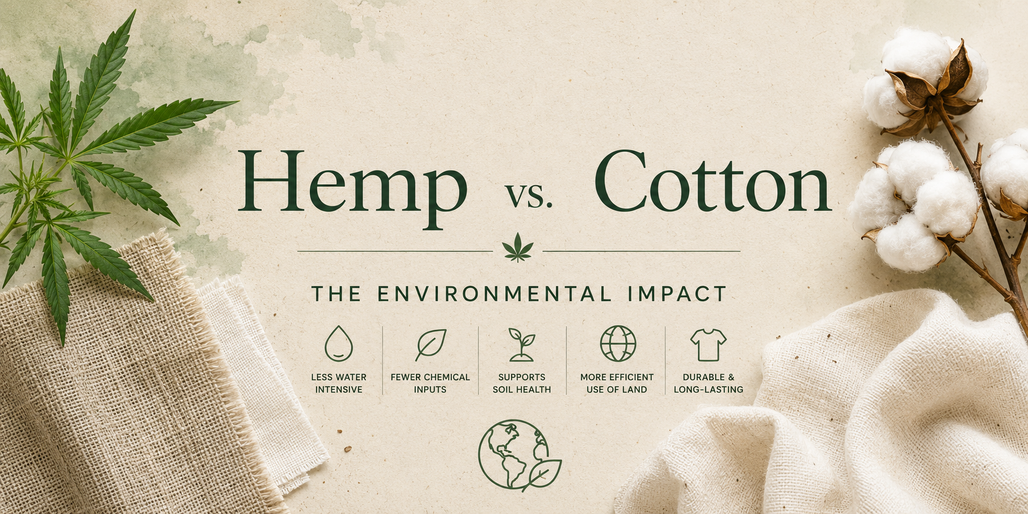
The Environmental Impact of Hemp vs. Cotton
Hemp Textiles and Sustainable Material Guide
The Environmental Impact of Hemp vs. Cotton
Hemp and cotton are both renewable, plant-based fibers, but “natural” does not automatically mean low impact. Their environmental footprints depend on where the crops are grown, whether they rely on irrigation, how pests and soil are managed, how the fibers are processed, what dyes and finishes are applied, how far materials travel and how long the finished garment remains in use.
Hemp has strong sustainability potential. It can produce useful stalk biomass, often grows with relatively limited pest pressure and may require less irrigation than cotton in suitable climates. However, a hemp stalk must pass through retting, decortication, cleaning, refinement, spinning, fabric production, dyeing and finishing before it becomes clothing.
Cotton can have a substantial water, pesticide and land footprint, especially when grown under intensive irrigation in water-stressed regions. It can also be rain-fed, grown under organic or regenerative systems and supported by a mature supply chain that uses cottonseed and other crop co-products.
The clearest answer is therefore not that hemp is always sustainable and cotton is always harmful. In many situations, responsibly grown and processed hemp can be a lower-impact alternative. The final comparison still depends on the complete textile system.
For the larger hemp-textile story, begin with Green Nursery’s guide to the future of hemp textiles in America . Readers comparing comfort, performance, price and infrastructure can also review the broader comparison between hemp fabric and cotton .
Quick Answer: Is Hemp More Sustainable Than Cotton?
Hemp can have a lower environmental impact than conventional cotton, particularly during cultivation, but it is not automatically the more sustainable finished fabric.
Hemp often performs well when it is grown in a suitable climate with limited irrigation and chemical inputs. Its stalk can produce outer bast fiber and inner hurd for several material applications. However, transforming stiff bast fiber into soft apparel can require additional mechanical, chemical, water and energy inputs.
Cotton’s impact also varies. Irrigated cotton grown in a water-stressed region presents a different profile from rain-fed cotton. Conventional, organic and regenerative farming systems use different pest, soil and nutrient strategies.
For finished clothing, the strongest environmental choice is usually a responsibly sourced fabric that is processed with lower-impact energy and chemistry, constructed well, worn frequently, repaired when necessary and kept in use for a long time.
Hemp vs. Cotton Environmental Comparison Chart
| Environmental Factor | Hemp | Cotton | Important Qualification |
|---|---|---|---|
| Water | Can grow with limited irrigation in suitable regions | May be rain-fed or heavily irrigated | Local rainfall, irrigation and water scarcity matter more than one global average |
| Pest management | Often described as having relatively low pest susceptibility | Can require substantial pest management | Neither crop is universally pesticide-free |
| Fertilizer | Still requires nutrient management for reliable yields | Input requirements vary by soil, yield target and system | Excess fertilizer can contribute to emissions and water pollution for either crop |
| Soil | Can diversify crop rotations and produce substantial roots and biomass | Can be grown with rotations, cover crops and conservation practices | Soil outcomes depend on tillage, residue, erosion control and nutrient management |
| Crop outputs | Bast fiber, hurd, seed and other biomass may enter different markets | Lint, cottonseed oil, meal, hulls and other byproducts have established uses | Potential co-products only reduce impact when real markets use them |
| Fiber processing | Requires retting, decortication and fiber preparation | Benefits from highly developed ginning and spinning infrastructure | Energy, water and chemical choices can change the result |
| Durability | Hemp bast fiber can provide high strength | Cotton durability varies widely by fiber and fabric construction | A strong fiber does not guarantee a long-lasting garment |
| Recycling | Cellulosic, but collection and recycling infrastructure remain limited | More established mechanical recycling pathways | Blends, elastane, coatings, dyes and trims complicate both |
These are general patterns, not guaranteed rankings. A well-managed cotton garment may outperform poorly processed hemp clothing, particularly when the cotton garment is durable and the hemp garment uses intensive chemical finishing or travels through a fragmented global supply chain.
Natural Does Not Always Mean Low Impact
Hemp and cotton begin as plants, making them renewable biological resources rather than fossil-derived synthetic fibers. Both are primarily cellulosic fibers and can avoid the direct fossil-feedstock dependence associated with polyester.
That does not mean their environmental footprints stop at the field.
The European environmental review of bio-based textile fibers explains that natural fibers still require land, agricultural inputs, transportation and energy-demanding processing.
A complete textile assessment may include:
- Seed production
- Farm machinery and fuel
- Irrigation
- Fertilizers and pest management
- Harvesting
- Fiber separation and cleaning
- Spinning
- Weaving or knitting
- Bleaching, dyeing and finishing
- Garment manufacturing
- Transportation
- Consumer washing and drying
- Repair, reuse, recycling and disposal
A claim about the crop alone does not describe all of those stages.
Hemp vs. Cotton Water Use
Water is one of the most common reasons hemp is promoted as an alternative to cotton. The basic comparison has merit, but it is often oversimplified.
Why Cotton Has a Water-Use Reputation
Cotton can require substantial water, particularly when it is irrigated in dry or water-stressed regions. The environmental effect is not only the volume delivered to a field. It also depends on whether the water comes from rainfall, rivers, reservoirs or groundwater and whether competing communities and ecosystems already face scarcity.
A comparative study of hemp and cotton water requirements emphasizes that cotton’s water footprint can contribute to ecosystem depletion, land degradation and the movement of agricultural pollutants.
Not All Cotton Is Irrigated Equally
Cotton can also be grown under rain-fed conditions. A rain-fed crop in a suitable climate does not create the same direct irrigation pressure as cotton dependent on groundwater or large water diversions.
This is why a single claim such as “one cotton shirt uses a fixed number of liters” can be misleading. The number can change according to location, yield, rainfall, irrigation efficiency, study boundaries and whether green rainwater is counted alongside blue surface and groundwater.
Does Hemp Need Water?
Yes. Hemp is not a crop that grows without water.
Hemp may grow largely under rainfall in some temperate regions, but it can require irrigation during establishment, drought or production in a dry climate. Fiber yield and quality can decline when the crop experiences unsuitable conditions.
The defensible conclusion is that hemp can offer lower irrigation pressure than cotton in many farming systems. The comparison should still be made at the regional and farm level.
Green Water vs. Blue Water
Green water is rainfall stored in soil and used by crops. Blue water is water withdrawn from rivers, lakes, reservoirs or groundwater for irrigation and other uses.
Blue-water consumption in a water-scarce region usually presents a different environmental concern from rainfall used where water is relatively abundant.
Pesticides, Herbicides and Fertilizers
Conventional cotton has a long history of insect, weed and disease management. That history is one reason cotton is frequently described as a chemically intensive crop.
However, claims based on global pesticide percentages from decades ago should not automatically be applied to every modern cotton field.
A USDA Economic Research Service review of pesticide use found that cotton’s share of the pesticide quantity applied to the crops studied had fallen substantially from the early 1960s to 2008. USDA associated that decline with changes in insecticides, boll-weevil eradication and the adoption of insect-resistant cotton.
This does not make conventional cotton pesticide-free. It shows that cotton production is dynamic and that modern impacts must be evaluated with current regional data.
Does Hemp Require Pesticides?
Hemp is often considered relatively resilient and may create a dense canopy that competes with weeds. Fiber hemp can therefore offer lower pest-management requirements in some environments.
It is inaccurate to claim that hemp can never experience insects, disease or weed pressure. Crop variety, climate, planting density, soil, surrounding crops and the number of years hemp is cultivated in a region can all affect pest problems.
Fertilizer Still Matters
Fast growth and high biomass do not mean hemp needs no nutrients. A high-yield fiber crop removes nutrients from the field, and fertilizer production and application can contribute to greenhouse-gas emissions, acidification, eutrophication and runoff.
A life-cycle assessment of fiber-hemp field production identified measurable impacts from cultivation, including energy use, global-warming potential, acidification and eutrophication.
The more responsible comparison is therefore:
- Which crop was suited to the region?
- Which pest-management methods were used?
- How much fertilizer was applied?
- Was nutrient runoff controlled?
- Were cover crops, rotations or integrated pest management used?
- What yield was achieved from those inputs?
Soil Health and Crop Rotation
Hemp is frequently described as a crop that restores soil. That statement needs qualification.
Hemp can provide valuable features within a farming system:
- Rapid growth
- Dense ground coverage
- A substantial root system
- Large amounts of above-ground biomass
- A different crop family for rotation planning
Those qualities may help diversify rotations, compete with weeds and contribute organic matter when roots or residues remain in the field.
Soil results still depend on how the crop is managed. Intensive tillage can increase erosion and disturb soil structure. Excess fertilizer can create pollution. Heavy equipment can compact soil. Removing most stalk biomass exports nutrients and carbon that might otherwise return to the field.
Cotton Soil Impact Also Depends on the System
Cotton can be associated with erosion, declining soil organic matter, compaction and chemical dependence when it is grown repeatedly under intensive management.
It can also be incorporated into systems using:
- Cover crops
- Reduced tillage
- Crop rotation
- Integrated pest management
- Precision nutrient application
- Erosion-control practices
A regenerative claim should describe measurable farm practices and outcomes rather than relying on the crop name.
No Crop Automatically Regenerates Soil
Hemp may be useful within a soil-health strategy, but planting hemp does not erase poor tillage, nutrient loss, erosion, compaction or contaminated land. Cotton is not automatically destructive when it is grown within a well-managed conservation system.
Land Efficiency and Crop Co-Products
Fiber hemp can produce substantial stalk biomass within one growing season. The outer bast fibers may be used for textiles, cordage, nonwovens and composites, while the inner woody hurd can move into bedding, absorbent material, construction products and other applications.
Depending on the variety and farming goal, hemp may also produce grain or seed. However, a crop optimized for fine textile fiber is not automatically optimized for maximum grain, flower and hurd value at the same time.
Multi-Use Potential Is Not the Same as Guaranteed Use
Hemp’s whole-crop potential is environmentally valuable only when processors and buyers actually use the outputs.
If hurd has no nearby buyer, stalks travel long distances or low-grade fiber is discarded, theoretical co-products may not create a real environmental credit.
Cotton Also Produces Co-Products
Cotton should not be described as producing fiber while everything else becomes waste. After ginning, cottonseed can be used for oil, livestock feed and industrial research applications. Other gin byproducts may enter fertilizer, mulch and additional material streams.
The USDA describes cottonseed and cotton-gin byproduct uses , while Agricultural Research Service programs continue researching food, feed and industrial uses for cottonseed components.
Hemp may still produce more useful stalk fiber per unit of land in certain systems, but land-efficiency comparisons must use the same functional output and allocate impacts fairly among co-products.
Carbon Claims and Climate Impact
Hemp grows quickly and takes carbon dioxide from the atmosphere as it builds plant biomass. Cotton does the same through photosynthesis.
Neither fact proves that a finished garment is carbon negative.
The carbon absorbed during growth may return to the atmosphere when residues decompose, products are incinerated or garments break down. Farming equipment, fertilizers, processing heat, electricity, transportation, dyeing and consumer care also create emissions.
Long-lived uses can store biogenic carbon for a period of time, particularly when hemp is incorporated into building materials. Apparel generally has a shorter and more variable service life.
Responsible climate claims should therefore specify:
- The life-cycle boundary
- The farming location
- Soil-carbon assumptions
- Fertilizer emissions
- Processing energy
- Transportation
- Garment lifespan
- End-of-life scenario
“Hemp absorbs carbon” is true but incomplete. The meaningful question is whether the complete system produces fewer net emissions than a credible alternative.
Textile Processing Can Change the Hemp vs. Cotton Comparison
Processing is the stage many simplified sustainability comparisons overlook.
How Hemp Becomes Textile Fiber
Fiber hemp commonly moves through several stages:
- Harvesting and drying
- Retting or degumming to help separate fiber bundles
- Baling and transportation
- Decortication to separate bast fiber from hurd
- Cleaning and grading
- Scutching, hackling or related fiber preparation
- Mechanical softening, degumming or cottonization
- Spinning into yarn
- Weaving or knitting
- Dyeing, finishing and garment construction
Green Nursery’s guide to hemp processing from farm to finished product explains this supply chain in greater detail.
Retting and Degumming Matter
Hemp fiber is held within the stalk by pectins, lignin and other non-cellulose materials. Retting or degumming helps release and refine the fiber.
Field retting relies on weather and microorganisms but can create inconsistent results. Water or biochemical processes can improve control while introducing water, wastewater, energy or chemical considerations.
The European review of bio-based textile fibers notes that the impact of hemp degumming can change according to the process and the energy source used for heating.
Cottonization Makes Hemp Easier to Process
Cottonization shortens and refines hemp so it can be processed through equipment developed for cotton or wool systems. This can expand access to existing mills and produce a softer, more familiar fabric.
Aggressive refinement can also consume energy and chemistry, shorten fibers and reduce some of the strength or character associated with long bast fibers.
Cotton Has Processing Impacts Too
Cotton moves through ginning, cleaning, carding, combing where applicable, spinning, fabric formation, preparation, bleaching, dyeing and finishing.
Cotton’s mature infrastructure can process large volumes efficiently, but efficiency does not remove the environmental impact of energy, wastewater, dyes and finishing chemistry.
A Lower-Impact Crop Can Become a Higher-Impact Fabric
Hemp’s cultivation advantages can be weakened by inefficient transport, fossil-powered processing, intensive degumming, harmful dyes or a short-lived garment. Cotton’s field impacts can be reduced through better farming, efficient mills, responsible wet processing and durable construction.
Dyeing, Finishing and Transportation
Once hemp and cotton become prepared cellulose fibers, many downstream impacts begin to look similar.
Both may be:
- Scoured or cleaned
- Bleached
- Dyed
- Printed
- Enzyme washed
- Softened
- Coated for water or stain resistance
- Treated for wrinkle resistance
- Combined with elastane or synthetic performance fibers
Wet processing can consume water, heat and chemicals and can generate polluted wastewater when treatment is inadequate. A natural fiber does not neutralize a harmful dyeing or finishing system.
Color and Finish Choices Matter
Undyed, solution-conscious or minimally finished fabrics may avoid some processing stages. Dark saturated colors, distressed finishes, repeated washing effects and complex coatings can add impacts.
Natural dyes are not automatically harmless. They may still require land, water, mordants, repeated dye baths and careful wastewater management.
Transportation Can Reshape the Footprint
Hemp may be grown in one country, decorticated in another, spun and woven elsewhere and sewn in a fourth location. Cotton can travel through an equally complex chain.
Regional processing can reduce bulk transportation and improve traceability, but local production is not automatically lower impact when facilities use inefficient energy or outdated equipment.
The weakness of the developing U.S. fiber-hemp chain is explored in Why Fiber Hemp Has Struggled to Scale in the United States .
Durability and Garment Lifespan
Material sustainability is not only about producing one kilogram of fiber. It is also about how much useful wear that fiber provides.
Hemp bast fibers can provide high tensile strength and are well suited to categories such as workwear, canvas, bags, outerwear, upholstery and durable shirting. That strength is an important environmental opportunity.
A garment labeled hemp is not automatically durable. Longevity also depends on:
- Fiber length and quality
- Yarn strength
- Fabric weight and construction
- Seam quality
- Stress-point reinforcement
- Finishing treatments
- Care requirements
- Whether the design remains useful to its owner
Cotton Quality Varies Widely
Cotton can become a thin promotional T-shirt designed around low cost, or a dense canvas, denim or workwear fabric that lasts for years. Fiber type alone does not determine lifespan.
Why Longer Use Matters
A garment that is worn repeatedly and repaired can spread its production impact across more uses. A theoretically sustainable shirt that is uncomfortable, poorly fitted or quickly discarded may perform worse in practice than a durable garment made from a more resource-intensive fiber.
European circular-textile research emphasizes that durability, reuse, repair and remanufacturing are at least as important as developing new recycling systems.
Ask for Impact per Wear, Not Only Impact per Kilogram
Textile comparisons often rank raw materials by weight. Consumers experience garments through wear. A well-designed uniform, work jacket or trouser that remains useful for years can justify more initial material and construction than a disposable garment.
The Environmental Role of Hemp Blends
Much of today’s hemp clothing is blended rather than made from 100% hemp.
Common combinations include:
- Hemp and cotton
- Hemp and organic cotton
- Hemp and recycled cotton
- Hemp and linen
- Hemp and lyocell
- Hemp and wool
- Hemp with polyester or elastane
Why Blends Can Improve Sustainability
A blend may improve softness, drape, stretch, wrinkle recovery, manufacturing compatibility and consumer acceptance. If those improvements make the garment more comfortable and extend its useful life, blending can support a lower-impact outcome.
Hemp-cotton blends can also help mills introduce hemp through equipment and knowledge already established for cotton.
Why Blends Can Complicate Recycling
Recycling systems must identify and separate materials or process them together without reducing quality. Mixed fibers can make that difficult, especially when a garment includes cellulose, polyester and elastane.
The European bio-based textile report identifies blends as a continuing challenge for high-value textile recycling and recommends considering end of life during product design.
A single-fiber fabric may be easier to classify, but labels, sewing thread, interlinings, coatings, zippers, elastic and finishes can still complicate recycling.
Keep reading with Why Most Hemp Clothing Isn’t 100% Hemp to learn how fiber blends affect softness, performance, manufacturing and end-of-life options.
Organic, Regenerative and Responsible Farming Can Change the Comparison
Organic Cotton
Certified organic cotton is grown under standards that restrict most synthetic pesticides and fertilizers and prohibit genetically engineered seed. This can reduce certain chemical and fossil-energy impacts.
Organic does not guarantee that cotton is rain-fed, high yielding, locally processed or made into a durable garment. Lower yields can also increase the land required for a given quantity of fiber in some situations.
Organic Hemp
Hemp can also be certified organic. The crop name alone does not provide that certification.
An organic hemp label primarily addresses agricultural practices. It does not automatically verify responsible retting, low-impact degumming, safe dyeing, renewable processing energy or garment-factory conditions.
Regenerative Agriculture
Regenerative programs may emphasize soil cover, reduced disturbance, diverse rotations, managed inputs, biodiversity and improved soil function.
The term does not yet represent one universal textile standard. Strong claims should identify:
- The certification or measurement framework
- The farms involved
- The practices used
- The baseline conditions
- The outcomes measured over time
Traceability Connects the Claims
A brand cannot substantiate detailed environmental claims without knowing where the crop was grown and how it moved through processors, mills, dye houses and factories.
Useful traceability may identify:
- Country or region of cultivation
- Fiber percentage
- Organic or agricultural certification
- Retting and decortication location
- Spinning and fabric mill
- Dyeing and finishing facility
- Garment manufacturer
- Chemical-management standards
How to Shop for Lower-Impact Hemp or Cotton Clothing
A fiber label is the beginning of the decision rather than the final answer.
1. Read the Exact Fiber Content
“Hemp clothing” may contain a small hemp percentage. Check whether the product is 100% hemp, hemp-cotton, hemp-lyocell or a blend containing synthetics.
2. Look for Specific Agricultural Information
Prefer claims such as certified organic, rain-fed, verified regenerative or sourced from an identified region over vague terms such as green, earth-friendly or conscious.
3. Ask How the Hemp Was Processed
A transparent brand may explain retting, decortication, cottonization, processing country and mill partners.
4. Review Dye and Finish Claims
Look for specific wastewater, restricted-substance or chemical-management information rather than assuming natural fiber means natural dye.
5. Evaluate Construction
Check fabric weight, seam quality, stress points, hardware, lining, repairability and care instructions.
6. Consider How Often You Will Wear It
A versatile garment that fits well and supports repeated use is more likely to justify its production impact than a novelty item purchased only for its fiber story.
7. Avoid Absolute Claims
Be cautious when a brand says:
- Hemp uses no water
- Hemp requires no pesticides
- Hemp automatically restores soil
- All cotton is environmentally destructive
- Natural means chemical-free
- A garment is carbon negative without a published method
- Biodegradable means it will harmlessly disappear anywhere
Lower-Impact Clothing Checklist
- Exact fiber percentages are disclosed
- The farming region or source is identifiable
- Agricultural claims are certified or supported
- Processing information is available
- Dyeing and finishing claims are specific
- The garment feels durable and repairable
- Care requirements are realistic
- The design is likely to remain useful
- End-of-life claims account for blends, finishes and trims
Frequently Asked Questions About the Environmental Impact of Hemp vs. Cotton
Is hemp more sustainable than cotton?
Hemp can have a lower cultivation impact than conventional cotton, especially when it is grown under rainfall with limited pest-management inputs. The final fabric is not automatically more sustainable because processing, dyeing, transport, quality and garment lifespan also matter.
Does hemp use less water than cotton?
Hemp often requires less irrigation than cotton in suitable growing regions. The result varies with rainfall, climate, soil, yield and farming practices. Rain-fed cotton can have a very different water profile from heavily irrigated cotton grown in a water-stressed region.
Does hemp require pesticides?
Hemp may experience relatively limited pest pressure in some farming systems, but it is not universally pest-free. Insects, disease and weeds can affect hemp, and management needs vary by location and crop history.
Is cotton bad for the environment?
Cotton can create serious impacts through irrigation, pesticides, fertilizers and soil degradation. Those impacts are not identical across all farms. Rain-fed, organic, regenerative and conservation-based cotton systems can change the comparison substantially.
Is organic cotton better than hemp?
Not automatically. Organic cotton may reduce reliance on synthetic pesticides and fertilizers, while hemp may offer lower irrigation or pest-management needs in some regions. The better finished textile depends on yield, location, processing, energy, dyeing, durability and use.
Does hemp improve soil?
Hemp can contribute to crop diversity, ground coverage and root biomass. Soil improvement depends on the full management system, including tillage, erosion control, fertilizer, residue handling and crop rotation. Hemp does not automatically regenerate damaged soil.
Does hemp produce more fiber per acre than cotton?
Hemp can produce high stalk and bast-fiber yields, but exact comparisons depend on cultivar, climate, harvest timing, fiber quality and the functional output being measured. Raw stalk biomass should not be compared directly with cleaned, spinnable cotton lint.
Is hemp fabric biodegradable?
Uncoated hemp cellulose can biodegrade under suitable conditions. Dyes, resins, water-resistant coatings, synthetic sewing thread, elastane and blended fibers can change how the finished garment breaks down.
Is hemp clothing more durable than cotton?
Hemp bast fiber can provide high strength, but finished-garment durability depends on fiber preparation, yarn, fabric construction, seams, finishing, care and design. Heavy cotton canvas may outlast a lightweight or poorly constructed hemp garment.
Are hemp-cotton blends sustainable?
They can be. Blending may improve softness, performance and garment lifespan while reducing the amount of conventional cotton used. Blends may also complicate textile recycling, so their total value depends on composition, durability and end-of-life design.
Is 100% hemp always better than a hemp blend?
No. A well-designed blend may be softer, more wearable and longer lasting. A 100% hemp fabric may be easier to identify as a single fiber, but finishes, trims and construction still affect processing and recyclability.
Can hemp replace cotton?
Hemp is unlikely to replace cotton completely. A more realistic opportunity is for hemp to expand within workwear, creative uniforms, durable shirting, canvas products, denim-like fabrics, home textiles and carefully designed blends.
Hemp Has Strong Potential, but the Whole System Matters
The environmental impact of hemp vs. cotton cannot be reduced to one water statistic or one claim about pesticides.
Hemp can offer important cultivation advantages. It can grow quickly, produce substantial stalk fiber, fit into diversified rotations and require relatively limited irrigation and pest management in suitable conditions.
Cotton’s environmental challenges are real, particularly in intensive, irrigated production. Cotton also exists across many farming systems and benefits from mature processing, established co-product markets and decades of agronomic development.
After harvest, both fibers move into textile systems that use energy, water, chemistry, transportation and labor. Hemp’s additional fiber-separation and refinement needs make responsible processing especially important.
The best choice is not simply hemp instead of cotton. It is responsibly grown fiber, traceable processing, safer chemistry, thoughtful design and clothing made to remain useful.
Continue with Why Most Hemp Clothing Isn’t 100% Hemp to learn why designers combine hemp with cotton, lyocell, linen, recycled fibers and other materials to balance durability, softness, cost, manufacturing and recyclability.
Popular Products
Check out these customer favorites.