
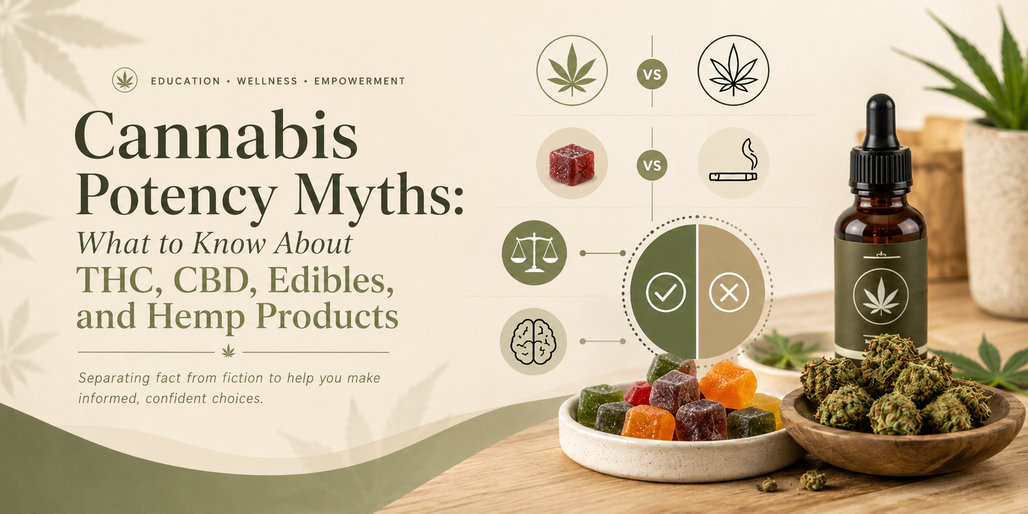
Cannabis Potency Myths: What to Know About THC, CBD, Edibles, and Hemp Products
Cannabis Potency Myths: What to Know About THC, CBD, Edibles, and Hemp Products
Cannabis has changed a lot in recent years, and for many people, it can feel confusing to understand what “strong” actually means. Shoppers now see THC percentages, CBD labels, edibles, gummies, flower, and hemp-derived products all at once. It is easy to rely on quick assumptions or common myths, but those assumptions can lead to uncomfortable experiences or unrealistic expectations.
This guide breaks down the most common cannabis potency myths and explains what really affects how cannabis feels, including THC content, CBD content, serving size, product type, timing, tolerance, terpenes, cannabinoids, and lab testing.
What Does Cannabis Potency Actually Mean?
When people talk about cannabis potency, they are usually referring to the strength or concentration of cannabinoids, especially THC. However, potency is not just one number.
The CDC’s cannabis overview explains that cannabis contains compounds such as THC and CBD, and different products can affect people differently depending on how they are used.
A product’s effects can depend on:
- THC content
- CBD content
- Other cannabinoids and terpenes
- Serving size in milligrams
- Product type, such as flower, edibles, gummies, oils, or prerolls
- Timing and absorption
- Your personal tolerance
- Product freshness and lab testing
This is why two products with similar THC percentages can feel completely different.
Myth: THC Percentage Tells You Everything
THC percentage is important, but it does not tell the full story. A higher THC number does not automatically mean a better, smoother, or more enjoyable experience.
Other compounds in cannabis, including terpenes and minor cannabinoids, can influence the overall character of a product. Your own tolerance, serving size, and product format also matter.
For a deeper breakdown, see our guide on Is THC Percentage Everything? The Myth of Choosing Cannabis by Potency Alone.
Myth: Cannabis Is the Same Strength It Used to Be
Modern cannabis products can be more potent than what many people remember from years ago, especially with the rise of concentrates, infused products, and stronger flower genetics. That does not mean every product is overwhelming, but it does mean shoppers should pay closer attention to potency and serving size.
Learn more in our full breakdown: Why Is Weed So Strong Now? How Modern Cannabis Changed.
Myth: CBD Can Instantly Bring You Down From a High
CBD is often described as something that can “cancel out” THC, but the reality is more nuanced. Some people report that CBD changes how THC feels, but it is not a guaranteed off switch or instant fix.
It is better to think of CBD as interacting with THC rather than reversing it. Everyone’s response is different, and timing, dose, product type, and tolerance all play a role.
The National Center for Complementary and Integrative Health provides additional background on cannabis, cannabinoids, and ongoing research.
Myth: Edibles Are Just Like Smoking
Edibles and smoking are very different experiences. When cannabis is smoked or vaped, effects are often felt quickly. Edibles take longer to kick in and may last much longer.
This delay is one of the main reasons people accidentally take too much. Taking another serving too soon can lead to a stronger experience than expected. If you are comparing product formats, browse our CBD gummies, full-spectrum CBD products, and CBD oils and extracts to see how serving styles differ.
Myth: Legal Hemp Products Are Always Mild
Legal does not always mean weak. Hemp-derived products can still feel potent depending on the formulation, serving size, and cannabinoids used.
The USDA Hemp Program explains the federal hemp production framework, but a hemp classification does not automatically tell you how a finished product will feel.
Some hemp-derived THC products are designed to stay within hemp requirements while still delivering noticeable effects. This is why it is important to read labels carefully, understand serving sizes, and review lab reports when available.
For more detail, read Can Legal Hemp Products Get You High? Hemp, THC, and Potency Explained.
Myth: CBD Flower Is Just Weak Weed
CBD flower often looks and smells similar to THC flower, but it has a different cannabinoid profile. Instead of being “weak weed,” it is better understood as CBD-rich hemp flower with low Delta-9 THC.
CBD flower is usually chosen by people who want the aroma, flavor, and flower format of cannabis without the same intoxicating effects associated with THC-dominant products.
If you are new to hemp flower, start with our CBD flower hub: What Are CBD Buds? A Clear Guide to CBD Bud, Hemp Flower, and What to Expect.
Myth: Full-Spectrum CBD and Broad-Spectrum CBD Are Basically the Same
Full-spectrum and broad-spectrum CBD products may sound similar, but they are not identical. Full-spectrum CBD usually contains CBD, other hemp compounds, and trace THC. Broad-spectrum CBD is generally processed to reduce or remove THC while keeping other cannabinoids and terpenes.
This difference matters for shoppers who are comparing THC exposure, product potency, cannabinoid profiles, and drug testing concerns. If you want a deeper explanation, read Full-Spectrum vs Broad-Spectrum CBD: THC Content, Potency, and Common Myths.
Myth: More Potent Means Better
Stronger is not always better. The best product depends on your goals, comfort level, experience, and preferred format.
Some people prefer mild or balanced products, while others may seek stronger options. Choosing based on your own tolerance and preferences is more useful than chasing the highest THC number.
Myth: Getting Too High Means Cannabis Is Not for You
Getting too high can happen for many reasons, including taking too much, having a low tolerance, waiting too little time between edible servings, or choosing a product that is stronger than expected.
That does not necessarily mean cannabis is not for you. Understanding serving size, timing, cannabinoid content, and product type can help you make more careful choices in the future.
CBD vs THC: Understanding the Difference
THC and CBD are two of the most well-known cannabinoids, but they affect the body differently. THC is associated with intoxicating effects, while CBD is generally described as non-intoxicating.
The FDA’s cannabis and CBD guidance explains that cannabis and cannabis-derived products are regulated differently depending on product type, ingredients, and claims.
Products like full-spectrum CBD gummies, CBD flower, CBD prerolls, and CBG flower give shoppers different ways to explore hemp-derived cannabinoids.
CBD and THC are often discussed together, but product labels matter. A CBD product may be non-intoxicating, may contain trace THC, or may be formulated as part of a full-spectrum hemp extract. To compare product test results, review Green Nursery’s lab reports and COAs.
Harvard Health also notes that consumers should be cautious with CBD products, especially when using medications or evaluating product quality and labeling.
How to Evaluate Cannabis and Hemp Products More Confidently
The safest way to think about potency is to look beyond the front label. A product name or category can give you a starting point, but it does not tell the full story.
When comparing cannabis or hemp products, look at:
- How much THC or CBD is in each serving
- Whether the product is full-spectrum, broad-spectrum, isolate-based, or THC-forward
- Whether the product has a current Certificate of Analysis
- How quickly the format usually takes effect
- How long the effects may last
- Your own tolerance and experience level
- Whether state laws or workplace policies affect your decision
For hemp agriculture and product-quality context, resources from Cornell Hemp and Penn State Extension provide helpful educational information about hemp production and research.
Final Takeaway: Cannabis Potency Is More Than One Number
Cannabis potency is often misunderstood because it is reduced to a single number like THC percentage. In reality, the experience depends on many factors, including product type, serving size, timing, cannabinoids, terpenes, lab testing, and personal tolerance.
By understanding these factors, you can make more informed choices and avoid common misconceptions that lead to uncomfortable experiences.
If you are exploring hemp products, you can browse CBD flower, CBD gummies, full-spectrum CBD products, or CBD oils and extracts. You can also continue reading our cannabis education guides to learn more about THC, CBD, edibles, hemp products, and potency.
Disclaimer: This content is for educational purposes only and is not medical or legal advice. Always consult a qualified healthcare professional before using cannabis products, especially if you are taking medications or have underlying health conditions. Hemp and cannabis laws vary by location and may change over time.
Popular Products
Check out these customer favorites.