
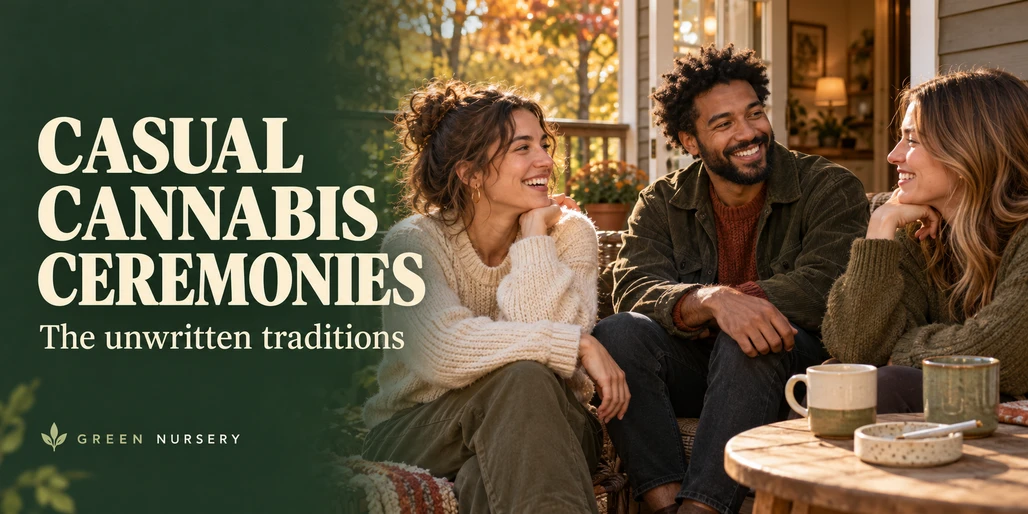
Casual Cannabis Ceremonies & Unwritten Weed Traditions
Cannabis culture and everyday traditions
Casual Cannabis Ceremonies You Didn’t Know Everyone Knew About
Last updated:
Someone at the holiday gathering asks whether anyone wants to take a walk. A few cousins reach for their jackets. Elsewhere, a friend announces a “safety meeting,” or someone glances at the clock and points out that it is 4:20.
These are the small, informal weed traditions that can make cannabis culture feel like a conversation already in progress. A cousin walk, a smoke sesh, and a cannabis holiday each have their own meaning, even when the same people participate in all three.
Here, “casual cannabis ceremonies” means familiar social customs and shared jokes. The focus is everyday gatherings, rather than religious ceremonies or guided therapeutic experiences. You do not need to consume cannabis to understand the references or enjoy the company.
For activities to go with a relaxed gathering, our guide to things to do alone or with friends offers a broader selection.
Weed traditions at a glance: a break, a gathering, or a date?
The easiest way to understand the vocabulary is to ask what the name describes. Some terms name a moment within a gathering. Others describe the gathering itself, a recurring date, or a retail promotion.
| Name | What it describes | Usual context |
|---|---|---|
| Cousin walk | A family break associated with cannabis | Thanksgiving, Christmas, and other family gatherings |
| Safety meeting | A joking name for a cannabis break | Can overlap with the cousin walk |
| Smoke sesh | A session involving cannabis | A casual gathering, without a required holiday |
| Puff, puff, pass | Sharing etiquette | A reminder not to monopolize a shared joint |
| 4:20 / 4/20 | A time reference and an annual cannabis observance | 4:20 p.m. / April 20 |
| Danksgiving | Cannabis-themed Thanksgiving celebrations | Thanksgiving and gatherings around it |
| Green Wednesday | A cannabis retail occasion | The Wednesday before U.S. Thanksgiving |
| 710 / 7/10 | An observance associated with cannabis oils and concentrates | July 10 |
These are informal terms. Their use varies, and none establishes a requirement to participate.
1. The cousin walk: a family tradition with an unofficial agenda
A cousin walk is a break from a family gathering during which some relatives go outside together to smoke cannabis. You may also hear “cousins’ walk,” “Thanksgiving walk,” or “walk with the cousins.” The wording changes; the recognizable setup stays much the same.
It was documented before the wave of 2025 holiday coverage. Leafly’s November 2021 article about the Thanksgiving weed walk discussed the custom and several of its nicknames. That establishes earlier published usage, not a definitive invention date.
The familiar scene explains the appeal of the joke: a crowded house, relatives catching up, and a small group finding a few minutes together away from the main event. Recognizing that scene does not mean every family does it, or that every walk has a hidden purpose.
Does the cousin walk happen at Christmas too?
Yes. The term also appears in Christmas contexts. A user-submitted Urban Dictionary entry dated December 27, 2023 includes a Christmas example. PAPER’s December 24, 2025 music feature also references the cousin walk when discussing Christmas Eve.
Thanksgiving and Christmas therefore fit within the same explanation. The holiday changes the backdrop, not the basic meaning.
2. The safety meeting: a very unofficial meeting
In cannabis slang, a “safety meeting” can mean a break to smoke. In a holiday setting, “pre-dinner safety meeting” may describe the same outing as a cousin walk. The Wall Street Journal’s 2025 Thanksgiving coverage identifies the phrase among the walk’s alternative names.
The humor comes from giving a casual break an unnecessarily official title. There is no universal agenda, membership list, or rule about when it happens.
The word “safety” is part of the joke. It is not a claim that cannabis use is risk-free, and the phrase does not replace an actual workplace safety discussion.
3. The smoke sesh: the gathering itself
“Sesh” is short for session. Leafly’s cannabis glossary describes a smoke session as people gathering to smoke cannabis, with etiquette around sharing and taking turns.
A sesh does not need an occasion. Picture a few friends, a familiar place to sit, and a conversation that keeps finding new subjects. One person puts on an album. Someone else has a question that takes considerably longer to answer than expected.
You can also give the gathering a little structure. Our smoke sesh themes for a night with friends include activities that work whether someone consumes cannabis or simply comes for the evening.
The useful distinction: a cousin walk names a particular kind of family break; a sesh names the session more generally.
4. Puff, puff, pass: the unwritten rule about taking turns
“Puff, puff, pass” is a familiar reminder to share rather than hold onto a joint indefinitely. It appears in GreenState’s reporting on cannabis etiquette, including interviews with etiquette specialists.
Treat the expression as a social convention, not a dosing instruction. Nobody owes the group two puffs, one puff, or any consumption at all. Passing without using it should be unremarkable, and sharing a mouthpiece should never be expected.
There is a reason the phrase belongs in a guide to customs: it expresses a rule about consideration in a few words. The same principle covers returning someone’s lighter and letting another person finish a story.
For the history of the object at the center of that custom, read our guide to how joints and pre-rolls developed.
5. 4:20 and 4/20: when a time becomes a shared reference
420 can refer to cannabis culture, the time 4:20 p.m., or April 20. Leafly’s overview of 420 explains how the number functions as both a daily reference and an annual cannabis observance.
The best-documented origin centers on the Waldos, a group of friends in San Rafael, California. In their own account of the term’s beginnings, they used 4:20 as a meeting time in 1971 while searching for a cannabis patch. Their archive describes early letters and other supporting evidence.
For this guide, the everyday version matters as much as the date. Pointing at the clock can become a tiny shared joke, even when nobody changes their plans. Understanding the reference is enough to be in on it.
6. Danksgiving: the Thanksgiving celebration, with cannabis in the picture
Danksgiving is a playful name for Thanksgiving celebrations that include cannabis. CNN’s November 26, 2025 reporting, republished by KESQ, discusses cannabis, family gatherings, and the holiday under the heading “Family Danksgiving.”
Think of Danksgiving as a broad description. A cousin walk might be one moment within it. The term can also describe a gathering with friends around the holiday, though it does not prescribe a particular menu or schedule.
Where does Friendsgiving fit?
For a cannabis-friendly Friendsgiving, the gathering still needs to work for friends who do not consume. Keep the meal enjoyable on its own, make expectations clear in advance, and avoid turning participation into a test of belonging.
Our recommendation is to keep the communal meal non-infused. Never surprise someone with cannabis in food, and keep any separately offered cannabis products clearly identified and secured. A holiday nickname is not informed consent.
7. Green Wednesday: the shopping occasion before Thanksgiving
Green Wednesday is the Wednesday before U.S. Thanksgiving, associated with cannabis shopping and promotions. Cannabis retail analytics company Headset describes the occasion in its analysis of Thanksgiving-week sales.
In 2026, Green Wednesday falls on November 25, immediately before Thanksgiving on November 26. The Thanksgiving date is listed in the U.S. Office of Personnel Management’s 2026 holiday calendar.
This is the retail side of the holiday vocabulary. A cousin walk is an activity; Danksgiving describes a celebration; Green Wednesday names the shopping day. They can be connected without being interchangeable.
It is worth recognizing the distinction when reading promotional language. A holiday sale does not establish product quality, and the calendar does not create a reason to buy more than you intended.
8. 710: the calendar reference for oils and concentrates
710 refers to cannabis oils and concentrates, with July 10 serving as the corresponding annual observance. Turn “710” upside down in calculator-style lettering and it resembles “OIL,” as Weedmaps explains in its guide to 7/10.
It belongs on this list because it is another reference that may seem obscure until someone explains it. Knowing the term does not require using concentrates, buying specialized equipment, or matching anyone else’s preferences.
Where CBD hemp flower fits into the conversation
The social vocabulary does not tell you what is in a product. A flower product, a joint, and a gummy can have very different cannabinoid profiles. The CDC distinguishes intoxicating THC from CBD, which does not cause a high by itself. That distinction is about the compound, not a guarantee about every finished product labeled CBD or hemp.
For a concrete example, Green Nursery lists Hawaiian Haze CBD hemp flower as a CBD flower product. Identify the actual product and review its current batch information through the lab-report page; a strain name or an invitation to a “sesh” does not communicate its contents.
Do not treat “hemp-derived” as a guarantee of no impairment or universal legality. The CDC’s cannabis FAQs explain that some hemp-market products contain intoxicating cannabinoids and that heating THCA converts it into intoxicating THC. Product details and applicable local rules matter more than the social nickname.
The best part of the ritual should be the company
Our approach to these customs is simple: make joining the conversation easy and consuming optional. The person who declines should not need a medical explanation, an excuse, or a different invitation.
- Ask the host. Agree on what is welcome, where it is allowed, and whether the gathering includes cannabis at all.
- Leave room for a plain walk. Someone can want fresh air or a conversation without wanting cannabis.
- Keep the camera optional. Ask before photographing, tagging, or posting other people.
- Plan a sober ride. Cannabis can impair driving, and combining it with alcohol can increase impairment, according to the CDC’s guidance on cannabis and driving.
- Keep edibles separate and secure. The CDC notes that edible effects can be delayed and advises locked storage away from children and pets. Do not put cannabis products into an ordinary snack bowl.
- Respect people who avoid smoke. Smoking cannabis can harm lung tissue, as described in the CDC’s overview of cannabis health effects. A familiar custom does not remove that risk.
A shared joke works best when people are free to enjoy it on their own terms.
Frequently asked questions about casual cannabis traditions
What is the holiday walk with your cousins called?
Common names include cousin walk, cousins’ walk, walk with the cousins, and Thanksgiving walk. In the cannabis context, they describe a family break associated with going outside to smoke. “Pre-dinner safety meeting” can be another nickname for the same moment.
Is the cousin walk only a Thanksgiving thing?
No. Christmas usage is documented too. Thanksgiving is a prominent setting, but the phrase can refer to the same kind of break at another family gathering. A walk by itself is not evidence that anyone is consuming cannabis.
Are Danksgiving and Green Wednesday the same?
The terms sometimes overlap in marketing, but it helps to distinguish them: Danksgiving broadly describes cannabis-themed Thanksgiving celebrations, while Green Wednesday identifies the retail occasion on the Wednesday before Thanksgiving.
Does a safety meeting mean cannabis is safe?
No. It is a slang expression in this context, not a health claim. Actual cannabis risks depend on the product, the person, the circumstances, and the way it is used.
Do you have to smoke to participate?
No. You can join a conversation, share a meal, or enjoy a gathering without consuming anything. Hosts should make that welcome explicit. Nobody should be pressured to share a product or explain why they are passing.
Are these formal cannabis ceremonies?
No. This guide uses “ceremonies” playfully for everyday social customs. Religious practice, guided sessions, and therapeutic services have different contexts and should not be assumed to follow the same meanings or expectations.
Popular Products
Check out these customer favorites.