
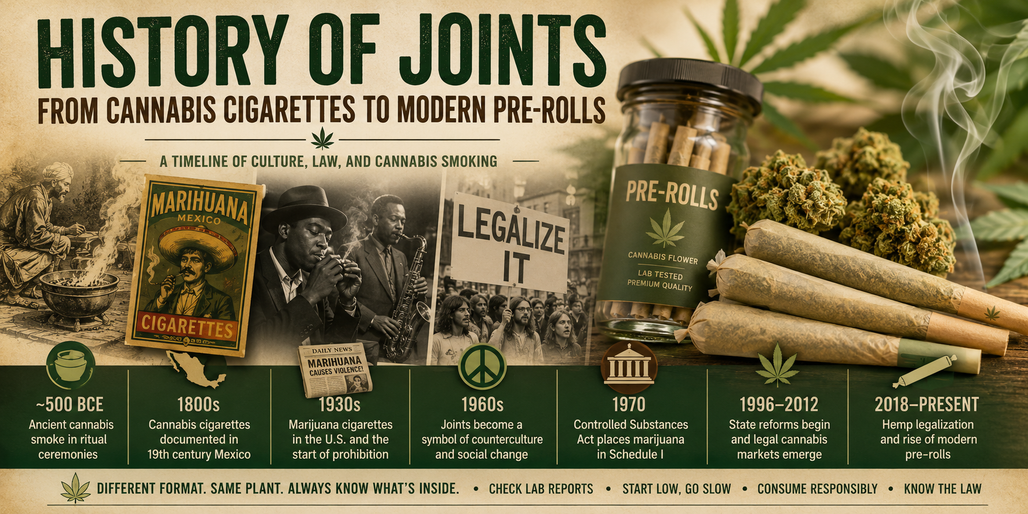
History of Joints: From Cannabis Cigarettes to Pre-Rolls
Cannabis History and Rolled Flower Guide
History of Joints: From Early Cannabis Cigarettes to Modern Pre-Rolls
The history of joints is much shorter and less certain than the history of cannabis itself. People inhaled cannabis smoke thousands of years ago, but the recognizable joint—a paper-wrapped cannabis cigarette—appears to have developed much later, after cigarette papers and hand-rolling practices became widely available.
No reliable historical record identifies one person who invented the first joint. The strongest documented trail leads to cannabis being smoked in cigarette form in nineteenth-century Mexico, followed by the spread of marijuana cigarettes and related terminology in the United States during the early twentieth century.
This article follows that development from ancient cannabis smoke to handmade joints, prohibition-era slang, counterculture, legalization, hemp pre-rolls, and modern commercial production. For a broader comparison of joints with other routes and formats, begin with Green Nursery’s complete guide to cannabis consumption methods .
Quick Answer: When Were Joints Invented?
There is no confirmed date or named inventor for the first joint. Cannabis was inhaled in ancient rituals, but the evidence involves smoke from braziers rather than paper cigarettes. Cannabis cigarettes are documented in nineteenth-century Mexico and became increasingly visible in the United States during the early twentieth century. The word joint was recorded with the meaning “marijuana cigarette” by 1938.
It is therefore more accurate to describe the joint as a format that evolved rather than an invention created at one identifiable moment. It combined an old plant with a comparatively modern technology: lightweight paper made for rolling cigarettes.
| Question | Best-Supported Answer |
|---|---|
| Who invented the joint? | No individual inventor has been reliably identified. |
| Were joints used in ancient history? | Ancient people inhaled cannabis smoke, but there is no evidence that they used modern paper-wrapped joints. |
| Where did cannabis cigarettes emerge? | Nineteenth-century Mexico provides some of the strongest documentation of recreational cannabis smoked in cigarette form. |
| When did “joint” acquire its cannabis meaning? | The marijuana-cigarette meaning is documented by 1938, although the reason for the name remains uncertain. |
| When did commercial pre-rolls appear? | Pre-filled products became a major retail category as regulated cannabis and hemp markets developed. |
What Is a Joint?
A joint is dried cannabis or hemp flower wrapped in thin rolling paper for combustion. In common United States usage, a joint generally contains cannabis without tobacco, although terminology varies among countries, regions, and communities.
Flower is the plant material inside the joint. Readers unfamiliar with hemp flower can review Green Nursery’s CBD buds and hemp flower guide for an explanation of buds, cannabinoids, terpenes, trichomes, curing, and laboratory reports.
Joint
Cannabis flower rolled in paper. A joint may be hand-rolled or prepared before sale.
Pre-Roll
A joint or cone that has already been filled before the consumer obtains it. “Pre-roll” describes preparation and retail format, not cannabinoid content or quality.
Cone
A tapered paper format that is usually wider at one end. An empty cone is only a wrapper; after it is filled with flower, the finished product may be sold or described as a pre-roll.
Spliff
A rolled product that usually combines cannabis and tobacco. The exact meaning changes regionally, so the name alone may not reveal every ingredient.
Blunt
A rolled cannabis product traditionally made with a cigar, cigarillo, tobacco leaf, or tobacco-derived wrapper. This can add nicotine and tobacco exposure that an ordinary paper joint does not have.
Infused Pre-Roll
A pre-roll containing flower plus a concentrate, cannabinoid coating, kief, or another infused ingredient. An infused pre-roll should not be assumed to have the same cannabinoid concentration as a flower-only joint.
| Format | Typical Plant Material | Wrapper | Main Distinction |
|---|---|---|---|
| Joint | Cannabis or hemp flower | Thin rolling paper | General paper-wrapped flower format |
| Pre-roll | Flower, or flower plus infused ingredients | Paper or cone | Filled before sale or use |
| Spliff | Cannabis mixed with tobacco | Rolling paper | Contains tobacco |
| Blunt | Cannabis flower | Traditionally tobacco-based | Wrapper may contain nicotine |
| Infused pre-roll | Flower plus concentrate or coating | Paper or cone | Potentially more concentrated than flower alone |
Ancient Cannabis Smoking Was Not Joint Smoking
Cannabis has a much older history than the joint. Humans have cultivated and gathered the plant for fiber, seeds, food, ritual practices, traditional preparations, and psychoactive use across different regions and periods.
A peer-reviewed history of cannabis and cannabinoid science traces this long relationship among agriculture, traditional medicine, pharmacology, and later cannabinoid research.
Some of the earliest directly dated and scientifically verified evidence of cannabis smoking comes from the Jirzankal Cemetery in the eastern Pamir Mountains. Researchers analyzing residues from approximately 500 BCE found evidence that cannabis had been burned in wooden braziers during mortuary ceremonies.
The Science Advances archaeological study describes cannabis placed in braziers with heated stones. People nearby may have inhaled the resulting smoke, but they were not holding paper-wrapped cigarettes.
Ancient Cannabis Smoke Is Not Evidence of Ancient Joints
“Smoking” can refer broadly to inhaling smoke from burning plant material. A joint requires a separate set of materials and practices: processed flower, thin paper, hand rolling, and a cigarette-like format. Archaeological evidence for one does not automatically establish the other.
Pipes, heated vessels, enclosed spaces, incense-like burning, and oral preparations all have histories that developed differently. The joint belongs specifically to the history of rolled cigarettes and commercial rolling paper.
Where Did the Modern Joint Originate?
The precise origin of the modern joint remains uncertain. Historians have not found a single surviving object or document that can be labeled the unquestioned first joint.
Nineteenth-century Mexico is nevertheless one of the strongest documented points in the history of cannabis cigarettes. Historian Isaac Campos has explained that cannabis developed a reputation as a recreational substance in nineteenth-century Mexico, where it appeared in cigarette form and became associated with prisons, soldiers’ barracks, and other marginalized environments.
A historical discussion of cannabis in Mexico and the United States notes that the Spanish had introduced cannabis to Mexico for fiber during the sixteenth century. By the nineteenth century, however, some cannabis was being used for its psychoactive properties and smoked in cigarettes.
This does not prove that Mexico produced the world’s first paper-wrapped cannabis product. Cannabis, tobacco, paper, pipes, and hand-rolled cigarettes circulated through many regions. It does show that cannabis cigarettes were an established and recognizable format in Mexico before they became a prominent subject of United States drug reporting and enforcement.
Why Cigarette Culture Mattered
The joint depended on the broader rise of paper cigarettes. Thin rolling papers made dried plant material portable, disposable, and usable without a permanent pipe. Cannabis could therefore be adapted to a format already familiar from tobacco.
That practical combination helps explain why the joint does not have an obvious inventor. It likely emerged through repeated adaptation by many people rather than through one patented device or documented commercial launch.
Why Is a Cannabis Cigarette Called a Joint?
The exact origin of the word joint in cannabis slang is unresolved.
The Online Etymology Dictionary documents “joint” with the meaning “marijuana cigarette” by 1938 . It suggests a possible connection to something smoked in common, but it also notes that other explanations exist.
That uncertainty matters. Popular explanations sometimes claim that the word came from jazz musicians, French vocabulary, opium dens, or the idea of “joining” paper and flower. These stories may sound plausible, but they should not be presented as established fact without documentary evidence.
Other terms were also used for cannabis cigarettes during the early twentieth century, including reefer and muggle. Meanings changed across cities and communities, and some words referred either to cannabis itself or to a rolled cigarette containing it.
Cannabis Cigarettes in the Early United States
Cannabis was not unknown in the United States before joints appeared in popular culture. Cannabis preparations were described in the United States Pharmacopoeia by 1850 and appeared in some pharmaceutical products during the nineteenth and early twentieth centuries.
Those preparations were often extracts or medicines rather than recreational joints. The spread of smoked cannabis cigarettes followed a separate social path.
During the early twentieth century, cannabis cigarettes became increasingly visible in border regions, port cities, nightlife districts, and newspaper reporting. Terminology and practices moved between Mexico and the United States, but the historical record was heavily shaped by sensationalism.
Reports often associated marijuana cigarettes with Mexican immigrants, Black musicians, prisoners, working-class communities, and other marginalized groups. These accounts regularly blended genuine observations with racial prejudice, anti-immigrant politics, exaggerated violence claims, and moral panic.
This history is important because joints were not simply becoming a consumption format. They were also becoming political symbols. Public fear focused not only on what was being smoked, but on who authorities and newspapers claimed was smoking it.
Prohibition, Jazz Culture, and the Joint as a Symbol
By the 1920s and 1930s, rolled cannabis cigarettes were associated with parts of nightlife and jazz culture. Musicians did not necessarily invent the joint, but songs, performances, slang, and urban social networks helped make the format more culturally recognizable.
At the same time, government campaigns and sensational media increasingly described marijuana as a threat. The joint’s portability made it an effective visual symbol for these campaigns: a small cigarette could be photographed, seized, hidden, or presented as evidence of a broader social danger.
The Marihuana Tax Act of 1937
The federal historical review published in the Federal Register explains that the Marihuana Tax Act of 1937 imposed taxes and controls that effectively prohibited marijuana uses for medical, nonmedical, scientific, and industrial purposes.
The law did not erase joints from American life. Cannabis use continued underground, and the hand-rolled joint became especially visible within postwar bohemian communities and the counterculture of the 1960s.
The Controlled Substances Act of 1970
The Controlled Substances Act replaced earlier federal drug laws with a unified scheduling framework and placed marijuana in Schedule I. This continued federal prohibition even as cannabis use and joint imagery became more visible in music, political protest, youth culture, and debates about criminal justice.
During this period, the joint became more than a delivery format. It could represent rebellion, artistic culture, opposition to prohibition, or belonging within a social group. Those meanings varied widely and should not be confused with evidence that every user or community approached cannabis in the same way.
From Handmade Joints to Commercial Pre-Rolls
For much of the twentieth century, most joints were informal, handmade products. Their contents, size, paper, and cannabinoid strength were rarely measured or verified.
The modern legal-market shift developed gradually. California voters approved Proposition 215 in 1996, beginning the modern era of state medical-cannabis laws. In 2012, Colorado and Washington became the first states to legalize nonmedical adult cannabis use.
As regulated markets expanded, the joint was converted into a standardized retail format: the pre-roll.
What Changed With Commercial Pre-Rolls?
- Preformed paper cones became common.
- Businesses introduced machine-assisted filling and finishing.
- Single pre-rolls, multipacks, and smaller-format products were packaged for retail sale.
- Labels began listing cannabinoid content, ingredients, batch information, and required warnings.
- Flower-only and infused pre-rolls became separate product categories.
- Laboratory reports became part of product evaluation in regulated cannabis and hemp markets.
“Pre-roll” does not automatically mean high quality. It only means the product was filled in advance. The contents may include carefully prepared flower, smaller buds, trim, sifted material, a flower blend, or infused ingredients. Accurate labeling and finished-product testing are more useful than assumptions based on the name.
Readers can compare available hemp pre-roll formats to see how flower type, cannabinoid profile, package size, and laboratory information differ among current products.
How Hemp Joints Entered the Modern Pre-Roll Market
The Agriculture Improvement Act of 2018 established a federal production framework for hemp and helped create a larger national market for hemp flower and hemp pre-rolls.
The USDA defines hemp through its cannabinoid threshold , rather than by a completely separate plant species. Hemp and marijuana are both cannabis, but federal law distinguishes them according to Delta-9 THC concentration, with USDA production testing also accounting for the potential conversion of THCA.
State rules may be stricter than the federal framework. Some jurisdictions regulate or prohibit smokable hemp, particular cannabinoids, or specific retail formats. A product being offered for sale does not establish that it is legal in every destination.
CBD Pre-Roll
A CBD pre-roll generally contains hemp flower selected for a CBD-dominant cannabinoid profile. CBD itself is not intoxicating in the way Delta-9 THC is, but finished flower may still contain measurable THC and may present drug-testing concerns.
Readers comparing loose material with ready-filled products can explore CBD flower and review the corresponding batch information.
THCA Pre-Roll
A THCA pre-roll contains flower with tetrahydrocannabinolic acid as a significant cannabinoid. THCA is the acidic precursor to THC. Heating can convert THCA toward Delta-9 THC through decarboxylation, meaning the product may be intoxicating when smoked.
Green Nursery’s guide to how THCA transforms into THC when heated explains this chemical change in greater detail.
Flower-Only vs. Infused Hemp Pre-Rolls
A flower-only pre-roll contains ground or prepared flower. An infused product adds a concentrate, extract, kief coating, or another cannabinoid ingredient. Because infusion can substantially change the cannabinoid concentration, the report for the finished product is more informative than a report covering only the original flower.
How Modern Pre-Roll Quality Is Evaluated
Historical joints rarely came with ingredient lists or laboratory measurements. Modern retail products can provide more information, but only when the label and report clearly correspond to the finished batch.
1. Confirm the Product Type
Determine whether the pre-roll contains ordinary flower, a blend, CBD-rich hemp, THCA-rich flower, tobacco, added terpenes, kief, distillate, or another infused ingredient.
2. Read the Cannabinoid Amount Correctly
A report may state cannabinoid content as a percentage, milligrams per gram, total milligrams, or another unit. Do not assume that the percentage for the original flower equals the final concentration of an infused pre-roll.
3. Match the Batch
The lot or batch number on the package should match the number on the certificate of analysis. Cannabinoid levels and contaminant results can change among harvests and production runs.
4. Review Relevant Safety Panels
Depending on the product and jurisdiction, useful testing can include cannabinoids, pesticides, heavy metals, microbial contaminants, mycotoxins, moisture or water activity, and residual solvents when extracts are present.
5. Check the Testing Date and Sample Description
A recent report should identify what was tested. “Flower,” “pre-roll,” and “infused pre-roll” are not necessarily interchangeable sample descriptions.
6. Look Beyond Appearance
A neat cone or attractive package does not establish cannabinoid accuracy, freshness, purity, or flower quality. Likewise, a very white ash, slow burn, strong aroma, or smooth appearance is not a substitute for product information and laboratory testing.
Green Nursery publishes available batch-specific certificates of analysis for product comparison. Readers new to laboratory documents can also review how to read a CBD flower lab report .
Pre-Roll Quality Checklist
- Clear flower and cannabinoid description
- Disclosure of infused ingredients
- Package and COA batch numbers that match
- Relevant potency and contaminant panels
- Testing date and laboratory identity
- Ingredient and wrapper information where applicable
- Required age, impairment, storage, and legal warnings
Why Have Joints Remained Popular?
The joint has survived changes in law, technology, and cannabis culture because the format is simple and recognizable.
- Portability: A rolled product does not require permanent glassware or an electronic device.
- Familiarity: The cigarette-like form became recognizable across many communities.
- Social ritual: Passing or sharing a joint developed cultural meanings in some groups.
- Low equipment requirement: The format requires fewer objects than many pipes, vaporizers, or concentrate systems.
- Commercial convenience: A pre-roll removes the need for the purchaser to prepare loose flower.
- Product flexibility: The same basic format can contain CBD flower, THC-rich cannabis, blends, or infused ingredients.
These practical qualities explain endurance, not safety. A convenient or traditional format still involves combustion when smoked.
History of Joints Timeline
| Period | Development | Why It Matters |
|---|---|---|
| Approximately 500 BCE | Cannabis is burned in wooden braziers during mortuary ceremonies in the eastern Pamirs. | Provides early scientific evidence of cannabis smoke, but not paper-wrapped joints. |
| Sixteenth century | Spanish colonists introduce cannabis to Mexico primarily as a fiber crop. | Establishes the plant in a region later important to cannabis-cigarette history. |
| Nineteenth century | Recreational cannabis smoked in cigarettes is documented in Mexico. | One of the clearest early links to the recognizable modern joint format. |
| Early twentieth century | Marijuana cigarettes become increasingly visible in United States border regions and nightlife reporting. | The format enters wider American awareness amid migration, sensationalism, and early prohibition. |
| 1937 | The Marihuana Tax Act imposes federal taxes and controls that effectively prohibit most marijuana uses. | Pushes production and use further underground. |
| 1938 | The marijuana-cigarette meaning of “joint” is documented in English. | Shows the now-familiar term entering the written slang record. |
| 1960s | Hand-rolled joints become highly visible within youth culture, music, protest, and counterculture. | The joint becomes a cultural and political symbol as well as a consumption format. |
| 1970 | The Controlled Substances Act creates a unified federal scheduling system and places marijuana in Schedule I. | Continues federal prohibition during a period of growing cultural visibility. |
| 1996 | California voters approve Proposition 215. | Begins the modern era of state medical-cannabis reform. |
| 2012 | Colorado and Washington legalize nonmedical adult cannabis use. | Helps establish regulated retail markets in which commercial pre-rolls become standardized products. |
| 2018 | The federal Farm Bill establishes the modern hemp-production framework. | Supports the growth of CBD flower, hemp joints, and other hemp-derived pre-roll formats. |
| 2020s | Pre-rolls expand into singles, multipacks, mini formats, strain-specific products, and infused products. | The handmade joint becomes a diverse manufactured retail category. |
Responsible-Use and Smoke Considerations
Historical significance does not make joint smoke harmless.
The CDC states that smoked cannabis can harm lung tissue regardless of how it is smoked . Cannabis smoke contains many of the same toxins, irritants, and carcinogens found in tobacco smoke. More research is still needed to understand the full relationship between cannabis smoking and specific long-term respiratory diseases.
Water pipes, specialty papers, filters, natural wrappers, organic claims, and hemp classification do not remove combustion exposure. A hemp joint still produces smoke when burned.
Secondhand cannabis smoke can expose other people to smoke chemicals and THC. Avoid smoking around children, pregnant people, pets, or anyone who has not chosen to be exposed.
- Do not drive, cycle in traffic, operate machinery, or perform hazardous work while impaired.
- Do not assume hemp-derived means non-intoxicating.
- Avoid combining intoxicating cannabinoids with alcohol or other substances.
- Keep pre-rolls in clearly labeled, child-resistant storage.
- Review the cannabinoid profile and batch report before use.
- Consider medication use, pregnancy, breastfeeding, and medical conditions with a qualified healthcare professional.
- Check the laws that apply at the purchase, possession, shipping, and use locations.
Frequently Asked Questions About the History of Joints
When were joints invented?
No exact invention date is known. Cannabis cigarettes were documented in nineteenth-century Mexico and became more visible in the United States during the early twentieth century. Ancient evidence of cannabis smoke is much older, but it does not involve paper-wrapped joints.
Who invented the first joint?
No single inventor has been reliably identified. The joint most likely evolved as people adapted cannabis to existing cigarette papers and hand-rolling practices.
Where did joints originate?
The exact origin is unresolved. Nineteenth-century Mexico provides some of the strongest documentation of recreational cannabis being smoked in cigarette form, making it an important point in the modern joint’s history.
Did ancient people smoke joints?
There is no established evidence of ancient paper-wrapped cannabis joints. Archaeologists have found evidence of cannabis burned in braziers and other forms of smoke inhalation, but the methods differed from modern cigarettes.
Why is a cannabis cigarette called a joint?
The reason is uncertain. The marijuana-cigarette meaning of “joint” is documented by 1938. One proposed explanation connects the term to something smoked in common, but no single origin theory has been proven.
When did joints become popular in the United States?
Marijuana cigarettes appeared in United States reporting during the early twentieth century. Joints became much more culturally visible during the 1960s through music, counterculture, political protest, and growing cannabis use.
What is the difference between a joint and a pre-roll?
A joint is cannabis flower wrapped in paper. A pre-roll is a joint or cone that was filled before sale or use. A pre-roll may contain ordinary flower or infused ingredients, so the term does not guarantee one composition.
Is a joint the same as a blunt or spliff?
No. A joint generally contains cannabis in thin paper. A spliff usually combines cannabis and tobacco. A blunt traditionally uses a cigar or tobacco-derived wrapper, although regional language varies.
Are hemp joints the same as marijuana joints?
They use the same basic rolled format, but their legal classification and cannabinoid profiles may differ. Hemp is defined through an applicable THC threshold. State laws may impose additional rules on smokable hemp and particular cannabinoids.
Can a CBD joint cause a positive drug test?
It can. CBD itself is not the target of standard THC drug tests, but full-spectrum hemp flower may contain measurable THC. Repeated use or product variability can create drug-testing risk.
Is every pre-roll made from whole flower?
No. Pre-rolls may contain prepared whole flower, smaller buds, blends, trim, sifted material, or infused ingredients. Check the product description, ingredient information, and finished-product COA instead of assuming composition from the word “pre-roll.”
Are joints safer than blunts?
Neither is risk-free because both involve combustion. A traditional blunt can add tobacco and nicotine exposure through its wrapper, but using paper does not make joint smoke harmless.
From Cannabis Cigarettes to the Modern Pre-Roll
The history of joints is not the story of one inventor or one first cigarette. It is a gradual history in which an ancient plant was adapted to paper-rolling practices, documented in nineteenth-century Mexico, carried into early twentieth-century United States culture, driven underground by prohibition, transformed into a countercultural symbol, and eventually standardized as the modern pre-roll.
Today’s joint may contain CBD-rich hemp flower, THC-rich cannabis, THCA flower, or infused ingredients. The familiar shape does not reveal the cannabinoid profile, strength, source material, legal status, or testing quality. Those details must come from the label and the correct batch-specific report.
To place the history of joints within the larger evolution of cannabis products, read Green Nursery’s guide to joints and other cannabis delivery methods . Readers comparing present-day flower products can then review the complete CBD buds guide , explore current pre-roll formats, and verify the corresponding certificate of analysis.
Popular Products
Check out these customer favorites.