
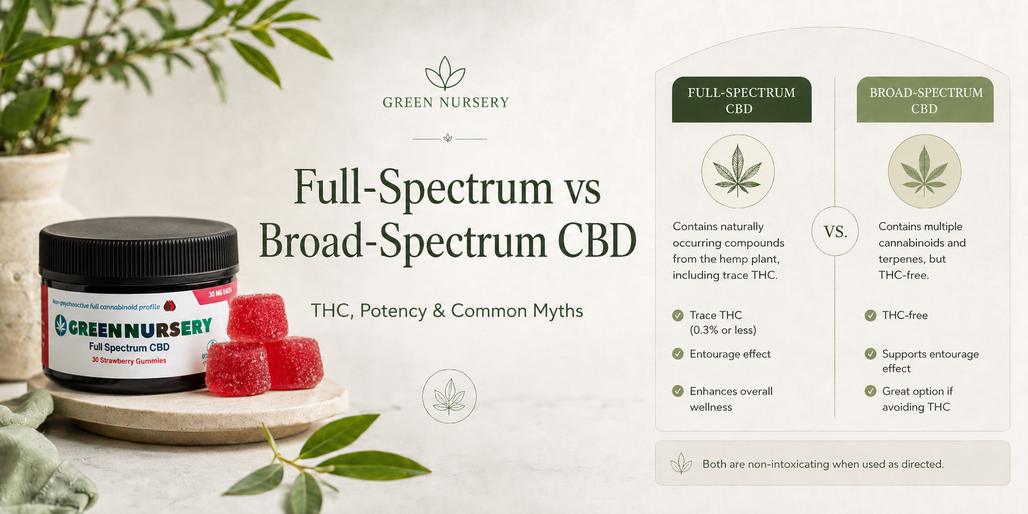
Full-Spectrum vs Broad-Spectrum CBD: THC Content, Potency, and Common Myths
Full-Spectrum vs Broad-Spectrum CBD: THC Content, Potency, and Common Myths
CBD product labels can be confusing. Terms like full-spectrum CBD, broad-spectrum CBD, CBD isolate, hemp extract, and trace THC describe different product types, but they are often used in ways that make them sound interchangeable.
This confusion matters because the CBD spectrum you choose can affect cannabinoid content, THC exposure, product potency, and potential drug testing considerations. This article is part of our Cannabis Potency Myths hub, where we explain common misconceptions about THC, CBD, hemp products, edibles, and cannabinoid strength.
For broader context, the FDA, USDA Hemp Program, CDC, and NCCIH provide useful background on hemp, CBD, THC, and cannabis-derived products.
What Does Full-Spectrum CBD Mean?
Full-spectrum CBD is a hemp extract that contains CBD along with a range of naturally occurring hemp compounds, including minor cannabinoids, terpenes, flavonoids, and trace amounts of THC. Rather than isolating CBD by itself, full-spectrum products are designed to preserve more of the hemp plant's original chemical profile.
Many shoppers choose full-spectrum CBD because they want a hemp extract that contains more than CBD alone. A full-spectrum CBD gummy, for example, may contain CBD, minor cannabinoids, terpenes, and legally compliant trace THC.
The key takeaway is that full-spectrum CBD usually contains a broader hemp profile, including trace THC.
What Does Broad-Spectrum CBD Mean?
Broad-spectrum CBD starts similarly to full-spectrum hemp extract, but manufacturers typically remove THC during processing. The goal is to retain CBD and many of the plant's other compounds while reducing or eliminating detectable THC.
For someone comparing broad-spectrum CBD vs full-spectrum CBD, the main difference is usually THC content. Broad-spectrum products are often chosen by shoppers who want multiple hemp compounds but prefer to avoid THC when possible.
Product formulations vary, so broad-spectrum should not be treated as a guarantee. Lab reports are still important for confirming what is actually in the product.
What Is CBD Isolate?
CBD isolate is the most refined form of CBD. During processing, manufacturers remove other cannabinoids, terpenes, and plant compounds until only CBD remains.
- Full-spectrum CBD: CBD plus other cannabinoids, terpenes, and trace THC
- Broad-spectrum CBD: CBD plus other hemp compounds with THC removed or reduced
- CBD isolate: CBD only
Understanding these differences makes it easier to compare product labels, serving sizes, and lab reports.
Does Full-Spectrum CBD Contain THC?
In most cases, yes. Full-spectrum CBD products commonly contain trace amounts of THC that remain within federal hemp limits. These amounts are much lower than THC-dominant cannabis products, but they are not necessarily zero.
This is why it is important to read product labels carefully. If THC exposure matters to you, review third-party lab reports instead of assuming every CBD product is THC-free.
For a broader discussion of THC content and potency, see our guide on THC percentage and cannabis potency myths.
Which CBD Spectrum Is More Potent?
Potency does not always mean the same thing to every shopper. Some people define potency by total CBD content. Others care more about the overall cannabinoid profile, the presence of trace THC, or how the product is formulated.
When comparing full-spectrum CBD, broad-spectrum CBD, and CBD isolate, look beyond the front label and review:
- Total CBD content
- Presence of minor cannabinoids
- THC content
- Serving size
- Third-party testing results
The practical takeaway is that CBD potency is about more than a single number on the label.
Drug Testing and Label Accuracy
Drug testing concerns are one of the biggest reasons people compare full-spectrum and broad-spectrum CBD.
Full-spectrum products typically contain trace THC, and broad-spectrum products are generally marketed as having THC removed or reduced. However, no CBD product can be guaranteed to avoid drug testing issues.
Research on CBD product labeling has found that cannabinoid content and label accuracy can vary across products, which is why testing transparency matters. You can review Green Nursery's available lab reports and COAs when comparing hemp products.
According to Harvard Health, consumers should be cautious about CBD product quality, labeling, and possible interactions. Peer-reviewed research also shows why cannabinoid testing and accurate labels matter for CBD products.
When shopping for hemp products such as CBD gummies or CBD flower, lab reports provide more useful information than marketing claims alone.
Common Myths About CBD Spectrum Products
Myth: All CBD Products Are THC-Free
Many consumers assume CBD automatically means no THC. In reality, full-spectrum CBD products commonly contain trace THC.
Myth: Broad-Spectrum and Full-Spectrum Are the Same Thing
Both products may contain multiple hemp compounds, but they differ mainly in THC content and processing.
Myth: More CBD Always Means Better
CBD content matters, but cannabinoid profile, serving size, product quality, and lab testing also matter.
Myth: Product Labels Tell You Everything
The label is only part of the picture. Third-party testing provides a clearer view of what is actually in the product.
Helpful External Resources
- FDA Cannabis and CBD Guidance
- USDA Hemp Program
- CDC About CBD
- NCCIH Cannabis and Cannabinoids Overview
- CBD Product Labeling and Contamination Research
- CBD, THC, and Urine Drug Testing Research
- Harvard Health CBD Overview
- Cornell Hemp Program
Final Takeaway
When comparing full-spectrum vs broad-spectrum CBD, the biggest difference is THC content. Full-spectrum CBD generally contains trace THC along with other cannabinoids, while broad-spectrum CBD is typically formulated to reduce or remove THC while preserving a broader hemp profile.
Neither option is automatically better. The right choice depends on your preferences, your comfort level with THC, and the type of product you are looking for.
If you want to continue learning about cannabinoids, potency, and hemp products, explore our Cannabis Potency Myths hub, browse our CBD gummies, compare full-spectrum CBD products, or explore our selection of CBD hemp flower.
Disclaimer: This content is for educational purposes only and is not medical advice. CBD products may affect individuals differently. No CBD product can be guaranteed to avoid drug testing outcomes. Always review product labels, third-party lab results, and consult a qualified healthcare professional with any questions.
Popular Products
Check out these customer favorites.