
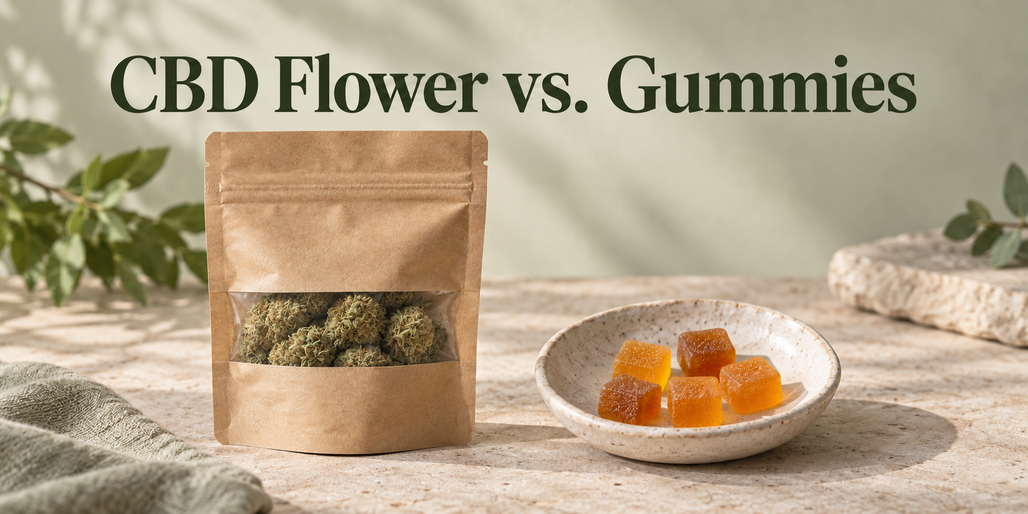
How Long Does CBD Take to Work? Oils, Gummies & Flower
How Long Does CBD Take to Work? Oils, Gummies, and Flower Compared
How long does CBD take to work? There is no universal countdown. Inhaled CBD reaches blood faster than swallowed CBD in controlled research, but absorption measurements cannot tell you exactly when you will notice an effect.
The useful question is what you mean by “work”: absorption, a noticeable sensation, or improvement in a particular symptom. Those are different outcomes, and product labels rarely explain the distinction. If you are still sorting out CBD, THC, and other ingredients, start with our guide to CBD and other cannabinoids.
How long does CBD take to work in different formats?
The strongest comparisons measure CBD in blood. That is useful evidence about delivery, but it cannot supply a universal schedule for relaxation, sleep, or symptom relief.
| Format | What the research can tell us | What it cannot promise |
|---|---|---|
| CBD gummies and other swallowed products | Oral CBD can take hours to reach peak blood levels. Much of the evidence concerns liquids or capsules, rather than retail gummies. | A particular gummy will produce a noticeable effect at a set minute. |
| CBD oil drops | Under-the-tongue use does not guarantee faster absorption than swallowing. A small oil study found similar timing for drops and capsules. | Every oil works within 15 minutes or beats every gummy. |
| Inhaled CBD, including CBD-dominant flower | Vaporized CBD reached peak blood levels much sooner than oral CBD in a controlled comparison. | Smoking and vaporizing are interchangeable, or faster delivery makes inhalation a safer choice. |
An 18-person study comparing oral and vaporized CBD found oral blood-level peaks at one to five hours, averaging about three. Vaporized CBD peaked around the end of administration. Researchers tested oral capsules and liquids, not gummies, and vaporization, not smoking. These measurements are not a dosing schedule.
What does it mean for CBD to start working?
Before comparing timing claims, separate three questions:
- Has CBD been absorbed? Researchers can measure its concentration in blood.
- Do I notice something? A personal sensation is a different observation from a laboratory result.
- Has a specific problem improved? That requires evidence about the condition and the product, not just its absorption speed.
Do not use a THC-like high as the test of whether CBD has worked. The CDC distinguishes CBD from THC’s intoxicating effects and warns that products labeled as CBD can contain THC. A noticeable sensation therefore does not tell you which ingredient caused it.
When reading a timing chart, look for the outcome behind its numbers. “Detected in blood,” “peak concentration,” and “participants reported an effect” should not be presented as if they mean the same thing.
How long do CBD gummies take to work?
A liquid or capsule study cannot establish a gummy’s exact onset. Look for evidence about the finished gummy before trusting a precise timing claim.
A gummy’s labeled CBD amount answers a different question. Our Full Spectrum CBD Gummies 30mg list 30 mg of CBD per gummy. That describes the labeled amount in each piece. It does not mean the product starts working in 30 minutes or establish a serving recommendation for every person.
Read the serving information and cannabinoid breakdown together. Check whether a number refers to one gummy, a serving containing several pieces, or the entire package. If you compare products, keep those units consistent before comparing any claims about speed.
How long does CBD oil take to work under the tongue?
“Sublingual” means placement under the tongue. The term alone does not prove faster absorption.
In a trial comparing CBD oil drops with the same oil in capsules, eight men had similar absorption profiles with both methods. Average time to peak blood concentration was about four hours for each. Researchers suggested that much of the oil was swallowed before meaningful absorption through the mouth.
One formulation in eight men cannot represent every oil. Still, this finding challenges blanket promises that under-the-tongue CBD works almost immediately.
For a practical comparison, identify the product, the directions used in its supporting study, and what the study actually measured. Our CBD gummies and oils shopping guide explains how to compare labels, serving information, and testing when choosing between formats.
Does CBD flower act faster?
Faster delivery into blood does not establish an exact moment when CBD flower will produce a benefit.
Our Lifter CBD hemp flower is a useful example of a different kind of label: flower is sold by weight, and cannabinoid concentration is reported separately. Neither the package weight nor a CBD percentage tells you exactly how much CBD reaches your bloodstream from a puff. Avoid treating flower percentages and gummy milligrams as interchangeable serving measures.
Speed also belongs alongside route-specific risks. The CDC’s guidance on cannabis and lung health explains that cannabis smoke can damage lung tissue. Faster absorption is not a reason to start smoking, and a vaporization study is not evidence that inhalation is harmless.
What changes CBD absorption and expectations?
Food can change exposure without making the peak arrive sooner
In a controlled food-effect study of pharmaceutical CBD, meals changed how much CBD reached the bloodstream, but did not produce a clinically relevant change in time to peak concentration. The study used a pharmaceutical oral solution, so its results cannot predict every retail gummy. Eating a fatty meal is not a reliable shortcut to a faster effect.
The finished formula matters
A 2026 trial comparing a CBD powder formulation with an oil solution found different absorption profiles under fed and fasting conditions. It studied specific formulations, with industry funding. It does not validate every product advertised as “nano” or “fast acting.” Ask whether evidence applies to the finished product rather than to an ingredient or technology name.
Other cannabinoids can change what you are evaluating
A spectrum label is not an onset guarantee. Use our full-spectrum versus broad-spectrum CBD comparison to understand the label, then check the product’s actual cannabinoid results.
If the product also contains THC, keep the questions separate. Our guide to THC edible onset addresses that topic. Do not copy a THC edible timeline into a CBD-only expectation.
What to check before deciding CBD is not working
If you do not notice an effect, review what you used before deciding that a larger amount is the answer:
- Define the outcome. Write down what you expected to change. “I felt something” is less useful than a clear observation.
- Check the serving units. Distinguish CBD per piece, per milliliter, per serving, and per container.
- Review the matching lab report. Start with our CBD and hemp product lab reports. Look for the product and batch, CBD results, THC results, and the testing date. Ask for clarification if the report does not match your package.
- Record the circumstances. Note the product, amount used, time, food, and any unwanted effects. This gives a clinician or pharmacist more useful information than a vague impression.
- Avoid adding more just to chase a sensation. Absence of a noticeable effect is not a reliable safety check.
The FDA identifies CBD risks including liver injury, medication interactions, and drowsiness. Some risks may occur without obvious symptoms. Ask a clinician or pharmacist about CBD if you take medicines or are considering it for a health problem. Retail CBD products should not replace prescribed treatment.
Frequently asked questions
Will I feel CBD the first time I take it?
There is no guarantee that you will notice a distinct sensation. Decide what outcome you are evaluating before use, and do not treat the absence of a high as a reason to take more.
Does CBD oil always work faster than gummies?
No. A format name alone cannot establish that comparison. The oil trial discussed above found similar blood-level timing for drops and capsules; it did not test gummies. A reliable head-to-head claim would need evidence for the actual products being compared.
Does full-spectrum CBD work faster than broad-spectrum CBD?
The spectrum description alone does not establish a faster onset. It describes the cannabinoid profile, not a tested delivery speed. Compare the actual formulations and lab reports instead of treating the label as a timing claim.
Does CBD need days or weeks to build up before it works?
The single-dose absorption studies discussed here cannot establish a universal waiting period for a health benefit. Claims such as “everyone needs 30 days” require separate evidence about the condition, formulation, and outcome. Do not delay medical care while waiting for a retail product to help.
Is the time to peak the same as how long CBD lasts?
No. Time to peak describes when the highest measured blood concentration occurs. It does not tell you how long a noticeable effect lasts, when a benefit begins, or when it is appropriate to take another serving.
Should I take more if I feel nothing after an hour?
An hour without a noticeable effect is not a sound basis for increasing the amount. Review the product directions and ingredients, and discuss questions about use with a clinician or pharmacist. Feeling nothing does not rule out interactions or other unwanted effects.
Popular Products
Check out these customer favorites.