
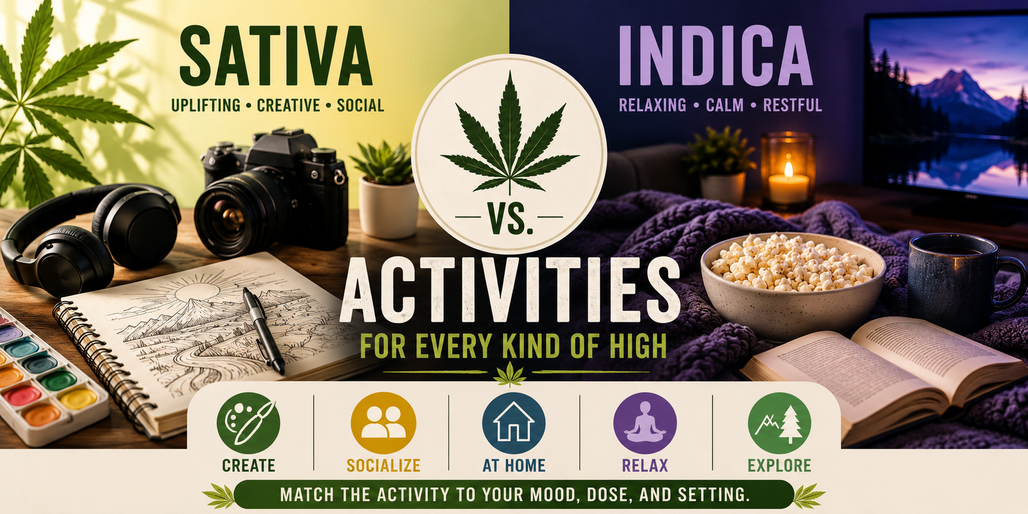
Indica vs Sativa: Best Activities for Every Type of High
Cannabis Activity and Strain Guide
Indica vs Sativa Activities: What Should You Do While High?
The familiar advice sounds simple: choose sativa when you want to be creative or social, and choose indica when you want to relax on the couch. That can be a useful starting point, but the real difference between indica and sativa is not nearly that predictable.
Sativa products are commonly marketed as brighter, more active, or more cerebral. Indica products are commonly marketed as calmer, slower, or more body-focused. However, those labels do not guarantee an effect. THC serving size, CBD content, product format, tolerance, setting, expectations, and individual biology can all influence how the experience actually feels.
This guide compares indica vs sativa activities without pretending every product or person fits neatly into one category. You will find creative and social ideas for more alert moods, quiet activities for slower experiences, balanced hybrid options, edible-specific guidance, and a practical way to choose based on how you feel rather than what the package promises.
For a broader list organized by setting, mood, and company, visit our complete guide to 50 things to do while high .
Quick Answer: What Activities Are Best for Indica vs Sativa?
Sativa-style activities usually involve creativity, conversation, music, photography, casual games, or other low-pressure activities that fit an alert or playful mood. Indica-style activities usually involve familiar movies, albums, coloring, audiobooks, gentle stretching, or a comfortable evening at home.
The better rule is to choose based on how you currently feel:
- Feeling alert or creative: Try drawing, photography, playlists, or a simple game.
- Feeling social: Try comedy, conversation prompts, or a cooperative activity.
- Feeling quiet or relaxed: Try a familiar film, music, coloring, or an audiobook.
- Feeling balanced: Try a puzzle, documentary, easy craft, or prepared snack tasting.
- Feeling overstimulated: Stop consuming more, lower stimulation, and contact a trusted sober person.
The main takeaway
A sativa or indica label can suggest the experience a product is intended to offer. It cannot promise how that product will affect you.
Sativa vs Indica Chart: Activities at a Glance
| Category | Sativa-Style Experience | Indica-Style Experience | Hybrid-Style Experience |
|---|---|---|---|
| Common marketing language | Uplifting, active, creative, social | Calm, slow, relaxing, evening-oriented | Balanced, flexible, mixed |
| Activities that may fit | Drawing, playlists, photography, casual games | Movies, music, coloring, audiobooks | Puzzles, documentaries, crafts, cooperative games |
| Social setting | Conversation, group games, comedy | Familiar film, quiet music, prepared snacks | Board games, documentaries, collaborative art |
| Solo setting | Mood board, writing, photo challenge | Podcast, journal, puzzle, comfort show | Collage, building set, photo sorting |
| What matters more than the label | THC serving, CBD and other cannabinoids, format, tolerance, mood, setting, expectations, and individual response | ||
This chart describes common product positioning, not guaranteed biological outcomes. Someone may feel tired after a sativa-labeled product or alert after an indica-labeled one.
What Is the Difference Between Indica and Sativa?
The words indica and sativa have been used in several different ways. Historically, they have described broad differences in cannabis plant appearance and growth patterns. Sativa has often been associated with taller plants and narrower leaves, while indica has often been associated with shorter plants and broader leaves.
In modern retail markets, the terms are more commonly used as experience labels:
- Sativa: commonly presented as uplifting, energetic, social, or creative
- Indica: commonly presented as relaxing, slow, quiet, or body-focused
- Hybrid: commonly presented as a blend or balance of the two
Scientific research suggests that these retail categories do not consistently capture the complete genetics or chemical composition of a product. A study published in Nature Plants found that the commonly used sativa–indica scale poorly reflected overall genomic and metabolomic variation. The researchers found that some labeling patterns were connected more closely with a small number of aromatic terpenes than with a clean genetic division.
A separate analysis of commercial cannabis chemistry published in PLOS ONE also found considerable chemical diversity within products carrying the same broad commercial labels.
This does not mean the labels are completely useless. They can help communicate how a breeder, manufacturer, or retailer intends to position a product. They simply should not be treated as precise scientific predictions.
Indica vs Sativa Effects: What the Labels Can and Cannot Tell You
The label may set an expectation, but it does not tell you everything about the product. According to the Centers for Disease Control and Prevention , cannabis products can contain THC, which is impairing or mind-altering, as well as CBD and other active compounds. The experience can vary based on product composition, method of use, frequency of use, other substances, and individual factors.
THC serving size
THC amount may have a greater influence than the strain category. A large serving of a sativa-labeled edible may feel heavier or more overwhelming than a small serving of an indica-labeled product.
Product format
Flower, vapes, beverages, and gummies do not have identical onset and duration patterns. Inhaled products generally begin acting faster, while edible effects are delayed and may last longer.
CBD and other cannabinoids
A THC-only product can feel different from a product containing both THC and CBD. Minor cannabinoids may also contribute to the overall chemical profile, although their presence does not create a guaranteed outcome.
Terpene profile
Terpenes contribute to aroma and flavor. Certain terpene patterns may also influence how consumers identify or describe cannabis categories, but terpenes should not be presented as automatic effect switches.
Tolerance and previous experience
Someone who uses THC regularly may respond differently than someone trying an intoxicating product for the first time. Familiarity with a specific product can be more useful for planning than relying on a broad category name.
Mood, setting, and expectations
Your mental state and environment can shape the experience. A product may feel different in a quiet home than it does in a crowded or unfamiliar setting. The words “sativa” and “indica” can also affect what a consumer expects to notice.
Individual biology
People do not metabolize or experience THC identically. NIDA explains that THC-containing cannabis products can change mood, thoughts, and perception, but the degree and nature of those effects are not identical for every person.
Best Sativa-Style Activities for an Alert or Creative Mood
These ideas may fit when you currently feel mentally active, playful, talkative, or curious. They are not guaranteed results of using a sativa-labeled product.
1. Build a themed playlist
Choose a simple theme such as late-night music, summer songs, film soundtracks, or overlooked favorites. Review the sequence later before using it for an important event or sharing it publicly.
2. Draw without planning the result
Start with loose shapes, automatic lines, fashion sketches, imaginary objects, or abstract patterns. Treat the page as an experiment rather than a finished artwork.
3. Make a digital mood board
Build a collection around color, fashion, interiors, landscapes, album art, photography, or another visual theme. Keep the task recreational rather than turning it into a work deadline.
4. Try a small photography challenge
Photograph five examples of a color, shape, shadow, or texture around your home or private yard. Stay away from roads, rooftops, water, and unfamiliar locations.
5. Play a simple creative game
Word association, drawing games, improvisational storytelling, or low-pressure trivia can channel a playful mood without requiring complicated rules.
6. Watch a familiar comedy special
Choose a comedian or style you already enjoy. Familiar material can be easier to manage than an intense film or a completely unpredictable show.
7. Use imaginative conversation prompts
Ask light questions such as what fictional world you would visit, what imaginary product you would invent, or what album best represents a specific year. Avoid serious confrontations or major relationship discussions.
8. Organize music or visual inspiration
Create folders, tag saved images, build playlists, or collect references. Avoid deleting irreplaceable material or making permanent organizational decisions until you can review them later.
9. Play a cooperative video game
Choose a familiar game where players work toward a shared goal. Competitive ranked play can become frustrating when coordination, timing, or attention changes.
10. Take a short familiar walk with sober support
A brief walk may fit an active mood when the route is familiar and away from heavy traffic. Go with a trusted sober person when possible. Do not drive, cycle in traffic, or use an electric scooter.
Best Indica-Style Activities for a Calm or Low-Energy Mood
These activities may fit when you currently feel quiet, comfortable, sensory, or ready to slow down. An indica label does not mean that everyone will feel sleepy or physically heavy.
1. Watch a familiar movie
A movie you already know removes the pressure of following a complicated plot. Comfort films, animation, comedy, and visually interesting documentaries can work well.
2. Listen to an album from beginning to end
Silence notifications and let the album be the full activity. Familiar headphones, a comfortable seat, and a clear walkway can help keep the setting simple.
3. Use a coloring book
Coloring offers structure without demanding major creative decisions. Use pencils, crayons, or markers instead of heated or sharp crafting tools.
4. Work on an easy puzzle
A jigsaw puzzle, word search, or simple logic game can provide a steady focus. Choose something pleasant rather than difficult enough to become frustrating.
5. Listen to an audiobook or calm podcast
Short stories, light fiction, comedy, cultural history, and familiar podcasts can work when looking at a screen becomes tiring.
6. Do gentle floor stretching
Use familiar movements close to the floor. Avoid balance challenges, heavy weights, inversions, intense exercise, or anything requiring quick coordination.
7. Sit in a safe private outdoor area
A fenced yard, porch, or patio can provide a change of setting without requiring transportation. Avoid rooftops, unsecured balconies, traffic, and uneven unfamiliar ground.
8. Look through old photographs
Browse a physical album or organized digital folder. This is an easy activity to pause and may lead naturally into music, memories, or quiet conversation.
9. Create a comfortable room setup
Reduce clutter, soften the lighting, prepare water, and bring over a blanket. Use lamps or battery-operated lighting instead of unattended candles or open flames.
10. Journal or record private voice notes
Write or speak without trying to create a polished result. Review anything important while sober before acting on it or sharing it.
Indica vs Sativa vs Hybrid Activities
Hybrid is another broad commercial category. It generally suggests that a product contains mixed ancestry or is intended to fall somewhere between classic sativa and indica expectations. It does not guarantee an exact 50/50 experience.
Hybrid-style activities work best when they offer some engagement without demanding intense energy or complete stillness:
- Watch a documentary with a clear, interesting subject.
- Play an easy board or card game.
- Make a paper or digital collage.
- Build with blocks, magnetic pieces, or air-dry clay.
- Try a prepared snack tasting.
- Play a cooperative video game.
- Organize a small group of photos or saved posts.
- Use light conversation prompts.
- Complete a familiar puzzle.
- Write down ideas to review later.
Hybrid can be useful shorthand when neither “energizing” nor “sedating” accurately describes what someone wants. The same rule still applies: choose based on your actual condition once the experience begins.
Sativa vs Indica Activities With Friends
Group energy matters more than forcing everyone into the same category. Agree on transportation and serving plans before anyone consumes, and never pressure someone to take the same amount as another person.
For a brighter or more playful group mood
- Create a collaborative playlist.
- Play a familiar party or drawing game.
- Watch stand-up comedy.
- Invent a group story one sentence at a time.
- Play a cooperative video game.
- Make a collaborative collage.
For a quieter group mood
- Watch a familiar film.
- Listen to an album together.
- Compare prepared snacks or non-intoxicating drinks.
- Look through old photographs.
- Play an easy card game.
- Use relaxed conversation prompts.
Sativa vs Indica Activities When You Are Alone
When you are alone, stay in a familiar environment, keep your phone charged, and avoid trying an unfamiliar or unusually strong product without letting a trusted person know.
If you feel active or engaged
- Create a mood board.
- Draw or freewrite.
- Photograph objects around your home.
- Organize music or inspiration.
- Make an idea list to review later.
If you feel quiet or slow
- Watch a familiar movie.
- Listen to an audiobook.
- Use a coloring book.
- Complete an easy puzzle.
- Sit in a private yard or patio.
- Follow a short, familiar breathing recording.
The broader things to do while high alone section provides more solo ideas and safety considerations.
Sativa vs Indica Edibles: Why Gummies Change the Plan
Sativa and indica gummies are formulated edible products. Their effects do not begin as quickly as inhaled cannabis, and the category label does not change the delayed nature of oral THC.
The CDC explains that edible THC products may take 30 minutes to two hours to produce intoxicating effects . They may also last longer than expected. A peer-reviewed review of cannabis edibles identifies delayed onset as one of the central differences between ingestion and inhalation.
A sativa-labeled gummy may still feel slow, heavy, or overwhelming at a high serving. An indica-labeled gummy may not make every person feel sleepy. Milligrams of THC, CBD content, formulation, tolerance, recent food intake, and individual response remain central.
Before taking a sativa or indica gummy
- Read the milligrams of THC per gummy and per serving.
- Check whether the product also contains CBD or other cannabinoids.
- Choose an activity and set up the environment beforehand.
- Write down the serving and time.
- Stay somewhere familiar.
- Do not take more simply because the effects are not immediate.
- Do not make plans that require driving or leaving home.
For a deeper comparison, read Sativa vs Indica Gummies: What’s the Difference and Which One Is Right for You?
Shoppers can also compare serving information across Green Nursery’s Delta-9 gummies and broader hemp-derived THC collection .
Match the Activity to How You Feel, Not Just the Label
Feeling social?
Try a group playlist, comedy, an easy game, or light conversation prompts. Avoid serious discussions that could have lasting consequences.
Feeling creative?
Try drawing, photography, collage, freewriting, music curation, or air-dry clay. Treat the result as an experiment to review later.
Feeling relaxed?
Try a familiar film, audiobook, album, puzzle, coloring page, or safe private outdoor space.
Feeling restless?
Try folding laundry, watering familiar houseplants, organizing one small drawer, or taking a short walk with sober support.
Feeling overstimulated?
Stop adding stimulation. Move to a quiet familiar room, lower the lights, sit somewhere safe, sip water, and contact someone you trust.
Not sure how you feel?
Choose a neutral, easy-to-stop activity such as music, a familiar show, a simple puzzle, or a prepared snack. You can change the plan as the experience develops.
Activities to Avoid Regardless of Indica or Sativa
Feeling alert after a sativa-labeled product does not make a risky activity safe. Feeling calm after an indica-labeled product does not mean judgment, reaction time, or coordination are unaffected.
- Do not drive.
- Do not cycle or use a scooter in traffic.
- Do not swim or enter open water.
- Do not climb ladders, rooftops, cliffs, or unfamiliar trails.
- Do not operate power tools, industrial sewing machines, or shop equipment.
- Do not cook with open flames or sharp equipment.
- Do not attempt an intense or unfamiliar workout.
- Do not make major purchases or financial decisions.
- Do not submit important work or school assignments.
- Do not initiate a serious argument or relationship decision.
- Do not supervise children while impaired.
- Do not mix cannabis with alcohol or other intoxicants.
What If the Sativa or Indica Feels Different Than Expected?
A product may not match its label or your expectations. A sativa-labeled product may feel too intense, mentally busy, or tiring. An indica-labeled product may feel more alert or less relaxing than expected.
When that happens:
- Do not consume more.
- Move to a quiet, familiar environment.
- Reduce bright light, noise, and screen stimulation.
- Sit or lie somewhere safe.
- Use slow, comfortable breathing.
- Sip water without forcing excessive fluids.
- Contact a trusted sober person.
- Keep the product package and serving information available.
In the United States, contact Poison Control at 1-800-222-1222 when guidance is needed after possible overconsumption. Call 911 for severe breathing difficulty, loss of consciousness, seizure-like activity, a serious injury, or an immediate threat to safety.
Do not treat pepper, caffeine, food, a shower, or CBD as a guaranteed way to instantly reverse THC effects.
How to Compare Indica, Sativa, and Hybrid Products
A product name and category tell only part of the story. Before planning an activity, review the measurable information available.
| Product Detail | Why It Matters |
|---|---|
| Cannabinoid type | Confirms whether the product contains Delta-9 THC, Delta-8 THC, THCA, CBD, or another cannabinoid. |
| THC per serving | May be more relevant to intensity than the sativa or indica label. |
| CBD and minor cannabinoids | Shows whether the formulation includes additional cannabinoids. |
| Product format | Flower, vapes, gummies, and beverages may differ in onset and duration. |
| Batch number and testing date | Help connect the product with its current laboratory report. |
| Cannabinoid COA | Shows what a laboratory detected in that specific batch. |
| Contaminant panels | May include testing for pesticides, heavy metals, microbials, mycotoxins, or residual solvents. |
| Local restrictions | Product legality and shipping eligibility can vary by jurisdiction. |
A certificate of analysis usually cannot prove that a product is truly sativa, indica, or hybrid. It can provide more useful measurable details, including cannabinoids, potency, batch information, and any included safety panels.
Review Green Nursery’s available lab reports and certificates of analysis before comparing products.
Readers who need help distinguishing Delta-9, Delta-8, THCA, THCP, HHC, THC-O, THCV, and Delta-10 can also read Types of THC Explained .
Frequently Asked Questions About Indica vs Sativa
What is indica vs sativa?
Indica and sativa are broad cannabis labels. In modern retail use, sativa commonly suggests a brighter or more active experience, while indica commonly suggests a calmer or slower experience. Scientific research indicates that these categories do not consistently predict genetics, chemistry, or individual effects.
What is the difference between indica and sativa?
Traditional descriptions emphasize plant shape and growth traits, while modern product labels emphasize intended experience. The practical difference for shoppers is usually marketing, ancestry, aroma, cannabinoid content, terpene profile, or a combination of these factors. The label alone cannot guarantee an effect.
How do you remember indica vs sativa?
The phrase “indica equals in-da-couch” is a popular mnemonic, while sativa is often remembered as the more active category. This can help recall the traditional marketing distinction, but it should not be mistaken for a scientific rule.
How can you tell sativa vs indica?
You cannot reliably predict a product’s effects by looking at the label or flower alone. Traditional plant descriptions associate sativa with taller, narrower-leaf plants and indica with shorter, broader-leaf plants, but extensive hybridization makes these visual shortcuts less reliable for modern products.
How can you tell indica vs sativa buds?
Bud density, color, shape, and aroma may differ among cultivars, but they do not reliably prove whether a modern product is sativa or indica. Genetics, cultivation, phenotype, curing, cannabinoid profile, and terpene composition all influence the finished flower.
Is indica vs sativa real?
The terms are real historical and commercial categories, but the popular claim that they reliably predict two completely different types of effects is oversimplified. Research has found that commercial labels poorly represent the full genetic and chemical variation among products.
What does indica smell like compared with sativa?
Indica products are often marketed with earthy, musky, herbal, or sweet aromas, while sativa products are often marketed with citrus, fruit, pine, or sharper aromas. Actual scent comes from the product’s terpene and volatile-compound profile, not the category name by itself.
How do companies classify indica vs sativa?
Classifications may be based on breeding history, reported ancestry, plant traits, aroma, intended experience, or manufacturer positioning. There is no single retail standard that guarantees every company uses the labels in exactly the same way.
Is sativa or indica better for creativity?
Sativa products are often marketed toward creative or active experiences, but cannabis does not guarantee improved creativity. If you currently feel curious or mentally engaged, low-pressure drawing, collage, photography, or freewriting may fit that mood regardless of the label.
Is sativa or indica better for watching movies?
Either can work. A quieter or lower-energy mood may pair well with a familiar movie, while a more alert mood may fit comedy, animation, or an engaging documentary. Choose according to how you feel rather than assuming the category will create the right mood.
Is sativa or indica better for socializing?
Sativa is commonly marketed as more social, but dose, setting, familiarity with the group, and individual response matter more. Choose trusted people, keep the activity low-pressure, and arrange transportation before consuming.
Is sativa or indica better for gaming?
An alert mood may fit creative, exploratory, or cooperative games, while a relaxed mood may fit slower puzzle or simulation games. Avoid driving simulations that encourage real-world driving afterward, ranked competition, or games that become frustrating when attention changes.
Is sativa or indica better for going outside?
The label does not determine outdoor safety. Stay close to home, use a familiar route or private yard, and go with a trusted sober companion. Do not drive, cycle in traffic, swim, climb, or explore unfamiliar trails while impaired.
Does sativa always make you energetic?
No. Some people may feel relaxed, tired, overstimulated, or uncomfortable after a sativa-labeled product. Serving size, chemistry, tolerance, setting, and individual response all matter.
Does indica always make you sleepy?
No. Indica is commonly marketed for calmer or evening-oriented experiences, but it is not a guaranteed sleep aid. Some people may feel alert, mentally active, or simply different from what the label suggested.
Do sativa and indica gummies feel different?
They may be formulated or marketed differently, but THC milligrams, CBD content, extract type, other cannabinoids, food intake, tolerance, and metabolism may influence the experience more than the category name. Edible effects are also delayed compared with inhaled cannabis.
Final Thoughts: Indica vs Sativa Is a Starting Point, Not the Whole Plan
The classic indica vs sativa distinction can help describe the type of experience a product is intended to offer. It should not decide the activity before you know how you actually feel.
If you feel alert, curious, or social, try drawing, playlists, photography, conversation, or a cooperative game. If you feel quiet or low-energy, choose a familiar movie, album, audiobook, puzzle, or comfortable space at home. If the experience falls somewhere in between, a documentary, collage, card game, or prepared snack tasting may provide the right amount of engagement.
Pay closer attention to THC serving size, product format, other cannabinoids, your tolerance, your setting, and the batch-specific lab report. Be willing to change the activity when the experience does not match the label.
Return to our complete Things to Do While High guide for more solo, social, creative, relaxing, at-home, outdoor, and edible-specific ideas.
Popular Products
Check out these customer favorites.