
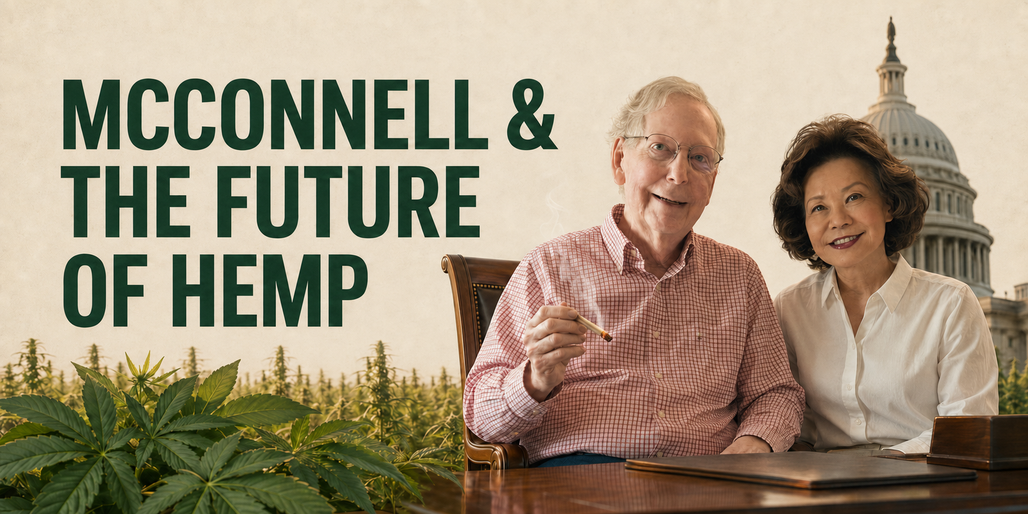
Is Mitch McConnell Alive? What His Prolonged Absence Could Mean for the Hemp Industry
Hemp Policy and Industry
Last updated: July 28, 2026
Legal information reviewed: July 28, 2026
Mitch McConnell’s Health, Retirement, and What His Departure Could Mean for Hemp
As of July 28, 2026, Mitch McConnell is not dead. According to the latest Associated Press reporting on his condition, the Kentucky senator remains in a rehabilitation facility following a June fall and has not been medically cleared to return to his Senate office.
That does not establish that McConnell is legally or cognitively incapacitated. His office says he continues to work with staff, intends to return, and plans to complete the Senate term that ends in January 2027. He has already announced that he will not seek reelection.
The more useful question for the hemp industry is therefore not whether an unconfirmed rumor is true. It is what McConnell’s prolonged absence, a possible early vacancy, or his planned retirement could mean for federal hemp policy.
McConnell occupies an unusual place in hemp history. He was one of the most influential supporters of the legislation that created the modern legal hemp industry. Years later, he also became a leading supporter of federal restrictions intended to close what lawmakers called the intoxicating-hemp loophole. His departure could consequently create both opportunities and risks for hemp farmers, manufacturers, retailers, and consumers.
This article is a policy-focused spoke within our Future of Hemp in America hub.
Is Mitch McConnell Dead or Incapacitated?
No credible reporting supports the claim that Mitch McConnell is dead. As of this article’s review date, he is alive and receiving rehabilitation following a fall and hospitalization.
The congressional Office of the Attending Physician has said that McConnell has not been medically cleared to leave rehabilitation and return to his office. He has missed Senate votes during his recovery, but his office says he remains involved with staff and intends to complete his term.
Physical Absence Is Not the Same as Legal Incapacity
The word “incapacitated” can refer to several different situations. A person may be physically unable to travel or attend work without being unable to understand information, communicate decisions, or carry out responsibilities through staff.
No publicly established legal process has declared McConnell incapacitated. It is therefore more accurate to describe him as medically absent from the Senate rather than to make an unsupported conclusion about his decision-making capacity.
Why Mitch McConnell Matters to the Hemp Industry
McConnell’s importance to hemp comes from both his seniority and his direct involvement in federal hemp legislation.
He Helped Establish the Modern Hemp Industry
McConnell supported the industrial hemp pilot-program framework in the 2014 Farm Bill and later introduced the Hemp Farming Act of 2018. Its main provisions were incorporated into the 2018 Farm Bill.
The USDA’s hemp overview explains that the 2018 Farm Bill authorized hemp production, removed qualifying hemp and hemp seed from the federal schedule of controlled substances, and directed USDA to create a national production framework.
That change did more than permit cultivation. It helped establish hemp as a regulated agricultural commodity and supported markets for flower, extraction biomass, grain, fiber, seed, and hemp-derived consumer products.
He Later Supported Tighter Cannabinoid Restrictions
After 2018, businesses developed products containing Delta-8 THC, hemp-derived Delta-9 THC, THCA, and other cannabinoids. McConnell argued that companies had used the original hemp definition to create intoxicating products that Congress never intended to legalize.
In 2025, he championed federal language intended to close that perceived loophole. The proposal changed how hemp would be measured, addressed cannabinoids manufactured or synthesized outside the plant, and established a strict combined THC limit for certain finished hemp-derived cannabinoid products.
How the Hemp Provision Moved Through Congress
The hemp restrictions did not receive a clean, standalone vote. Instead, the language appeared as Section 781 within Division B of H.R. 5371, a large, multi-division government-funding package designed to end the federal shutdown. The final law can be reviewed in the official text of Public Law 119-37.
That procedural context matters. The federal government had been shut down for 43 days, disrupting agencies, delaying services, leaving federal employees without regular pay, and placing increasing pressure on Congress to restore funding. Air travel had become one of the most visible consequences. Staffing problems connected to the funding lapse led the FAA to order flight reductions at major airports, and the agency did not announce a full return to normal air-traffic operations until after the government reopened.
By the time the funding package reached its decisive votes, lawmakers faced an unusually difficult choice. They could approve the complete package with the hemp language included, attempt to amend or reopen the bill and risk delaying its enactment, or vote against the package while the shutdown and its wider disruptions continued. Reporting on the final House debate noted that amending the legislation would have required sending it back to the Senate, preventing the shutdown from ending that night.
Senator Rand Paul attempted to remove the hemp language and warned that the proposed limit could damage CBD businesses, farmers, and manufacturers along with the intoxicating products McConnell said he was targeting. However, removing the provision would have required additional legislative action while pressure to reopen the government continued. Louisville Public Media documented the dispute between Kentucky’s senators and the concerns raised by hemp farmers and businesses.
Supporters argued that the restrictions were necessary to prevent unregulated intoxicating products from being sold in gas stations, convenience stores, and online without consistent age limits or product standards. Critics agreed that intoxicating products needed regulation but argued that the language went much further, potentially excluding non-intoxicating full-spectrum CBD products and other established hemp goods because of the extremely low per-container threshold.
This distinction is important when evaluating McConnell’s hemp legacy. He did not merely change his position through a standalone hemp debate. He helped attach a sweeping hemp-policy change to legislation carrying extraordinary pressure to pass. The process made it substantially more difficult for lawmakers to oppose the hemp language without also risking further delay in reopening the federal government.
McConnell’s hemp legacy is therefore complicated. He helped create the modern industry and later supported rules that could significantly narrow parts of it.
How Much Influence Does McConnell Still Have?
McConnell is no longer the Senate Republican leader, so his absence does not create a vacancy in party leadership. Other senators now control the Republican floor agenda and leadership operation.
However, he remains one of the Senate’s most senior members. Current U.S. Senate committee assignments place him on committees that include Agriculture and Appropriations. Those committees can affect farming programs, federal spending, agency funding, and hemp-related legislative language.
His influence also comes from decades of relationships, procedural experience, knowledge of Kentucky agriculture, and his identification with federal hemp legalization. Even without serving as party leader, he can still help shape negotiations and provide political cover for other Republican senators.
At the same time, hemp policy does not belong to one senator. The Senate Agriculture Committee, House Agriculture Committee, appropriators, federal agencies, state governments, courts, and other lawmakers all influence the industry.
Three Possible Political Scenarios
The hemp effects depend heavily on what actually happens. Continued medical absence, an early vacancy, and a planned retirement are not the same event.
| Scenario | Immediate Political Result | Possible Hemp Effect |
|---|---|---|
| Prolonged absence | McConnell retains the seat but has limited in-person participation in votes, hearings, and negotiations. | His staff may remain involved, but his ability to personally influence fast-moving legislation could be reduced. |
| Early resignation or vacancy | Kentucky would begin its statutory process for filling the vacant Senate seat. | The state could temporarily lose seniority and direct representation while a replacement process unfolds. |
| Planned retirement | A newly elected senator takes office when McConnell’s term ends in January 2027. | Hemp policy would depend on the successor’s priorities, committee assignments, and willingness to represent Kentucky’s hemp sector. |
None of these scenarios automatically changes federal hemp law. They change the people, influence, timing, and coalitions involved in future legislation.
Possible Positive Effects on the Hemp Industry
McConnell’s reduced influence or eventual departure could create an opening for different hemp-policy approaches. These benefits are possible rather than guaranteed.
1. More Room to Reconsider Broad Product Restrictions
Some hemp businesses argue that Congress can regulate intoxicating products without excluding non-intoxicating, full-spectrum, or trace-THC products that were not designed to cause impairment.
With McConnell no longer serving as a central advocate for the existing restriction, lawmakers might have more room to consider distinctions among:
- Non-intoxicating CBD products
- Full-spectrum products containing trace THC
- High-THCA flower
- Delta-8 THC and other converted cannabinoids
- Low-dose hemp-derived Delta-9 products
- Industrial hemp grown for fiber, grain, or seed
A more detailed framework could potentially use age restrictions, manufacturing standards, potency limits, serving-size rules, testing, packaging, and sales-channel controls instead of treating every cannabinoid product alike.
2. An Opportunity for More Precise CBD Protections
The scheduled federal language has raised concerns because a strict per-container threshold may affect products that are not marketed as intoxicating. A new coalition could attempt to protect legitimate non-intoxicating CBD products while maintaining restrictions on products designed to cause intoxication.
That would require new legislation. McConnell’s departure would merely change the negotiating environment; it would not create an exemption by itself.
3. A New Kentucky Senator Could Reassess the Industry
Kentucky has been central to modern hemp policy. A new senator may hold hearings, meet with farmers and processors, examine the economic effects of the 2026 changes, or support a different balance between public-safety controls and commercial access.
A successor could also pay more attention to the differences between cannabinoid hemp and agricultural hemp grown for fiber, grain, or seed.
4. Hemp Advocacy Could Become Less Dependent on One Politician
The industry benefited from McConnell’s influence, but relying heavily on one political sponsor creates long-term risk. His departure could encourage hemp organizations to build broader support across parties, regions, committees, and agricultural groups.
A durable industry needs support that survives elections, retirements, leadership changes, and individual disagreements.
5. Industrial Hemp Could Receive More Attention
If the federal debate moves away from one senator’s focus on intoxicating cannabinoid products, lawmakers may spend more time on fiber processing, crop insurance, grain markets, seed genetics, research, manufacturing, and rural infrastructure.
That possibility is examined further in Could New Hemp Laws Trigger a Fiber Hemp Boom? However, political interest alone cannot create the processors, contracts, transportation networks, and buyers that industrial hemp needs.
Possible Negative Effects on the Hemp Industry
The industry could also lose important political advantages when McConnell leaves office.
1. Hemp Could Lose Its Best-Known Republican Sponsor
Whatever businesses think about his later restrictions, McConnell helped make hemp politically credible within the Republican Party and the wider agricultural establishment.
His support helped present hemp as a farm commodity rather than simply another cannabis issue. A replacement senator may not have the same interest, seniority, or ability to persuade skeptical lawmakers.
2. Kentucky Would Lose Decades of Senate Seniority
A newly elected senator begins without McConnell’s institutional standing, committee influence, or long-standing relationships. That could reduce Kentucky’s ability to shape federal agriculture and appropriations negotiations in the near term.
Even a strongly pro-hemp successor would need time to build influence.
3. The November 2026 Deadline Could Arrive Before Congress Acts
The most consequential federal changes are scheduled to take effect on November 12, 2026. A health-related absence, vacancy, election, or leadership transition could consume time while businesses wait for clarity.
Legislative delay could be especially difficult for farmers and manufacturers that must make decisions about planting, contracting, formulation, packaging, and inventory before they know whether Congress will revise the law.
Our guide to how the November hemp law changes could affect hemp farmers explains why agricultural decisions often have to be made months before retail consequences become visible.
4. McConnell’s Successor Could Be Less Supportive of Hemp
A new senator could favor stricter restrictions, focus primarily on state-licensed marijuana systems, or have little interest in hemp agriculture. A change in officeholder does not guarantee a more industry-friendly policy.
The successor’s position may also differ by hemp category. A senator could support fiber and grain hemp while opposing most cannabinoid products.
5. The Industry Could Become More Fragmented
Hemp businesses do not agree on a single policy. Fiber farmers, CBD brands, THCA flower sellers, beverage companies, licensed cannabis operators, laboratories, and converted-cannabinoid manufacturers can have very different interests.
Without an influential negotiator, those divisions could make it harder to present Congress with a workable alternative to the enacted restrictions.
How Different Hemp Sectors Could Be Affected
McConnell’s departure would not affect every part of hemp equally. The outcome would depend on what products or crops a business handles.
| Industry Segment | Possible Opportunity | Possible Risk |
|---|---|---|
| Non-intoxicating CBD | Lawmakers could create clearer protections for products not intended to cause intoxication. | Trace-THC and full-spectrum products could remain exposed to strict per-container limits. |
| THCA flower | A future debate could consider a more specific regulatory system. | Total-THC language directly challenges the federal market for high-THCA products. |
| Delta-8 and converted cannabinoids | Congress could replace a broad exclusion with manufacturing, age, testing, and sales rules. | These products are a central target of current federal restrictions and may receive little political support. |
| Hemp-derived Delta-9 products | Lawmakers could consider serving-based or potency-based regulation. | The scheduled container limit could exclude many existing formulations. |
| Fiber, grain, and seed hemp | Non-cannabinoid agriculture could receive more policy attention and investment. | Loss of McConnell’s agricultural influence could weaken federal support or funding. |
| Farmers and processors | A new policy coalition could improve contracts, crop rules, and regulatory clarity. | Transition and uncertainty could discourage planting, purchasing, or infrastructure investment. |
Could McConnell’s Departure Change the November 2026 Hemp Law?
Not automatically. The law has already been enacted.
The Agricultural Marketing Act text compiled by GovInfo states that the Section 781 amendments take effect on November 12, 2026. Among other changes, the amended definition uses total tetrahydrocannabinols, including THCA, and excludes certain final hemp-derived cannabinoid products above a combined per-container threshold.
A senator’s retirement, resignation, absence, or death does not erase enacted legislation. Congress would have to pass a new law, delay implementation, amend the language, or create a different statutory framework. Depending on the issue, agency implementation and court decisions could also affect how particular provisions are interpreted.
For a provision-by-provision explanation, read Understanding THC Limits in Hemp Products.
What Would Happen to McConnell’s Senate Seat?
McConnell has already said he will not seek reelection, so Kentucky voters are scheduled to choose his successor for the next Senate term.
If the seat became vacant before the end of his current term, Kentucky law would govern the process for filling the remainder. The state changed that process through Kentucky House Bill 622.
The enacted measure repealed the previous gubernatorial appointment mechanism and requires a proclamation for a special election to fill a U.S. Senate vacancy. The precise timing and election procedure would depend on when a vacancy occurred and how state election officials applied the relevant statutes.
For hemp, the practical concern would be representation. An unfilled seat could temporarily reduce Kentucky’s voting power in closely divided Senate decisions. A replacement would also lack McConnell’s seniority, even if that person strongly supported hemp.
What the Hemp Industry Should Watch Next
The hemp industry should prepare for political transition regardless of whether McConnell returns before his term ends. His retirement is already planned, and federal hemp rules are already scheduled to change.
Watch for Legislative Amendments
Businesses should watch for proposals that delay, replace, or modify the November 2026 provisions. The most important details will include how legislation defines total THC, non-intoxicating CBD, converted cannabinoids, final products, containers, and industrial hemp.
Watch the Next Kentucky Senator’s Position
Campaign language about “supporting hemp” may not provide enough detail. Farmers and businesses should look for specific positions on CBD, THCA, Delta-8, low-dose Delta-9 products, fiber, grain, seed, testing, age restrictions, and FDA regulation.
Build Support Beyond Kentucky
A national industry cannot rely solely on Kentucky’s delegation. Hemp organizations may need stronger relationships with lawmakers from states that have CBD manufacturing, hemp beverages, fiber processing, grain farming, cannabis regulation, or established consumer-protection systems.
Propose a Workable Alternative
Opposing a restriction is more effective when the industry can explain what should replace it. A detailed proposal might address:
- Minimum purchasing ages
- Serving and package limits
- Child-resistant packaging
- Restrictions on youth-oriented marketing
- Independent laboratory testing
- Manufacturing standards
- Accurate cannabinoid labels
- Rules for converted cannabinoids
- Product registration or licensing
- Clear protections for non-intoxicating CBD and industrial hemp
Prepare for More Than One Outcome
Farmers, manufacturers, and retailers may need contingency plans. Those plans could include alternative crop contracts, reformulated products, revised inventories, updated labels, stronger testing, or greater focus on non-cannabinoid hemp markets.
Businesses should obtain qualified legal advice before relying on any particular interpretation. Federal hemp law, state law, product format, cannabinoid content, manufacturing method, and sales destination can all affect compliance.
What This Political Change Could Mean for Consumers
Consumers will not necessarily see an immediate change because of McConnell’s absence. Product availability is more directly affected by enacted laws, state restrictions, retailer decisions, and implementation deadlines.
Over time, shoppers could see changes in product formulas, package sizes, cannabinoid content, lab reports, shipping availability, and the distinction between hemp retailers and state-licensed cannabis dispensaries.
Until the legal framework becomes clearer, product names alone should not be treated as proof of legality. Consumers comparing current CBD flower options should review batch information and available certificates of analysis, while also checking the rules that apply in their state.
The Most Likely Hemp-Industry Outcome
The most likely outcome is neither an immediate rescue nor an immediate collapse of the hemp industry. McConnell’s influence is important, but federal hemp policy is now larger than one senator.
His departure could make it easier for lawmakers to reconsider restrictions that critics believe are too broad. It could also remove an experienced agricultural advocate who helped make hemp legal in the first place.
The decisive factor will be what coalition replaces his influence. If lawmakers create a clearer distinction between non-intoxicating CBD, intoxicating cannabinoid products, converted cannabinoids, and industrial hemp, the transition could lead to a more durable market. If Congress allows uncertainty to continue, farmers and businesses may face disruption regardless of who occupies Kentucky’s Senate seat.
Practical Takeaways
- Mitch McConnell is alive as of July 28, 2026 and remains in rehabilitation.
- Being medically unable to return to the Senate office is not the same as a public legal determination of incapacity.
- McConnell helped create the modern hemp industry through the 2018 Farm Bill framework.
- He later supported stricter federal rules for intoxicating and other hemp-derived cannabinoid products.
- The restrictions were enacted through a must-pass government-funding package rather than a clean, standalone hemp vote.
- His absence or departure would not automatically repeal the changes scheduled for November 12, 2026.
- A departure could create room for more precise CBD and cannabinoid regulations.
- The industry could also lose a powerful agricultural ally with extensive Senate seniority.
- Kentucky law now uses a special-election process rather than a gubernatorial appointment to fill a U.S. Senate vacancy.
- The long-term outcome depends more on the next legislative coalition than on one senator’s health.
Frequently Asked Questions
Is Mitch McConnell dead?
No. As of July 28, 2026, credible reporting says Mitch McConnell is alive and receiving rehabilitation after a fall and hospitalization.
Is Mitch McConnell incapacitated?
He has not been medically cleared to return to his Senate office, but there has been no public legal determination that he is unable to make decisions or carry out responsibilities through his staff. It is more accurate to describe him as medically absent.
Did Mitch McConnell legalize hemp?
McConnell was a major architect and political supporter of the federal hemp provisions incorporated into the 2018 Farm Bill. Congress passed the legislation and the president signed it, so no single senator legalized hemp alone.
Why did McConnell later support hemp restrictions?
McConnell argued that businesses used the 2018 definition to create intoxicating products that Congress had not intended to legalize. Hemp businesses responded that the language could also affect non-intoxicating CBD and other legitimate products.
Did Congress vote on the hemp restrictions separately?
No. The restrictions were included in a broad government-funding package needed to end the 2025 federal shutdown. Lawmakers voting on final passage could not reject only the hemp provision while approving the rest of the reopening agreement.
Would McConnell’s death or resignation repeal the November hemp law?
No. The law has already been enacted. A vacancy would change Senate membership, but Congress would still need to pass new legislation to amend or delay the scheduled provisions.
Could McConnell’s departure help the CBD industry?
Possibly. It could create more room to distinguish non-intoxicating CBD products from products designed to cause intoxication. However, there is no guarantee that a new senator or congressional coalition would adopt a more favorable policy.
Could his departure help fiber hemp?
It could increase attention to fiber, grain, and seed hemp, but those markets still need processors, contracts, transportation, manufacturing capacity, and buyers. A political change cannot create industrial infrastructure by itself.
Who would replace McConnell if his seat became vacant?
Kentucky law now provides for a special-election process rather than a temporary gubernatorial appointment. The specific timing would depend on when the vacancy occurred and the election statutes in effect.
What should hemp businesses do now?
Businesses should monitor federal and state developments, review contracts and inventory, maintain current testing records, consider multiple regulatory outcomes, and obtain qualified legal guidance before making compliance decisions.
Popular Products
Check out these customer favorites.