
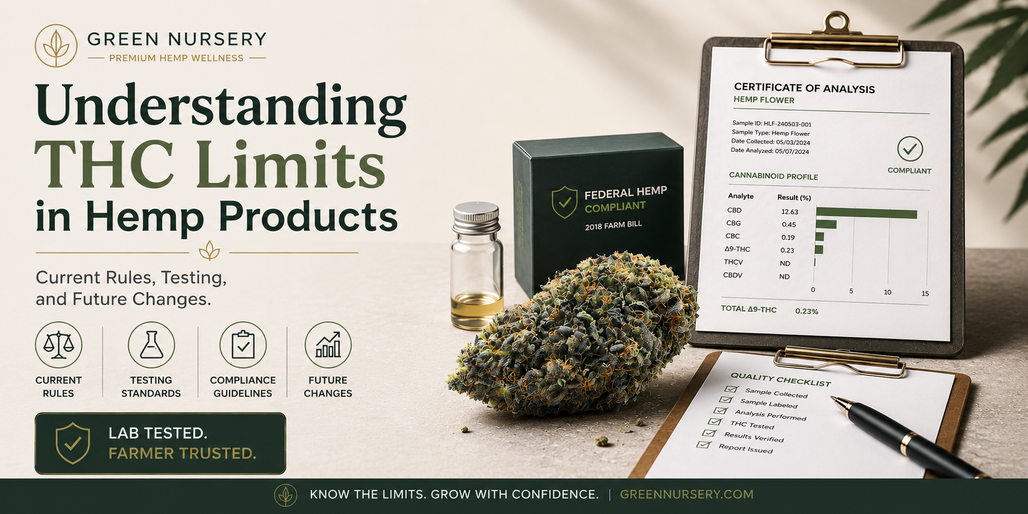
Understanding THC Limits in Hemp Products: Current Rules, Testing, and Future Changes
Understanding THC Limits in Hemp Products: Federal Rules, Compliance Testing, and What Consumers Should Know
THC limits are one of the most important legal issues in the hemp industry. They help determine whether a cannabis product is treated as federally lawful hemp or regulated as marijuana under federal law.
Hemp flower, CBD oils, gummies, and full-spectrum products may all contain cannabinoids, but legality depends on measurable testing standards, not product names or marketing claims.
This guide explains the current federal THC rules, how hemp products are tested, why THCA and total THC are part of the debate, and what future federal changes could mean for hemp products.
For broader legal context, read CBD and Cannabis Laws Explained. You can also review What Makes Hemp Flower Federally Legal?.
Why THC Limits Matter in Hemp Products
THC limits matter because they create the legal line between hemp and marijuana. A product may look like hemp, be labeled as hemp, or be sold by a hemp company, but compliance depends on laboratory testing.
- Farmers use THC testing to confirm crops meet hemp requirements.
- Manufacturers use testing to verify product formulation and compliance.
- Retailers use lab reports to evaluate products before sale.
- Consumers use COAs to understand what they are buying.
- Labs help confirm cannabinoid content and contaminant screening.
This is why hemp compliance testing and Certificates of Analysis are so important. A COA can help verify cannabinoid levels, THC results, batch information, and product transparency.
The Difference Between Hemp and Marijuana Under Federal Law
Hemp and marijuana both come from the cannabis plant. The main federal legal difference is THC concentration. The USDA Domestic Hemp Production Program provides the federal framework for hemp production and compliance.
| Category | Federal Meaning | Main Legal Issue |
|---|---|---|
| Hemp | Cannabis that meets the federal hemp definition | Must stay within legal THC limits |
| Marijuana | Cannabis that does not qualify as hemp | Generally remains controlled under federal law |
CURRENT FEDERAL LAW: Understanding the 0.3% Delta-9 THC Rule
Under the 2018 Farm Bill framework, hemp is generally defined as cannabis with a Delta-9 THC concentration of not more than 0.3 percent on a dry-weight basis. The original hemp language can be reviewed through Congress.gov’s 2018 Farm Bill record.
This rule became the foundation of the modern hemp industry. It allowed compliant hemp to be treated differently from marijuana under federal law and helped create the market for CBD products, hemp flower, and other hemp-derived goods.
The 0.3% Delta-9 THC rule is especially important for hemp flower because flower is tested directly for cannabinoid content. For finished products, compliance can also depend on product type, state law, labeling, testing, and other rules.
Federal Hemp Timeline
| Year | Major Development | Why It Matters |
|---|---|---|
| 2018 | Farm Bill legalizes hemp federally | Creates the modern hemp framework based on Delta-9 THC. |
| 2021 | USDA final hemp rule becomes effective | Clarifies production, sampling, testing, and compliance expectations. |
| 2021 to 2024 | Growth of Delta-8, THCA, and other hemp-derived cannabinoids | Creates new legal and safety debates. |
| 2025 to 2026 | Federal policy debates intensify | Total THC and intoxicating hemp products become central issues. |
| November 2026 | Scheduled Section 781 effective date, unless changed | Could shift federal hemp rules toward broader total THC standards. |
How Hemp Products Are Tested for THC
Hemp testing usually involves collecting a sample and sending it to a laboratory for cannabinoid analysis. The lab measures compounds such as CBD, CBDA, Delta-9 THC, THCA, CBG, and other cannabinoids.
Testing may include Delta-9 THC testing, THCA testing, total THC calculations, full cannabinoid profiles, and contaminant testing for pesticides, heavy metals, and microbials.
The Federal Register final rule for the Domestic Hemp Production Program provides additional detail on federal hemp production standards.
For a deeper testing overview, read Why Third-Party Testing Matters for CBD and Hemp Products. You can also browse Green Nursery’s lab-tested CBD flower.
Understanding THC Results on a COA
A Certificate of Analysis is a laboratory report for a product or batch. For hemp compliance, the cannabinoid section is one of the most important parts of the report.
| COA Term | What It Means | Why It Matters |
|---|---|---|
| Delta-9 THC | The main THC compound used in the 2018 federal hemp definition | Central to current hemp legality |
| THCA | An acidic cannabinoid found in raw cannabis flower | Can convert into Delta-9 THC when heated |
| Total THC | A calculation that accounts for Delta-9 THC and potential THCA conversion | Important in testing debates and future regulation |
| Batch Number | Identifies the tested product batch | Helps connect the COA to the product being sold |
Consumers can review Green Nursery’s COAs and lab reports before purchasing CBD products. For help reading reports, visit How to Read a CBD Flower Lab Report.
Delta-9 THC vs Total THC
Delta-9 THC and total THC are related, but they are not the same thing.
Delta-9 THC measures the active Delta-9 THC present in the sample. Total THC attempts to account for Delta-9 THC plus the potential conversion of THCA into Delta-9 THC when heated.
| Testing Approach | What It Measures | Why It Matters |
|---|---|---|
| Delta-9 THC | Only Delta-9 THC | Basis of the 2018 federal hemp definition |
| Total THC | Delta-9 THC plus potential THCA conversion | More relevant to heated products like smokable flower |
| Full Cannabinoid Profile | Multiple cannabinoids | Provides broader product transparency |
What Is THCA and Why Is It Part of the Debate?
THCA is the natural acidic precursor to Delta-9 THC. In raw cannabis and hemp flower, much of the THC-related content may appear as THCA.
THCA itself is not generally treated the same as Delta-9 THC before heating. However, when flower is smoked, vaped, or cooked, THCA can convert into Delta-9 THC. This conversion is why THCA hemp flower became a major legal debate.
Some products may test below 0.3% Delta-9 THC while still containing higher THCA levels. Supporters argue those products followed the 2018 Farm Bill language. Critics argue that Delta-9-only testing does not reflect how THCA flower is actually used.
For more background on hemp flower legality, read What Makes Hemp Flower Federally Legal?.
State vs Federal THC Regulations
Federal law sets a national hemp framework, but states may create their own rules. Some states allow certain hemp-derived products, while others restrict or ban products involving Delta-8 THC, THCA flower, or intoxicating hemp cannabinoids.
This means a product may appear compliant under one legal standard but still face restrictions in a specific state. Consumers should check local rules before buying, possessing, or transporting hemp products.
PROPOSED AND FUTURE CHANGES: How THC Rules Are Changing
Federal hemp law has continued to evolve since the 2018 Farm Bill. Lawmakers have focused increasingly on total THC, THCA, Delta-8 THC, and other hemp-derived cannabinoids.
According to Congressional Research Service analysis of Section 781, Section 781 amended the federal hemp definition and is currently scheduled to take effect on November 12, 2026, unless changed by future legislation, regulatory action, or court rulings.
CRS explains that the amended definition moves toward a broader total THC framework that includes THCA and addresses several hemp-derived THC compounds.
Congress has also seen proposed bills that could affect those changes. H.R. 6209, the American Hemp Protection Act of 2025, was introduced to repeal Section 781. Other proposals have sought to delay or revise implementation. These are proposals unless Congress passes them and they are signed into law.
The key takeaway is that consumers should separate current law from pending changes. The 2018 Delta-9 framework still matters, but the industry is preparing for a broader total THC approach unless federal law changes again.
FDA Oversight and Consumer Safety Concerns
The FDA continues to raise concerns about cannabis-derived products, including CBD and Delta-8 THC products. The agency’s CBD consumer guidance explains that many CBD products have not been evaluated by FDA for safety and that the agency continues to evaluate regulatory pathways.
The FDA has also warned consumers that Delta-8 THC products have not been evaluated or approved by FDA for safe use and may be marketed in ways that put public health at risk.
For consumers, this reinforces the importance of shopping from transparent companies that provide lab reports, product information, and clear testing practices.
How Consumers Can Verify Compliance Before Purchasing
Consumers do not need to become legal experts, but they should look for transparent testing and clear product information.
- Check for a recent COA.
- Make sure the batch number matches the product.
- Review Delta-9 THC results.
- Look for THCA and total THC when available.
- Choose products from companies that publish lab reports.
- Review state restrictions before buying hemp products.
You can browse Green Nursery’s CBD Flower Collection, shop CBD Product Collection, review COAs and lab reports, read customer reviews, and visit the FAQ page for additional information.
What We Know vs What Is Still Uncertain
Enacted Law
- The 2018 Farm Bill created the modern federal hemp framework.
- The federal hemp definition historically relied on Delta-9 THC concentration.
- USDA hemp production programs remain active.
- Section 781 amended the federal hemp definition, with a future effective date identified by CRS as November 12, 2026.
Agency Guidance
- USDA continues to oversee hemp production rules and compliance programs.
- FDA continues to warn consumers about unapproved CBD and Delta-8 THC products.
- Federal agencies may issue additional guidance as implementation dates approach.
Proposed Legislation
- H.R. 6209 was introduced to repeal Section 781.
- Other proposals may seek to delay, revise, or replace future hemp restrictions.
- Proposed bills are not current law unless passed by Congress and signed into law.
Industry Expectations
- Many hemp businesses are preparing for increased emphasis on total THC calculations.
- Testing transparency and compliance documentation are expected to become more important.
- State-by-state rules may continue creating uncertainty for consumers and retailers.
Frequently Asked Questions About THC Limits
What is the legal THC limit for hemp?
Under the 2018 federal hemp framework, hemp is generally defined by a Delta-9 THC concentration of not more than 0.3% on a dry-weight basis.
What is Delta-9 THC?
Delta-9 THC is the main intoxicating THC compound and the cannabinoid used in the 2018 federal hemp definition.
What is total THC?
Total THC is a calculation that accounts for Delta-9 THC and the potential conversion of THCA into Delta-9 THC.
Why does THCA matter?
THCA can convert into Delta-9 THC when heated, which makes it important for smokable hemp flower and future THC compliance debates.
Is THCA hemp flower currently federally legal?
THCA hemp flower remains one of the most debated areas of hemp law. Some businesses argue that products meeting the Delta-9 THC threshold comply with the 2018 framework, while regulators and lawmakers increasingly focus on total THC and THCA conversion. State laws may also restrict or prohibit THCA products.
Does a COA prove a product is legal?
A COA can help verify cannabinoid content and THC levels, but legality may also depend on state law, product type, labeling, licensing, and other compliance factors.
Can hemp products show up on a drug test?
Yes, some hemp products contain measurable THC or THC-related compounds. Read Can CBD Show Up on a Drug Test? for more information.
Are THC limits the same in every state?
No. States can impose additional restrictions on hemp products, including rules for Delta-8 THC, THCA flower, total THC, packaging, testing, and sales.
Does federal law override state hemp laws?
Not always. Federal law creates a national hemp framework, but states can impose additional rules within their jurisdictions. Consumers should check state law before buying or transporting hemp products.
Are hemp THC rules changing?
Yes. Federal hemp policy has continued to evolve, especially around total THC, THCA, and intoxicating hemp-derived cannabinoids. Some changes are enacted with future effective dates, while others remain proposed legislation or industry expectations.
Final Takeaway
THC limits are at the center of hemp legality. The 2018 Farm Bill created the modern federal hemp framework by focusing on Delta-9 THC, but future rules are moving toward broader discussions of total THC, THCA, and intoxicating hemp-derived cannabinoids.
For consumers, the best approach is to review COAs, check THC results, understand state laws, and choose transparent companies that make testing information easy to access.
To keep learning, visit CBD and Cannabis Laws Explained, explore the CBD Flower Collection, shop CBD products, and review Green Nursery’s COAs and lab reports.
Disclaimer: This article is for educational and informational purposes only and is not legal or medical advice. Hemp laws, testing standards, enforcement priorities, and product requirements may vary by jurisdiction and may change over time.
Popular Products
Check out these customer favorites.