
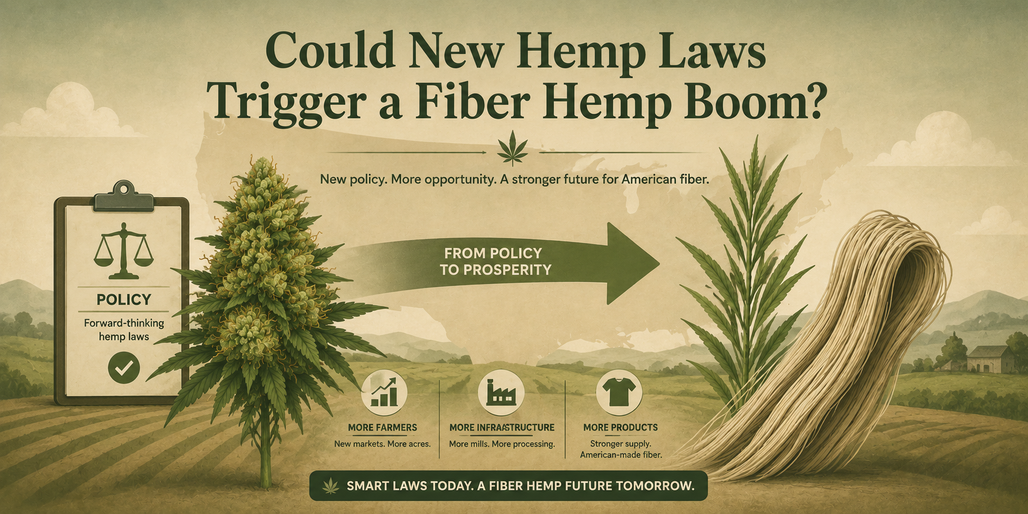
Could New Hemp Laws Trigger a Fiber Hemp Boom?
Last updated:
Could New Hemp Laws Trigger a Fiber Hemp Boom?
New federal hemp rules could increase interest in fiber hemp, but they will not automatically create a fiber boom. If cannabinoid-focused hemp becomes harder to produce or sell under the scheduled federal definition, some farmers and businesses may look more seriously at fiber, grain, seed, and other non-cannabinoid markets.
The problem is that changing a law is faster than building an industrial supply chain. Fiber hemp still needs regional processors, decortication equipment, transportation networks, quality standards, manufacturers, contracts, and reliable buyers.
This article is a supporting spoke beneath our parent hub, CBD Hemp vs Fiber Hemp: How American Hemp Farms Choose What to Grow. Read that guide for the broader economic and agricultural differences between floral and industrial hemp.
The Current Hemp Market
American hemp is not one unified market. Hemp can be grown for flower, extraction biomass, fiber, grain, planting seed, clones, transplants, textiles, construction materials, food ingredients, and other industrial uses.
The USDA Farmers.gov hemp guide distinguishes acreage by intended use, including cannabidiol, fiber, grain, and seed. That distinction matters because hemp grown for flowers is not planted, managed, harvested, processed, or sold like hemp grown for stalk fiber.
Floral Hemp Still Dominates Production Value
According to the USDA National Hemp Report for the 2025 production year, total U.S. industrial hemp production value reached $739 million. Open-field floral hemp accounted for $574 million, while open-field fiber hemp accounted for $13.5 million.
| Hemp Category | Reported Value | Harvested Acres | What the Data Shows |
|---|---|---|---|
| Floral hemp | $574 million | 16,880 acres | Flower and cannabinoid markets produced the highest reported value. |
| Fiber hemp | $13.5 million | 21,693 acres | Fiber had more harvested acreage but substantially less reported value. |
| Grain hemp | $8.09 million | 7,515 acres | Grain remained a smaller market tied to seed, oil, and ingredient uses. |
| Seed hemp | $49.7 million | 3,537 acres | Seed value reflects the importance of genetics and propagation material. |
These are aggregate production-value figures, not farm-profit calculations. Profitability also depends on yield, labor, equipment, contracts, crop quality, transportation, testing, processing, and buyer reliability.
Still, the contrast is important. Floral hemp connected relatively quickly to consumer products. Fiber hemp depends on a longer industrial chain before most of its value is created.
What the New Federal Hemp Law Changes
The modern hemp market developed after the 2018 Farm Bill removed qualifying hemp from the federal Controlled Substances Act definition of marijuana. The FDA’s 2019 testimony on hemp and the 2018 Farm Bill explained that hemp was defined using a Delta-9 THC concentration of no more than 0.3% on a dry-weight basis. The testimony also emphasized that the Farm Bill preserved FDA authority over products containing cannabis or cannabis-derived compounds.
The Agricultural Marketing Act text compiled by GovInfo, as amended by Public Law 119-37, contains further changes scheduled to take effect on November 12, 2026. Unless Congress changes the law before that date, the amended definition will use total tetrahydrocannabinols, including THCA, and exclude several categories of cannabinoid products from the federal definition of hemp.
Current Crop Testing and the Future Definition Are Not the Same Thing
USDA production testing already accounts for THCA when determining crop compliance. The scheduled law goes further by changing the statutory definition of hemp and creating specific exclusions for intermediate and final hemp-derived cannabinoid products.
| Area | Current Framework | Scheduled Change |
|---|---|---|
| Statutory hemp definition | No more than 0.3% Delta-9 THC on a dry-weight basis | No more than 0.3% total tetrahydrocannabinols, including THCA, on a dry-weight basis |
| USDA crop-compliance testing | Already measures total THC using a method that accounts for THCA conversion | Implementation may require updated rules or guidance consistent with the amended statute |
| Intermediate cannabinoid products | Regulation depends on federal and state requirements applicable to the product | Certain products are excluded, including those above 0.3% combined total of covered cannabinoids |
| Final cannabinoid products | No equivalent federal hemp-definition cap of 0.4 milligrams per retail container | Certain final products above 0.4 milligrams combined total per container are excluded from the hemp definition |
| Industrial hemp | Fiber, grain, and seed are treated as intended hemp uses in production reporting | The statute expressly defines industrial hemp around specified non-cannabinoid uses |
Key Scheduled Changes
- Total-tetrahydrocannabinol standard: The amended definition includes THCA when applying the 0.3% dry-weight threshold.
- Intermediate-product exclusions: Certain intermediate products are excluded based on cannabinoid source, manufacturing method, cannabinoid concentration, or sale directly to consumers.
- Final-product exclusions: Certain final products containing more than 0.4 milligrams combined total per retail container of total tetrahydrocannabinols and covered similar-effect cannabinoids are excluded.
- Manufactured cannabinoids: The exclusions address cannabinoids that cannot be produced naturally by the plant and naturally occurring cannabinoids synthesized or manufactured outside the plant.
- Industrial-hemp definition: The statute expressly identifies hemp grown for stalk, fiber, non-cannabinoid stalk derivatives, grain, seed products, qualifying microgreens, research, and related planting seed.
The “container” described in the amended statute is the innermost retail package in direct contact with the finished product, such as a jar, bottle, bag, box, packet, can, carton, or cartridge. It does not mean a bulk shipping carton or unnecessary outer wrapping.
For a focused explanation of the farmer-level consequences, read How the November Hemp Law Changes Could Affect Hemp Farmers.
Important: These amendments are scheduled but not yet effective as of this article’s July 2026 review date. Federal or state law, agency guidance, or implementation details may change before or after November 12, 2026.
Potential Impact on Cannabinoid Hemp
The most direct pressure would likely fall on hemp businesses whose value depends on cannabinoid-rich flower, extracts, intoxicating cannabinoids, or finished products containing more than the scheduled limits.
That does not mean every cannabinoid product will be treated identically. The effect on a specific product will depend on its cannabinoid profile, manufacturing method, package size, intended use, federal status, state law, and future agency interpretation.
THCA Flower Would Face a Direct Definition Problem
High-THCA flower relies on a distinction between Delta-9 THC and THCA under the current statutory wording. A future definition based on total tetrahydrocannabinols, including THCA, would make that distinction much harder to use for flower that exceeds the new total threshold.
Manufactured Cannabinoids Could Face Additional Pressure
The amended text excludes certain intermediate and final products containing cannabinoids that cannot be naturally produced by the plant. It also addresses naturally occurring cannabinoids that were synthesized or manufactured outside the plant.
This language could directly affect business models involving converted, synthesized, or highly processed cannabinoid inputs. The exact treatment of a particular ingredient or process may depend on future rules and interpretation.
CBD Does Not Simply Disappear
CBD itself is naturally produced by hemp, and the amended law does not prohibit the molecule by name. However, many full-spectrum products naturally contain measurable amounts of THC or THCA. Businesses may need to reconsider formulations, package sizes, sourcing, testing, and distribution if their products exceed the scheduled final-container threshold.
CBD-rich plants would also need to satisfy the total-tetrahydrocannabinol standard applicable to hemp. Farms should not assume that a high-CBD crop will automatically remain compliant simply because CBD is non-intoxicating.
Farm Decisions Could Change Before Planting
For growers, uncertainty can affect:
- Genetic selection.
- Buyer contracts.
- Planted acreage.
- Testing schedules.
- Harvest timing.
- Drying and storage investments.
- Crop insurance and financing decisions.
- Whether to grow flower, fiber, grain, seed, or a non-hemp crop.
Retailers and manufacturers may also change purchasing, formulation, packaging, inventory, and compliance-review practices before the effective date.
Why Fiber Hemp Could Benefit
Fiber hemp could benefit because its primary value comes from stalk material rather than cannabinoid-rich flowers. The amended federal text expressly describes industrial hemp grown for the stalk, fiber produced from the stalk, non-cannabinoid stalk derivatives, and specified non-cannabinoid seed uses.
Fiber Is Less Dependent on Cannabinoid Retail Rules
A fiber farmer is generally trying to produce uniform stalks that can be separated into bast fiber and hurd. The farm is not attempting to maximize the cannabinoid content of the flower.
That does not remove every compliance or business risk. Fiber crops still need qualifying genetics, lawful planting seed, licensing where required, production records, suitable buyers, and compliance with applicable federal and state rules. The risk simply shifts away from finished cannabinoid-product potency and toward industrial logistics and economics.
Fiber Hemp Has Multiple Potential Markets
- Textiles and apparel.
- Workwear and home goods.
- Rope and cordage.
- Paper and packaging.
- Animal bedding.
- Hempcrete and building materials.
- Insulation and nonwovens.
- Biocomposites.
- Automotive and industrial components.
- Erosion-control materials.
The Textile Exchange report Growing Hemp for the Future discusses hemp’s potential across textiles and other material applications while emphasizing the need for processing, data, traceability, and credible sourcing.
More possible uses do not guarantee more farm demand. Each market requires manufacturers that can use hemp at a competitive price and consistent specification.
For the existing obstacles, read the closely related spoke Why Fiber Hemp Has Struggled to Scale in the United States.
Infrastructure Challenges
The strongest argument against an immediate fiber boom is infrastructure. Fiber hemp does not become valuable merely because farmers plant more acres. It becomes valuable when processors and manufacturers can turn stalks into materials that meet buyer requirements.
Processing Is the First Bottleneck
Fiber hemp may need to be cut, dried, retted, baled, transported, decorticated, cleaned, graded, and refined. Rutgers Cooperative Extension’s hemp fiber production guide explains that hemp stalks contain outer bast fibers and inner woody hurd. Those materials must be separated and prepared for their intended uses.
Decortication is especially important. It mechanically separates the stalk into bast fiber and hurd. Without appropriately sized processing capacity near farms, bulky stalks or bales may be too expensive to transport profitably.
Transportation Can Eliminate Thin Margins
Raw fiber hemp has relatively low value per pound compared with premium floral products. Long transportation distances can therefore consume a larger share of the crop’s value.
Efficient fiber production is more likely to develop through regional networks where farms, processors, storage, manufacturers, and buyers are located close enough to work together.
Textile-Grade Hemp Is More Complex
Textile applications can require retting, decortication, cleaning, scutching, degumming, softening or cottonization, spinning, yarn development, fabric formation, dyeing, finishing, and garment manufacturing.
More hemp acreage cannot replace missing spinners, mills, finishers, and brands. For a closer look at that chain, read Can Hemp Textiles Make a Comeback in America?.
Manufacturers Need Measurable Quality
Industrial buyers need to know what material they are purchasing. Important specifications may include fiber length, fineness, strength, moisture, cleanliness, retting quality, color, and bale consistency.
A USDA Agricultural Research Service project on industrial hemp fiber characterization identifies fiber length and fineness as important attributes for converting fiber into yarn. The project also explains why consistent measurement methods are needed for textile applications.
For the wider post-harvest chain, read How Hemp Processing Works: From Farm to Finished Product.
Possible Market Scenarios
The scheduled law could produce several different outcomes. These scenarios are informed predictions, not claims about what will definitely happen.
Scenario 1: Cannabinoid Hemp Contracts and Fiber Interest Rises Slowly
Some cannabinoid businesses may reduce inventory or acreage while farmers and investors begin exploring fiber. Because processing facilities take time and capital to build, actual fiber growth could remain gradual and concentrated around existing processors.
Scenario 2: Industrial Buyers Create Regional Fiber Hubs
Textile companies, building-material manufacturers, paper producers, bedding suppliers, or composite makers could contract with farms and processors before planting. This would allow acreage, processing, and manufacturing capacity to grow together.
This is the scenario most likely to produce meaningful fiber expansion because buyer commitment creates a reason for farmers to plant.
Scenario 3: Farmers Choose Grain, Seed, or Non-Hemp Crops
Farmers leaving cannabinoid hemp may not choose fiber. Some could grow grain or planting seed. Others may return to crops with more predictable regional buyers, equipment, crop insurance, and price history.
Fiber hemp must compete economically with corn, soybeans, wheat, hay, tobacco, vegetables, and other crops suitable for the same land. It is not competing only with floral hemp.
Scenario 4: The Market Separates into Cannabinoid and Industrial Sectors
The industry may divide more clearly between businesses producing compliant cannabinoid products and businesses focused on fiber, grain, seed, food ingredients, textiles, bedding, paper, and construction materials.
Greater specialization could make hemp markets easier to understand. Farms and processors would plan around specific buyers instead of treating all hemp acreage as interchangeable.
What a Fiber Hemp Boom Would Require
New restrictions could change incentives, but a sustained fiber boom would require several conditions to develop together:
- Regional decortication and fiber-processing facilities.
- Contracts among farmers, processors, and manufacturers before planting.
- Suitable and dependable fiber genetics.
- Clear specifications for moisture, cleanliness, fiber length, fineness, and consistency.
- Affordable transportation and storage systems.
- Realistic regional enterprise budgets.
- Reliable textile, bedding, paper, packaging, building-material, and composite buyers.
- Manufacturing research and product development.
- Price and performance competitive with other materials.
- Traceable sourcing and carefully supported environmental claims.
Without these pieces, fiber hemp may receive more publicity without creating a dependable farm market. With them, the scheduled legal change could become one part of a broader shift toward industrial hemp.
What This Means for Farms, Businesses, and Consumers
For Farmers
Farmers should not plant fiber hemp solely because cannabinoid rules are changing. They should identify the intended buyer, processing facility, transportation distance, quality specifications, contract terms, production costs, and alternative crops before committing acreage.
For Processors and Manufacturers
The potential opportunity lies in building capacity that connects farms with actual products. Equipment should be matched to expected acreage and buyer specifications. A decorticator without enough contracted hemp may struggle just as much as a farm without a processor.
For Cannabinoid Businesses
Businesses should review formulations, source materials, package sizes, laboratory reports, state restrictions, and the scheduled federal exclusions. Because the final implementation may evolve, qualified legal and compliance review is important.
For Consumers
Consumers should expect product availability and formulations to change if the amendments take effect as scheduled. Clear descriptions, current laboratory reports, batch matching, and reasonable claims will become even more important.
Green Nursery customers can browse the current CBD flower collection and review available testing through the COA library. For more context on why independent testing matters, read Why Third-Party Testing Matters for CBD and Hemp Products.
Fiber hemp may be less visible to the average hemp shopper. Its growth would more likely appear through clothing, packaging, bedding, insulation, hempcrete, paper, composites, and other material categories.
Practical Takeaways
- Federal hemp definitions are scheduled to change on November 12, 2026, unless the law is amended beforehand.
- The scheduled definition uses total tetrahydrocannabinols, including THCA, rather than only Delta-9 THC.
- USDA crop testing already accounts for THCA conversion, but the future statute adds broader product exclusions.
- Certain intermediate products above a 0.3% combined threshold would be excluded from the hemp definition.
- Certain final cannabinoid products above 0.4 milligrams combined total per retail container would also be excluded.
- The amended text expressly defines industrial hemp around specified non-cannabinoid uses.
- These changes could redirect some attention and investment toward fiber, grain, and seed.
- A fiber boom would still depend on processors, transportation, contracts, standards, manufacturing demand, and competitive economics.
- The most realistic near-term growth would likely be regional and led by committed buyers.
Frequently Asked Questions
Could new hemp laws trigger a fiber hemp boom?
They could increase interest and investment in fiber hemp, especially if cannabinoid markets contract. A boom is not guaranteed because fiber production still needs processors, contracts, transportation, standards, manufacturers, and buyers.
When are the federal hemp changes scheduled to take effect?
The amendments in Public Law 119-37 are scheduled to take effect on November 12, 2026. Congress could amend the law, and agencies may issue additional implementation guidance, so businesses should continue checking official sources.
Is federal hemp law already based on total THC?
The current statutory definition refers to Delta-9 THC, but USDA crop-compliance testing already uses a total-THC method that accounts for the potential conversion of THCA. The scheduled statute expressly changes the broader hemp definition to total tetrahydrocannabinols, including THCA.
What is the scheduled 0.4-milligram limit?
The amended text excludes certain final hemp-derived cannabinoid products containing greater than 0.4 milligrams combined total per retail container of total tetrahydrocannabinols, including THCA, and covered cannabinoids with similar effects. It is not a per-serving limit.
Would THCA flower remain hemp under the scheduled definition?
Flower with total tetrahydrocannabinols above the future 0.3% dry-weight threshold would not meet the amended federal hemp definition. Because THCA is expressly included, high-THCA flower would face a direct federal-definition problem.
Will CBD hemp farming disappear?
Not necessarily. CBD is a naturally occurring hemp cannabinoid, but CBD-rich plants and finished products would still need to satisfy applicable limits and other federal and state requirements. Some products may require reformulation, different packaging, or a different legal pathway.
Why has fiber hemp struggled to scale?
Fiber hemp needs specialized processing and reliable industrial demand. Farmers may struggle when decortication facilities are distant, transportation is expensive, specifications are unclear, or buyers are not committed before planting.
What products can fiber hemp become?
Fiber hemp can supply textiles, rope, paper, packaging, bedding, insulation, hempcrete, nonwovens, biocomposites, automotive components, and other industrial materials. Bast fiber and hurd have different properties and end uses.
What should farmers do before switching to fiber hemp?
Farmers should identify a buyer and processor, understand contract specifications, calculate transportation costs, confirm suitable genetics, prepare realistic enterprise budgets, and compare fiber hemp with other crops available in their region.
What should consumers do as hemp laws change?
Consumers should review current product descriptions, package information, batch-linked COAs, cannabinoid results, and applicable state rules. Green Nursery customers can review available COAs and lab reports before ordering.
Popular Products
Check out these customer favorites.