
What Is Kava? Effects, Uses, Dosage, and Safety
What Is Kava? Effects, Uses, Dosage, and Safety
Kava is a Pacific Island plant whose roots are used to prepare an earthy beverage associated with relaxation, social gatherings, and ceremony. Known botanically as Piper methysticum, it also appears in supplements studied for anxiety. Its long history is part of the appeal, but NCCIH's overview describes mixed evidence and important safety concerns, including rare, sometimes severe liver injury.
Understanding kava starts with the preparation. Cut root, ground root, instant mixes, and concentrated extracts can differ substantially. This guide explains those differences, the research, and the practical questions to ask. For broader context, see our guide to herbal supplements, uses, and safety.
What is kava, and where does it come from?
Kava belongs to the pepper family and is native to the South Pacific. NCCIH describes thousands of years of use in ceremonial and medicinal beverages. Today, kava is also served socially and sold through supplement stores and kava bars.
Its cultural role extends beyond the modern idea of a relaxation product. The University of Hawaiʻi's Pacific Food Guide describes ceremonial, spiritual, medicinal, and recreational uses. Names include ʻawa in Hawaiʻi, ava in Samoa, and sakau in Pohnpei. These traditions belong to distinct communities, with their own practices and meanings.
The same guide describes preparing the roots with cold water. That background helps explain why a traditional kava drink can look and taste quite different from a flavored bottled product or a capsule.
Kava effects and potential benefits
Why people use it for relaxation
Kava contains compounds called kavalactones that contribute to its effects on the nervous system. A Food Standards Australia New Zealand assessment discusses relaxing effects alongside drowsiness and sedation. Feeling calmer is possible, but the experience depends on the preparation and amount consumed.
That distinction matters when reading testimonials. A person's description of unwinding after a drink is different from evidence that a product reliably treats a health condition.
What does anxiety research show?
The results are mixed. A small six-week trial published in 2013 found greater anxiety reduction with a water-based kava extract than with placebo. However, a larger 16-week trial published in 2020, involving 171 participants with generalized anxiety disorder, found no significant advantage over placebo.
NCCIH's current summary says some kava supplements may help anxiety, potentially after several weeks, but do not appear helpful for generalized anxiety disorder. Kava should not replace evaluation or treatment for persistent anxiety.
What about sleep and other uses?
Drowsiness does not establish that something improves restorative sleep. NCCIH finds insufficient evidence for other health conditions. Claims about treating insomnia, chronic pain, or other disorders need more support than kava's relaxing reputation.
Cut root, ground root, instant products, and extracts
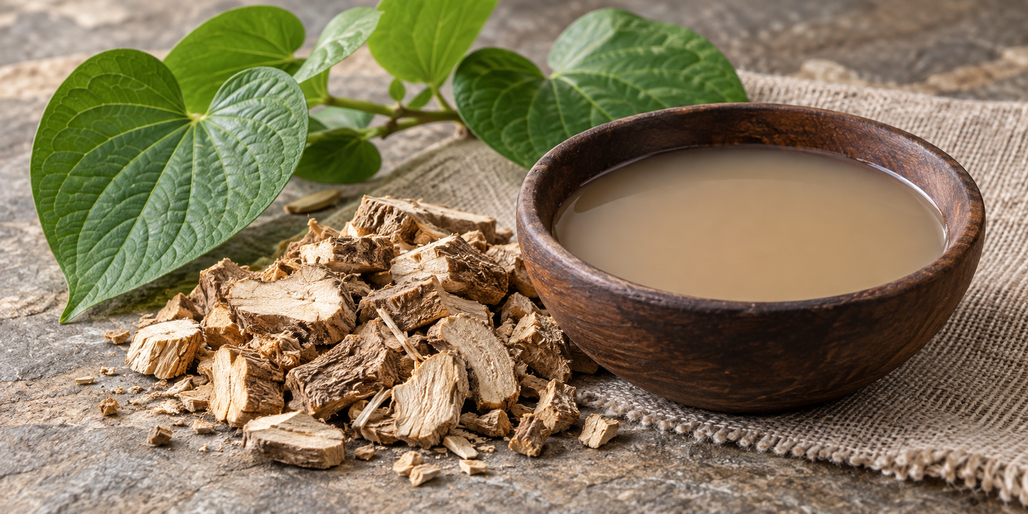
Green Nursery's Kava Kava Root - Cut & Sifted listing identifies the product as dried root from Fiji and describes it as noble kava. It contains visible woody pieces, so instructions for an instant powder should not be applied to it.
| Format | Basic distinction | Useful label information |
|---|---|---|
| Cut root | Dried root pieces requiring preparation. | Serving weight, processing directions, water quantity, and straining method. |
| Ground root | Root reduced to smaller particles for preparation. | Grind, serving weight, and whether straining is required. |
| Instant mix | A product marketed for direct mixing. | Exact ingredients, directions, and any declared kavalactone amount. |
| Extract | A preparation that extracts selected plant constituents. | Extraction method and the distinction between extract weight and kavalactone content. |
“Noble” describes a group of varieties associated with traditional beverage use, as explained by Food Standards Australia New Zealand. It does not specify a serving's potency or independently verify a batch's identity and purity.
Kava preparation and dosage: read the units carefully
Milligrams of root, milligrams of extract, and milligrams of kavalactones measure different things. A label that only states the amount of root does not tell you how much of its active constituents reaches a prepared drink.
For context, the 2013 adult anxiety trial used an oral water-based extract supplying 120 or 240 mg of kavalactones daily, depending on response. The 2020 trial used tablets supplying 120 mg twice daily. These describe study protocols, not recommended doses for loose root or a guarantee of safety.
There is no reliable way to turn those amounts into teaspoons of Green Nursery's cut root without product-specific composition and preparation data. A clinical study's measured extract dose cannot establish the strength of a homemade drink.
How is traditional kava prepared?
Traditional methods commonly involve grinding or pounding root, working it with water, and separating fibrous material. The food-standard assessment describes ground dried root wrapped in cloth and infused in water. This differs from simply stirring root pieces into a cup.
For cut root, obtain directions covering the serving weight, whether further grinding is needed, water quantity, preparation time, and filtration. Follow the instructions for that exact product. If those details are missing, ask the supplier rather than borrowing a powder recipe or repeatedly strengthening the drink.
Side effects, liver concerns, and interactions
Kava can cause digestive upset, headache, dizziness, and drowsiness. Prolonged use of large amounts can cause dry, scaly skin known as kava dermopathy. These effects are described in NCCIH's safety guidance.
The most serious concern is liver injury. NCCIH reports rare cases that have sometimes been severe or fatal, involving different products, including water-prepared beverages. The explanation is not fully settled; plant variety, plant parts, contamination, alcohol, and individual susceptibility have all been investigated.
Stop using kava and seek prompt medical care if you develop yellowing skin or eyes, or persistent nausea and unusual fatigue. A CDC investigation of kava-associated liver injury documented these symptoms and urged extra caution for people with liver disease. Discuss any liver condition with your clinician before considering kava.
Other important precautions follow NCCIH's recommendations and the FDA's safety review:
- Avoid alcohol and other sedatives: this includes benzodiazepines and other medicines that make you sleepy.
- Review all medications: ask a pharmacist about your prescriptions, over-the-counter medicines, and other supplements.
- Avoid use during pregnancy or breastfeeding: kava may pose special risks.
- Tell your surgical team: kava may interact with anesthesia or other sedating medicines.
Do not use kava before driving or operating machinery. Plan transportation before consuming it, and do not use a relaxed feeling as proof that your alertness is unaffected.
Is kava legal in the United States?
As of September 24, 2026, the answer depends partly on how a product is sold and used. Kava is sold as a dietary supplement in the United States, but supplements are not FDA-approved before sale.
Conventional foods and drinks are a separate regulatory question. The FDA currently lists kava among substances with a determination that their use in food is not generally recognized as safe. Its linked assessment considers kava an unapproved additive when used as an ingredient in conventional foods.
There is also preparation-specific state guidance. A 2024 Hawaiʻi Department of Health determination recognizes a traditional beverage made from noble ʻawa root with water or coconut water, subject to other applicable requirements. This does not establish nationwide FDA approval.
Check current requirements for your location, product, and intended use, especially when selling beverages or importing products. A supplement listing does not resolve every food, shipping, or customs question.
What to check before considering kava
- Identity: confirm Piper methysticum, the plant part, and any cultivar information.
- Directions: look for a measured serving and preparation instructions matching the product's form.
- Documentation: ask what testing supports identity, composition, and contaminant control. An organic or noble claim answers only part of that question.
- Your situation: review medications, liver health, and any plans to drive before use.
Frequently asked questions
Is kava the same as kratom or kanna?
No. Kava is Piper methysticum. Kratom is Mitragyna speciosa, a different plant with different active compounds and risks. Kanna is another distinct botanical, explained in our guide to kanna's effects, uses, and research. Their preparation and dosage information are not interchangeable.
Does kava contain alcohol or caffeine?
Plain kava root is naturally caffeine-free, as stated in Green Nursery's listing. A root-and-water preparation contains no added alcohol. Bottled blends and tinctures may contain additional ingredients or alcohol-based solvents, so read the full label.
How long do kava's effects last?
There is no single dependable duration for every product and serving. Human timing data are limited, as the food-standard assessment explains. A timeframe quoted for one extract is not a reliable countdown for another drink, and should not be used to decide when to drive.
Can you combine kava with CBD, hemp products, or cannabis?
Do not assume the combination is safe. NCCIH advises against combining kava with substances that have sedative effects. Research on kava alone does not establish the safety of adding CBD or THC. Ask a pharmacist to review the actual products and medications involved.
Is kava a safer substitute for alcohol?
Being alcohol-free does not establish that a drink is safer for you. Kava has its own sedation, interaction, and liver concerns. NCCIH specifically advises against using kava with alcohol; they should not be combined.
Popular Products
Check out these customer favorites.