
What Is Kanna? Effects, Uses, Research & Safety
What Is Kanna? Effects, Uses, and What the Research Says
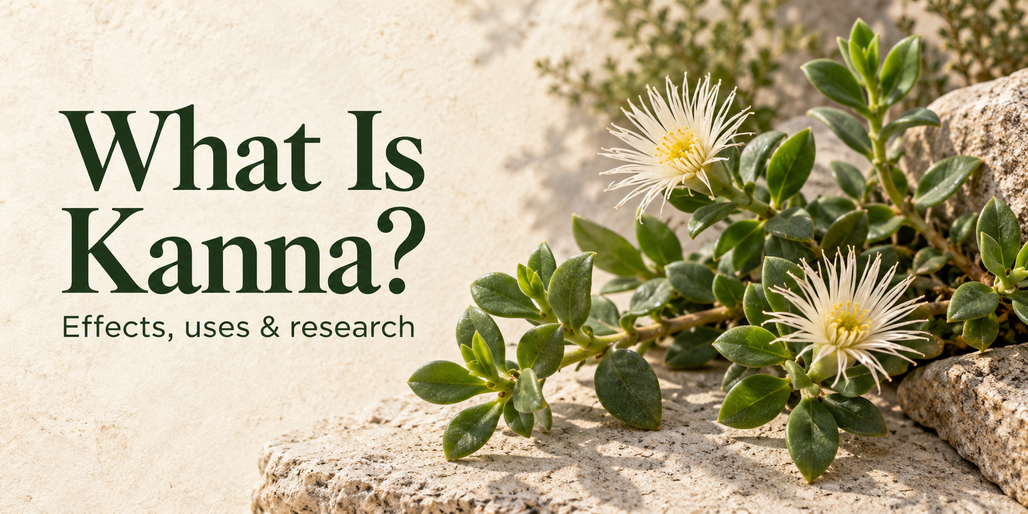
Kanna is a South African succulent commonly known as Sceletium tortuosum. It has a history of use among San and Khoikhoi peoples and contains alkaloids studied for their effects on mood and stress responses. The background to a human brain-imaging study describes that botanical and traditional context.
Today, kanna supplements are marketed for relaxation, stress, and focus. However, the human research remains small and short term, as explained by Operation Supplement Safety's kanna review. A promising finding about one extract does not establish the benefits of every product carrying the plant's name.
This guide explains the research, product differences, and questions to ask before considering kanna. For broader context, start with our guide to herbal supplements, their uses, and safety considerations.
The kanna plant and its traditional use
Scientific literature may also call the plant Mesembryanthemum tortuosum. Traditional preparations included fermented plant material, and historical accounts describe chewing it or preparing it for other uses. The 2013 research paper's introduction discusses this history. Traditional use provides context, but it does not settle questions about modern extract strength, medication interactions, or long-term safety.
How does kanna work?
Kanna contains alkaloids including mesembrine and mesembrenone. In a laboratory pharmacology study, a standardized extract and individual alkaloids affected the serotonin transporter and an enzyme called phosphodiesterase 4, or PDE4. These are biological targets involved in chemical signaling.
That helps explain researchers' interest in mood and cognition. It does not establish that kanna treats depression, works like a prescribed antidepressant in practice, or produces the same response in everyone. Laboratory activity is a starting point for human research, not a clinical result.
Kanna effects: what do human studies actually show?
The evidence gives a more qualified picture than a simple list of kanna benefits. For example, two experiments published in 2020 found different results: one showed no treatment effect during a multitasking challenge, while the other found lower reported anxiety before a simulated public-speaking stressor. Neither establishes reliable treatment of an anxiety disorder.
These four publications illustrate the scope and limits of the human evidence. All tested Zembrin, a specific standardized extract, in healthy adults.
| Study and participants | What researchers tested | Finding and limitation |
|---|---|---|
| Terburg and colleagues, 2013: 16 healthy participants | A single 25 mg dose in a placebo-controlled crossover brain-imaging study | Reduced amygdala reactivity to fearful faces under one task condition. A scan result does not demonstrate relief of a diagnosed anxiety disorder. |
| Nell and colleagues, 2013: 37 healthy adults | 8 mg or 25 mg daily, compared with placebo, for three months | The extract was well tolerated, without significant treatment-related changes in the assessed clinical measures. This small safety study did not test efficacy or establish safety for other products. |
| Chiu and colleagues, 2014: 21 healthy adults | 25 mg daily for three weeks in a placebo-controlled crossover trial | Improvements appeared in executive-function and cognitive-flexibility testing. The sample and duration were limited; this was not a dementia treatment or prevention trial. |
| Reay and colleagues, 2020: two experiments with 20 participants each | A single 25 mg dose before laboratory stress tasks | Results were mixed across the experiments, with an anxiety finding before one stress task and no treatment effect in the other experiment. |
The amounts above describe study protocols, not dosing recommendations. These findings leave substantial questions about sustained benefits, uncommon adverse effects, and use by people with medical conditions.
Funding also belongs in the picture. The 2014 cognition paper disclosed funding from the extract's developer and distributor and included researchers with commercial ties. That does not invalidate its findings, but larger independent studies would strengthen confidence in them.
Kanna herb, extracts, and capsules are not interchangeable
For botanical supplements generally, dried plant material, tea, tinctures, and extracts can differ substantially in composition and concentration. The NIH Office of Dietary Supplements explains these preparation differences and why standardization needs careful interpretation.
- Herb or plain plant powder: the amount of plant material does not by itself tell you the amount of each alkaloid.
- Extract: preparation can concentrate selected constituents. The extract's identity and composition matter alongside its weight.
- Standardized extract: look for the constituent being measured and its stated amount. The word “standardized” alone does not prove effectiveness.
- Capsule, gummy, or liquid: the delivery format does not establish what is inside. Read the ingredient panel and serving information.
For example, matching the milligram amount in a study is insufficient if the retail product contains a different preparation. NCCIH specifically cautions that supplements used in research can differ from products sold to consumers.
Kanna side effects and medication interactions
Reported side effects include headache, digestive problems, tiredness, drowsiness, and difficulty concentrating, according to Operation Supplement Safety. Their frequency and severity across different commercial preparations are not well established.
Get a medication review before considering kanna
Kanna's observed activity at the serotonin transporter provides a reason for caution with medicines that affect serotonin. This is a precaution based on pharmacology, not a measured interaction rate. Ask a pharmacist or prescribing clinician to review the actual product and your medication list before combining them.
SSRIs, SNRIs, and MAOIs are among the medicines relevant to serotonin toxicity. MedlinePlus explains serotonin syndrome, a potentially serious reaction associated with excessive serotonergic activity. Seek urgent medical help for concerning combinations of symptoms such as agitation or confusion, fever, heavy sweating, tremor, or muscle rigidity after taking a substance.
Do not stop or reduce a prescribed antidepressant to make room for kanna. Discuss any proposed change with the prescriber.
Be especially cautious where safety data are missing
The adult studies above do not answer safety questions for children, pregnancy, or breastfeeding. NCCIH's supplement guidance emphasizes that many supplements have not been adequately studied in these groups and can complicate surgery or interact with medicines. Consult an appropriate clinician before use if any of these circumstances applies.
What about combining kanna with cannabis?
Research on kanna alone does not establish the safety of combining it with THC, CBD, alcohol, or other psychoactive substances. OPSS highlights unanswered questions about recreational preparations and combinations. Claims that a blend reliably improves a cannabis experience go beyond that evidence.
If you are comparing herbal blends, our guide to smoking herbs with cannabis, evidence, and risks provides broader context. An oral-extract study should not be used as proof that smoking the same plant is safe.
How to evaluate a kanna label
Before focusing on a promised effect, check whether the product can be identified and assessed. These questions make a discussion with a pharmacist or clinician more useful:
- What is the botanical ingredient? Look for the scientific name and whether the product contains plant material or an extract.
- What is in one serving? Check the serving size, ingredient amounts, and any other active ingredients in the blend.
- What does the standardization claim mean? Look for a named constituent or alkaloid specification rather than relying on a strength adjective.
- Is there a report for this batch? Ask for independent testing that identifies the product and clearly states which constituents and contaminants were assessed.
- Does the cited research match the product? Compare the preparation and route of administration, not just the word “kanna.”
- Has someone qualified reviewed the combination? Bring the complete label alongside your medicines and other supplements.
The FDA's dietary supplement guidance explains required label information and the limits of premarket oversight. A proprietary blend can make individual amounts less transparent, and a supplement label does not mean the FDA approved the product before sale.
Our guide to why third-party testing matters for CBD and hemp products explains useful report-reading principles. For kanna, ask whether testing actually measures kanna constituents; a cannabinoid panel does not answer that question.
Testing has limits, too. The NIH botanical supplement guide notes that a quality seal does not guarantee a supplement is safe or effective. A laboratory report helps answer what was measured, not whether the product is appropriate for you.
Frequently asked questions
Is kanna psychoactive, and does it get you high?
Kanna is psychoactive in the broad sense that it can affect mental processes. However, “high” is an imprecise description. The human stress experiments measured specific responses to a standardized extract; they do not establish a predictable recreational experience.
Is Zembrin the same thing as kanna?
Zembrin is a named standardized extract made from kanna. It is the preparation tested in the three-month safety trial, among other studies. “Kanna” is the broader plant name, so a product labeled kanna is not necessarily equivalent to Zembrin.
What is the right kanna dosage?
The studies summarized here do not establish a universal dose for every kanna product or person. Their amounts apply to particular research preparations. Because retail supplements can differ from study products, copying a trial's milligram amount is not a reliable way to choose a dose.
How long does kanna take to work, and how long does it last?
These studies do not provide a dependable onset-and-duration timetable for every preparation. A measurement taken at one scheduled point after a dose cannot show exactly when an effect began or ended. Treat precise universal timelines as claims that need product-specific human evidence.
Is kanna safe to take every day?
The small three-month safety study offers limited reassurance for the tested extract and study population. It does not establish indefinite daily safety, safety during medication combinations, or the safety of stronger or differently prepared extracts.
Is kanna addictive?
The short tolerability trial does not settle dependence or withdrawal risk. Its results should not be turned into a blanket “non-addictive” claim, particularly for preparations and patterns of use it did not examine.
Is kanna the same as kava or kratom?
No. These are different plants. Kava is Piper methysticum, while kratom is Mitragyna speciosa. Similar marketing language does not make their ingredients, effects, or safety profiles interchangeable.
Are kanna supplements FDA approved?
Dietary supplements do not undergo FDA approval for safety and effectiveness before marketing. The FDA explains this distinction. Supplement availability should not be interpreted as approval to treat anxiety, depression, or another medical condition.
Popular Products
Check out these customer favorites.