
Why Cannabis Strain Names Are So Weird and What They Mean
Why Cannabis Strain Names Are So Weird
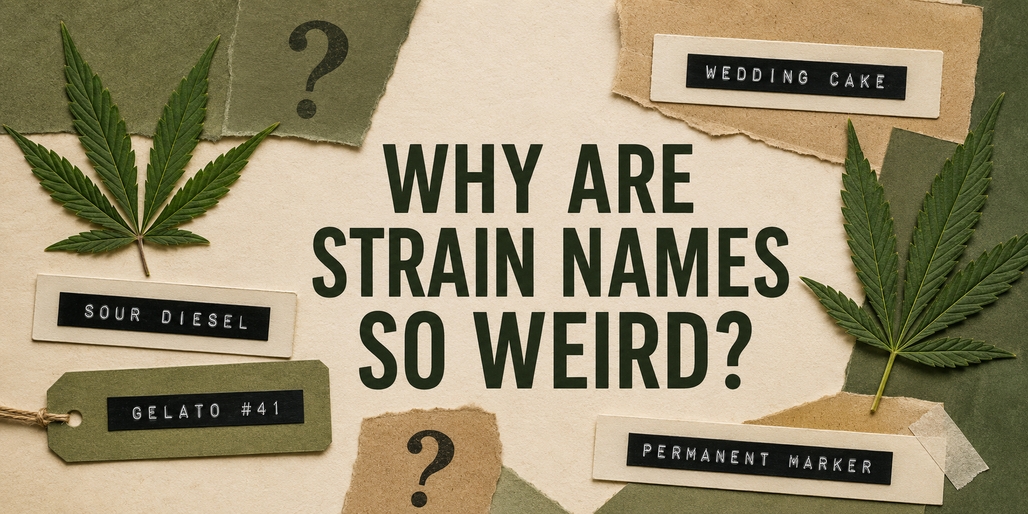
A cannabis menu can sound like someone combined a bakery, a gas station, a comic-book convention, and a botany experiment. Wedding Cake might sit beside Sour Diesel, Permanent Marker, Gelato #41, Durban Poison, and Jack Herer. Without context, the list barely sounds like it describes the same plant.
Cannabis strain names are so weird because they were never created under one universal naming system. Breeders, growers, and brands have drawn names from genetics, geography, aroma, appearance, people, jokes, perceived effects, and whatever might make a new cultivar memorable. Some names preserve useful history. Others are mostly stories or branding.
Before decoding the names, keep one distinction clear. A strain name identifies a marketed plant variety or breeding line. THCA, delta-9 THC, delta-8 THC, and similar terms identify cannabinoids. To understand those chemical labels separately, start with Green Nursery’s guide to the different types of THC.
Why cannabis strain names became so unusual
For much of modern cannabis history, breeding happened without the transparent records, centralized cultivar registries, and documented supply chains associated with many conventional crops. Genetics traveled through seeds, clones, private collections, informal exchanges, and word of mouth. A memorable name helped growers distinguish one plant from another, even when the underlying records were incomplete.
Researchers studying cannabis genetics have connected some of today’s naming confusion to the plant’s history of clandestine cultivation and extensive hybridization. A name could move from one grower to another while the plant changed, the original genetics disappeared, or a different cultivar inherited the familiar label.
Modern legalization did not erase that history. It added retail shelves, packaging, online menus, review platforms, and intense competition. A cultivar now needs to be remembered by customers as well as breeders. “Hybrid Selection 27-B” might work inside a breeding room. Wedding Cake is much more likely to stick in someone’s mind.
The result is a naming culture that mixes horticulture, oral history, sensory language, humor, and marketing. That combination is messy, but it is also part of what makes cannabis culture recognizable.
Six ways cannabis strains get their names
There is no single formula, but most cannabis strain names fall into several overlapping patterns. One cultivar can fit more than one category at the same time.
| Naming pattern | What inspires it | What it may communicate | What it cannot prove |
|---|---|---|---|
| Geography | A region or claimed place of origin | Heritage or geographic association | Current genetics, chemistry, or legal category |
| Parent lineage | One or both parent names | A possible genetic relationship | Exact ancestry or batch composition |
| Aroma and flavor | Fruit, fuel, spice, earth, candy, or dessert notes | An intended sensory direction | A guaranteed terpene profile or flavor |
| Appearance | Color, trichomes, or plant structure | A memorable visual characteristic | Potency, purity, or quality |
| People and culture | Activists, music, stories, or inside references | A tribute or cultural connection | Genetics or expected effects |
| Marketing and humor | A name designed to attract attention | A memorable retail identity | Anything measurable about the batch |
These patterns can help you interpret a name, but they are clues rather than fixed rules.
1. Names based on geography
Some older names are associated with places, including Durban Poison, Acapulco Gold, Colombian Gold, and Hindu Kush. These names may preserve a connection to regional cultivation or to genetics historically associated with a particular area.
Geographic language can also outlive the original genetics. “Kush,” for example, began as a reference to the Hindu Kush region and later became a much broader cannabis-family and marketing term. Green Nursery’s guide to what Kush means in modern strain names explains how that transition occurred.
2. Names assembled from parent strains
Breeders sometimes combine or preserve parts of the parents’ names. This can give buyers and other breeders a rough hint about the family tree.
Super Lemon Haze is a particularly clear example. Green House Seed Company, its original breeder, identifies it as a cross between Lemon Skunk and Super Silver Haze. The finished name preserves recognizable pieces of both parents. The lineage is documented on the breeder’s official Super Lemon Haze page.
Even a well-documented parent-based name does not tell you the chemical profile of every harvest. Other hybrid names are less transparent because breeders may use a pun, replace the parent names entirely, or emphasize only the more recognizable side of the family.
3. Names inspired by aroma or flavor
Cannabis flower can produce citrus, berry, pine, pepper, floral, earthy, creamy, fuel-like, and sulfurous aromas. Names such as Skunk, Sour Diesel, Lemon, Cheese, Garlic, Cake, and Gelato turn those sensory associations into memorable shorthand.
These names should be read as expectations rather than laboratory findings. A lemon-themed name might suggest a citrus aroma, but it does not prove that limonene is the dominant terpene. Two batches carrying the same name can also smell noticeably different. For a clearer explanation of what shapes cannabis aroma, continue with Green Nursery’s guide to terpenes in cannabis and hemp.
4. Names based on appearance
Colors and visible traits frequently enter the name. Words such as Purple, White, Frost, Gold, and Platinum can refer to coloration, resin coverage, trichome-heavy appearance, or the image a breeder wants the name to create.
Appearance does not establish potency. Purple flower is not automatically stronger, and visible trichome coverage does not reveal an exact THC or CBD percentage. Color and resin can be meaningful plant traits, but they must be interpreted separately from laboratory measurements.
5. Names that honor people or culture
Some cultivars are tributes. Jack Herer was named for the cannabis author and activist. Sensi Seeds, the breeder responsible for the cultivar, describes the name as an honor recognizing his work in the cannabis community on its Jack Herer history page.
Other names reference music, films, fictional characters, local stories, or private jokes. These names can become difficult to trace once they separate from the original breeder. When several origin stories circulate without strong documentation, the honest answer may be that the history is disputed.
6. Names created to be memorable
Sometimes the weirdness is the point. A surprising name earns a second look, gives customers something to talk about, and distinguishes one cultivar from hundreds of competing options.
Dessert, candy, fuel, soap, marker, and food names have become especially visible in modern cannabis branding. They make an unfamiliar cultivar feel vivid before the package is opened. That is effective storytelling, but it can also encourage shoppers to assume more consistency than the name deserves.
What do numbers in strain names mean?
A number such as #4, #33, or #41 often identifies a plant selected during a breeding or phenotype-hunting project. A breeder may grow multiple seeds from the same cross, label the resulting plants, and retain the selection with the most desirable combination of aroma, appearance, growth, or chemical traits. If selection 41 becomes popular, the number may remain attached to the commercial name.
That is why Gelato #41 and other numbered names may refer to a particular selection within a broader genetic family. However, the numbers do not follow one universal code. A number might identify a selected plant, breeding line, seed lot, internal project, generation, or something personally meaningful to the breeder.
What a cannabis strain name can and cannot reveal
A strain name is not meaningless. It can point toward a claimed parent, breeding family, geographic history, sensory goal, or cultural story. The problem begins when that clue is treated as a certificate.
| A name may suggest | A name does not establish |
|---|---|
| Claimed lineage or family | Verified genetic identity |
| Expected aroma direction | The actual terpene panel |
| A geographic or cultural association | Where the batch was grown |
| A breeder’s selected phenotype | THC, THCA, CBD, or minor-cannabinoid content |
| A familiar market category | Guaranteed effects for an individual |
| A memorable identity | Freshness, purity, safety, or legal status |
Genetic research provides a concrete reason for that caution. A study of commercial cannabis samples found that, in 6 of 17 same-name comparisons, samples were genetically closer to differently named samples than to samples carrying the same name. The researchers concluded that genetic identity could not reliably be inferred from the strain name alone. The complete study is available through the National Library of Medicine.
Other studies have identified similar problems in chemical classification. Research examining state-regulated medical cannabis found that products sharing a reported chemovar name could differ significantly in their chemical profiles. This does not make every name false. It shows why a name should not replace measured batch information. See the peer-reviewed study on cannabis chemovar names and chemical variation.
Is cultivar more accurate than strain?
“Cultivar” is often the more precise horticultural term for a cultivated plant selection, while “strain” remains deeply established in cannabis retail and culture. Changing the word does not automatically solve the identification problem. A cultivar name is only as reliable as the breeding records, propagation, labeling, and supply chain behind it.
Why the same strain name can describe different flower
Two packages can carry the same strain name and still look, smell, or test differently. Several sources of variation may be involved.
- Different genetics: Two breeders may release different plants under the same or similar name.
- Seed variation: Plants grown from seeds produced by the same cross are siblings, not necessarily identical copies.
- Clone identity: Clones can preserve a selected genotype more closely, but labeling mistakes and supply-chain substitutions can still occur.
- Phenotype selection: Breeders may retain different expressions from the same genetic family.
- Cultivation: Light, temperature, nutrition, stress, and harvest timing can affect the traits a plant expresses.
- Postharvest handling: Drying, curing, storage, age, oxygen, light, and heat can change aroma and overall condition.
- Renaming: A familiar or marketable name may be applied to genetics with an uncertain connection to the original.
Genotype refers to the plant’s genetic makeup. Phenotype refers to the observable traits produced through the interaction of genetics and environment. Cultivation can change how a plant expresses its traits, but it does not transform one genotype into an unrelated cultivar.
This is why consistency should be evaluated at the breeder, cultivator, and batch levels instead of being assumed from the name alone.
Why familiar cannabis names also appear on hemp flower
Names such as Bubba Kush, Hawaiian Haze, Lifter, or Sour Space Candy can appear in hemp-flower conversations because hemp and marijuana do not use separate cultural naming systems. A familiar cannabis-family name may be retained, adapted, or used to communicate a similar aroma or breeding direction.
The name does not determine the product’s cannabinoid category. As of August 21, 2026, the USDA’s federal hemp information distinguishes hemp through THC concentration and regulatory testing, not through words such as Kush, Haze, Gelato, or Diesel. The USDA hemp program FAQ explains the current federal distinction. State rules and federal requirements can change, so a strain name should never be used as a legal-status shortcut.
A CBD-dominant Bubba Kush hemp batch and a THC-dominant Bubba Kush cannabis batch may share name recognition or an intended earthy aroma direction, but they should not be treated as chemically interchangeable. Green Nursery’s guide to how the same cannabis strain can be hemp or marijuana explains this distinction in greater detail.
This is also where the difference between strain names and cannabinoid names matters most. “Bubba Kush” may describe a cultivar family or market identity. “CBD,” “THCA,” and “delta-9 THC” describe parts of the measured cannabinoid profile. One is a name. The others are chemistry.
How to look beyond the strain name
You do not have to ignore strain names. Use them as the beginning of the investigation rather than the final answer.
- Identify the breeder or cultivator. The company behind the genetics may have more useful records than a retailer repeating a familiar name.
- Look for documented lineage. Separate an original breeder statement from an origin story repeated without a source.
- Read the description critically. Aroma language describes an intended sensory profile, not guaranteed chemistry or effects.
- Match the product to its batch. Confirm that the package, lot number, and laboratory report belong together.
- Check the cannabinoid panel. Review the measured THC, THCA, CBD, CBDA, and other reported cannabinoids instead of inferring potency from the name.
- Review the terpene panel when available. Compare measured compounds and units instead of assuming a citrus, Kush, or dessert name identifies the dominant terpene.
- Check which safety panels were included. A potency result does not prove that pesticides, heavy metals, microbes, or other potential contaminants were tested.
- Consider freshness and storage. Even accurate genetics and testing cannot compensate for poor postharvest handling.
- Keep expectations flexible. Names, indica and sativa labels, and marketing descriptions do not guarantee how an individual will respond.
Green Nursery’s guide to reading a CBD flower lab report explains how to check batch information, cannabinoids, terpenes, and tested contaminant panels. You can also review Green Nursery’s available COAs and laboratory reports when comparing current products.
Frequently asked questions
Who names a cannabis strain?
The breeder who creates or selects the cultivar usually chooses its first name. A grower, brand, distributor, or retailer may later shorten, modify, or replace that name. This is one reason tracing a name back to the original breeder can be useful.
Is there an official registry of cannabis strain names?
There is no single global registry governing every cannabis strain name used by breeders and retailers. Individual companies may maintain breeding records, and particular jurisdictions may regulate product labels, but those systems do not create one worldwide naming standard.
Why are so many cannabis strains named after food?
Food names are memorable and can communicate an intended aroma or flavor quickly. Words such as Cake, Gelato, Cookies, Cherry, Lemon, and Garlic create an expectation before someone smells the flower. The comparison may be useful, but it does not verify the terpene profile.
Why are some weed strain names so funny?
Humor helps a cultivar stand out and reflects cannabis culture’s history of inside jokes, wordplay, and informal breeding communities. A strange name can also generate conversation and make a product easier to remember on a crowded menu.
What does a number such as #41 mean in a strain name?
It often identifies a plant or phenotype selected during a breeding project, but the meaning depends on the breeder. It is not automatically a THC percentage, generation number, or quality ranking.
Can two different cannabis strains have the same name?
Yes. Different genetics may be sold under identical or very similar names, especially when a name becomes popular. Two same-name products can also come from related genetics but different seed selections, cultivators, or batches.
Can strain names reliably predict effects?
No. A name may preserve a reputation or intended profile, but effects can be influenced by cannabinoids, serving size, product form, individual tolerance, biology, setting, and other factors. Neither a strain name nor an indica or sativa label guarantees a particular experience.
Is THCA a cannabis strain?
No. THCA is a cannabinoid found in raw cannabis flower. A strain name identifies a marketed cultivar or breeding line, while THCA describes part of the plant’s chemistry. Many different strains can contain THCA in different amounts.
Does a strain name prove whether flower is hemp or marijuana?
No. Legal classification depends on applicable law and measured cannabinoid information, not on names such as Kush, Haze, Diesel, or Gelato. Review current batch testing and the rules that apply in your jurisdiction.
Can a COA confirm that a strain’s genetics are authentic?
Usually not. A standard COA can report the tested sample’s cannabinoids, terpenes, and any included contaminant panels. It normally does not provide full genetic authentication or prove that the flower descends from the original cultivar associated with the name.
Should shoppers ignore strain names completely?
No. Names can be useful for discovering breeding families, aroma preferences, and cultural history. They work best as an entry point followed by breeder information, batch-specific testing, freshness evaluation, and careful comparison.
Popular Products
Check out these customer favorites.