
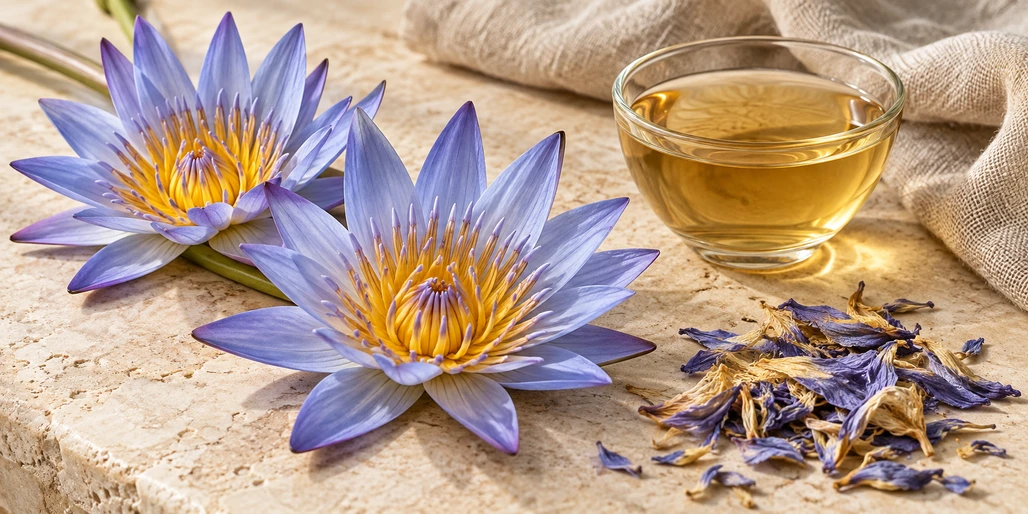
Blue Lotus Effects, Uses, Tea Preparation & History
Blue Lotus: Effects, How to Use It, and Ancient Egyptian History
Blue lotus is a water lily best known for its place in ancient Egyptian culture and its modern use in herbal teas and extracts. People seek it out for relaxation, dream experiences, and a possible sense of euphoria. However, reliable human evidence has not established those benefits, a standard dose, or a predictable experience. Operation Supplement Safety's overview explains the gap between its reputation and the evidence.
Its story is still worth exploring. The flower connects Egyptian ideas about rebirth with present-day questions about botanical identity, preparation, and effects. This guide covers that history and explains how people use blue lotus today. For the wider context, start with our guide to herbal supplements and botanical safety.
What is blue lotus?
Egyptian blue lotus is commonly called Nymphaea caerulea. Despite the name, it is a water lily. Kew's Plants of the World Online treats that name as a synonym of Nymphaea nouchali var. caerulea, so both names can appear in botanical references.
A common name is only a starting point for identification. Ask which botanical the supplier is selling and which plant part is included. A flower photograph or the words "sacred lotus" do not establish that two products contain the same plant.
Blue lotus is also separate from hemp and cannabis. It should not be understood as a type of CBD flower, THCA flower, or a cannabinoid. Products combining botanicals with hemp ingredients need to be evaluated as blends, using their full ingredient lists.
Blue lotus history: why the flower mattered in ancient Egypt
A flower associated with the returning sun
Picture a flower closing at night and opening again in the morning. That daily rhythm helps explain the blue water lily's symbolic power. The Metropolitan Museum of Art connects blue lotus imagery with the sun and rebirth. Its collection includes a blue faience chalice fragment, dated approximately 1080 to 664 BCE, decorated with alternating water lilies and papyrus.
The image carried meaning beyond decoration. The museum explains that the lily represented Upper Egypt and papyrus represented Lower Egypt; the plants could be intertwined to express the country's unification. On a drinking vessel, the flower belonged to a wider visual language of renewal, identity, and the natural world.
What can we say about ancient preparations?
Claims that Egyptians simply steeped blue lotus in wine and experienced a predictable psychedelic effect are less settled. A March 11, 2025 UC Berkeley report on ongoing research describes questions about plant identification and how ancient preparations might have worked. It presents an oil-and-wine preparation as a research hypothesis, not a confirmed universal recipe.
That distinction leaves room for curiosity without inventing certainty. Egyptian objects document the flower's cultural importance. They cannot tell us exactly what every participant drank or felt. A modern cup of blue lotus tea should be described as a contemporary preparation, rather than a verified recreation of an ancient ceremony.
Blue lotus effects: what might it feel like?
Descriptions of blue lotus often include feeling calmer, sleepier, or mildly euphoric. Those reports do not establish how likely an effect is, how strong it will be, or whether it comes from the labeled plant alone. OPSS finds no reliable scientific evidence establishing its safety or effectiveness for a specific human use.
| Claim or experience | What the evidence allows us to say |
|---|---|
| Relaxation or an uplifted mood | Reported experiences, without a dependable response or strength established in controlled human research. |
| Better sleep | A sleepy feeling does not demonstrate improved sleep quality or an effective insomnia treatment. |
| Vivid or lucid dreams | Treat these claims as anecdotal, not a reliable outcome to expect from tea. |
| Increased libido | A traditional reputation or marketing claim does not establish a sexual-health benefit. |
Intoxication has been reported, but the product matters
A case series published online in August 2021 described five patients with altered mental status after using products identified as blue lotus. Four had vaped and one had consumed an infused beverage. Symptoms included sedation and altered perception. These were emergency presentations, not a trial measuring the usual experience of drinking authenticated flower tea.
Later forensic research published in 2024 found synthetic cannabinoids in some products associated with blue lotus. The authors also noted that the earlier case series lacked analytical confirmation of what caused the reactions. This makes it inappropriate to attribute every reported "blue lotus high" to the flower itself.
Why the chemistry is less straightforward than it sounds
Apomorphine and nuciferine frequently appear in explanations of blue lotus. But a 2023 chemical analysis of six authentic extracts and eleven commercial products found these compounds virtually absent from the authentic extracts it examined. Its safety assessment concerned diluted topical fragrance use, not drinking or inhalation. Neither that study nor research on isolated compounds establishes what a cup of tea will do.
How to use blue lotus: tea, extracts, and other forms
Blue lotus is sold as dried plant material, tea, and various extracts, as documented in the clinical case-series background. The first practical question is which preparation you actually have. Directions for loose flowers cannot be transferred to a resin, tincture, or vape liquid.
How blue lotus tea is prepared
The basic method is an herbal infusion: steep plant material in hot water, then remove the solids. The NIH Office of Dietary Supplements explains this preparation method and why teas and extracts can differ in strength. The following sequence applies only to a product explicitly intended for oral tea preparation.
- Read the package first. Confirm the botanical name, ingredients, intended use, and preparation directions. Do not brew products labeled for fragrance, decoration, or external use.
- Measure as directed. Use the supplier's stated flower quantity and water volume. Do not substitute an extract amount for dried-flower weight.
- Steep in a clean cup or teapot. Use drinking water and the temperature and steeping time specified for that product.
- Strain and let it cool. Remove the plant material with a food-safe strainer before drinking.
If the label omits the amount, water volume, or steeping time, ask the supplier. These steps describe preparation, not a clinically validated safe dose. A darker infusion is not a measurement of active compounds.
Why there is no universal blue lotus dosage
There is no well-established clinical dosing schedule for blue lotus tea. A June 2026 conference abstract reviewing the limited literature highlights uncertainties around dose, composition, and psychiatric effects. It was a conference contribution, not a controlled dosing trial or a standard peer-reviewed journal article.
Claims such as "10x" or "20x" are not enough to calculate an equivalent cup of tea. Ask what the ratio means and whether any relevant constituents were actually measured. Avoid repeatedly increasing the amount to chase an expected sensation.
Smoking, vaping, and alcohol infusions
Smoking a flower adds combustion exposure. The National Cancer Institute explains that herbal cigarettes produce harmful substances including tar and carbon monoxide, even without tobacco or nicotine. That makes smoking a poor choice for someone trying to avoid smoke-related harm.
Vape liquids introduce separate concerns about ingredients and adulteration. Historical discussion of wine preparations also should not be read as advice to combine blue lotus with alcohol. Neither route solves the uncertainty about dose or contents.
Side effects and precautions before use
Unwanted sedation and changes in perception were observed in the five-patient case series. The small sample and uncertain product composition mean it cannot establish how often reactions occur across the market.
Given those reports and the limited evidence, take a cautious approach:
- Do not use before driving or hazardous work. A product promoted for relaxation should not be assumed to leave alertness unchanged.
- Avoid mixing with alcohol, cannabis, or sedating medicines. Blue-lotus-specific interaction data are inadequate; this is a precaution, not a claim that every combination has been studied.
- Discuss medications and health conditions with a clinician or pharmacist. Bring the actual product label.
- Avoid use during pregnancy or breastfeeding, and do not give it to children. Adequate safety evidence is lacking.
NCCIH's supplement guidance explains the broader concerns about interactions, untested use in pregnancy and childhood, and stopping a supplement after an adverse reaction. Seek urgent medical help for severe confusion, a seizure, breathing difficulty, chest pain, or an inability to wake normally. Keep the packaging available for the treating team.
What to check on a blue lotus product
Product identity deserves as much attention as the advertised effect. The 2024 forensic study examined evidence from investigations mentioning blue lotus or valerian root, including mislabeled vaping products. It was not a random survey of retail flower or tea, so its findings should not be presented as the contamination rate of all blue lotus products.
Before choosing a product, ask:
- What botanical name and plant part does it contain?
- Is it dried flower, an extract, or a blend with other active ingredients?
- What use is it actually intended for?
- Does testing identify this product and batch, and what did the laboratory test?
- Can the supplier explain its identity checks and contaminant controls?
For readers familiar with hemp testing, our explanation of why third-party testing matters provides useful background. A CBD or THC potency panel alone cannot authenticate blue lotus or rule out substances outside that panel.
Is blue lotus legal?
Check the current rules for your location and the exact product. A store listing does not settle questions about possession, intended use, imports, or workplace requirements.
For example, as checked on October 1, 2026, Louisiana Revised Statutes 40:989.2 names blue lotus among prohibited plants for specified preparations and activities. The statute also includes exceptions, including strictly decorative uses and certain compliant dietary supplement dosage forms. Calling it either universally legal or completely banned misses those conditions.
Service members have a separate restriction: OPSS lists blue lotus as prohibited for military use. Civilian retail availability does not override that rule.
Frequently asked questions
Does blue lotus get you high?
Intoxication has been reported after products sold as blue lotus, but the contents and preparations vary. Those reports cannot predict the effects of an authenticated flower tea. Treat impairment as possible, without expecting a particular kind of high.
How long does blue lotus take to work, and how long does it last?
Research does not provide a dependable onset or duration for a standard cup. Product differences make precise online timelines difficult to apply. Do not use an advertised duration to decide when it is safe to drive or to justify taking more.
Can you drink blue lotus tea every day?
Long-term daily safety has not been established. A history of use does not answer that question for a modern product. Discuss repeated use with a qualified health professional, especially if your goal is managing ongoing sleep or mood symptoms.
Is blue lotus the same as kava?
No. Blue lotus is a water lily; kava is Piper methysticum. Green Nursery's cut and sifted kava root is a root preparation, not blue lotus flower. Our guide to kava's effects and preparation explains its distinct research and risks. Serving instructions should not be swapped between them.
Will blue lotus show up on a drug test?
No article can guarantee a negative result for an unverified product. Tests vary, and forensic investigations have identified undeclared synthetic cannabinoids in some associated products. "Herbal" does not mean drug-test-safe.
Popular Products
Check out these customer favorites.