
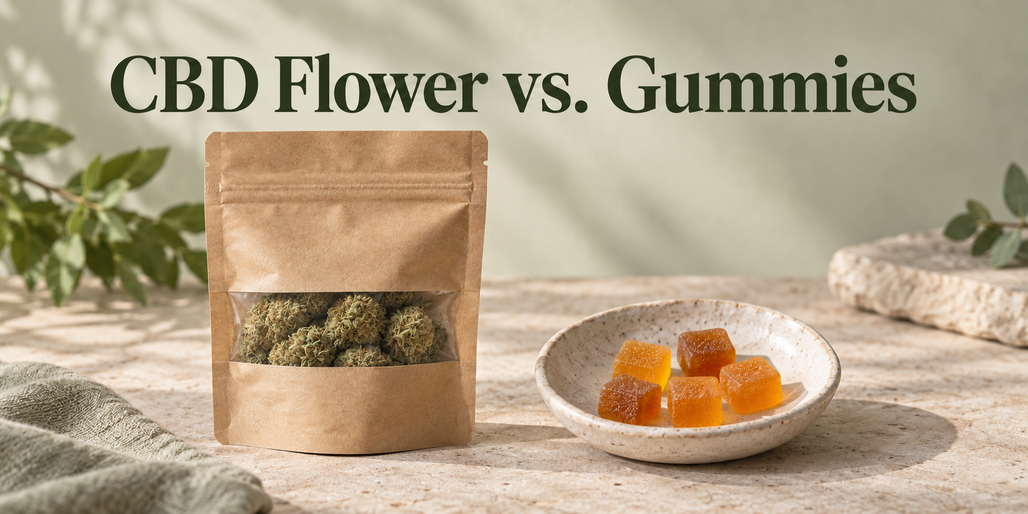
CBD Flower vs. CBD Gummies: What’s the Difference?
CBD Flower vs. CBD Gummies: What's the Difference?
CBD flower is dried hemp flower, commonly smoked or used in a dry-herb vaporizer. CBD gummies are edible products with CBD added to a gummy recipe. The practical difference is how you use them: flower involves preparation and an inhaled route, while gummies offer a portable, smoke-free format with a labeled amount per piece or serving.
Neither format is automatically stronger or better. A useful comparison looks at CBD content, THC content, ingredients, preparation, and product testing. If the cannabinoid names on a label are unfamiliar, our guide to CBD, THC, and other cannabinoids explains the broader terminology.
CBD flower and gummies compared
Start with the everyday differences. This table describes typical products, so check the actual package and batch report before applying it to a particular item.
| What to compare | CBD flower | CBD gummies |
|---|---|---|
| Product form | Dried hemp flower sold loose or in prepared products such as pre-rolls. | A gummy recipe containing a CBD ingredient. |
| Typical route | Inhalation when smoked or vaporized. | Swallowed and digested. |
| Preparation | Loose flower generally requires accessories, handling, and cleanup. | Usually ready to use from the package. |
| CBD measurement | Often shown as a percentage or milligrams per gram. | Usually shown as milligrams per piece, serving, or package. |
| Aroma and portability | Distinct plant aroma; accessories can make carrying it less convenient. | No smoke or vapor; portable packaging still needs secure storage. |
| Ingredient review | Check whether it is plain flower or has added flavorings, coatings, or cannabinoids. | Check sweeteners, gelatin or pectin, allergens, and other active ingredients. |
| THC review | Read the actual cannabinoid results instead of relying on the strain name. | Read the spectrum description and THC results instead of assuming all gummies are THC-free. |
A convenient format and a clear label are useful, but neither establishes medical effectiveness or confirms that the product is suitable for you.
What each format contains
CBD flower is a botanical product
Flower retains the plant material itself. Appearance, aroma, moisture, trim, and cannabinoid composition can vary between batches. Those differences make the batch information more useful than a familiar strain name alone.
For example, our Lifter CBD flower is sold by weight. When evaluating a flower product like this, compare the package size with the cannabinoid information and matching batch report.
This comparison concerns flower used by inhalation. Turning flower into a homemade edible changes the preparation and route, so the same comparison no longer applies. For help evaluating flower descriptions and product documentation, see our CBD flower shopping guide.
CBD gummies are formulated products
A gummy combines a CBD ingredient with an edible base. That recipe may include sugar, alternative sweeteners, flavorings, colors, gelatin, or pectin. Some products add other cannabinoids or ingredients such as melatonin, which means they are not straightforward comparisons with a CBD-only gummy.
Read the full ingredient list alongside the cannabinoid information. Our guide to evaluating CBD gummies and oils covers the product details worth reviewing before an order.
Timing: absorption is different from a noticeable effect
Inhaled CBD generally reaches the bloodstream more quickly than swallowed CBD. A controlled study of oral and vaporized CBD illustrates how route and formulation change CBD exposure. However, its oral products included capsules, syrup, and a pharmaceutical solution. It was not a direct test of retail CBD gummies against smoked flower, and it does not establish a universal gummy timetable.
There are three separate questions here: when CBD enters the blood, when its concentration peaks, and whether someone notices an effect. An absorption measurement does not answer all three. Treat precise promises such as “works in exactly 15 minutes” or “lasts all night” cautiously unless the particular claim has suitable evidence.
Noticeable effects are not guaranteed. In a small controlled study of oral CBD, vaporized CBD, and CBD-dominant cannabis, the oral CBD condition did not differ from placebo on the measured subjective effects. This does not settle every possible use of CBD, but it shows why a guaranteed sensation is a poor standard for judging a gummy.
For the comparison in front of you, ask whether the manufacturer describes the actual product and evidence, or simply repeats a timing chart. A retail label cannot promise when you will feel something.
Is CBD flower stronger than CBD gummies?
“Stronger” needs a definition. It might mean more CBD in the package, a higher concentration, more THC, or a more noticeable experience. Those are different comparisons.
Read gummy amounts per piece and per serving
Our Full Spectrum CBD Gummies 30mg provide a concrete label example: the product listing specifies 30 milligrams of CBD per gummy. For the 30-count option, that adds up to 900 milligrams of labeled CBD in the bottle. That package total is not a suggested amount to take.
When comparing gummy labels, check whether a serving means one piece or several. Milligrams per gummy, per serving, and per bottle are separate measurements.
Check that the number refers specifically to CBD. “Hemp extract,” “total cannabinoids,” and “CBD” do not necessarily describe the same quantity. The front label may also emphasize the whole package rather than one piece.
Read flower percentages as concentrations
A cannabinoid concentration of 15% by weight corresponds to 150 milligrams of that reported cannabinoid per gram of material. This describes the tested material, not a delivered dose. Also check whether the report lists CBD, CBDA, or a calculated total CBD value; those entries should not be treated as interchangeable labels.
The amount in flower does not tell you how much ends up in a puff or in your bloodstream. Likewise, a gummy's labeled content is not the amount your body necessarily absorbs. There is no dependable general conversion from a flower percentage to an equivalent number of gummies. Our CBD flower lab-report guide explains how to read the reported measurements.
THC content matters in both formats
Do not use “flower” or “gummy” as shorthand for THC content. Gummies can use full-spectrum, broad-spectrum, or isolate ingredients, and the actual cannabinoid results matter more than a reassuring name. Our full-spectrum and broad-spectrum CBD comparison explains those label terms.
CBD itself does not cause the characteristic THC high, but a CBD-labeled product can contain THC or other substances. The CDC's CBD guidance explains this distinction and the limits of product labeling. Neither format should be assumed to be nonintoxicating solely because CBD appears on the package.
Look for a certificate of analysis, or COA, that matches the product and batch. Review what was tested, the units, and the reporting limits. A result marked “not detected” means the laboratory did not detect the substance above its stated detection limit; it is not a promise about every possible exposure or testing outcome.
For Green Nursery products, use the available certificates of analysis to locate the matching report. If the batch or relevant test results are missing, ask for clarification before relying on the listing.
Safety differences worth considering
Smoking introduces a separate lung-health concern
The CDC explains that cannabis smoke contains harmful chemicals and can damage lung tissue. A high CBD content does not remove the hazards of burning and inhaling plant material. A gummy avoids that smoke exposure, although it still carries the risks associated with its ingredients.
A dry-herb vaporizer uses a different heating method from smoking. That distinction should not be turned into a claim that inhalation is risk-free.
CBD-related precautions apply beyond smoking
The FDA identifies CBD risks including medication interactions, liver injury, and drowsiness. Combining CBD with alcohol or other substances that slow brain activity can increase sedation. Talk with a clinician or pharmacist about medications and health conditions before using either format.
Pregnancy and breastfeeding are additional reasons to avoid CBD, as explained in the CDC's safety guidance. Store CBD products securely away from children. A gummy's candy-like appearance makes careful storage especially important.
Neither format guarantees a negative drug test
The Department of Transportation's CBD notice warns that CBD products may contain THC and that CBD use is not an accepted explanation for a positive marijuana test under DOT rules. Those rules specifically concern DOT-regulated testing. For a broader explanation of product uncertainty, see our guide to CBD and drug tests.
A practical checklist for comparing two products
Put the two listings side by side and work through these questions before comparing price:
- Does the format fit your constraints? Consider inhalation, aroma, equipment, preparation, and secure storage.
- What quantity does the label describe? Identify milligrams per gummy and per serving, or the flower's concentration and package weight.
- What else is in it? Review other cannabinoids, added active ingredients, allergens, and sweeteners.
- Does the COA match? Confirm the product, batch, cannabinoid results, and relevant contaminant testing.
- What remains unclear? Ask the seller about missing documentation rather than filling in the gaps yourself.
For someone prioritizing minimal preparation and no smoke, gummies have clear practical advantages. Someone considering flower should be comfortable evaluating botanical batches and accounting for the equipment and inhalation-related concerns. These are format preferences, not evidence that one product will provide better health outcomes.
Compare prices only after checking package size and contents. Price per gummy and price per gram answer different questions. Neither tells you the cost of a reliably equivalent absorbed amount of CBD.
Frequently asked questions
Are CBD gummies the same as eating CBD flower?
No. Gummies are formulated foods with a specified CBD ingredient and recipe. Flower is plant material with its own cannabinoid composition. A gummy label cannot be used to calculate a serving of raw flower.
Do CBD gummies last longer than CBD flower?
There is no dependable duration that applies to every product and person. Oral and inhaled routes produce different exposure patterns, but that does not establish how long a noticeable effect will last. See the timing discussion for the limits of the available comparison.
How many puffs of CBD flower equal one gummy?
There is no reliable universal conversion. A puff is not a standardized quantity, and a gummy's CBD content does not directly measure absorption. Matching the numbers printed on two packages does not establish equivalent exposure.
Are gummies easier for beginners?
They are generally simpler to handle because they need no smoking or vaporizing equipment and have a labeled amount per piece or serving. That convenience does not make them appropriate for everyone. Review the ingredients, THC results, and health considerations first.
Does a full-spectrum gummy contain the same things as flower?
Not necessarily. “Full-spectrum” describes an extract category, not a promise that the finished gummy reproduces a particular flower's composition. Compare the cannabinoid reports and ingredient lists for the specific products.
Is either format proven to treat anxiety, pain, or sleep problems?
Neither format label establishes an effective treatment. The FDA distinguishes approved prescription CBD treatment for certain seizure disorders from unapproved CBD products. Retail flower and gummies should not inherit prescription-drug claims. Discuss persistent symptoms with a qualified healthcare professional.
Popular Products
Check out these customer favorites.