
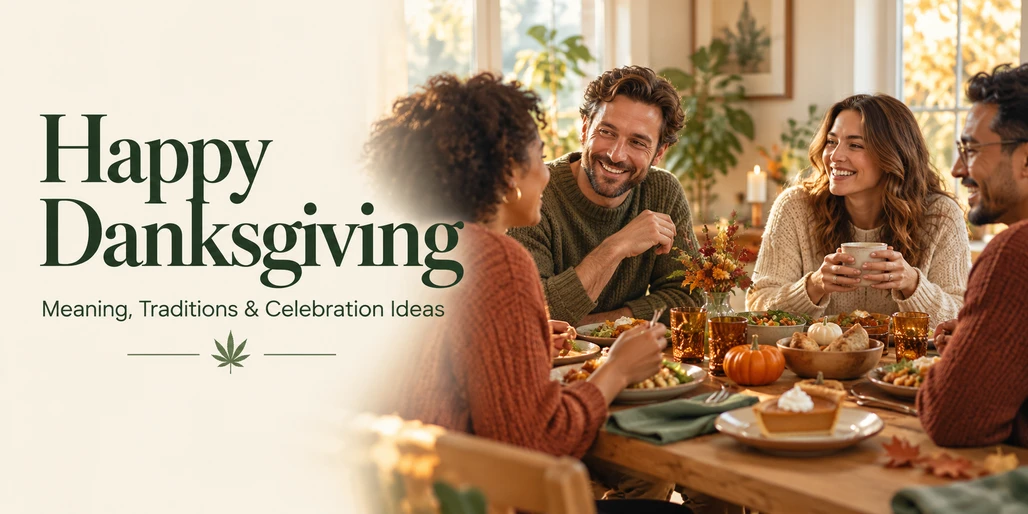
Happy Danksgiving: Meaning, Traditions & Celebration Ideas
Cannabis culture and holiday traditions
Happy Danksgiving: What It Means and How People Celebrate
Last updated:
“Happy Danksgiving” is a cannabis-themed Thanksgiving greeting. Danksgiving combines “dank,” a slang term associated with cannabis, with “Thanksgiving.” It can describe adults including cannabis in a holiday gathering, a separate Friendsgiving, or a get-together over Thanksgiving weekend. It does not require an infused turkey, a particular strain, or one universally agreed date.
The name puts a wink into a familiar scene: people arriving with covered dishes, negotiating oven space, and settling in for an afternoon together. Cannabis is part of the occasion for some adults, while the meal and company still give the gathering its shape.
For the wider cultural context, start with our guide to casual cannabis ceremonies and unwritten traditions.
What does “Happy Danksgiving” mean?
It is a holiday greeting with a cannabis reference built into the word. Leafly’s cannabis glossary describes “dank” as slang for fragrant, high-quality cannabis. In “Danksgiving,” that word supplies the joke.
The greeting does not describe a standardized event. Someone might use it in a group chat, on an invitation to a cannabis-friendly dinner, or while talking about a Thanksgiving weekend with friends. Published guides describe versions ranging from cannabis use around an otherwise ordinary meal to a deliberately infused dinner.
For example, Where’s Weed’s November 2020 guide describes that range of celebrations. The useful point is the variety, not the idea that every guest should follow the same plan.
“Dank” is also a subjective slang compliment, not a laboratory result. The name of the party tells you nothing reliable about a product’s THC content, testing, or suitability for a particular guest.
Where did the name Danksgiving come from?
There is evidence of the term well before recent holiday marketing, but no verified single inventor.
An Urban Dictionary entry dated January 14, 2008 describes a cannabis-related gathering on the Sunday after Thanksgiving. Other entries on the same page describe different schedules. These are user-submitted records of slang, not an official history or a guide to responsible consumption.
By November 15, 2018, the National Highway Traffic Safety Administration was using “Danksgiving” in a holiday driving advisory. The agency associated it with marijuana use over Thanksgiving weekend and urged people to arrange sober transportation.
The term also moved into reported food culture. In a November 21, 2022 newsletter, journalist Jackie Bryant described reporting on the word’s social history and attending a Danksgiving dinner in Los Angeles for a New York Times article.
Together, these records show a term used in community slang, public messaging, and journalism. They do not establish how many households celebrate it or when the first gathering happened.
When is Danksgiving in 2026?
There is no universally agreed Danksgiving date. If someone uses the name for U.S. Thanksgiving itself, the 2026 date is Thursday, November 26, as listed in the Office of Personnel Management’s holiday calendar.
Other uses refer to a separate gathering during the surrounding weekend. The dated slang entries mentioned above include the Friday and Sunday after Thanksgiving. Neither schedule is binding on anyone else’s celebration.
You may also encounter November 30. In a Leafly column last updated November 24, 2020, comedian Ngaio Bealum proposed that date as a playful combination of 4/20 and 7/10. That is one published interpretation, not a universal calendar rule.
For an invitation, use an actual date and time. “Danksgiving at our place” supplies the theme; “Saturday at 5 p.m.” supplies the information guests need.
Five ideas for a Danksgiving or cannabis-friendly Friendsgiving
The following are suggestions for shaping a gathering, not a list of required traditions. Choose something your guests would enjoy even if nobody consumed cannabis.
1. Give every potluck dish a story
Ask guests to bring an ordinary, non-infused dish connected to a memory: a family recipe, a college-apartment staple, or the side they think deserves more attention than turkey. Let each person explain their choice before dinner. The stories give a mixed group an easy place to start talking.
2. Make a “small things we’re thankful for” round
Keep the prompt specific enough to avoid a formal speech. Ask for a small kindness someone remembers, a song that carried them through the year, or a surprisingly good meal. Anyone can pass. A little structure can make room for quieter guests without putting them on the spot.
3. Build the playlist from everyone’s year
Have each guest contribute two songs before the gathering: one new discovery and one old favorite. Play it during dinner or cleanup, and let people explain their choices if they want to. It gives the evening a shared soundtrack without making one person the permanent DJ.
4. Keep the after-dinner plan easy to join
Put out conversation cards, a simple drawing game, or a familiar movie people can drift in and out of. Avoid making consumption part of a game’s rules. Our collection of relaxed activities to do with friends offers more options for the quieter part of the evening.
5. Make the leftovers gathering its own occasion
If Thanksgiving Day belongs to family commitments, arrange a separate friends’ meal with a clear start time and a short contribution list. A soup-and-sandwich dinner or dessert afternoon can work as well as a second full feast. Keep all shared food non-infused unless specific adults have knowingly agreed to a clearly identified alternative.
Does Danksgiving food have to contain cannabis?
No. Cannabis-infused dishes are one documented version of the celebration, not a requirement. An ordinary dinner with optional, separate adult cannabis use still fits the broad meaning of the term.
Keeping the meal non-infused also makes it easier for people to choose their food independently of cannabis. A guest should be able to take another helping of potatoes without having to calculate an additional THC serving.
That distinction matters because the CDC warns that edible effects can be delayed, last longer than expected, and be difficult to predict. A dinner schedule is not a reliable guide to when someone will feel an edible or when its effects will end.
If cannabis foods or drinks are present, keep them clearly identified, separate from ordinary refreshments, and secured away from children and pets. Keep original packaging available. A small label does not replace telling someone directly what a product contains.
Read the cannabinoids, not just the flavor
A fruit-flavored gummy may contain THC, CBD, or both. For a concrete example, Green Nursery’s Delta 9 + CBD Cannabliss Gummies are listed as containing 12 mg of delta-9 THC and 12 mg of CBD per gummy. That is a product-label example, not a recommended serving for a guest.
Check the current package and matching batch certificate of analysis. The CDC distinguishes non-intoxicating CBD itself from products that also contain THC and notes that CBD use has risks. “Hemp-derived” or “contains CBD” should never be treated as a promise that a product cannot cause impairment.
What hosts and guests should agree on before dinner
Be direct about the plan in advance. “Cannabis-friendly” can mean different things to different people, so specify whether use is allowed, where it would happen, and whether any food or drinks contain cannabinoids. A guest can accept the dinner invitation while declining cannabis.
Property permission and legal permission are separate questions. For example, California’s Department of Cannabis Control explains that property owners can prohibit cannabis use and that local rules can be stricter than state rules. Check the rules for the actual location and date of your gathering; a holiday nickname creates no exception.
Arrange transportation before anyone consumes. The CDC advises against driving after cannabis use and warns that using cannabis with alcohol can increase impairment. Choose a sober driver, taxi, or rideshare rather than assuming dinner or a cup of coffee makes someone ready to drive.
Finally, ask before posting photos or identifying anyone as a cannabis consumer. A private invitation is not permission to make someone part of a public holiday caption.
A few Happy Danksgiving greetings
If you want a light line for an invitation or a message to friends, here are three original options:
- “Happy Danksgiving. Save me a seat and a slice of pie.”
- “Happy Danksgiving to the friends who always bring a dish and a story.”
- “Good company, full plates, and plenty to be thankful for. Happy Danksgiving.”
For an invitation, follow the joke with practical details: the date, what to bring, the house rules, and an explicit welcome for people who do not consume.
Frequently asked questions about Danksgiving
Is Danksgiving an official holiday?
It is an informal cultural term rather than a separate U.S. federal holiday. People use it for Thanksgiving celebrations involving cannabis and for related gatherings on other dates.
Is Danksgiving always the Sunday after Thanksgiving?
No. A dated 2008 slang entry describes that version, but other records refer to Friday, Thanksgiving itself, or the broader weekend. Use the date on the actual invitation.
Can Friendsgiving also be Danksgiving?
Yes, if adults choose to include cannabis and use that name for the occasion. Friendsgiving by itself simply describes a Thanksgiving-style gathering with friends; it does not imply cannabis use.
Can I bring cannabis to someone else’s Thanksgiving dinner?
Ask the host first and check the applicable rules. Do not bring infused food as a surprise, leave products on a shared snack table, or assume one relative’s approval speaks for the household.
Does everyone at a Danksgiving gathering have to get high?
No. The name is not a requirement to consume. Guests should be able to eat, socialize, and decline cannabis without pressure, and anyone avoiding smoke should have that choice respected.
Popular Products
Check out these customer favorites.