
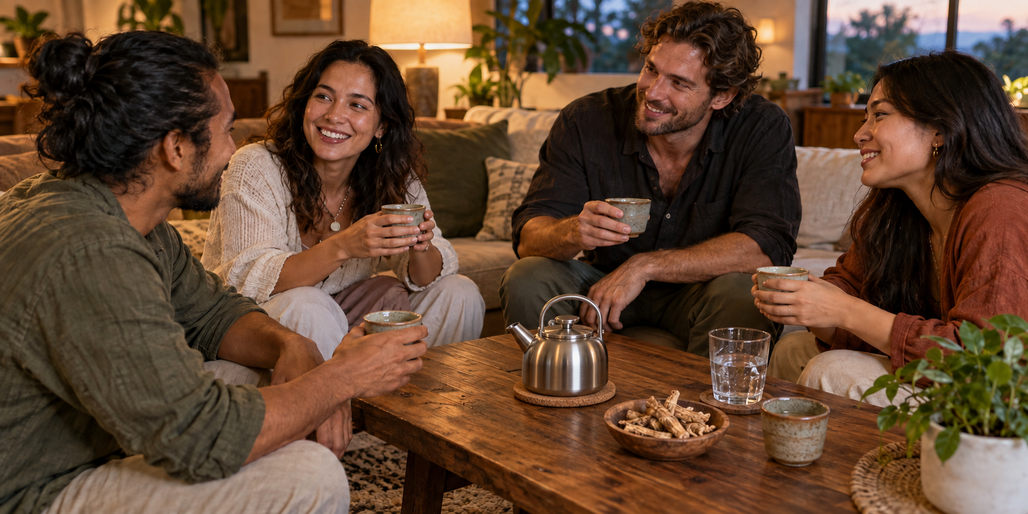
How to Create a Kava Ritual With Friends
Kava Rituals: History, Preparation, and What They Feel Like
What makes a kava ritual meaningful to the people who practice it? In published accounts of Pacific kava gatherings, participants describe belonging, learning, and relationships that continue across generations. Understanding that experience begins with the people around the drink and the traditions they bring to it.
This guide explores that cultural history, explains how the drink is prepared, and separates possible physical effects from the feelings a shared gathering can create. For background on the plant and its different forms, see our complete guide to kava.
The history of kava rituals: a plant carried across the Pacific
Kava's history follows Pacific migration and exchange. In his study of kava and cultural identity, researcher S. Apo Aporosa describes evidence linking its origins to northern Vanuatu around 3,000 years ago. Pacific voyagers carried planting material between islands long before European arrival. Communities developed their own practices and accounts connecting kava with ancestors, spiritual power, and social life.
Ceremonial details can express relationships. In Tonga, for example, Arcia Tecun describes how formal kava presentation and service reflect social rank. Who attends and the occasion influence the form of the gathering. Everyday faikava and chiefly ceremonies belong to a varied cultural practice.
Traditions also change. Te Papa's history of Samoan kava bowls explains that designs with many legs, initially made for tourists in the late 1920s, later became customary. The museum emphasizes the significance of preparation and serving alongside the vessel itself. An object that looks timeless may have its own history of adaptation.
How people within kava traditions describe the experience
Fiji: a connection to land, people, and identity
In Aporosa's account, yaqona, the Fijian name for kava, is connected with vanua: land understood together with its people, relationships, and culture. That helps explain the strength of one teacher's response in research discussing restrictions on teachers' nightly kava use:
“Yaqona is the cornerstone of our culture.”
The interviews concerned possible effects on next-day teaching, so the quote sits within a real debate about use and responsibility. It shows how a question about drinking can also become a question about identity.
Tonga and its diaspora: carrying a sense of home
In his 2017 study, Tecun records an expression developed collectively during a gathering in Utah:
“Kava is like the ocean, it’s what connects us.”
That connection had practical consequences. Some participants in Utah and Aotearoa New Zealand described learning songs at faikava that enabled them to join the singing at Tongan wakes. For people still learning the language, the gatherings offered a way into cultural participation. Tecun also observed members contributing money or other support when someone needed help.
These accounts give belonging a concrete meaning: knowing the songs, being able to participate, and having people who show up for one another.
Vanuatu: welcome, listening, and a quieter pace
The Vanuatu Tourism Office describes kava's place in welcomes, weddings, funerals, and community meetings. Its account emphasizes respect, listening, and the settling of disagreements, alongside evening gatherings in nakamals where people share time after work.
Its guidance for visitors includes keeping voices low and following the customs of the place hosting them. That offers a useful clue to the experience: the manner of gathering matters. A visitor enters a social setting with expectations already established by the people who belong there.
Conversation can be part of the ritual's purpose
A 2026 paper by Edmond Fehoko and colleagues explains how Tongan faikava can support learning through stories, humor, debate, and observation. Younger people may gain cultural knowledge through their exchanges with elders. Difficult subjects can become discussable, although age, status, gender, and local expectations still shape who speaks and how.
Read together, these accounts suggest a useful way to understand ritual: repeated acts create a setting where relationships can be maintained, knowledge shared, and obligations acknowledged. The particular meaning depends on the community.
Preparation: how kava root becomes a drink
Traditional water preparation begins with root that has been crushed or ground. Food Standards Australia New Zealand describes methods using fresh or dried root, water, and filtration. For dried ground root, working the material in a cloth or strainer bag helps release it into the water while retaining coarse fibers.
Identify the form you have
Begin with the product's actual format and directions. Green Nursery's Kava Kava Root - Cut & Sifted contains dried root pieces. Ask for directions covering any further grinding, the root-to-water ratio, preparation time, and filtration before treating it as a ready-to-mix powder.
A recipe written for ground root should not be transferred automatically to an instant preparation or concentrated extract. Keep the original packaging available so everyone can see what is being prepared.
The sequence for ground root intended for a strainer bag
- Measure. Use the product's directions for the quantity of root and drinking water. Put the measured root inside a clean, food-safe strainer bag.
- Wet the root. Lower the bag into a clean bowl of water at the temperature specified by the supplier. Traditional water preparation commonly uses cool or room-temperature water.
- Knead and squeeze. Work the submerged bag with clean hands for the instructed time, keeping the coarse root material contained.
- Strain. Squeeze out the liquid and remove the bag. Portion the finished beverage according to the product's directions.
This describes the method, not a universal dose. A larger bowl or darker drink does not tell you how much active material each person will receive.
Preparation has local histories, too
In Vanuatu, fresh root may be pounded or ground before mixing and straining. The Tourism Office also documents chewing the root in some communities on Tanna, a practice connected with local custom. Knowing that history helps explain the variety of preparations; it is not an instruction to reproduce every method at home.
What drinking kava may feel like
There are two parts to this question: sensations associated with the drink and feelings associated with the occasion. Both may influence how someone remembers a kava ritual.
Kava is psychoactive. Its active compounds, called kavalactones, affect the central nervous system. NSW Health lists relaxation, drowsiness, and a sense of well-being among possible short-term effects. Healthdirect also describes mouth and throat numbness, with effects varying according to the amount consumed and the individual.
| Experience | What to understand |
|---|---|
| Numbness around the mouth | A possible local sensation, not a reliable measurement of the amount consumed. |
| A relaxed or sleepy body | Muscle relaxation and drowsiness can occur. Stronger sedation may reduce coordination and responsiveness. |
| A feeling of ease or well-being | Some people report this, but a particular mood or social experience cannot be promised. |
| Nausea or poor muscle control | Unwanted effects are possible. Feeling unwell is a reason to stop, not a stage to push through. |
These effects are described in Healthdirect's kava guidance and the NSW clinical factsheet. Feeling mentally clear does not establish that judgment, coordination, or driving ability is unimpaired.
The feeling of connection involves more than a dose
Fehoko and colleagues describe accounts of relaxation alongside continued engagement in conversation. Their discussion also emphasizes time, trust, shared expectations, and relationships. Those conditions help explain why a gathering may feel emotionally significant.
For someone exploring kava with friends, that suggests a realistic expectation: the drink may change how the body feels, while the quality of the gathering still depends on the people involved. A feeling of closeness cannot be measured into the preparation.
Health considerations before drinking
Traditional use and a plant origin do not establish safety for every person. NCCIH reports rare but sometimes severe or fatal liver injuries associated with kava, including water-prepared drinks. It advises against combining kava with alcohol or other sedatives and recommends discussing medication use with a health professional. Avoid use during pregnancy or breastfeeding.
People with liver disease should avoid kava and seek individual medical advice, a concern highlighted in the CDC's investigation of kava-associated liver injury.
Do not drive or operate machinery after drinking. NSW Health warns that kava can affect alertness and responsiveness. Arrange transportation beforehand.
Bringing that understanding to a gathering with friends
Start with curiosity about the practice: where your kava came from, how it was prepared, and what you learned about the people who have kept these traditions alive. You could share one of the participant accounts above and discuss what makes a gathering meaningful in your own lives.
Make time for the preparation and conversation without requiring a particular emotional outcome. Keep drinking optional. Describe your evening as your own gathering with kava; seek guidance from community members if you want to learn a specific tradition's ceremony and protocols.
Frequently asked questions
What is the purpose of a traditional kava ceremony?
It depends on the occasion and community. The examples above include welcoming people, expressing social relationships, maintaining cultural knowledge, and marking significant events. Ask about the meaning of the particular ceremony you are attending.
Is kava prepared like hot tea?
The traditional root preparation described here uses water, physical working of the root, and straining. Pouring boiling water over root pieces is not the same process. Use instructions for the exact product you have.
Does kava make everyone feel calm?
No. Relaxation is a possible effect, but individual responses vary and unwanted effects can occur. Nobody needs to feel a certain way for the gathering to be worthwhile.
How much kava goes into one serving?
There is no universal cup strength. The FDA's scientific review describes variation in kava's chemical composition by cultivar, plant part, and growing conditions. Follow product-specific directions and individual medical advice rather than borrowing a serving size from another preparation.
Is kava a natural alternative to cannabis or hemp-derived THC?
Someone may prefer its different effects, but kava remains a psychoactive substance with its own risks. “Natural” does not mean harmless, and it does not establish that kava is safer or suitable for a particular person.
Popular Products
Check out these customer favorites.