
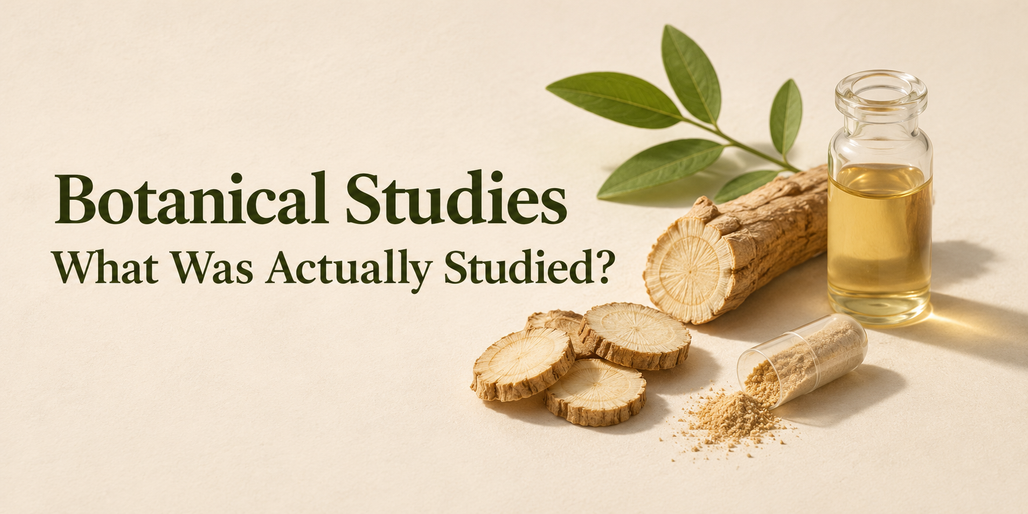
Whole Herb vs. Extract: What Botanical Studies Tested
Botanical Studies: What Was Actually Studied?
When a headline says a study tested kava, passionflower, or ashwagandha, the plant name is only the beginning. The study might have used a tea bag filled with several plant parts, a tablet made from an extract of dried root, or a laboratory sample nobody consumed. To see whether its findings apply to a product, start with the species, the plant part, how it was prepared, and what the researchers measured.
This reference compares five original papers side by side. For a wider introduction to the plants and preparation types, see our guide to botanical herbal supplements.
Five botanical studies compared
Start with the first three columns to identify the material. Then read the study design and limits to see which claim the paper can support. Study amounts identify the tested preparations and should not be used as serving instructions.
| Botanical and original paper | Plant part | Preparation studied | What the study found | Limits when citing it |
|---|---|---|---|---|
| Passionflower Passiflora incarnata Ngan and Conduit, 2011 |
Dried leaves, stems, seeds, and flowers | Custom tea bags containing 2 g of dried plant material, steeped in hot water. See the paper's full study methods. | In a crossover study of 41 adults ages 18 to 35, each tea was used for one week. Participants rated their sleep quality higher with passionflower than with the parsley comparison tea. Five other sleep-diary measures showed no significant difference. | The primary signal here was a self-rating. The small overnight sleep-monitoring subgroup showed no significant differences on the measured outcomes. The trial excluded people with sleep disorders and used a specific blend of plant parts. |
| Kava Piper methysticum Sarris et al., 2020 |
Dried roots of the Borogu cultivar from Vanuatu | Hot-water root extract pressed into tablets, with 60 mg of total kavalactones per tablet. The trial's daily amount was 240 mg of kavalactones. See the full paper's tablet specifications. | In a 16-week randomized, placebo-controlled trial with 171 participants with diagnosed generalized anxiety disorder, anxiety reduction did not differ significantly between groups. Abnormal liver test results were more frequent in the kava group. | The trial evaluated one tablet formulation and one clinical population. It cannot tell us how a traditional kava beverage or another extract would perform. |
| Ashwagandha Withania somnifera Chandrasekhar et al., 2012 |
Root only | KSM-66 root extract in 300 mg capsules, standardized to at least 5% withanolides. The trial used one capsule twice daily for 60 days. | In a single-center trial that randomized 64 adults reporting stress, the extract group had a greater reduction in perceived stress scores and serum cortisol than the placebo group. | The sample was small and follow-up lasted 60 days. The paper identifies the extract supplier. Its findings pertain to that formulation and provide no dose conversion to dried root, root powder, or root-and-leaf extracts. |
| Gotu kola Centella asiatica Wright et al., 2023 |
Dried aerial parts, meaning above-ground plant material | Standardized water extract, spray-dried onto a carrier and supplied as powder in sachets. The study compared two amounts, each taken dissolved in warm water on a separate visit. | This phase 1 study tracked selected compounds and their metabolites in blood and urine over 12 hours in eight healthy older adults. | The study measured how the body handled compounds from the extract. It did not test memory improvement or establish the effects of a tea brewed from loose leaf. |
| Blue lotus Nymphaea caerulea Dosoky et al., 2023 |
Fresh flowers in the reference samples | Industrial hexane extract (called a concrete) and a further ethanol-processed fragrance extract (called an absolute). Researchers analyzed six reference extracts and 11 commercial samples. | The researchers found trace nuciferine and did not detect apomorphine in the reference extracts they tested. | This was a lab analysis, with a safety discussion focused on topical fragrance use. The authors were affiliated with an essential-oil company. The paper does not establish the alkaloid content or oral safety of dried flowers or brewed tea. |
How the papers were selected
We chose one original peer-reviewed paper per botanical to illustrate different preparations and study questions. The set includes a tea, extract tablets, extract capsules, a powdered extract dissolved in water, and extracts analyzed in a lab. We checked the papers' methods for the species, plant part, and preparation, and their results for what was measured. The table is an illustrative reference. It does not capture the full body of evidence for any botanical.
The fields draw on CONSORT reporting guidance for trials of herbal interventions. If you're referencing a finding, cite the original paper and name the actual preparation in your sentence. For example, describe the passionflower finding as a change in self-rated sleep quality after a week with a prepared P. incarnata tea. That wording keeps the species, preparation, time frame, and outcome together.
How to compare a study with a product label
- Match the scientific name and plant part. Start with the two-part Latin name, then see whether the study used root, leaf, flower, or a mixture. A broad term such as “aerial parts” can leave the exact mix unclear. Green Nursery's dried passionflower herb is listed as P. incarnata. The paper specifies four components and a custom tea bag. Matching the species alone leaves the blend unverified. Our dried gotu kola leaf and the study's standardized extract from aerial material also differ in preparation.
- Read past the delivery form. Look for “powder,” “extract,” the extraction liquid, and any named formulation. Green Nursery's dried ashwagandha root shares the plant part with the capsule trial. The trial still used a specific root extract. Similarly, Green Nursery's cut-and-sifted kava root is sold as dried plant material. The kava trial administered tablets made from a hot-water extract standardized for kavalactones.
- Check what the number refers to. Grams of dried plant material, milligrams of finished extract, and milligrams of a named marker measure different things. The 60 mg printed in the kava paper's tablet specifications refers to total kavalactones per tablet. A weight of dried root alone gives no matching kavalactone figure. The NIH explanation of standardization describes why makers measure specific markers.
- Match the claim to what was measured. A paper that detects compounds in a lab sample answers a chemistry question. A study that measures compounds in blood answers an exposure question. To make a claim about sleep, memory, or another health outcome, look for research that measured that outcome in people. The industrial extracts in the blue lotus paper are distinct from Green Nursery's whole dried blue lotus flowers. See our blue lotus guide for the broader evidence and safety context.
Green Nursery lists the linked botanicals in its store. These examples illustrate how product descriptions identify preparations. The cited studies used their own research materials.
Frequently asked questions
Is a capsule always an extract?
No. The food or supplement label may identify a capsule's contents as ground plant material, an extract, or a combination. Look at the ingredient description or Supplement Facts panel to identify the preparation. See the NCCIH guide to reading supplement labels.
Is herbal tea a water extract?
Steeping a herb in water draws some of its constituents into the liquid. A commercial water extract may be concentrated, dried, or mixed with a carrier under different conditions. The gotu kola trial is a useful example: the researchers dissolved a prepared powdered extract in warm water after it had already been extracted and dried. See the gotu kola trial methods.
Can an extract ratio tell me how much loose herb to use?
An extract ratio describes a manufacturing relationship between the starting plant material and the resulting extract. It does not tell you which compounds would transfer into a homemade preparation or whether the two preparations would produce the same exposure. Use the ratio to describe the studied product. See the NIH explanation of botanical preparation strengths.
Do two extracts match if they have the same marker percentage?
A shared marker percentage tells you about the declared concentration of the measured marker. Check the amount per serving, which plant parts were used, the extraction process, and any available chemical profile. Those details can differ even when the stated marker concentration is identical. See reporting guidance for herbal trials.
What if the paper never identifies the plant part?
Check the methods, supplement, and study protocol. If the authors still give no clear plant part, report it as unreported. A plausible guess from a brand's current label cannot fill a gap in the original study record.
Popular Products
Check out these customer favorites.