
How to Find Art Inspiration Beyond the Feed
How to Find Art Inspiration Beyond the Feed
You can save forty images for a project and still sit down with no idea what to make. Then a singer takes a breath before coming back in, or you turn over a chipped cup and see a seam in the glaze. Hours later, that’s the thing you’re still thinking about. Give it a page. Write down exactly what stayed with you, what it brought to mind, and one thing you could try because of it. That’s how to find inspiration for art you can actually make.
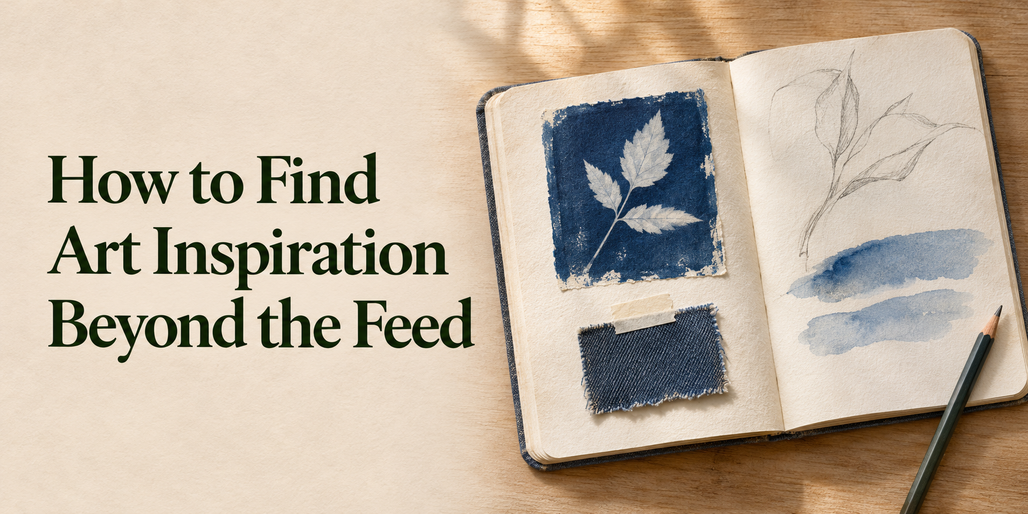
Keep those encounters in a design journal. It might hold half a magazine ad, a fabric sample, the time a song changes, and three versions of an idea you tried on a Tuesday. When you flip back through it months later, you can see what you were drawn to before you had words for it.
Instagram and TikTok use signals such as predicted shares and viewing behavior to decide what comes up next. If a clip catches your eye, see where your own curiosity takes you. Find the person who made it, look up the full work, or follow something named in the credits.
Practice paying attention with a beginner’s mind
In The Creative Act: A Way of Being, Rick Rubin explores awareness, listening, and beginner’s mind. In his On Being interview, he talks about taking notes on things he notices and being surprised by them years later. Think of these observations as seeds. Put something on the page while it’s fresh and give yourself time to see what it might become.
Try looking at something familiar the way you did as a kid, when you could spend ten minutes figuring out how a latch worked. Run your finger over the worn part of a wooden handle. Listen to the sound a room makes after everyone leaves. If the smell of wet pavement brings back a particular gymnasium, write down what you remember about that room. Let the association be as odd or specific as it was when it arrived.
Start a design journal you’ll actually carry
A pocket notebook and a pen can catch most things. Write the time a harmony enters, sketch the silhouette of a chair, or jot the three words that came to you in a hallway. If your notebook is at home, use a voice memo or a phone note and bring the detail back to paper when it still interests you.
At home, use a mixed-media book if you like working with washes or dry drawing materials. Loose sheets in a binder give thick swatches and collages room. A regular notebook, a glue stick, and a pencil are enough to start. Date the page, record where the reference came from, and leave a place for a later thought.
University of the Arts London treats sketchbooks as places to collect references, experiment, and reflect as work develops. Cooper Hewitt’s collection includes one of Peter Girardi’s working notebooks with fabric scraps, ticket stubs, doodles, and lettering prototypes. Your own book can hold an unfinished line beside a scrap that explains where it came from. See University of the Arts London’s sketchbook guide and Cooper Hewitt’s look at a designer’s sketchbook for examples.
Where to find art inspiration beyond social media
At the library, bring a subject a librarian can work with. Ask for books with pictures of old grocery packaging, backstage lighting, or the history of your own neighborhood. Try an exhibition catalog, a bound magazine, or the local-history collection. Find one useful book, then read the spines around its call number. Ask about interlibrary loan if there’s a specific title your branch doesn’t have.
At a flea market, antique mall, or Goodwill, pick one kind of thing and look at the parts that show how people used it. Turn over a wooden box and look at the hinge. Read the notes in the front of a used book. A family snapshot, a grooved cutting board, or a paper bag from the back of your cupboard can give you just as much to work with. Write down one detail while you can still put your finger on it.
Online collections let you start with a subject, a decade, a place, or a material. Open an item record, then follow a subject term, a maker’s name, or the next page of the issue. Try one of these searches.
| Collection | A first move |
|---|---|
| Internet Archive’s Magazine Rack | Search for a magazine about radio repair. Read the ads and diagrams around the page you came for. |
| The Met’s collection | Look for cut paper or wallpaper. Open an object record and use its material or date to guide your next search. |
| NYPL Picture Collection | Start with postcards or children’s book illustrations and see which detail repeats across several examples. |
| Smithsonian Collections Search | Search for a theater program or textile sample. Note which museum holds the object and follow that collection. |
| Europeana Collections | Enter by century, topic, or institution. See how different collections document the same kind of everyday object. |
| David Rumsey Map Collection | Find two maps of the same city and compare how each uses symbols, scale, and lettering. |
| Prelinger Archives | Search historical home movies and instructional films for a word like “shopping.” Watch how people handle ordinary objects. |
| Smithsonian Folkways | Browse by genre, region, or label. If a recording catches you, read its credits or liner notes and follow a name. |
Save enough information to find the source again: the maker if known, the title, the item number or page, and where you found it. If you print an image for the journal, put that information next to the clipping. Check the item’s rights statement before reproducing it in work you plan to share or publish. The Met’s Open Access guide explains its public-domain labels.
Find ideas in films and unfamiliar music
Play a whole album in order, ask a friend for one record they wish more people knew, or pick up a recording from a genre you rarely hear. Follow a producer, instrument, or performer named in the credits. Liner notes can tell you who played and help you understand where the music came from. Smithsonian Folkways’ Musical Sources has downloadable notes.
On the first pass through a song or film, mark the moment you want to come back to. On the second, pay attention to what changed. Maybe a voice went dry, the frame held a beat longer than you expected, or a sound pulled your attention to something in the background. Write the timestamp, describe the change, and add what it made you feel or remember. If a lyric caught you, jot it in your personal journal with the song and artist. Beside it, write why the words mattered to you that day.
Three films to look at closely
- In Jacques Tati’s PlayTime, notice how a small sound draws your attention across a wide frame. Try placing the detail that matters at the edge of a composition. Criterion on how Tati uses sound.
- In Věra Chytilová’s Daisies, watch how shifts in color and abrupt cuts change the rhythm. Set a rule for the marks on a page, then break it once and see where your eye goes. Criterion’s film entry.
- In A Trip Down Market Street Before the Fire, watch people and vehicles cross the path of the moving camera. Draw the routes three people take through a space you know. The Miles Brothers’ film at the Library of Congress.
Three recordings to listen to again
- In Elizabeth Cotten’s “Freight Train,” listen for the treble melody moving around the bass. Put one irregular mark over an even repeat and see how it changes the pace. Cotten’s performance at Smithsonian Folkways.
- In Nina Simone’s “Sinnerman,” listen for the break where the handclaps come forward. Try taking most of the detail out of a paragraph and leaving one emphatic sentence. A discussion of Simone’s handclap break.
- In Björk’s “Jóga,” listen to the way the strings sit against the electronic beat. Try putting a smooth line next to a jagged one and write down what the pairing feels like. Björk’s Homogenic and a closer look at its arrangements.
Build a spread with what you see, hear, and touch
Give two things a chance to share a page. Paste in a clipping from a magazine you own and put a memory or a phrase from your listening notes beside it. Draw an arrow to the part that mattered. Write the reason now, while you can still remember why you looked twice.
- Draw with the tool that suits the question. Use a pencil to work out proportion, a pen or marker to test a silhouette, or charcoal, crayon, and pastel to see what happens at a rough edge. Try three watercolor washes of the blue you remember from a room. Let them dry on a separate sheet if your notebook paper is thin.
- Keep fabric you can handle. Tape one end of a small swatch you own and leave the other free. Lift it, turn it over, and note the weight, sheen, drape, or sound it makes when it folds. Write down which side you want to use and why.
- Press a leaf or flower. Try a flower from your own bouquet or a leaf from your garden. Put it between absorbent sheets under heavy books, replace damp paper as needed, and attach it to the journal once it’s fully dry. Add the date and where it came from. Follow the Field Museum’s plant-pressing guide if you want to press several at once.
- Make a cyanotype. Put a leaf or flower on precoated sun-print paper and follow the paper’s directions for exposure and rinsing. Mount the dry print beside a sketch. Look at the spaces between the stems and try using that spacing somewhere else. Start with Getty’s sun-print activity, or look at Anna Atkins’s botanical cyanotypes at The Met to see how she arranged her specimens.
Turn what you noticed into a creative decision
A feeling becomes something you can work with once you connect it to a detail and give yourself a decision to test. This exercise borrows the general pattern of discovery, development, and small-scale testing from the Design Council’s framework.
- Describe something you can point to. “The room sounds hollow after the door shuts” gives you something more precise to work with than “lonely.”
- Record what it brought up. Maybe that sound reminds you of being the last person in a building. Write the association down even if someone else would hear it differently.
- Ask a question you can test. How long can a group hold still before one small movement changes the mood? How early can a reader sense that somebody’s in the house?
- Carry one property into your medium. Let the silence after a drum fill become space between words. Use the distance between two leaf veins to set the spacing of stitches.
- Make a few versions and compare them. Change the timing, spacing, or amount of color one at a time. Use the feeling or question you wrote down to decide which version to keep developing.
If you’ve collected twenty references and still feel stuck, put two from different places beside each other and name one quality they share. Try expressing that quality in one sentence, one sound, or a thumbnail sketch. If a test comes out differently than you expected, write down what happened before you cover it up or throw it out.
Flip back through the journal to see what keeps drawing you in
At the start of a project, read ten recent pages and a few pages from an older book. Put a dated note beside whatever still holds your attention. If two pages seem related, write each page number on the other. A penciled note in a used book, a soft harmony in a loud track, and a scuff under a table might all appeal to you for the same reason. Maybe you’re drawn to things you could almost walk past. Keep that thought in the margin and see where it shows up next.
For a longer project, give one page to the connections you keep finding. Write a question that appears more than once, a test you still want to try, and an older idea you finally have a place for. When one study is ready for a longer session, continue with our studio guide to cannabis and creativity.
Where CBD flower or THCA flower can fit
If you’re an adult who already uses hemp flower, you can keep it for the at-home session after you’ve gathered your references. Keep the work to a listening note, a pencil sketch, or a voice memo. Review the ideas sober before you develop them. Save driving and work with blades, hot tools, or machinery for sober time. In two experiments on cannabis and creativity, people who used cannabis rated ideas more favorably, while their creativity scores showed no improvement. The experiments didn’t measure the effects of CBD flower specifically.
Green Nursery’s Bubba Kush CBD flower is an example of CBD-dominant hemp flower. Products labeled CBD or hemp can still contain THC. THCA flower is a different format. Heat can convert its THCA into THC, which can be intoxicating. Read our THCA flower explainer for more detail.
Make a first page today
Put a familiar object on the table and play one song. Write a detail about each and what it brought to mind. Find a word or a question that connects them. Give yourself five minutes to try it in any medium. At the bottom of the page, write the date and one instruction you can pick up tomorrow.
Frequently asked questions
How do I know when I have enough references?
Start making when you can name one thing you want to test. Keep the source on the page, put the rest of your references away, and make two versions. If both stall on the same question, you know what to look for next.
What should I put in a design journal?
Start with a dated reference, the detail you noticed, and your response. Add a cutout, sketch, swatch, timestamp, or voice-memo name when it helps you recall the encounter. Leave space to add what happened when you tried the idea.
Can I keep a design journal if I don’t draw?
Yes. Use words, diagrams, collages, or links to sounds you recorded. A square with an arrow and the words “light comes from here” may tell you everything you need when you open the book again.
How can I use art references without copying?
Pick one quality to study, such as pacing, scale, or spacing, then work from a different subject or in another medium. Keep credits in your journal. If you want to reproduce an image, lyric, or recording in a published piece, check its license or assess the specific use. The U.S. Copyright Office’s fair use FAQ explains why a fixed word count offers no guarantee.
How do I choose which old idea to develop?
Look for a page you keep returning to and a question on it you can answer with a small test. If several ideas qualify, try the one you can work on with what you have today. Write down what the test teaches you.
Popular Products
Check out these customer favorites.