
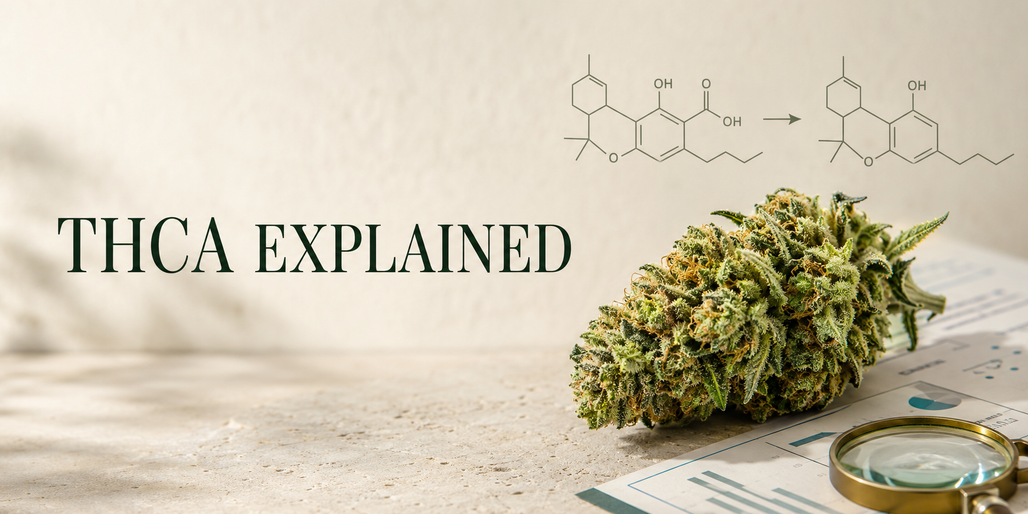
THCA Explained: What It Is and How It Becomes THC
Cannabinoid Education Guide
THCA Explained: What It Is, How It Becomes THC, and Why Total THC Matters
THCA is the naturally occurring acidic precursor to Delta-9 THC found in raw cannabis flower. Unheated THCA does not produce the conventional THC high, but heat can convert it into intoxicating Delta-9 THC. That transformation explains why high-THCA flower can have powerful effects even when its label shows relatively little Delta-9 THC.
This THCA explained guide focuses on that relationship, the meaning of total THC, how to read a laboratory report and the legal and drug-testing questions consumers should understand. To compare THCA with Delta-8, Delta-9, THCP, HHC and related cannabinoids, begin with Green Nursery’s Types of THC Explained hub.
Science and legal information reviewed: July 21, 2026.
What Is THCA?
THCA, or tetrahydrocannabinolic acid, is an acidic phytocannabinoid found naturally in Cannabis sativa. In freshly harvested and unheated cannabis flower, much of the plant’s potential THC exists as THCA rather than active Delta-9 THC.
The word “acid” refers to a carboxyl group attached to the THCA molecule. It does not mean the cannabinoid is corrosive or comparable to a strong household acid. That additional molecular group is one of the features that distinguishes THCA from Delta-9 THC.
The NIH PubChem record for Delta-9 THCA identifies it as a naturally occurring cannabinoid and biosynthetic precursor to Delta-9 THC.
THCA is also not Delta-8 THC, CBD or a general name for hemp. Similar abbreviations do not make these compounds interchangeable.
THCA vs. THC: What Is the Difference?
When consumers say “THC,” they usually mean Delta-9 tetrahydrocannabinol, the cannabinoid most associated with cannabis intoxication. THCA and Delta-9 THC are closely related, but they are not the same molecule and do not create the same experience before THCA is heated.
| Feature | THCA | Delta-9 THC |
|---|---|---|
| Full name | Tetrahydrocannabinolic acid | Delta-9 tetrahydrocannabinol |
| Common location | Often abundant in raw or unheated cannabis flower | May already be present and can increase when THCA is heated |
| Conventional intoxicating effect | Not generally intoxicating like Delta-9 THC before heating | Intoxicating and capable of impairing attention, coordination and judgment |
| Response to heat | Can convert toward Delta-9 THC | May remain active or degrade depending on conditions |
| COA listing | Usually reported as THCA, often as a percentage or milligrams per gram | Usually reported separately as Delta-9 THC |
| Legal significance | May be included in total-THC calculations and state restrictions | Central to the currently effective federal hemp threshold |
“Raw” and “heated” are more useful distinctions than assuming every product with THCA is non-intoxicating. A dried flower product may already contain some Delta-9 THC, and its THCA can create substantially more Delta-9 THC when heated.
How Does THCA Become THC?
THCA becomes Delta-9 THC through decarboxylation. During this chemical reaction, THCA loses a carboxyl group as carbon dioxide. The resulting molecule has less mass and a different effect profile.
Heat can accelerate this transformation. Slow changes can also occur during drying, processing and storage, which is one reason a laboratory report may show both THCA and some existing Delta-9 THC.
Decarboxylation is not necessarily instant, complete or perfectly uniform. The amount converted depends on the material and the conditions involved, while excessive heat or prolonged storage can contribute to further cannabinoid degradation. A laboratory study indexed by PubMed illustrates that measured conversion efficiency can vary and may remain below 100 percent under particular analytical conditions.
Does THCA Get You High?
Unheated THCA does not generally produce the conventional high associated with Delta-9 THC. Heated high-THCA products can be strongly intoxicating because THCA can convert into Delta-9 THC.
The CDC’s cannabis FAQ makes this distinction directly: THCA is not mind-altering in its unheated form, but exposure to heat can convert it into impairing THC.
Whether a particular product causes intoxication also depends on:
- How much THCA and Delta-9 THC the product contains
- Whether it has already been heated or processed
- The product format and route of use
- The amount used
- The person’s tolerance, experience and individual response
- Other cannabinoids, ingredients, alcohol or medications involved
What Does Total THC Mean?
Total THC estimates the Delta-9 THC already present plus the amount that could theoretically result from the product’s THCA. A commonly used calculation is:
The 0.877 factor accounts for the difference in molecular weight after THCA loses carbon dioxide. It does not mean that exactly 87.7 percent of the THCA in every product will convert during real-world use.
The USDA Hemp Program FAQ uses THCA × 0.877 plus Delta-9 THC when describing total available THC for licensed hemp-production testing.
Total THC Calculation Example
Suppose a flower COA reports 20.00 percent THCA and 0.20 percent Delta-9 THC:
| Calculation step | Result |
|---|---|
| THCA shown on COA | 20.00% |
| Potential THC from THCA | 20.00% × 0.877 = 17.54% |
| Existing Delta-9 THC | 0.20% |
| Estimated total THC | 17.54% + 0.20% = 17.74% |
This is a theoretical potency estimate, not a guaranteed delivered dose or prediction of how strong the product will feel. Conversion may be incomplete, material can be lost, and individual exposure varies by product and use.
Percentages and Milligrams Are Not Interchangeable
Flower and concentrates are commonly reported by percentage or milligrams per gram. Edibles and oils may be described in milligrams per piece, serving or container. Always confirm the units before comparing two products or performing a calculation.
Where Does THCA Appear?
THCA can appear in several product categories, but the cannabinoid name alone does not reveal how the product was processed or how it will behave.
| Product context | What to understand |
|---|---|
| Cannabis or hemp flower | Raw flower may contain abundant THCA. Heating it can create intoxicating Delta-9 THC. |
| Concentrates and crystalline products | These may contain highly concentrated THCA. Potency, processing and contaminant testing require close review. |
| Vape products | Manufacturing and device heat can change the cannabinoid profile. The complete COA matters more than the front-label name. |
| Oils, capsules and edible products | A THCA label does not prove that the product contains no Delta-9 THC or will remain non-intoxicating. Check formulation and batch results. |
| Fresh or minimally processed plant material | It may retain acidic cannabinoids, but composition still varies with genetics, harvest, drying and storage. |
Be cautious when one product is marketed simultaneously as “raw THCA” and as producing guaranteed THC-like effects. Those claims may depend on heating, additional cannabinoids or processing that should be disclosed.
What Is THCA Flower?
THCA flower is cannabis flower marketed for a cannabinoid profile that contains substantial THCA before use. It is not a separate plant species, and it does not need to be sprayed with THCA simply because the laboratory report shows a high percentage.
Cannabis plants can naturally produce THCA-rich flower. However, infused, coated and otherwise enhanced flower products also exist. Sellers should identify added cannabinoids or ingredients instead of allowing shoppers to assume every product is natural, unmodified flower.
Can Appearance Tell You Whether Flower Is Hemp or Marijuana?
No. Hemp and marijuana are primarily legal classifications, not dependable visual categories. High-THCA flower sold through a hemp retailer can look and smell similar to flower sold through a state-licensed cannabis dispensary. A photograph, strain name, aroma or “hemp” label cannot establish the product’s legal status.
Classification may depend on the applicable law, cannabinoid results, testing method, testing date, production records, product format and jurisdiction. Online availability is not proof that possession or shipment is lawful everywhere.
How to Read a THCA Certificate of Analysis
A certificate of analysis, or COA, reports what a laboratory found in a submitted sample. It is useful evidence, but “lab tested” is not a complete safety or legality guarantee.
1. Match the Report to the Product
Look for the product or strain name, batch or lot number, laboratory sample identifier and testing date. A generic report from another batch may not describe the package currently being sold.
2. Find THCA, Delta-9 THC and Total THC
Do not stop at the largest number on the document. Read the separate THCA and Delta-9 THC results, then locate or calculate total THC using consistent units.
3. Understand the Units and Laboratory Terms
| COA term | What it usually means |
|---|---|
| % | Percentage by weight, commonly used for flower or concentrates |
| mg/g | Milligrams of cannabinoid per gram of product |
| mg/unit | Milligrams per piece, bottle, package or another defined unit |
| ND | Not detected under the laboratory’s method and reporting limit; not necessarily absolute zero |
| LOQ | The lowest amount the method can reliably quantify |
4. Distinguish a Preharvest Test From a Retail-Batch COA
A preharvest compliance test examines a crop sample before harvest. A retail COA may examine flower after drying, trimming, storage or packaging. The documents can describe different samples collected at different stages, so a crop report should not automatically be treated as the current retail batch report.
5. Check Which Contaminant Panels Were Completed
Depending on the product and testing scope, relevant panels may include pesticides, heavy metals, microbial contaminants, mycotoxins, moisture or water activity and residual solvents for processed products. A potency-only report does not establish that all these panels were completed.
Review Green Nursery’s available laboratory reports and COAs, and learn more about why third-party testing requires more context than a badge or slogan.
Is THCA Legal?
As of the review date, the currently effective federal statutory definition of hemp generally focuses on cannabis containing no more than 0.3 percent Delta-9 THC by dry weight. That statement does not tell the whole compliance story.
USDA production rules require licensed hemp producers to use post-decarboxylation or similarly reliable testing that accounts for THCA when determining total available THC before harvest. States may also use total-THC standards, regulate smokable hemp, restrict intoxicating hemp products or address THCA directly.
Legal treatment may depend on:
- Delta-9 THC and total THC
- Whether THCA is included in the jurisdiction’s calculation
- The testing method and stage at which the sample was collected
- Product format and intended use
- State and local cannabis or hemp rules
- Age, possession and shipping restrictions
- Whether the seller operates as a hemp retailer or state-licensed dispensary
A Federal Definition Change Is Scheduled for November 12, 2026
Public Law 119-37, enacted November 12, 2025, says its revised hemp definition takes effect 365 days after enactment. The new text applies a 0.3 percent dry-weight threshold to total tetrahydrocannabinols, expressly including THCA. It also creates additional exclusions for certain intermediate and final hemp-derived cannabinoid products, including a 0.4-milligram combined limit per container for specified final products.
If the law takes effect as written on November 12, 2026, it will materially change the federal framework affecting many high-THCA and intoxicating hemp products. Later legislation, agency action or litigation could change implementation, so consumers and businesses should verify current law again near and after that date.
A product being offered online does not establish that purchase, shipment, possession or use is allowed at the delivery destination.
Is THCA a Medicine?
Retail THCA products should not be presented as approved treatments for pain, inflammation, nausea, cancer, anxiety or any other condition. Laboratory and early-stage research can help scientists investigate a compound, but it does not prove that a retail product is safe and effective for treating a disease.
The FDA’s cannabis regulation guidance explains that the agency has approved specific cannabis-derived or cannabis-related prescription drugs, but it has not approved cannabis itself or ordinary retail THCA products to treat diseases or conditions.
Anyone considering cannabis in connection with symptoms, medications or a diagnosed condition should speak with a qualified healthcare professional rather than substituting an online product for appropriate care.
Responsible Use, Impairment and Drug Testing
A product sold through a hemp channel can still create THC exposure and impairment. Treat heated high-THCA products with the same caution used for other intoxicating cannabis products.
- Do not drive while impaired. The CDC reports that cannabis can affect reaction time, decision-making, coordination and perception.
- Do not operate machinery or perform hazardous work while impaired or uncertain about a product’s effects.
- Avoid casually combining cannabis with alcohol, sedating medicines or other substances. Discuss possible interactions with a doctor or pharmacist.
- Do not use cannabis during pregnancy or breastfeeding. Review the CDC’s pregnancy and breastfeeding guidance.
- Smoking and vaping are not risk-free. Combustion exposes the lungs and people nearby to smoke, while vape products can introduce additional device and ingredient concerns.
- Store all products securely away from children, pets and anyone who might use them accidentally.
Can THCA Cause a Positive Drug Test?
Yes, THCA products can create a positive THC drug-test result. Heating and using a high-THCA product can expose the body to Delta-9 THC and its metabolites. Some test types look for THC while others look for marijuana metabolites; the SAMHSA workplace drug-testing FAQ explains the analytes used in federal urine and oral-fluid testing.
A hemp label, low pre-use Delta-9 THC result or seller assurance cannot guarantee a negative test. If avoiding a positive employment, athletic, probation or medical test is essential, the lowest-risk choice is to avoid THCA and other cannabinoid products that may contain or produce THC.
Common THCA Myths and Better Explanations
| Claim | More accurate explanation |
|---|---|
| “THCA flower cannot get you high.” | Unheated THCA is not conventionally intoxicating, but heating high-THCA flower can create intoxicating Delta-9 THC. |
| “The 0.877 factor means exactly 87.7% always converts.” | The factor corrects for molecular-weight loss. Actual conversion efficiency varies and may be incomplete. |
| “Low Delta-9 THC means low potential potency.” | A product can show little existing Delta-9 THC while containing substantial THCA. Total THC provides more context. |
| “All THCA flower is sprayed.” | Cannabis naturally produces THCA. Infused and coated products also exist, so the exact format should be disclosed. |
| “Hemp-derived means non-intoxicating.” | Source classification does not determine the experience after THCA is heated. |
| “Higher THCA always means better flower.” | Potency does not establish freshness, aroma, contaminant results, cure, suitability or overall quality. |
| “A COA proves the product is safe and legal everywhere.” | A COA reports results for a sample and specified tests. It does not replace state law or prove that every possible contaminant was examined. |
Frequently Asked Questions About THCA
What does THCA stand for?
THCA stands for tetrahydrocannabinolic acid. It is an acidic cannabinoid found naturally in cannabis and a precursor to Delta-9 THC.
Is THCA the same as THC?
No. THCA and Delta-9 THC are related but distinct molecules. THCA does not produce the same conventional high before heating, while Delta-9 THC is intoxicating. Heat can convert THCA toward Delta-9 THC.
Is THCA natural?
Yes. Cannabis plants naturally produce THCA. However, “natural” does not guarantee that a finished product is unprocessed, safe, legal or appropriate for every person.
Does eating raw THCA cause a high?
Unheated THCA is not generally intoxicating like Delta-9 THC. A finished product may still contain existing Delta-9 THC, other intoxicating cannabinoids or processed ingredients, so its complete label and batch-specific COA matter.
Is 20% THCA the same as 20% THC?
No. Using the common molecular-weight factor, 20 percent THCA represents approximately 17.54 percent potential Delta-9 THC before adding any Delta-9 already present. That remains a theoretical calculation rather than a guaranteed delivered amount.
What does 0.877 mean on a THCA calculation?
It adjusts for the molecular mass lost when THCA releases carbon dioxide and becomes Delta-9 THC. It is not a promise that every product will achieve 87.7 percent conversion efficiency.
Is THCA flower hemp or marijuana?
That cannot be determined reliably by appearance or product name. Hemp and marijuana are legal classifications that depend on applicable definitions, cannabinoid testing, production records and jurisdiction.
Is THCA legal in every state?
No. States may regulate total THC, THCA, smokable hemp or intoxicating hemp products more strictly than the currently effective federal definition. A major federal hemp-definition change is also scheduled for November 12, 2026.
Will THCA show up on a drug test?
It can. Use may expose the body to THC and its metabolites. No COA, hemp label or seller can guarantee that a THCA product will produce a negative drug test.
Does more THCA mean better quality?
No. Higher THCA indicates greater potential THC potency after conversion, not greater freshness, cleanliness, aroma, cultivation quality or suitability for the consumer.
How can I tell whether a THCA COA matches the product?
Compare the product or strain name, batch or lot number, sample identifier and testing date. Confirm that the report shows the relevant cannabinoid and contaminant panels rather than only a generic potency result.
THCA Explained: The Bottom Line
THCA is the acidic precursor to Delta-9 THC found naturally in raw cannabis. It does not produce the same conventional high before heating, but it can convert into intoxicating Delta-9 THC. That is why understanding total THC is more useful than looking at Delta-9 THC or the word “hemp” alone.
Before evaluating a THCA product, check the current batch-specific COA, distinguish THCA from Delta-9 THC, calculate or locate total THC, identify the contaminant panels and verify the law where the product will be purchased, possessed or used. Remember that higher potency does not automatically mean higher quality.
Return to the Types of THC Explained guide to compare other THC-related cannabinoids. If you are considering flower, use the THCA flower online shopping guide before reviewing currently available THCA flower and its corresponding laboratory report.
Popular Products
Check out these customer favorites.