
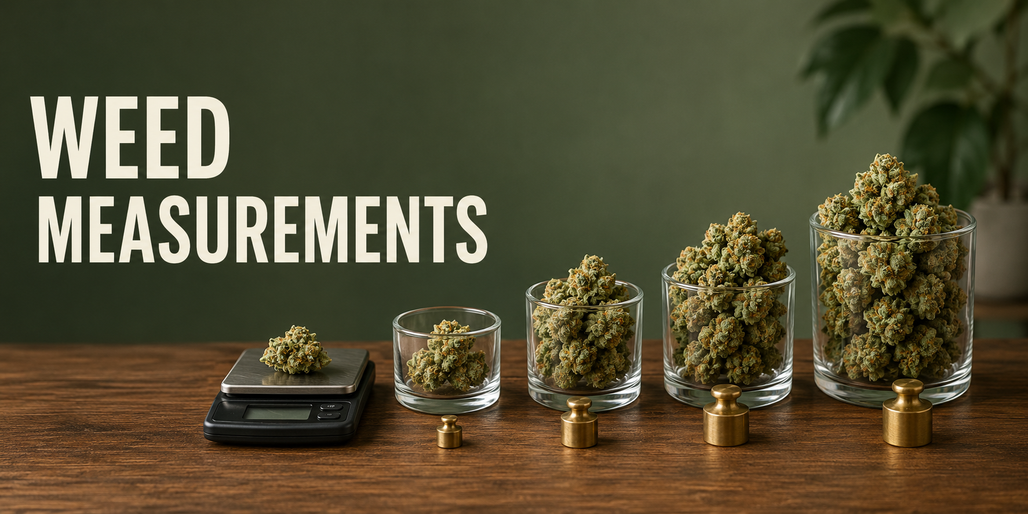
Weed Measurements Explained: Eighths to Ounces
Weed Measurements Explained: Eighths, Quarters, Halves and Ounces
Common weed measurements are fractions of an ounce expressed as convenient gram amounts: an eighth is 3.5 grams, a quarter is 7 grams, a half ounce is 14 grams, and an ounce is usually treated as 28 grams. These terms describe the weight of cannabis flower—not its potency, quality, effects, or legal status.
The same weight vocabulary can be used for marijuana flower, CBD flower, and other hemp flower. What changes is the product’s cannabinoid profile and the rules that apply to it. If those categories are new to you, Green Nursery’s guide to CBD buds and hemp flower explains the product terminology.
Weed measurement chart: eighths, quarters, halves, and ounces
This chart shows the rounded gram amounts commonly used for cannabis flower. The final column makes the fractions easier to compare within one ounce.
| Common term | Fraction of an ounce | Common retail weight | How many make an ounce? |
|---|---|---|---|
| Gram | About 1/28 ounce | 1 g | About 28 |
| Eighth | 1/8 ounce | 3.5 g | 8 |
| Quarter | 1/4 ounce | 7 g | 4 |
| Half ounce | 1/2 ounce | 14 g | 2 |
| Ounce | 1 ounce | 28 g in common retail shorthand | 1 |
The rounded values are widely used in cannabis retail education. For example, the Montana Department of Revenue’s marijuana measurement chart lists an eighth as 3.5 grams, a quarter as 7 grams, a half ounce as 14 grams, and an ounce as 28.35 grams. That last decimal points to an important distinction between an exact unit conversion and common package shorthand.
Why is weed measured in both grams and ounces?
Cannabis flower is commonly discussed with a hybrid vocabulary. Small amounts use metric grams, while larger amounts use fractions of an avoirdupois ounce—the ordinary ounce used for most goods in the United States, not a fluid ounce or a troy ounce.
NIST’s mass conversion table gives one avoirdupois ounce as 28.34952 grams. Dividing that exact figure produces approximately 3.54369 grams per eighth, 7.08738 grams per quarter, and 14.17476 grams per half ounce. Cannabis retail convention rounds those values to 3.5, 7, 14, and often 28 grams for simple labeling and comparison.
That convention is useful, but it does not override the package. A container labeled 3.5 grams states its net quantity directly. A package labeled 28 grams and one labeled 30 grams do not contain the same amount simply because both may be described with ounce-related language.
How many grams are in an eighth of weed?
An eighth of weed is commonly 3.5 grams of flower. The name comes from one-eighth of an ounce, and eight eighths make one ounce under the usual retail convention.
An eighth is a weight category, not a promise about the number of buds, uses, or servings. One 3.5-gram package might contain a few larger flowers; another might contain more small buds. Grind, stem content, moisture, density, and the way a product is trimmed can all change how the same weight looks.
How many grams are in a quarter of weed?
A quarter of weed is commonly 7 grams. “Quarter” means one-quarter of an ounce, not one-quarter of a pound and not four grams. Four quarters make an ounce.
You may also see this amount written as 1/4 oz or 7 g. Those labels communicate the same common retail quantity, but the printed net weight remains the clearest statement of what is actually in a sealed package.
How many grams are in a half ounce of weed?
A half ounce of weed is commonly 14 grams. It may appear on a label as 1/2 oz, 0.5 oz, a half, or 14 g. Two half ounces make one ounce.
“Half” can be ambiguous without context, so a gram figure is better when accuracy matters. The word could refer to half of almost any quantity; “14 g” states the package weight directly.
How many grams are in an ounce of weed?
An ounce of weed is commonly treated as 28 grams in retail shorthand, although the exact avoirdupois conversion is approximately 28.35 grams. An ounce contains eight eighths, four quarters, or two half ounces.
Why do people say 28 grams instead of 28.35? The cannabis convention is built from the familiar rounded amounts: eight packages of 3.5 grams total 28 grams. Some sellers use 28.35 grams, and others may offer a package with a different stated gram count. Read the net-weight declaration rather than assuming every product carrying the word “ounce” contains an identical mass.
What does an eighth, quarter, half ounce, or ounce look like?
There is no dependable visual answer. Equal weights of flower can occupy different volumes because buds vary in density, structure, moisture, trim, and stem content. Dense flowers may look surprisingly small beside loose, airy flowers of the same weight.
Everyday-object comparisons can help someone imagine a general scale, but they are not measuring tools. A photograph has the same problem: camera angle, container size, and bud structure can make equal quantities look different. For a packaged product, rely on the declared net weight. If an accurate independent measurement is needed, use an appropriate scale and follow all applicable laws and workplace or housing rules.
Common weed measurement slang—and where it can mislead
Some slang maps fairly consistently to a weight, while other terms began as price references and have never represented one universal number of grams.
| Term | Common meaning | Important limitation |
|---|---|---|
| Zip | Usually one ounce | Informal slang; confirm the gram amount. |
| Half | Usually a half ounce, or 14 g | Ambiguous without the word “ounce” or a stated weight. |
| Dub | Traditionally a price-based amount | Not a fixed weight; price and quantity vary. |
| Dime bag | Traditionally a price-based amount | Not a standardized gram amount. |
For regulated or packaged products, the formal net weight is more useful than slang. Price-based terms are especially poor measurement shortcuts because prices change with market, product type, taxes, quality, and location.
How to read net weight on a cannabis flower package
Look for a quantity such as 3.5 g, 7 g, 14 g, or 28 g on the package. That number is more precise than a nickname such as “eighth” or “zip.” It also makes two products easier to compare when sellers use different rounding conventions.
Net weight means the amount of product without the wrapper, jar, or other packing material. NIST’s 2026 Uniform Packaging and Labeling Regulation says a package’s net-quantity declaration excludes wrappers and other packing material. In practical terms, the labeled flower weight should not be confused with the gross weight you would see if you placed the sealed package—container and all—on a scale.
State cannabis-label rules can add requirements beyond general weights-and-measures guidance. When an exact quantity matters, check the gram declaration on the product sold in your jurisdiction rather than converting a slang term on your own.
Weight is not potency, dose, or a serving size
A gram tells you how much flower is present by mass. It does not tell you how much THC, CBD, or another cannabinoid the flower contains. Two eighths can both weigh 3.5 grams while having very different cannabinoid profiles.
The CDC’s cannabis overview identifies THC concentration, method of use, frequency, other substances, prior experience, and individual biology among the factors that can affect risk and response. That is why an eighth, quarter, half ounce, or ounce should not be treated as a recommended dose or a predictable number of servings.
For hemp flower, compare the package with the batch-specific chemistry. Green Nursery’s guide to reading a CBD flower lab report explains cannabinoid results and batch details, while the COA library provides available reports for verification. A weight label and a laboratory report answer different questions; a careful comparison uses both.
Practical takeaways before comparing flower packages
- Translate the common terms first: eighth equals 3.5 g, quarter equals 7 g, half ounce equals 14 g, and an ounce is commonly 28 g.
- Use the package’s stated net weight when the exact quantity matters.
- Do not compare the package’s net weight with the gross weight of the flower plus its container.
- Do not estimate weight from bud count, a photograph, or an everyday-object comparison.
- Confirm whether a slang term refers to a real weight or only a historical price point.
- Read cannabinoid content separately; identical weights can have very different chemical profiles.
- Check the rules that apply where you are, because purchase, possession, shipping, and age requirements can differ by product and jurisdiction.
Readers comparing hemp products available in their jurisdiction can apply the same measurement chart to Green Nursery’s CBD flower selection, then confirm the listed package size and matching laboratory report rather than relying on a nickname alone.
Frequently asked questions
How many eighths are in an ounce?
There are eight eighths in one ounce. Using common cannabis retail weights, eight packages of 3.5 grams total 28 grams.
How many quarters are in an ounce?
There are four quarters in one ounce. Each quarter is commonly 7 grams, so four quarters total 28 grams.
Is 3.5 grams exactly one-eighth of an ounce?
Not mathematically exact. One-eighth of a precise 28.34952-gram avoirdupois ounce is about 3.54369 grams. Cannabis retail convention rounds that quantity to 3.5 grams, so the package’s net-weight label is the clearest statement of the amount sold.
Why is an ounce of weed usually 28 grams instead of 28.35 grams?
Because common cannabis amounts use convenient retail rounding. An eighth is treated as 3.5 grams; multiplying that by eight produces 28 grams. A seller may label a package as 28 grams, 28.35 grams, 30 grams, or another quantity, so read the actual net weight.
Is a zip the same as an ounce?
Usually, yes. “Zip” is common slang for an ounce of cannabis flower. It is still informal language, so confirm the stated gram weight instead of assuming.
Is a dub a fixed number of grams?
No. “Dub” is traditionally a price-based term, not a standardized weight. The amount can change with product, market, and seller, so it should not replace a gram measurement.
Do hemp flower and marijuana flower use the same measurements?
Yes. Grams and ounces are units of mass, so the physical measurement system is the same. The product’s cannabinoid profile and legal treatment can differ, which is why the label and laboratory report still matter.
Can you tell how much weed you have by looking at it?
Not reliably. Flower density, moisture, trim, stems, bud size, camera angle, and container shape can all distort visual estimates. Use the declared net weight or an appropriate scale where lawful.
Does net weight include the jar or bag?
No. Net weight refers to the product quantity and excludes the wrapper, jar, bag, or other packing material. The combined weight of the flower and its container is gross weight, so it will be higher.
Does an eighth mean one serving?
No. “Eighth” describes 3.5 grams of flower; it is not a serving recommendation. Potency, method of use, individual response, product instructions, and applicable health guidance are separate considerations.
Does a heavier package mean stronger cannabis?
No. Weight and cannabinoid concentration are different measurements. A larger amount contains more flower, but it is not automatically more potent by percentage or better in quality.
Popular Products
Check out these customer favorites.