
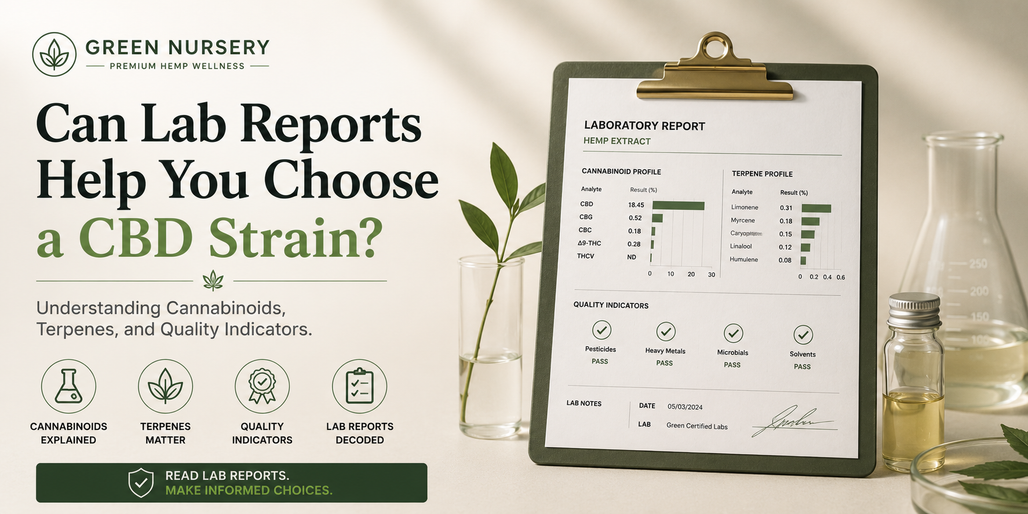
Can Lab Reports Help You Choose a CBD Strain? Understanding Cannabinoids, Terpenes, and Quality Indicators
Can Lab Reports Help You Choose a CBD Strain? Understanding Cannabinoids, Terpenes, and Quality Indicators
Choosing a CBD strain can be difficult because strain names, product descriptions, and customer reviews only tell part of the story. A strain may be described as tropical, earthy, relaxing, bright, sativa-leaning, indica-leaning, or hybrid, but those descriptions are not the same as verified product data.
A Certificate of Analysis, often called a COA or lab report, can help shoppers compare CBD flower strains using objective information. A CBD flower COA may show cannabinoid content, terpene profile, THC levels, total cannabinoids, batch details, and product testing results. This makes it easier to compare strains like Hawaiian Haze, Lifter, Sour Space Candy, and Kush-style hemp flower without relying only on marketing language.
This article is part of our CBD lab testing education series. For the full parent guide, start with How to Read a CBD Flower Lab Report. If you are new to hemp flower, read What Are CBD Buds?. You can also review Green Nursery’s current COAs and lab reports before choosing a product.
Why Choosing the Right CBD Strain Can Be Difficult
CBD flower strains are often described with familiar cannabis categories such as sativa, indica, or hybrid. These terms can be helpful as a general shopping shortcut, but they are not usually confirmed by a lab report. A COA does not normally prove whether a strain is truly sativa or indica. Instead, it provides measurable details such as cannabinoids, terpenes, THC levels, and testing results.
This matters because two products with the same strain name can still test differently. For example, one Hawaiian Haze batch may show a citrus-heavy terpene profile, while another may lean more floral or herbal. One Kush-style flower may have more myrcene and caryophyllene, while another may show more pinene or limonene. Lab reports help reveal those differences.
The FDA’s cannabis and CBD guidance explains that cannabis-derived products can vary in composition, labeling, ingredients, and intended use. That is one reason transparent testing is so useful when comparing CBD strains.
What Information a CBD Lab Report Provides
A CBD flower lab report gives batch-specific data about the product being tested. While formats vary by laboratory, most useful COAs include cannabinoid testing, THC results, terpene analysis, and safety screening.
- Cannabinoid profile
- Total CBD percentage
- Delta-9 THC content
- THCA and total THC details when available
- Terpene profile
- Heavy metal screening
- Pesticide testing
- Microbial testing
- Residual solvent testing when applicable
- Batch number and test date
The most useful sections for choosing a CBD strain are usually the cannabinoid profile and terpene profile. The safety sections are still important because they help confirm product quality and transparency before purchase.
How Cannabinoid Profiles Help Compare CBD Strains
A cannabinoid profile shows which cannabinoids are present and how much of each one appears in the tested sample. CBD percentage is important, but it should not be the only number shoppers review.
| Cannabinoid | What It Tells You |
|---|---|
| CBD | The main cannabinoid in most CBD flower strains. |
| CBDA | The natural acidic precursor to CBD found in raw hemp flower. |
| CBG | A minor cannabinoid that may appear in some hemp strains. |
| CBC | A less common cannabinoid sometimes included in full cannabinoid panels. |
| Delta-9 THC | The THC value most closely tied to federal hemp compliance. |
| THCA | An acidic cannabinoid that can convert into THC when heated. |
| Total Cannabinoids | A broader snapshot of the plant’s cannabinoid richness. |
For example, two CBD flower strains may both test around 15% CBD, but one may have higher total cannabinoids or more minor cannabinoids. That does not automatically make it better, but it gives shoppers more information than CBD percentage alone.
The USDA Domestic Hemp Production Program provides the federal hemp framework that makes cannabinoid testing important for hemp classification and compliance. For more context, read Understanding THC Limits in Hemp Products.
How Terpene Profiles Influence Strain Characteristics
Terpenes are aromatic compounds that help shape the smell and flavor of hemp flower. While a lab report cannot tell you exactly how a strain will feel for you personally, terpene analysis can help explain why one strain smells citrusy, another smells earthy, and another smells sweet or floral.
| Terpene | Common Aroma Notes | Often Associated With |
|---|---|---|
| Myrcene | Earthy, herbal, musky | Kush-style and richer hemp profiles |
| Limonene | Citrus, lemon, orange | Bright and fruit-forward strains |
| Pinene | Pine, fresh herbs, forest | Crisp and green aromatic profiles |
| Caryophyllene | Peppery, woody, spicy | Earthy and complex strains |
| Linalool | Floral, lavender-like | Softer aromatic profiles |
Research available through the National Center for Biotechnology Information discusses the diversity of cannabinoids and terpenes in cannabis. For a Green Nursery guide focused specifically on aroma, read CBD Flower Terpenes: Why Aroma Matters.
Do Sativa, Indica, and Hybrid Labels Matter?
Sativa, indica, and hybrid labels can be useful for organizing strain descriptions, but shoppers should understand their limits. These labels are usually based on genetics, growth traits, market category, or customer expectations. They are not typically verified by the COA itself.
A lab report is more useful for comparing measurable traits. For example, a sativa-leaning CBD strain may be marketed as bright or daytime-friendly, but the COA can show whether it actually has a citrus-heavy limonene profile, higher pinene content, or a more balanced terpene mix. An indica-leaning or Kush-style strain may be described as earthy or heavier, but the COA can help confirm whether myrcene, caryophyllene, or other earthy terpenes are present.
| Label | How It Is Usually Used | What the COA Can Actually Show |
|---|---|---|
| Sativa-leaning | Often used for brighter, citrusy, or more uplifting-style descriptions. | Terpenes such as limonene, pinene, and total terpene percentage. |
| Indica-leaning | Often used for earthy, Kush-like, or richer strain descriptions. | Terpenes such as myrcene, caryophyllene, and overall cannabinoid profile. |
| Hybrid | Used for strains with mixed or balanced characteristics. | A broader terpene mix and cannabinoid profile. |
The best approach is to use strain type as a starting point, then use the COA to compare cannabinoids, terpenes, and testing results.
Comparing Popular CBD Strains Using Lab Reports
Lab reports are especially useful when comparing well-known CBD flower strains. They help shoppers move beyond strain names and look at measurable differences between batches.
| CBD Strain | Common Market Description | COA Details to Compare |
|---|---|---|
| Hawaiian Haze | Tropical, citrus-forward, often described as sativa-leaning. | Limonene, pinene, total terpenes, CBD percentage, THC level. |
| Lifter | Bright, balanced, citrus-herbal profile. | Total CBD, minor cannabinoids, limonene, myrcene, caryophyllene. |
| Sour Space Candy | Sweet, fruity, candy-like aroma. | Terpene diversity, total terpenes, cannabinoid richness. |
| Bubba Kush | Earthy, woody, Kush-style, often described as indica-leaning. | Myrcene, caryophyllene, total cannabinoids, freshness indicators. |
For more strain education, explore our CBD Flower Strain Guide. You can also read individual strain guides for Hawaiian Haze, Lifter, Sour Space Candy, and Bubba Kush.
Why COA Links Matter When Comparing CBD Strains
When an article, product page, or strain guide discusses CBD flower quality, COA access should be easy to find. A shopper comparing strains should not have to guess whether the flower was tested, whether the report is current, or whether the batch matches the product being sold.
Green Nursery provides a dedicated COA and lab reports page so shoppers can review testing information before buying. When comparing CBD flower products, it is also helpful to check the CBD flower collection and look for product-specific testing details where available.
For a deeper explanation of why independent testing matters, read Why Third-Party Testing Matters for CBD and Hemp Products. For contaminant-specific safety testing, see Hemp Testing for Pesticides and Heavy Metals.
What Lab Reports Cannot Tell You
CBD strain lab reports are useful, but they do not explain everything about a product. A COA can show measurable data, but the overall flower experience also depends on genetics, cultivation quality, harvest timing, drying, curing, storage, freshness, and personal preference.
| A COA Can Help Show | A COA Cannot Fully Show |
|---|---|
| Cannabinoid profile | Exact aroma intensity when opened |
| Terpene profile | Freshness by touch or texture |
| Delta-9 THC level | Personal preference |
| Contaminant screening | How well the flower was cured |
| Batch-specific testing | Visual bag appeal in person |
This is why the best buying decision combines lab reports, strain education, product descriptions, customer reviews, and brand transparency. You can also review Green Nursery’s customer reviews for additional shopping context.
Red Flags to Watch for When Reviewing Strain COAs
Not all CBD flower COAs are equally useful. Before choosing a strain, check whether the report is current, complete, and clearly connected to the product batch.
- No COA is available
- The lab report is outdated
- The batch number does not match the product
- THC results are missing or unclear
- Only potency is shown, with no contaminant screening
- No terpene profile is included for a strain-focused product
- The laboratory is not clearly identified
- The product description makes claims the COA does not support
Laboratory quality matters too. The NIST cannabis laboratory quality assurance program explains why consistent measurement is important for cannabis and hemp testing. ISO/IEC 17025 also provides an international standard for testing and calibration laboratory competence.
Using Lab Reports to Make Better Purchasing Decisions
When choosing CBD flower, start with your preferred aroma profile and product format, then use the COA to compare the numbers. A citrus hemp flower may appeal to one shopper, while another may prefer earthy Kush-style CBD flower. The COA helps verify whether the product’s measurable profile lines up with the description.
- Check total CBD and total cannabinoids
- Review Delta-9 THC and THCA
- Compare terpene profiles
- Look for batch-specific testing
- Check test dates
- Confirm contaminant screening where available
- Use the COA page before purchasing
For product options, browse Green Nursery’s lab-tested CBD flower. For general product questions, visit the FAQ page.
Where to Find Reliable CBD Strain Testing Information
The most reliable CBD strain testing information comes from a current, batch-specific Certificate of Analysis from an independent laboratory. A useful COA should show the product name, batch number, test date, cannabinoid panel, THC results, and relevant safety testing.
Green Nursery makes testing easier to review through the COA and lab testing page. Shoppers can use those reports alongside product pages, strain guides, and educational articles to make better decisions.
For broader legal and compliance context, read CBD and Cannabis Laws Explained. For federal hemp context, the USDA hemp overview explains how hemp became a regulated agricultural commodity.
Frequently Asked Questions
Can lab reports help you choose a CBD strain?
Yes. Lab reports help compare CBD strains by showing cannabinoid content, terpene profile, THC levels, and testing results. They do not replace personal preference, but they provide objective data.
Do sativa, indica, and hybrid labels appear on a COA?
Usually no. COAs typically show cannabinoids, terpenes, THC results, and contaminant testing. Sativa, indica, and hybrid labels are usually product or genetics descriptions, not lab-tested categories.
What is the most important part of a CBD flower COA?
For strain comparison, the cannabinoid profile and terpene profile are usually the most useful sections. For safety and compliance, THC levels and contaminant testing are also important.
Does higher CBD mean better CBD flower?
Not always. Higher CBD may be appealing, but terpene content, freshness, cure quality, strain preference, and testing transparency also matter.
Where can I find Green Nursery COAs?
You can review available reports on Green Nursery’s COA and lab testing page.
Final Takeaway
Lab reports can absolutely help you choose a CBD strain. They provide objective details about cannabinoids, terpenes, THC content, batch testing, and quality indicators that product descriptions alone cannot fully confirm.
The best approach is to use strain names, sativa or indica-style descriptions, terpene information, customer reviews, and COAs together. Before buying CBD flower, review the lab reports, compare the CBD flower collection, and choose the strain profile that best fits your preferences.
Disclaimer: This article is for educational purposes only and does not provide medical or legal advice. Hemp laws, testing standards, and product availability may vary by jurisdiction.
Popular Products
Check out these customer favorites.