
CBD Dosage for Seniors: A Beginner Guide to Starting Low and Going Slow
CBD Dosage for Seniors: A Beginner Guide to Starting Low and Going Slow
One of the most common questions older adults and caregivers ask is: how much CBD should a senior take? There is no one-size-fits-all answer, but understanding CBD serving sizes can help seniors start more cautiously and compare products more confidently.
Research on cannabis use in older adults from the National Institutes of Health shows growing interest among seniors, but also highlights the importance of education, caution, and medical guidance.
If you are new to CBD, start with our main guide on CBD for Seniors for a full beginner-friendly overview.
What Does CBD Dosage Mean?
In CBD products, dosage usually refers to the amount of CBD consumed at one time. However, many brands and educators prefer the term serving size, since CBD is not a standardized medication and can affect people differently.
CBD is typically measured in milligrams, often written as mg. Product labels may list:
- Total CBD per package: for example, 600 mg per bottle
- CBD per serving: for example, 10 mg per gummy
Understanding the difference between total CBD and CBD per serving is especially important for seniors who are just getting started.
Why Seniors Should Start Low and Go Slow
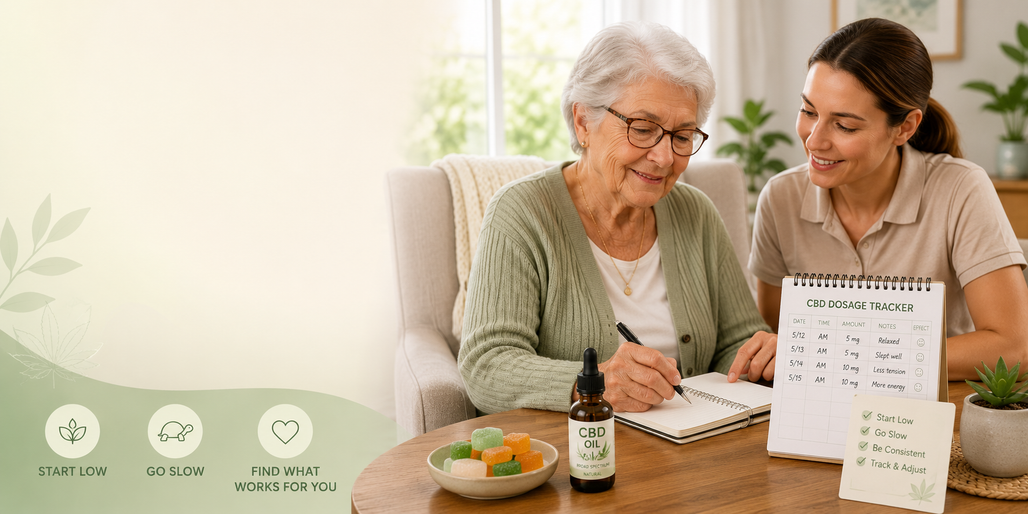
The most cautious approach for older adults is simple: start low and go slow. This means beginning with a small serving size and increasing gradually only if needed.
Resources from Harvard Health and MedlinePlus note that CBD may cause side effects or interact with medications, which is why a cautious starting point matters.
This is especially important for seniors who may be more sensitive to cannabinoids or taking prescription medications. If you are concerned about safety or interactions, see our guide on Is CBD Safe for Elderly Adults?.
How Different CBD Products Are Measured
CBD products come in several formats, and each one is measured differently. Understanding these differences helps seniors choose what feels easiest and most manageable.
CBD Gummies
Gummies are one of the simplest options because they are pre-measured. For example, Full Spectrum CBD Gummies provide a consistent amount per piece, making them easier for beginners to track.
CBD Oil
CBD oil is typically measured using a dropper, which allows flexible serving sizes but can be harder to measure accurately. If you want to learn more about this format, see our guide on CBD Oil for Seniors.
CBD Capsules
Capsules work similarly to gummies because each capsule contains a fixed amount of CBD. They are consistent, but less adjustable than oils.
CBD Topicals
Topicals such as creams and balms are not measured the same way as ingestible products. Instead of a serving size, they are usually applied to specific areas as needed.
CBD Flower
CBD flower is typically used by more experienced hemp users and is not as precisely measured as gummies, capsules, or oils. This may make it less ideal for seniors who want a simple, beginner-friendly starting point.
What Affects CBD Serving Size?
CBD does not affect everyone the same way. Several factors can influence how a senior responds to a given serving size:
- Body size and metabolism
- Sensitivity to cannabinoids
- Current medications
- Product strength and format
- THC content
- Health conditions
- Timing of use
Because of these variables, two people taking the same amount of CBD may have different experiences.
Why THC Content Matters
CBD products can contain different cannabinoid profiles. Some contain CBD only, while others include additional hemp compounds and trace THC.
- CBD isolate: CBD only
- Broad-spectrum CBD: multiple hemp compounds with THC removed or reduced
- Full-spectrum CBD: CBD plus other hemp compounds and trace THC
For seniors, THC content matters because even small amounts may feel stronger for someone who is sensitive or new to cannabis products. To understand these product types more clearly, read Full-Spectrum vs Broad-Spectrum CBD.
Why Increasing Too Quickly Can Be a Problem
Taking too much CBD too quickly can lead to mild but uncomfortable side effects, especially for beginners. These may include:
- Drowsiness
- Dry mouth
- Digestive discomfort
- Lightheadedness
- Feeling less alert than expected
Gradual increases allow the body to adjust and help identify the lowest comfortable serving size. Clinical discussions on CBD dosing and safety also reinforce that dose, product type, and individual response matter.
CBD and Medication Concerns for Seniors
Medication interaction is one of the most important CBD dosage concerns for seniors. Many older adults take multiple prescriptions, and CBD may affect how certain medications are processed.
Research on CBD and medication interactions explains why medical guidance is especially important for older adults.
The FDA’s cannabis and CBD guidance also notes concerns around side effects, product quality, and unproven claims.
How to Track CBD Use
Tracking your experience can help you better understand how CBD affects you over time. This does not need to be complicated.
- Write down the serving size
- Note the time of day
- Track how you feel before and after
- Watch for drowsiness, dizziness, or digestive discomfort
- Adjust slowly if needed
This simple approach can help seniors and caregivers make more informed decisions without guessing.
Why Lab Reports and COAs Matter
A Certificate of Analysis, often called a COA, is a third-party lab report that shows what is in a CBD product. For seniors, this is an important trust signal because it can verify CBD content, THC levels, batch information, and contaminant testing.
You can review Green Nursery’s COA and lab reports page when comparing products. Lab reports are especially helpful when choosing full-spectrum CBD products, gummies, oils, or any product where THC content matters.
CBD for Evening and Sleep Routines
Some seniors explore CBD as part of a nighttime routine. Because consistency matters, simple formats like CBD gummies may be easier to manage than products that require measuring.
Older adults should pay attention to next-day drowsiness, balance, and alertness when trying CBD in the evening. If you are exploring this topic specifically, see our guide on CBD for Sleep in Elderly Adults.
Questions to Ask a Doctor About CBD Serving Size
Before starting CBD, seniors and caregivers may want to ask a healthcare provider:
- Could CBD interact with any current medications?
- Do any prescriptions carry a grapefruit warning?
- Could CBD increase drowsiness, dizziness, or fall risk?
- Should THC or full-spectrum CBD be avoided?
- What side effects should be monitored?
- Is CBD appropriate with current health conditions?
- Should liver function or other health markers be monitored?
When to Stop and Talk to a Doctor
Older adults should pause and speak with a healthcare provider if:
- Unexpected side effects occur
- Drowsiness or dizziness feels concerning
- Medication changes are made
- CBD feels too strong or uncomfortable
- There is uncertainty about interactions
For a broader safety overview, return to Is CBD Safe for Elderly Adults?.
Final Thoughts: Finding the Right CBD Serving Size
CBD dosage for seniors is less about finding a perfect number and more about starting carefully, adjusting slowly, and choosing products that are easy to use consistently.
For many beginners, pre-measured options like CBD gummies provide a simple starting point, while other formats like CBD flower may be better suited for experienced users.
To continue building your understanding, return to our main guide on CBD for Seniors, read about CBD Oil for Seniors, or review Green Nursery’s lab reports and COAs.
Disclaimer: This content is for educational purposes only and is not medical advice. CBD may affect individuals differently and may interact with medications. Older adults should consult a qualified healthcare provider before using CBD or hemp products.
Popular Products
Check out these customer favorites.