
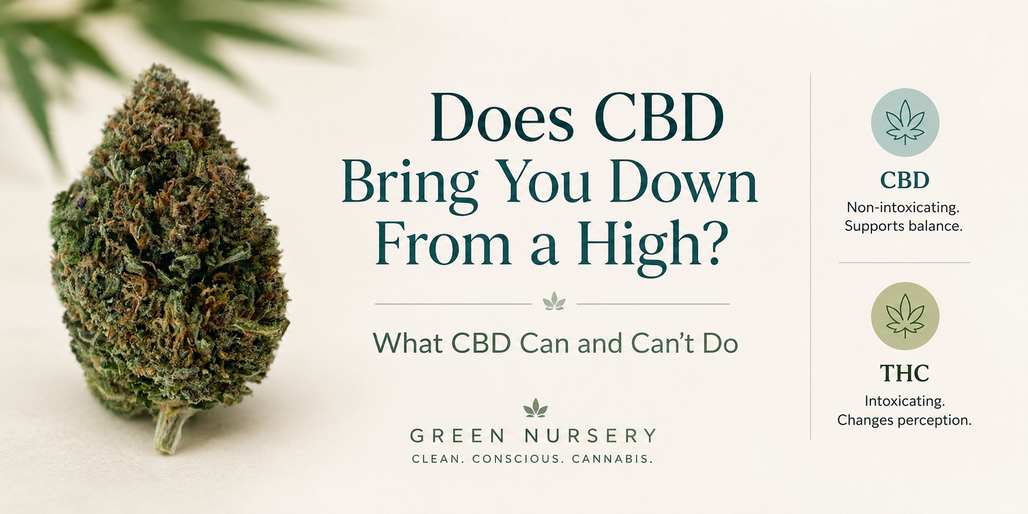
Does CBD Bring You Down From a High? What CBD Can and Can’t Do
Does CBD Bring You Down From a High? What CBD Can and Can’t Do
It is one of the most common questions in cannabis: does CBD bring you down from a high? You may have heard that taking CBD after THC can “balance things out” or help you feel normal again. While that idea sounds simple, the reality is more complex.
CBD and THC interact in the body, but CBD is not a guaranteed way to sober up or instantly reverse a strong experience. If you want a broader understanding of how cannabis strength works, start with our main guide on Cannabis Potency Myths.
Research on cannabinoids continues to show that dose, timing, product type, and individual response all matter. The FDA’s cannabis and CBD guidance also explains that cannabis-derived products can vary widely depending on formulation, ingredients, and intended use.
Understanding what CBD can and cannot do is the key to staying comfortable and in control.
What Does It Mean to Be Too High?
Being “too high” usually means the intensity of THC is stronger than expected. This can happen with edibles, high-potency flower, or simply taking more than your tolerance allows.
For some people, this may feel like racing thoughts, uneasiness, or a strong body sensation that is hard to ignore. For others, it may simply feel overwhelming or longer-lasting than expected. This is especially common when people underestimate how strong modern cannabis products can be.
If you want to avoid this situation in the first place, see our guide on How to Not Get Too High. The most reliable strategy is controlling dose and pacing before the experience gets too intense.
How THC and CBD Are Different
THC and CBD are both cannabinoids, but they behave very differently in the body. THC is associated with intoxicating effects, while CBD is generally described as non-intoxicating.
This difference is why many people assume CBD can cancel out THC. However, according to Harvard Health, CBD can interact with medications and affects the body in more complex ways than many product labels suggest. It does not simply override or shut off THC’s effects.
What this means in practice is that CBD may change how a product feels, but it does not erase what has already been consumed.
If you are comparing CBD product types, it also helps to understand the difference between full-spectrum, broad-spectrum, and isolate-based products. Our guide on Full-Spectrum vs Broad-Spectrum CBD explains how THC content and cannabinoid profiles can vary between products.
Can CBD Counteract THC?
Some people report that CBD helps make a THC experience feel more manageable. This may be related to how CBD and THC interact with cannabinoid systems in the body, but the effect is not consistent or guaranteed.
CBD does not remove THC from your system, and it does not stop the metabolic process that is already happening. Research published through PubMed and a broader cannabinoid review published by the National Institutes of Health highlights that cannabinoid interactions are complex and can vary significantly between individuals.
In real-world terms, CBD might take the edge off for some people, while others may notice little to no difference. It should not be relied on as a guaranteed solution to being too high.
Why Some People Notice CBD More Than Others
CBD may feel different from person to person because cannabis experiences are influenced by tolerance, dose, product type, timing, body chemistry, and the amount of THC already consumed.
Someone using a small amount of THC may notice CBD more clearly than someone who has consumed a much stronger edible or concentrate. Product quality also matters. A CBD product with unclear labeling or no lab report may not contain the cannabinoid levels a shopper expects.
This is why third-party testing is important. If you are comparing CBD flower, gummies, or other hemp products, review current lab reports when available. Green Nursery makes product testing available through its COA and lab reports page, allowing shoppers to verify cannabinoid content, terpene profiles, and product testing results.
Our guide on How to Read a CBD Flower Lab Report explains how COAs show cannabinoid content, THC levels, terpene profiles, and product testing information.
Why CBD Is Not an Instant Off Switch
One of the biggest misconceptions is that CBD works like a reset button. In reality, THC follows a timeline based on how it was consumed.
- Smoking or vaping tends to have faster onset and shorter duration
- Edibles take longer to kick in and can last much longer
If THC is already active in your system, especially from edibles, the experience will usually continue until your body processes it. CBD does not override this timeline.
This is why understanding product differences matters. If you want to go deeper into edible timing and intensity, read Why Do Edibles Feel Stronger Than Smoking?.
The practical takeaway is simple. CBD may be part of what someone tries, but time is still the biggest factor in how long a high lasts.
Product Timing: CBD Gummies vs CBD Flower
If someone chooses to try CBD after THC, the type of product can affect how quickly it is felt.
CBD Gummies
CBD gummies are easy to use and pre-measured, but they take time to digest. This means they are not ideal if someone is looking for a quick shift in how they feel.
For example, if someone already feels too high, taking a gummy may take 30 to 90 minutes to fully process, which may not align with what they are trying to achieve in the moment.
CBD Flower
CBD flower is inhaled, which leads to faster onset. Some people prefer this option because it may be felt more quickly and fits into the same routine as smoking.
Even with faster onset, results are not guaranteed. The benefit is timing, not certainty.
If you are new to CBD flower as a product category, start with our CBD flower hub: What Are CBD Buds?
What to Do If You Feel Too High
If you feel too high, the most reliable approach is not to rely on a single fix, but to focus on simple actions that help you stay grounded.
- Give it time since THC effects will pass
- Stay in a calm and familiar environment
- Hydrate and take slow breaths
- Avoid adding more THC
If the experience feels intense, it may help to understand what is happening. See What Is Greening Out? for a breakdown of why these experiences happen.
The key takeaway is that most uncomfortable highs fade naturally. CBD may be something someone tries, but it should not be treated as a guaranteed solution.
Where This Fits Into Cannabis Potency Myths
The idea that CBD can instantly bring you down from a high is one of several cannabis potency myths. It connects closely with other misunderstandings about edibles, THC percentage, hemp products, and full-spectrum CBD.
For more context, explore our Cannabis Potency Myths hub or read Can Legal Hemp Products Get You High? to understand why product labels, cannabinoids, and serving sizes matter.
Final Takeaway: What CBD Can and Can’t Do
CBD is often described as a way to bring you down from a high, but that idea is simplified. While CBD may influence how THC feels for some people, it is not a reliable off switch or a way to instantly sober up.
Cannabis experiences depend on dose, timing, product type, cannabinoid profile, and personal sensitivity. Understanding those factors is the most effective way to stay comfortable and avoid unwanted intensity.
If you are exploring hemp products as part of a more balanced approach, you can browse CBD flower, CBD gummies, or full-spectrum CBD products to better understand different formats and how they fit into your routine.
As cannabinoid research continues to evolve, scientists are still learning more about how CBD, THC, and other hemp compounds interact. Individual responses can vary considerably, which is why product selection, serving size, timing, and lab-tested quality remain important considerations.
Disclaimer: This content is for educational purposes only and is not medical advice. Do not drive or operate machinery while impaired. Always consult a healthcare professional if you have questions about cannabis use or interactions with medications.
Popular Products
Check out these customer favorites.