
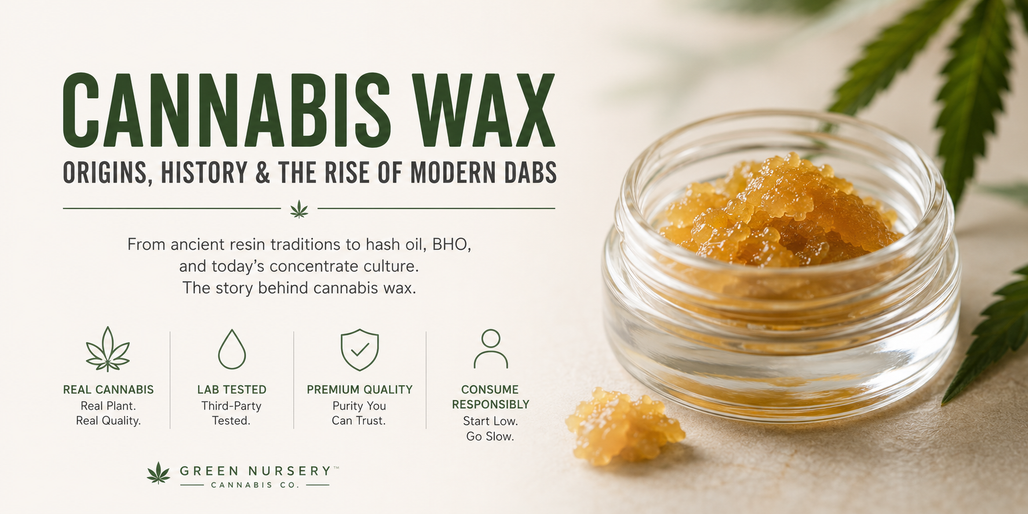
Cannabis Wax: Origins, History, Types, and Modern Dabs
Cannabis Concentrate History and Terminology Guide
Cannabis Wax: Origins, History, Types, and Modern Dabs
Cannabis wax is a soft or semi-solid cannabis concentrate named for its wax-like appearance and consistency. It belongs to a much older history of concentrated cannabis resin, but the modern product commonly called wax developed more recently through advances in hash-oil extraction, concentrate processing, dabbing devices, and regulated cannabis manufacturing.
No reliable historical record identifies one person who invented cannabis wax or one exact date when it first appeared. Modern wax evolved gradually as older cannabis-oil products were refined into different consistencies and marketed under texture-based names such as wax, budder, badder, crumble, and shatter.
This article explains what cannabis wax is, where it came from, why it is different from ordinary hash and cannabis oil, how it became associated with dabs and wax pens, and what consumers should understand about potency, testing, and product variability.
For a broader overview of flower, extracts, dabs, vape products, edibles, oils, and other formats, begin with Green Nursery’s complete guide to cannabis consumption methods .
Quick Answer: Where Did Cannabis Wax Come From?
Cannabis wax developed from the history of cannabis resin and extracted hash oil. Traditional cultures had collected and concentrated cannabis trichomes for centuries, but those products were generally forms of hash rather than modern wax. The soft, opaque concentrate now called wax emerged much later as solvent-extracted cannabis oils, texture-focused processing, dabbing, and concentrate devices became more widespread during the late twentieth and early twenty-first centuries.
It is more accurate to describe wax as an evolving product category than as a single invention. No verified record identifies a first batch, one original producer, or a universally accepted date of invention.
The history can be summarized as a progression:
- People collected and concentrated cannabis resin into traditional hash.
- Solvents and pharmaceutical extraction methods produced cannabis extracts and hash oils.
- Modern hydrocarbon extraction produced highly concentrated oils with different physical properties.
- Producers and consumers began using appearance-based terms such as wax, budder, crumble, and shatter.
- Dabbing devices created a recognizable culture and delivery method around these concentrates.
- Legal markets turned wax into a packaged and laboratory-tested retail category.
What Is Cannabis Wax?
Cannabis wax is a concentrated cannabis extract with a soft, opaque, sticky, crumbly, or wax-like consistency. Depending on the product, it may contain THC, THCA, CBD, other cannabinoids, terpenes, plant-derived compounds, or added ingredients.
The National Institute on Drug Abuse describes wax and budder as soft-solid cannabis concentrates and distinguishes them from more fluid hash oils and brittle products such as shatter.
The word wax mainly describes physical consistency. It does not identify:
- One cannabinoid
- One cannabis strain
- One extraction method
- One potency level
- One terpene profile
- One legal classification
- One device or delivery route
Two products sold as cannabis wax may therefore differ considerably in cannabinoid concentration, ingredients, extraction category, aroma, texture, contaminant testing, and intended hardware.
Weed Wax, Marijuana Wax, and THC Wax
Weed wax, marijuana wax, and cannabis wax are often used as near-synonyms. “THC wax” more specifically suggests a concentrate containing substantial THC or THCA-related content, but the name alone does not confirm the actual cannabinoid concentration.
A CBD-dominant concentrate can also have a wax-like texture. Appearance cannot reliably tell a consumer whether a product is THC-dominant, CBD-dominant, intoxicating, hemp-derived, or compliant with a particular law.
Cannabis Wax, Dabs, Pens, and Devices Are Not the Same Thing
Concentrate terminology often mixes the product, portion, method, and device into one category. Keeping them separate makes wax easier to understand.
| Term | What It Describes | Example |
|---|---|---|
| Cannabis wax | The concentrate | A soft or opaque cannabis extract |
| Dab | A portion of concentrate | A portion of wax, rosin, resin, or shatter |
| Dabbing | The delivery method | Vaporizing and inhaling a concentrate |
| Dab rig | A device | A water-pipe-style concentrate device |
| Wax pen | A portable device | An electronic concentrate pen with a compatible chamber |
| Vape cartridge | A hardware and formulation format | A cartridge containing a flowable formulated oil |
Wax Is Not the Same as a Dab
Wax is a type of concentrate. A dab is a portion of concentrate. Dabbing is a method of vaporizing that material, and a dab rig or concentrate pen is a device. A dab can consist of wax, but it can also consist of rosin, resin, shatter, sauce, badder, or another concentrate.
Cannabis Wax Is a Texture Category, Not One Exact Formula
Cannabis concentrate names frequently describe how a product looks or behaves rather than providing a standardized chemical definition.
A peer-reviewed review of cannabis processing and extraction methods explains that extraction and processing choices can produce extracts with different chemical profiles and physical characteristics.
The consistency of a finished concentrate may be influenced by factors including:
- The original flower or resin material
- The cannabinoids and terpenes present
- The broad extraction category
- Refinement and filtration
- Storage conditions
- Age and oxidation
- Finished-product formulation
- Post-extraction handling
These variables are not visible from a product name alone. A concentrate labeled “wax” should be evaluated by its complete description, ingredients, cannabinoid report, batch information, and relevant contaminant tests.
Terms also vary among producers and markets. One company’s badder may resemble another company’s wax, while a product called sugar wax may fall somewhere between crystalline sugar and a soft concentrate.
Before Wax: Resin, Kief, and Traditional Hash
Cannabis wax did not begin the history of cannabis concentrates. The plant’s flowers contain resin-producing structures called trichomes, which contain cannabinoids, terpenes, and other compounds.
People have collected and concentrated this resin through mechanical practices for centuries. Traditional products include:
- Kief: loose resin glands and fine plant particles separated from dried flower
- Dry sift: resin separated through screens
- Charas: resin traditionally collected by hand from living cannabis flowers
- Pressed hash: separated resin compressed into blocks, slabs, balls, or other shapes
- Ice-water hash: resin separated using cold water, agitation, and filtration
A peer-reviewed history of cannabis and cannabinoid science traces the plant’s long use in agriculture, ritual, traditional preparations, medicine, and intoxicating products.
These traditional resin products established the central idea behind all concentrates: separating or collecting cannabinoid-rich material from the rest of the plant.
They should not, however, be retroactively called cannabis wax. Traditional hash and modern wax differ in their typical processing categories, physical forms, terminology, and historical settings.
Hash Oil and the Direct Origins of Cannabis Wax
Hash oil is the more direct predecessor of modern cannabis wax. The term broadly refers to concentrated cannabis resin obtained through extraction rather than only through mechanical trichome collection.
Cannabis extracts existed in medicinal, pharmaceutical, informal, and illicit contexts before modern dabbing culture. Some were liquid tinctures, while others were thicker oils or resinous extracts.
As extraction technology changed, producers could create materials with increasingly varied consistencies. A cannabis extract might remain fluid, become sticky and sap-like, form a brittle sheet, or develop a soft, opaque consistency.
Wax therefore belongs to the larger family of hash oils and modern cannabis extracts, but the terms are not perfectly interchangeable.
Is Cannabis Wax the Same as Hash Oil?
Wax can be considered one physical form within the broad history of extracted cannabis oil. However, “hash oil” is usually a broader category, while “wax” describes a more specific soft or semi-solid consistency.
A fluid cartridge oil, thick honey oil, brittle shatter, and soft wax may all begin as extracted cannabis concentrates but behave differently as finished products.
The Rise of Butane Hash Oil and Modern Wax
Butane hash oil, commonly abbreviated BHO, became historically important because hydrocarbon extraction could produce concentrated resin that was later sold under names such as oil, honey, amber, shatter, budder, crumble, and wax.
BHO is a broad processing category rather than one final texture. A hydrocarbon-extracted concentrate may become wax-like, brittle, fluid, crystalline, or sauce-like depending on the source material, equipment, formulation, refinement, and handling.
Knowledge about BHO circulated within cannabis communities during the late twentieth century and spread more visibly through internet forums and documents around the turn of the twenty-first century. That online history is sometimes misrepresented as the moment wax was invented.
A dated online document can show when information was publicly circulated, but it cannot prove that nobody had used the method previously. For that reason, claims that one online writer invented BHO or cannabis wax should be treated cautiously.
A peer-reviewed review of butane hash oil and dabbing describes the growth of BHO use, the spread of amateur production, and the serious hazards associated with flammable solvents.
Why Is It Called Cannabis Wax?
Cannabis wax received its name from its appearance and consistency. Many examples are opaque, pliable, sticky, crumbly, or visually similar to beeswax, earwax, lip balm, or softened candle wax.
The term became useful because concentrate markets needed a way to distinguish soft products from:
- Fluid hash oil
- Sticky sap
- Glass-like shatter
- Creamy budder or badder
- Dry crumble
- Crystalline sugar or diamonds
- Liquid terpene-rich sauce
These names developed through consumer culture and commercial marketing rather than one universal scientific classification system. Texture names can be useful descriptions, but they should not replace laboratory information.
Cannabis Wax, Budder, Crumble, Sugar, and Shatter Explained
| Term | General Description | Important Limitation |
|---|---|---|
| Wax | Soft, opaque, sticky, or wax-like concentrate | Does not identify one extraction method or potency |
| Budder | Creamy or butter-like concentrate | Often overlaps with badder and wax terminology |
| Badder or batter | Soft, whipped, or batter-like texture | Spelling and consistency vary by producer |
| Crumble | Drier concentrate that breaks apart readily | May also be marketed as honeycomb |
| Sugar wax | Wax-like material containing small visible crystals | Not the same as cosmetic sugar wax used for hair removal |
| Shatter | Hard, brittle, or glass-like concentrate | Transparency does not prove purity or safety |
| Sap | Sticky, flexible consistency between oil and solid extract | Meaning varies considerably |
| Sauce | Liquid or semi-liquid concentrate that may contain crystals | “Terpene-rich” claims should be verified by product data |
| Rosin | Extract associated with heat and mechanical pressure | Rosin describes a processing category, not simply a texture |
What Is Sugar Wax Cannabis?
Cannabis sugar wax is generally a soft concentrate with a grainy or crystalline appearance. Small cannabinoid crystals may be suspended within a waxy or sauce-like material, giving it a texture that resembles wet sugar.
The term does not identify one guaranteed cannabinoid concentration or extraction process. It should not be confused with the sugar-based cosmetic product used for hair removal.
Cannabis Wax vs. Oil: What Is the Difference?
Cannabis wax and cannabis oil are both concentrates, but the terms usually describe different consistencies and product formats.
| Feature | Cannabis Wax | Cannabis Oil |
|---|---|---|
| Consistency | Soft, sticky, opaque, crumbly, or semi-solid | Fluid, viscous, or pourable |
| Typical packaging | Small concentrate container | Cartridge, syringe, bottle, capsule, or concentrate container |
| Common device association | Concentrate pen or dab device | Cartridge, formulated vape, oral product, or concentrate device |
| Meaning | Primarily a texture term | Broad term covering several liquid or viscous products |
| Interchangeability | Not automatically compatible with oil cartridges | Not every oil is designed for inhalation |
The word “oil” is especially broad. It may refer to vape oil, hash oil, oral cannabinoid oil, tincture-style products, cooking ingredients, or pharmaceutical formulations.
A product intended to be swallowed should never be assumed to be suitable for inhalation. Likewise, solid wax should not be placed into a cartridge or device unless the manufacturer specifically identifies the hardware as compatible with that finished product.
How Dabbing Changed the History of Cannabis Wax
Cannabis extracts existed before modern dabbing, but dabbing gave products such as wax and shatter a distinct delivery culture, vocabulary, and device ecosystem.
Dabbing generally refers to vaporizing a portion of concentrate and inhaling the resulting aerosol. Early systems were often adapted from glass water pipes and manually heated concentrate surfaces. Later devices introduced electronic heating and portable concentrate chambers.
By the early and mid-2010s, dabs were receiving increasing attention from researchers, regulators, news organizations, and public-health agencies.
A review of cannabis-concentrate research describes the rapid growth of high-potency concentrate products while emphasizing that scientific evidence about their long-term behavioral and health effects remains incomplete.
The growth of dabbing also helped turn physical texture into a major commercial distinction. Wax, shatter, badder, resin, rosin, and sauce became separate menu categories even when their boundaries remained inconsistent.
What Is a Cannabis Wax Pen?
A cannabis wax pen is a portable electronic device designed to heat compatible solid or semi-solid concentrates. It commonly contains a battery, heating chamber, mouthpiece, and electronic controls.
A wax pen is not the same as a standard prefilled vape cartridge:
- A wax pen generally has a chamber intended for compatible concentrate.
- A cartridge contains a pre-formulated oil designed to flow within that hardware.
- A disposable vape combines the oil, battery, heater, and mouthpiece into one unit.
- A dry-herb vaporizer heats plant material rather than wax or cartridge oil.
“Cannabis wax vape” is often used casually for several different devices. Consumers should identify the actual hardware category rather than relying on the marketing phrase.
From Informal Hash Oil to Licensed Concentrate Laboratories
Regulated cannabis markets did not invent wax, but they changed how it was manufactured, categorized, packaged, and tested.
Licensed production may involve:
- Purpose-built closed processing systems
- Hazardous-location electrical controls
- Ventilation and gas monitoring
- Standard operating procedures
- Employee training
- Batch and source-material records
- Packaging and cannabinoid labels
- Third-party compliance testing
These controls reduce certain risks but do not make every product identical or automatically free from concern. State requirements differ, and product quality can vary among manufacturers, batches, laboratories, and regulatory systems.
As one regulated-market example, the California Department of Cannabis Control requires batches to be tested for categories including cannabinoids, residual solvents, pesticides, heavy metals, microbial impurities, and mycotoxins before regulated sale.
That example should not be treated as a nationwide standard. Consumers must evaluate the requirements and legal status that apply in their own jurisdiction.
How to Evaluate a Cannabis Wax Certificate of Analysis
A wax product’s color, aroma, transparency, or texture cannot confirm its potency or purity. A batch-specific certificate of analysis provides more useful information.
1. Match the Batch Number
The batch or lot number on the product should match the number on the laboratory report. A result for another batch, strain, or source extract does not verify the finished product in front of the consumer.
2. Confirm the Sample Description
The report should identify the tested material as the finished concentrate whenever possible. A flower report does not automatically represent a concentrate made from that flower.
3. Review the Cannabinoid Profile
Look for THC, THCA, CBD, CBDA, and any other reported cannabinoids. Results may appear as percentages, milligrams per gram, or both.
THCA can convert toward Delta-9 THC when strongly heated. Green Nursery’s guide to how THCA transforms into THC explains the role of decarboxylation in greater detail.
4. Check Residual-Solvent Results
Residual-solvent testing is especially relevant to solvent-extracted concentrates. The report should make clear which solvents were included in the panel and whether the sample passed the applicable limits.
5. Review Contaminant Panels
Depending on the product and regulatory system, useful panels may include:
- Pesticides
- Heavy metals
- Microbial contaminants
- Mycotoxins
- Foreign material
- Residual solvents and processing chemicals
6. Check Ingredients and Terpene Claims
Determine whether the concentrate contains only cannabis extract or also includes added terpenes, cannabinoid distillates, thinning ingredients, flavors, or other formulation components.
7. Review the Laboratory and Testing Date
The report should identify the laboratory, testing date, sample information, analytical methods where provided, and pass-or-fail results.
Green Nursery publishes available certificates of analysis and laboratory reports for products it carries. Readers can also review why third-party testing matters .
Green Nursery’s guide to reading a CBD flower lab report explains cannabinoids, batch numbers, and common contaminant panels. Concentrates require additional attention to extraction-related information and residual-solvent results.
Cannabis Wax Quality Checklist
- Finished-product name and sample type are clear
- Package and laboratory batch numbers match
- THC, THCA, CBD, and other relevant cannabinoids are reported
- Residual-solvent testing is included where applicable
- Pesticide and heavy-metal results are available
- Ingredients and added terpenes are disclosed
- The testing date and laboratory identity are visible
- Claims match the actual certificate of analysis
Cannabis Wax History Timeline
| Period | Development | Historical Importance |
|---|---|---|
| Traditional and premodern periods | Communities collect and concentrate cannabis resin into kief, charas, and pressed hash. | Establishes the long history of separating cannabinoid-rich resin from plant material. |
| Nineteenth and early twentieth centuries | Cannabis extracts, tinctures, and hash oils appear in pharmaceutical and informal preparations. | Creates a bridge between mechanically collected hash and extracted cannabis oil. |
| Late twentieth century | Modern solvent-extracted hash oils develop within changing cannabis markets. | Produces concentrated materials capable of taking on oil, sap, wax, and brittle consistencies. |
| Late 1990s and early 2000s | Internet forums and online documents accelerate the circulation of BHO information. | Expands informal production knowledge but does not establish one verified invention date. |
| Early to mid-2000s | Wax, budder, crumble, shatter, honey oil, and related texture names become more visible. | Turns concentrate consistency into an important product category. |
| Early 2010s | Dabbing gains broader cultural, regulatory, media, and scientific attention. | Connects modern concentrates with specialized devices and high-potency inhalation. |
| 2010s regulated markets | Licensed extraction facilities and retail concentrate categories expand. | Introduces commercial packaging, batch tracking, product labels, and compliance testing. |
| Present | Wax exists alongside live resin, rosin, sugar, sauce, diamonds, cartridges, and formulated extracts. | Shows how broad and specialized modern concentrate terminology has become. |
Cannabis Wax Potency and Responsible-Use Considerations
Cannabis concentrates may contain substantially higher cannabinoid concentrations than ordinary flower. The exact difference depends on the flower, extract, formulation, batch, and laboratory result.
The CDC notes that concentrates used in vaping and dabbing devices may increase certain risks because of their concentration or strength, along with variables related to products, ingredients, and devices.
Higher concentration does not create one predictable experience. Effects can vary with:
- THC and THCA concentration
- CBD and minor cannabinoids
- The amount inhaled
- Device performance
- Individual tolerance
- Medication or substance use
- Physical and mental health
- Setting and prior experience
Potential concerns associated with highly concentrated THC exposure include stronger impairment, anxiety, panic, confusion, agitation, and an increased risk of consuming more THC than intended.
- Do not drive, operate machinery, or perform hazardous work while impaired.
- Do not combine intoxicating cannabis with alcohol or other substances.
- Do not attempt informal hydrocarbon extraction.
- Do not place concentrates in incompatible devices.
- Store concentrates away from children, pets, and unintended users.
- Review the finished product’s cannabinoid profile and contaminant testing.
- Check the laws that apply to purchase, possession, shipping, and use.
- Avoid cannabis during pregnancy and breastfeeding and discuss health concerns with a qualified professional.
Frequently Asked Questions About Cannabis Wax
What is cannabis wax?
Cannabis wax is a soft, opaque, sticky, or crumbly cannabis concentrate. The term mainly describes physical consistency rather than one exact cannabinoid profile, extraction method, or potency.
When was cannabis wax invented?
No verified invention date exists. Modern cannabis wax developed gradually from older hash-oil and cannabis-extraction practices, becoming more recognizable during the rise of BHO, texture-based concentrate names, and dabbing culture around the turn of the twenty-first century.
Who invented cannabis wax?
No single inventor has been reliably established. Online accounts sometimes credit specific producers with wax, budder, or BHO innovations, but many of those claims lack independent contemporary documentation.
Is cannabis wax the same as a dab?
No. Wax is a type of concentrate. A dab is a portion of concentrate, and dabbing is the method of vaporizing and inhaling it. A dab may contain wax, rosin, resin, shatter, badder, sauce, or another concentrate.
Is cannabis wax the same as hash oil?
Wax is related to hash oil but is more specific. Hash oil is a broad term for extracted cannabis resin, while wax generally describes a soft or semi-solid finished consistency.
Is all cannabis wax made with butane?
No. BHO is strongly associated with modern wax, but a wax-like consistency does not prove one extraction method. Review the product description and laboratory documentation rather than assuming the process from appearance.
What is sugar wax cannabis?
Sugar wax is generally a soft cannabis concentrate containing small visible crystals that create a wet-sugar or grainy appearance. It is not related to cosmetic sugar wax used for hair removal.
What is the difference between cannabis wax and shatter?
Wax is usually soft, opaque, and pliable or crumbly. Shatter is generally harder, more translucent, and brittle. Texture does not by itself establish potency, purity, safety, or quality.
Can cannabis wax be used in a vape pen?
Only hardware specifically designed and labeled for compatible concentrates should be considered. A concentrate pen or wax pen differs from an ordinary oil cartridge, disposable vape, and dry-herb vaporizer.
Can cannabis wax be placed in a normal vape cartridge?
It should not be assumed to be compatible. Wax and cartridge oils have different physical properties, and improvised mixing or dilution can create unpredictable heating, ingredient, and inhalation risks.
Can cannabis vape juice be made from wax?
Consumers should not attempt to turn wax into homemade vape liquid. A safe inhalable formulation requires verified ingredients, controlled manufacturing, appropriate hardware, stability evaluation, and contaminant testing.
Can cannabis wax be made at home?
Home hydrocarbon extraction should not be attempted. Butane and related solvents can accumulate and ignite, causing explosions, fires, severe burns, and toxic exposure. This article does not provide extraction instructions.
How much cannabis is equal to one gram of wax?
There is no universal flower equivalent. One gram describes product weight, not cannabinoid content. The comparison depends on the potency of both the wax and the flower, product composition, laboratory accuracy, and actual amount consumed.
Is THC wax stronger than cannabis flower?
THC-dominant wax is generally more concentrated than ordinary flower, but exact strength varies. Compare the finished products’ cannabinoid results rather than relying on the terms “wax” or “flower” alone.
How can consumers tell what is in cannabis wax?
Review the ingredient list, cannabinoid profile, batch number, residual-solvent results, pesticide panel, heavy-metal results, testing date, and finished-product certificate of analysis.
Cannabis Wax Is a Modern Chapter in Concentrate History
The origins of cannabis wax extend from traditional resin collection to hash oil, hydrocarbon extraction, dabbing culture, electronic concentrate devices, and licensed laboratories. It was not invented at one proven moment by one documented person.
Modern cannabis wax is best understood as a texture category within a much larger concentrate market. The word does not reveal the product’s cannabinoid content, extraction history, purity, ingredients, legal status, or intended hardware.
Consumers should look beyond names such as weed wax, THC wax, sugar wax, and marijuana wax. The finished product’s description, batch identity, cannabinoid profile, ingredient disclosure, and contaminant testing provide more meaningful information.
Continue with Green Nursery’s guide to cannabis concentrates and delivery methods to compare wax with flower, vape cartridges, dry-herb vaporization, edibles, tinctures, topicals, and other product formats.
Popular Products
Check out these customer favorites.