
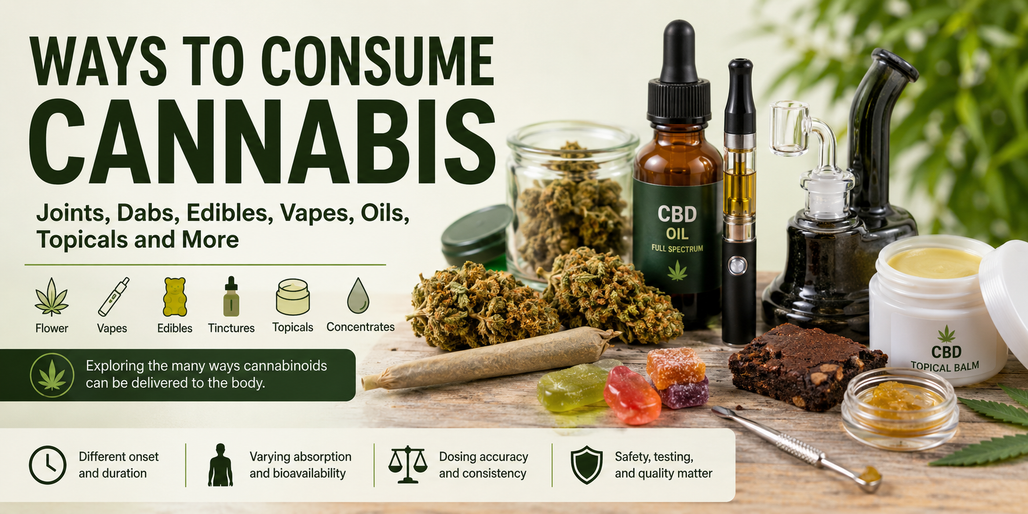
Ways to Consume Cannabis: Joints, Dabs, Edibles, Vapes & More
Cannabis History and Cannabinoid Delivery Guide
Ways to Consume Cannabis: Joints, Dabs, Edibles, Vapes, Oils, Topicals and More
Cannabis can be rolled into a joint, smoked through a pipe, pressed into hash, refined into wax, vaporized from a cartridge, eaten in a gummy, held under the tongue as an oil, applied to the skin, or incorporated into specialized pharmaceutical delivery systems.
These products may contain related cannabinoids, but they do not deliver those compounds to the body in the same way. The route can influence how quickly cannabinoids are absorbed, how long their effects may remain noticeable, which metabolites are produced, how clearly a serving can be measured, and which safety and testing questions matter most.
The Centers for Disease Control and Prevention identifies smoking, vaping, eating, and drinking as common ways cannabis is used . Modern markets also include dabbing, oromucosal products, topical products, transdermal systems, infused flower, concentrated extracts, and emerging delivery technologies.
Flower is the starting material behind many familiar consumption methods, including joints, pre-rolls, pipes, bongs, dry-herb vaporizers, hash, and several types of concentrate. Readers new to hemp flower should begin with What Are CBD Buds? A Clear Guide to CBD Bud, Hemp Flower, and What to Expect . That master guide explains CBD-rich flower, cannabinoids, terpenes, quality indicators, and batch-specific testing.
Green Nursery carries several of the formats discussed throughout this guide, including CBD flower, pre-rolls, hemp-derived THC edibles, and vape products. The sections below explain how those formats differ before directing readers to relevant products or deeper educational resources.
Quick Answer: What Are the Main Ways to Consume Cannabis?
The main cannabis and cannabinoid delivery methods are:
- Smoking: joints, pre-rolls, blunts, spliffs, pipes, bowls, one-hitters, chillums, bubblers, bongs, hookahs, and water pipes.
- Dry-herb vaporization: portable or tabletop devices that heat flower without intentionally burning it.
- Extract vaporization: vape cartridges, disposable vapes, vape pens, and related devices containing cannabinoid oils or concentrates.
- Dabbing: vaporizing a portion of cannabis concentrate, often using a dab rig, electronic rig, wax pen, or concentrate pen.
- Oral ingestion: gummies, capsules, tablets, brownies, chocolates, candies, oils, infused foods, and beverages.
- Oromucosal delivery: tinctures, sublingual drops, buccal sprays, lozenges, troches, gum, and dissolving films held in the mouth.
- Topical application: creams, lotions, balms, salves, roll-ons, cosmetic oils, and bath or body products.
- Transdermal delivery: patches or specialized gels designed to move cannabinoids across the skin barrier.
- Specialized systems: suppositories, nasal products, inhalers, pharmaceutical oral solutions, and controlled-release technologies.
No single method is universally best. Each creates a different balance among onset, duration, dose control, convenience, lung exposure, accidental-ingestion risk, equipment requirements, and testing needs.
Cannabis Consumption Methods Comparison Chart
| Delivery Method | Common Forms | General Onset Pattern | General Duration Pattern | Main Consideration |
|---|---|---|---|---|
| Combustion | Joints, blunts, spliffs, pipes, bongs | Rapid | Often shorter than swallowed products | Smoke and combustion exposure |
| Dry-herb vaporization | Portable and tabletop flower vaporizers | Rapid | Often shorter than swallowed products | Device quality, heat control, maintenance, and flower quality |
| Extract vaping | Cartridges, disposables, vape pens | Rapid | Product-dependent | Oil formulation, hardware, contaminants, and potency |
| Dabbing | Wax, shatter, rosin, resin, sauce, diamonds | Rapid | Product- and amount-dependent | Concentrated cannabinoids and heated equipment |
| Oral ingestion | Gummies, capsules, foods, beverages | Slower and more variable | Often longer | Delayed onset and taking more too early |
| Oromucosal | Tinctures, drops, sprays, lozenges, strips | Formulation- and technique-dependent | Moderate and variable | Some or most of the product may still be swallowed |
| Topical | Balms, creams, lotions, salves | Primarily local-use pattern | Product-dependent | Ordinary topicals are not automatically systemic |
| Transdermal | Patches and specialized gels | Gradual | Potentially extended | Requires purpose-built formulation to cross the skin barrier |
These are general patterns rather than guaranteed timelines. Cannabinoid content, formulation, amount, food intake, metabolism, tolerance, technique, and individual biology can all influence timing and intensity.
Delivery Route, Product Form, and Device Are Not the Same Thing
Much of the confusion surrounding cannabis consumption comes from mixing three different categories.
Delivery Route
The delivery route describes how cannabinoids enter or interact with the body. Examples include inhalation, oral ingestion, oromucosal absorption, topical application, and transdermal delivery.
Product Form
The product form describes the cannabis or cannabinoid material itself. Flower, hash, wax, distillate, gummies, tincture solution, and topical cream are product forms.
Device or Format
The device or format describes how the product is prepared or delivered. A joint, bong, vape cartridge, dab rig, dropper bottle, capsule, and adhesive patch are examples.
| Example | Delivery Route | Product Form | Device or Format |
|---|---|---|---|
| Joint | Inhalation through combustion | Dried flower | Rolling paper |
| Bong | Inhalation through combustion | Flower or certain hash products | Water pipe |
| Dab | Inhalation through vaporization | Wax, rosin, resin, shatter, or another concentrate | Dab rig, electronic rig, or concentrate pen |
| Gummy | Oral ingestion | Infused edible | Pre-portioned candy format |
| Tincture | Oromucosal, oral, or a combination | Cannabinoid solution | Dropper or spray bottle |
| Patch | Transdermal | Cannabinoid-containing matrix | Adhesive patch |
Wax Is Not the Same Thing as a Dab
Wax is a cannabis-concentrate texture. A dab is a portion of concentrate. Dabbing is the method of vaporizing and inhaling that concentrate. A dab rig, electronic rig, or dab pen is the device.
A Brief History of Cannabis Consumption
Humans have used cannabis for thousands of years as a fiber crop, food source, ritual plant, intoxicant, and ingredient in traditional preparations. Historical practices differed widely across regions and included seeds, plant material, resin, drinks, foods, smoke, and medicinal formulations.
A peer-reviewed history of cannabis and cannabinoid science traces the plant’s long relationship with agriculture, traditional medicine, pharmacology, and the later discovery of cannabinoids and the endocannabinoid system.
Hashish developed from collecting and concentrating cannabis resin glands. Long-standing hash traditions became particularly associated with areas of Central and South Asia, the Middle East, and North Africa. Depending on region and period, resin was hand-rubbed, dry-sifted, pressed into slabs or balls, incorporated into foods, or smoked through pipes.
Cannabis tinctures later entered Western pharmaceutical practice, especially during the nineteenth and early twentieth centuries. These alcohol-based preparations offered a liquid form before prohibition removed many cannabis products from formal pharmacies.
Rolled cannabis cigarettes evolved into what are now called joints, spliffs, blunts, cones, and commercial pre-rolls. Pipes, chillums, hookah-style devices, and water pipes continued alongside rolled forms.
During the twentieth century, cannabis brownies and other homemade edibles became cultural symbols, while improving extraction and refinement methods produced hash oil and increasingly concentrated products.
Late twentieth- and early twenty-first-century concentrate culture popularized BHO, wax, shatter, budder, live resin, rosin, sauces, crystalline products, and dabbing devices. At the same time, vaporizers developed from large tabletop flower systems into portable dry-herb devices, cartridges, disposables, and electronic concentrate rigs.
Regulated hemp and cannabis markets later expanded gummies, measured capsules, beverages, sublingual oils, topicals, transdermal patches, nanoemulsions, and other specialized delivery technologies.
Each of these subjects deserves its own history and terminology guide. This article provides the overall map, while its related spoke articles can examine how joints, hash, dabs, edibles, tinctures, vaporizers, and other systems evolved through culture, prohibition, science, legalization, and commercialization.
Flower, Joints, Blunts, Spliffs, Pipes, and Bongs
Dried cannabis or hemp flower remains one of the most recognizable cannabis forms. It may be rolled in paper or placed in a pipe, bowl, bong, bubbler, chillum, one-hitter, hookah, steamroller, or another combustion device.
Before comparing devices, readers can review Green Nursery’s complete CBD buds and hemp flower guide for a deeper explanation of flower structure, cannabinoids, trichomes, terpenes, curing, and laboratory reports.
Joint
A joint is cannabis flower rolled in thin paper. It generally contains cannabis rather than tobacco, although regional terminology can vary.
Pre-Roll
A pre-roll is a joint or cone filled before sale. Pre-rolls may be hand-finished or machine-filled and can contain whole flower, smaller flower material, ground flower, or infused ingredients depending on the product.
Readers comparing ready-filled formats can browse Green Nursery’s hemp pre-roll collection . Review the finished product’s cannabinoid report because infused pre-rolls may differ substantially from ordinary flower-only products.
Blunt
A blunt traditionally uses a cigar, cigarillo, or tobacco-based wrapper filled partly or completely with cannabis. The tobacco wrapper introduces nicotine and additional tobacco exposure.
Spliff
A spliff usually contains a mixture of cannabis and tobacco rolled in paper. The exact meaning varies geographically, so product descriptions and local terminology matter.
Pipe, Bowl, Chillum, and One-Hitter
These are compact devices that hold flower for combustion. Their shape changes portability, cooling, airflow, and ritual, but does not eliminate smoke exposure.
Bong, Bubbler, and Water Pipe
These devices draw smoke through water before inhalation. Water can cool and alter smoke, but it does not make combustion harmless or remove every harmful component.
Changing the paper, pipe, or water-filtration design does not remove the central issue of combustion. The CDC states that smoked cannabis can harm lung tissue regardless of how it is smoked and specifically discusses joints, bongs, bowls, and blunts.
For loose flower, compare Green Nursery’s CBD flower collection with its THCA flower collection. The flowers may look similar, but their cannabinoid profiles and potential for intoxication can differ considerably.
Dry-Herb Vaporizers
Dry-herb vaporizers heat cannabis or hemp flower without intentionally setting it on fire. The user inhales an aerosol or vapor containing compounds released from the heated plant material.
Dry-herb vaporizers may be:
- Portable: battery-powered devices intended for personal use.
- Tabletop: larger devices usually powered through an electrical outlet.
- Conduction-based: flower contacts a heated chamber or surface.
- Convection-based: heated air passes through the flower.
- Hybrid: combines more than one heating mechanism.
Dry-herb vaporization is not the same as using a vape cartridge. One heats plant material; the other generally heats a formulated cannabis or hemp extract.
Human cannabinoid pharmacokinetic research shows that inhaled cannabinoids generally enter the bloodstream rapidly , although the absorbed amount can vary with device performance, product content, and inhalation behavior.
Avoid describing dry-herb vaporization as risk-free. Device construction, temperature control, cleanliness, flower quality, contaminants, and user technique all matter.
Vape Pens, Cartridges, Pods, and Disposable Vapes
Extract-based vape products contain cannabinoid oil or another concentrate rather than loose flower. Common formats include threaded cartridges, disposable vapes, pod systems, and refillable devices.
Distillate Cartridge
Distillate is a highly refined cannabinoid extract. Terpenes or other permitted ingredients may be added to influence aroma, flavor, viscosity, or device performance.
Live-Resin Cartridge
Live resin is generally produced from plant material preserved shortly after harvest instead of being conventionally dried and cured first. The term emphasizes preservation of volatile plant compounds, although exact processing and quality vary.
Rosin Cartridge
Rosin cartridges use an extract produced through heat and mechanical pressure rather than hydrocarbon-solvent extraction. Hardware and formulation still matter because the extract must function properly within the device.
Disposable Vape
A disposable combines the oil reservoir, heating element, battery, mouthpiece, and electronics into one unit. “Disposable” describes the hardware format, not the extract type.
Vaping should not be treated as one uniform category. The CDC notes that cannabis-vaping risks depend partly on the product, device, ingredients, and source . Informal or inaccurately labeled products can create additional uncertainty.
Important testing and quality considerations include cannabinoid potency, pesticides, residual solvents, heavy metals, ingredient transparency, oil consistency, and the interaction between the formulation and the hardware.
To see how these distinctions appear on current retail products, review Green Nursery’s THCA vape collection alongside available cannabinoid reports, ingredient information, and device descriptions.
Kief, Dry Sift, Charas, and Traditional Hash
Cannabis flowers are covered in resin-producing structures called trichomes. Products within the hash family concentrate or collect these resin glands through hand-rubbing, sieving, cold water, pressure, or related mechanical processes.
Kief
Kief is a loose collection of resin glands and fine plant particles separated from cannabis flower. It may accumulate during handling or be intentionally collected through screening.
Dry Sift
Dry sift is produced by moving dried plant material across screens so resin glands separate by size. The term often implies a more deliberate and graded process than casually collected grinder kief.
Pressed Hash
Loose resin material can be compressed into slabs, bricks, cakes, balls, sticks, or other forms. Color, texture, aroma, and consistency differ according to source material, region, technique, age, and storage.
Charas
Charas traditionally refers to resin collected by hand-rubbing living cannabis flowers. It is associated with long-standing practices in parts of South Asia.
Bubble Hash or Ice-Water Hash
Ice-water processing uses cold water and agitation to separate resin glands from plant material. The resin is then filtered and dried. The term “bubble hash” is linked to how certain grades behave when heated.
Full-Melt Hash
“Full melt” is a quality and behavior term used for highly refined hash that leaves relatively little plant residue when heated. It is not a separate cannabinoid or cannabis species.
The DEA Museum’s cannabis history materials provide public-history context for traditional cannabis, resin, and hashish use across different periods and regions.
“Solventless” means that a chemical solvent was not used as the primary separation medium. It does not mean a product is non-intoxicating, low in cannabinoids, automatically clean, or free from testing concerns.
Modern Cannabis Concentrates: Wax, Shatter, Rosin, Resin, Sauce, and Diamonds
Cannabis concentrate names can sound like separate delivery systems even when they mainly describe texture, source material, processing, refinement, cannabinoid structure, or post-processing.
Hash Oil
Hash oil is a broad term for concentrated resin extracted from cannabis. It predates many modern texture names and can refer to products created through different extraction and refinement systems.
BHO and Hydrocarbon Extracts
BHO means butane hash oil, although commercial hydrocarbon extraction may involve butane, propane, or mixtures. These processes require professional closed-loop equipment, ventilation, safety controls, and residual-solvent testing.
Home hydrocarbon extraction can create serious fire, explosion, and injury risks. This article does not provide extraction instructions or production procedures.
Wax
Cannabis wax is a soft, opaque, wax-like concentrate. The word mainly describes consistency rather than one universal chemical composition.
Budder, Badder, and Batter
These names describe whipped, creamy, or batter-like textures. Spelling and terminology differ among producers and regional markets.
Crumble and Honeycomb
Crumble is a drier concentrate that breaks apart readily. Honeycomb is a related appearance term sometimes applied to porous concentrates.
Shatter
Shatter is a brittle or glass-like concentrate. Transparency and appearance do not, by themselves, prove potency, purity, safety, or quality.
Sap and Pull-and-Snap
These names describe sticky or flexible consistencies that sit between liquid oil and brittle shatter.
Sugar and Sauce
Sugar concentrates contain visible crystalline material within a softer matrix. Sauce or terp sauce generally refers to a liquid or semi-liquid, terpene-rich fraction that may also contain cannabinoid crystals.
THCA Diamonds or Crystalline
Diamonds are crystal-rich products containing high concentrations of THCA. They may be sold alone or combined with a sauce fraction. When strongly heated, THCA converts toward delta-9 THC.
Live Resin
Live resin generally begins with plant material preserved shortly after harvest. It is commonly solvent-extracted and marketed around preserving more of the plant’s volatile profile.
Rosin
Rosin is produced through heat and mechanical pressure. Flower rosin begins with flower, while hash rosin begins with mechanically separated resin material.
Live Rosin
Live rosin usually begins with fresh-frozen plant material that is processed into hash and then pressed. It is distinct from live resin despite the similar names.
Distillate
Distillate is a highly refined extract concentrated around selected cannabinoids. Refinement can reduce many original plant compounds, after which terpenes may be reintroduced in a finished product.
Isolate
Isolate is a highly purified form of one cannabinoid, such as CBD isolate. The term describes refinement rather than a delivery route.
Rosin vs. Resin
Resin is a broad term connected to the plant’s trichome-rich material and appears in names such as live resin. Rosin specifically describes an extract produced using pressure and heat. Similar spelling does not mean identical processing.
What Is a Dab? Dabbing, Dab Pens, Wax Pens, and Dab Rigs Explained
A dab is a portion of cannabis concentrate intended for rapid vaporization and inhalation. The concentrate may be wax, shatter, rosin, live resin, badder, sauce, crystalline material, or another concentrated product.
The National Institute on Drug Abuse describes wax, shatter, and related extracts as cannabis concentrates and uses “dabbing” for the practice of vaporizing concentrated material.
Dabbing refers to vaporizing concentrate on or within a heated surface or chamber. Because the source material is concentrated, cannabinoid levels can be substantially higher than those found in ordinary flower.
Dab Rig
A dab rig is a water-pipe-style device adapted for concentrates. Instead of a flower bowl, it uses a concentrate surface or chamber commonly called a nail or banger.
Electronic Dab Rig
An electronic rig uses electrically controlled heating instead of a manually heated surface. It remains a concentrate-vaporization device.
Dab Pen or Wax Pen
A dab pen is a portable electronic device designed for cannabis concentrates. “Wax pen” is frequently used as a near-synonym, even when the chamber accepts several concentrate textures rather than wax alone.
Vape Pen
“Vape pen” more often refers to a device using a prefilled or refillable oil cartridge. A dab pen usually contains a chamber into which a concentrate is placed. Retail terminology is inconsistent, so the product description and device design matter.
Nectar Collector
A nectar collector is a concentrate device with a heated tip that contacts concentrate while vapor is drawn through the device. It is a device category rather than a concentrate form.
This hub does not provide heating temperatures, loading instructions, extraction guidance, or procedures for operating dab rigs. Concentrated THC and heated equipment create separate impairment, burn, fire, and product-purity considerations.
Infused Flower, Infused Pre-Rolls, Moon Rocks, and Cannabis Caviar
Infused flower combines dried cannabis or hemp flower with a concentrate or cannabinoid-rich coating. Common forms include:
- Flower coated or infused with distillate
- Flower coated in hash oil and rolled in kief
- Pre-rolls infused with concentrate
- Liquid-diamond-infused products
- Products marketed as moon rocks or cannabis caviar
“Moon rocks” commonly refers to flower coated with oil and then covered with kief. “Cannabis caviar” is used inconsistently and may describe a similar preparation or another infused-flower format.
The presence of visible flower does not mean the cannabinoid level is comparable to ordinary uninfused flower. The COA should represent the finished infused product rather than only the original base flower.
Cannabis Edibles and Infused Foods
Edibles deliver cannabinoids through the digestive system. Historical and modern forms include:
- Bhang and other traditional cannabis drinks
- Majoun and regional confections
- Brownies, cookies, and baked goods
- Chocolates and caramels
- Hard candies and mints
- Gummies
- Infused cooking oils and butter
- Savory foods
- Raw or minimally heated cannabis preparations
Swallowed THC passes through digestion and undergoes first-pass metabolism in the liver. This produces active metabolites, including 11-hydroxy-THC, and helps explain why edible experiences can differ from inhaled cannabis.
Pharmacokinetic research shows that oral and inhaled cannabinoids follow different absorption patterns , with swallowed products generally producing slower and more variable exposure than inhaled products.
Edible onset is delayed and variable. Taking another serving before the first serving has fully developed is a common pattern behind overconsumption.
Readers interested in a non-intoxicating edible category can compare Green Nursery’s CBD gummies. Product labels should identify the cannabinoid amount per piece, serving size, total amount in the package, ingredients, and spectrum type.
Raw Cannabis
Raw, unheated cannabis contains acidic cannabinoids such as THCA and CBDA. Heating changes these compounds through decarboxylation, so raw preparations are chemically different from smoked flower or fully heated edibles.
Read How THCA Transforms Into THC for a deeper explanation of heat, decarboxylation, and cannabinoid conversion.
For an intoxicating hemp-derived edible example, review Green Nursery’s Delta-9 THC gummies. Edible strength should be evaluated by milligrams per serving rather than the gummy’s physical size.
Some edibles combine cannabinoids rather than relying on THC alone. Green Nursery’s THC-and-CBD gummy collection provides an example of formulated edibles containing both cannabinoids in measured servings.
Capsules, Softgels, Tablets, and Swallowed Oils
Capsules and tablets are oral delivery systems even though they do not resemble conventional food. They may contain cannabinoid oil, powder, isolate, broad-spectrum extract, full-spectrum extract, or an approved pharmaceutical formulation.
Capsule
A capsule contains ingredients inside a soluble shell. Powder-filled capsules and liquid-filled softgels belong to the same broad oral route.
Tablet
Tablets are compressed solid doses. Some are swallowed, while others are designed to dissolve within the mouth.
Swallowed Oil
An oil taken directly and swallowed behaves primarily as an oral product. Using a dropper does not automatically make the route sublingual.
Capsules can provide clearly labeled unit amounts, but absorption, meal timing, metabolism, product accuracy, and individual response still influence the experience.
Cannabis and Hemp Beverages
Cannabinoid beverages include seltzers, shots, drink powders, syrups, teas, coffee products, traditional drinks, and ready-to-drink products.
Cannabinoids are naturally lipophilic, meaning they interact more readily with fats than with water. Beverage formulators may use emulsions, encapsulation systems, or finely dispersed droplets to help cannabinoids remain distributed within water-based products.
Traditional Beverage
Traditional preparations may rely on fats, dairy, plant ingredients, or culinary processing to carry cannabinoids.
Emulsified Beverage
An emulsion disperses small droplets of one phase within another. This can improve consistency in a water-based drink, but the term does not guarantee a particular onset, absorption rate, or effect.
Water-Soluble or Water-Dispersible Cannabinoids
Cannabinoids do not literally become water-soluble in the same sense as salt or sugar. “Water-soluble” is often consumer shorthand for a formulation designed to disperse cannabinoids more effectively in water.
Nano Beverages
“Nano” may refer to small dispersed particles or droplets, but the word alone does not prove particle size, stability, absorption, or faster onset.
Reviews of cannabinoid formulations and delivery technologies describe emulsions, lipid carriers, and other systems being explored to improve the dispersion and delivery of poorly water-soluble cannabinoids.
Beverages should identify milligrams per serving, total servings per container, whether the entire container is one serving, and any instructions for mixing or shaking.
Tinctures, Oils, Sublingual Drops, Sprays, Lozenges, and Oral Films
Cannabis tinctures have a long pharmaceutical history. Traditional tinctures were commonly alcohol-based plant extracts. Modern retail products frequently use carrier oils and may still be called tinctures even when they contain little or no alcohol.
Sublingual Delivery
Sublingual means a product is held beneath the tongue, where some compounds may be absorbed through tissues in the mouth.
Buccal Delivery
Buccal means a product is held against the inner cheek.
Oromucosal Delivery
Oromucosal is a broader term for delivery through the tissues of the mouth. Sprays, lozenges, troches, gums, and dissolving films may use this route.
Swallowed Tincture or Oil
Any swallowed portion enters the digestive route. A product held briefly in the mouth and then swallowed may involve both oromucosal and oral absorption.
Lozenge, Troche, or Gum
These remain in the mouth longer than immediately swallowed products, but formulation and use determine how much is absorbed through the mouth versus swallowed.
Dissolving Strip or Oral Film
Thin films are placed in the mouth to dissolve. They may be designed for buccal, sublingual, or broader oromucosal delivery.
“Tincture,” “oil,” and “drops” describe a product form or container more than they guarantee one exact route. Consumers should follow the intended-use directions for the specific finished product.
Topical Cannabinoid Products
Topicals are products applied to the skin. Common formats include:
- Balms
- Salves
- Creams
- Lotions
- Roll-ons
- Massage oils
- Cosmetic serums
- Lip products
- Bath products
- Hair and scalp products
An ordinary topical is usually designed for application at or near the skin. Applying a cannabinoid cream does not automatically mean a meaningful amount of cannabinoid reaches systemic circulation.
Topical quality considerations include:
- Total cannabinoid amount and container size
- Complete ingredient list
- Fragrances, essential oils, and potential allergens
- Microbial testing
- Heavy-metal testing where relevant
- Batch number and testing date
- Directions and patch-testing guidance
- Clear distinction between topical and transdermal use
Avoid assuming that a topical treats pain, arthritis, inflammation, eczema, or another medical condition merely because it contains CBD or THC. Disease-treatment claims require appropriate evidence and regulatory authorization.
Topical vs. Transdermal Cannabinoid Delivery
Topical and transdermal are not interchangeable terms.
Topical
A topical product is applied to the skin and may remain primarily at or near the application area.
Transdermal
A transdermal product is specifically formulated to move an ingredient across the skin barrier and potentially into systemic circulation.
A scientific review of transdermal cannabinoid delivery explains why moving highly lipophilic cannabinoids through the skin requires purpose-built formulations and specialized delivery strategies.
Transdermal systems may use patches, gels, penetration enhancers, carrier systems, or controlled-release designs. Performance depends on the cannabinoid, formulation, amount, patch structure, adhesive, skin condition, and evidence supporting the finished product.
Suppositories, Nasal Products, Inhalers, and Emerging Delivery Systems
Some cannabinoid delivery systems are uncommon, pharmaceutical, experimental, or highly dependent on local regulation.
Rectal or Vaginal Suppositories
These are solid or semi-solid formulations designed for mucosal placement. Evidence, absorption, product standards, and legal status vary widely. They should not be treated as interchangeable with ordinary oral or topical products.
Intranasal Delivery
Nasal sprays and powders are being studied as ways to deliver compounds across nasal tissues. Cannabinoid products marketed this way require careful evaluation of formulation, sterility, evidence, and regulatory status.
Metered-Dose Inhalers
A metered-dose inhaler is designed to release a controlled aerosol amount. Pharmaceutical inhaler research should not be treated as equivalent to using an ordinary retail vape.
Nebulized Formulations
Nebulizers convert liquid formulations into inhalable aerosols. Only products specifically developed, tested, and authorized for that route should be considered for inhalation.
Nanoemulsions and Microemulsions
These are formulation systems designed to disperse cannabinoids into small droplets. They may be incorporated into oral liquids, foods, sprays, gummies, or other formats.
Liposomes
Liposomes are lipid-based vesicles used to carry compounds. Their presence does not automatically prove superior absorption or effectiveness.
Micelles
Micelles are structures formed by amphiphilic molecules that can help disperse fat-soluble compounds in water-based environments.
Cyclodextrins
Cyclodextrins are ring-shaped molecules that can form complexes with poorly water-soluble compounds and change formulation characteristics.
Mucoadhesive Gels and Films
These are designed to remain in contact with oral or other mucosal tissue for a longer period.
Controlled-Release Systems
Patches, matrices, capsules, films, implants, and other pharmaceutical technologies may be designed to release a cannabinoid gradually. These remain product-specific technologies rather than one universal delivery route.
Terms such as “nano,” “liposomal,” “advanced,” “pharmaceutical-grade,” and “fast acting” should be supported by evidence for the finished product instead of being accepted as automatic proof of better performance.
Why the Same Milligram Amount Can Feel Different
Ten milligrams listed on one product label is not necessarily interchangeable with ten milligrams delivered through another route.
Differences may result from:
- Absorption route: lungs, digestive system, oral tissues, or skin
- Bioavailability: the proportion of a compound reaching systemic circulation
- First-pass metabolism: liver processing after swallowing
- Active metabolites: including 11-hydroxy-THC after oral THC
- Onset: when effects first become noticeable
- Peak: when blood levels or effects reach their highest point
- Duration: how long effects or impairment remain noticeable
- Formulation: oil, emulsion, food, capsule, aerosol, or concentrate
- Cannabinoid ratio: THC, CBD, and minor cannabinoids
- Product accuracy: whether the label matches the finished product
- Individual factors: tolerance, metabolism, food intake, medication use, and biology
Human pharmacokinetic research documents substantial route-dependent differences in cannabinoid absorption and exposure . Exact percentages vary by product and study, which is why one bioavailability number should not be treated as universal.
Inhaled Cannabinoids
Inhaled cannabinoids generally reach the bloodstream rapidly through the lungs. Peak concentrations can occur within minutes, although the amount absorbed varies with the product, device, and inhalation behavior.
Swallowed Cannabinoids
Swallowed cannabinoids are absorbed more slowly and variably. Oral THC is processed by the liver before reaching broader circulation, producing metabolites that contribute to an experience distinct from inhalation.
Oromucosal Products
Mouth-held products may involve some absorption through oral tissues, but swallowed portions follow the oral route. Timing therefore depends on formulation, technique, and how long the product remains in contact with the mouth.
Topical and Transdermal Products
Ordinary topicals and purpose-built transdermal products should not be assumed to produce the same level or type of systemic exposure.
How to Compare Cannabis Consumption Methods
Instead of asking which format is universally best, compare the practical tradeoffs.
| Consideration | Questions to Ask |
|---|---|
| Onset | How quickly does this route generally begin, and do I understand that timing can vary? |
| Duration | Do I have enough time, a safe setting, and no need to drive or operate equipment? |
| Serving clarity | Is the cannabinoid amount stated per puff, piece, milliliter, serving, container, gram, or package? |
| Intoxication | Does the product contain THC, heated THCA, Delta-8 THC, or another intoxicating cannabinoid? |
| Lung exposure | Does the route involve smoke, aerosol, heated plant material, or concentrated vapor? |
| Equipment | Does the method require heated surfaces, batteries, glassware, charging, or maintenance? |
| Accidental exposure | Could the product be mistaken for candy, food, a beverage, medicine, or an ordinary cosmetic? |
| Testing | Is a recent, batch-specific COA available for the finished product? |
| Ingredients | Are carrier oils, flavorings, solvents, additives, allergens, fragrances, or processing aids disclosed? |
| Drug testing | Could the product contain enough THC to create a positive result? |
| Interactions | Could medications, medical conditions, pregnancy, or breastfeeding make cannabinoid use inappropriate? |
| Legality | Is this cannabinoid and product format permitted in the buyer’s location? |
What Is the Safest or Healthiest Way to Consume Cannabis?
No cannabis-consumption method is completely risk-free, and “healthiest” depends on which risks are being compared.
- Smoking: provides rapid onset but exposes the lungs to smoke and combustion products.
- Dry-herb vaporization: avoids intentional combustion, but device quality, temperature control, flower quality, and inhalation exposure still matter.
- Vape cartridges: avoid burning flower but add questions about extract formulation, additives, hardware, heavy metals, and product source.
- Dabbing: vaporizes concentrate rather than burning flower but often involves high cannabinoid concentrations and heated equipment.
- Edibles: avoid lung exposure but have delayed onset, potentially longer duration, and a greater risk of consuming another serving too early.
- Tinctures and oils: avoid smoke, but measurement, concentration, swallowing, medication interactions, and product accuracy still matter.
- Topicals: avoid inhalation and ingestion, but they belong to a different product category and should not be assumed to provide systemic cannabinoid effects.
A lower-risk decision begins with choosing a clearly labeled, legally permitted, batch-tested product; understanding its cannabinoid content and serving; avoiding driving and substance mixing; and using it only in an appropriate environment.
Cannabis should be avoided during pregnancy and breastfeeding. People taking medications or managing medical conditions should discuss cannabinoid use with a qualified healthcare professional.
What Is the Most Economical Way to Consume Cannabis?
There is no universal answer. Cost depends on local pricing, taxes, cannabinoid concentration, equipment, product waste, shelf life, serving consistency, and how much of the product is actually used.
A low sticker price may not represent a better value when the product is inaccurately labeled, improperly stored, inconsistently formulated, or missing current testing.
What Is the Most Efficient Way to Consume Cannabis?
“Efficient” can mean fast onset, clear serving size, long duration, low equipment cost, minimal waste, or greater bioavailability. These goals point toward different formats, so the term must be defined before comparing products.
Lab Testing Requirements by Cannabis Product Type
Before comparing any cannabis or hemp format, review the product’s batch-specific report. Green Nursery publishes available certificates of analysis and lab results so shoppers can compare cannabinoid content, potency, batch identity, testing date, and the safety panels included for a particular product.
Every format creates different quality-control priorities. A cannabinoid percentage alone does not answer every question.
| Product Type | Important COA or Quality Information |
|---|---|
| Flower | Cannabinoids, THCA, Delta-9 THC, pesticides, heavy metals, microbials, mycotoxins, and moisture or water activity when provided |
| Pre-Rolls | Finished-product cannabinoids, flower source, infused ingredients, pesticides, microbials, and heavy metals |
| Hash and Kief | Cannabinoids, pesticides, microbials, mycotoxins, moisture handling, and residual plant material |
| Wax, Shatter, Resin, and Rosin | Cannabinoids, residual solvents where applicable, pesticides, heavy metals, microbials, and processing transparency |
| Vape Products | Cannabinoid potency, residual solvents, pesticides, heavy metals, additives, oil ingredients, and hardware quality |
| Gummies and Foods | Cannabinoids per piece, serving count, homogeneity, pesticides, microbials, heavy metals, ingredients, and allergens |
| Beverages | Cannabinoids per serving and container, serving count, formulation consistency, ingredients, and stability information when available |
| Oils and Tinctures | Cannabinoids per milliliter, bottle total, carrier oil, residual solvents, pesticides, and heavy metals |
| Topicals | Total cannabinoids, container size, complete ingredients, microbials, heavy metals, allergens, and fragrances |
| Transdermal Products | Cannabinoid amount, release claims, adhesive ingredients, formulation stability, and evidence for the delivery design |
The batch number on the package should match the batch number on the report. Testing dates should be relevant to the current product, and finished-product testing is especially valuable when manufacturing can change potency or introduce contaminants.
NIST has developed hemp reference material intended to support more accurate cannabis laboratory measurements , demonstrating why standardized testing and reference materials matter across the industry.
Flower shoppers can also read How to Read a CBD Flower Lab Report for a closer explanation of cannabinoids, terpenes, batch numbers, detection limits, and contaminant panels.
Related Guides in This Cannabis Consumption Cluster
This master hub supports deeper history, comparison, science, testing, and terminology articles. Priority spokes include the following.
Rolled Cannabis and Smoking Traditions
- The History of Joints: From Early Cannabis Cigarettes to Modern Pre-Rolls
- Joints vs. Blunts vs. Spliffs
- The History of Rolling Papers and Cannabis
- How Pre-Rolls Changed the Legal Cannabis Market
- Infused Pre-Rolls, Moon Rocks, and Cannabis Caviar
- The History of Cannabis Pipes and One-Hitters
- Chillums, Hookahs, and Traditional Cannabis Smoking Devices
- The History of Bongs and Water Pipes
- Joints vs. Pipes vs. Bongs
Hash and Traditional Resin
- The History of Hashish
- What Is Kief?
- Kief vs. Dry Sift vs. Hash
- Charas and the History of Hand-Rubbed Resin
- Pressed Hash: Regional Traditions and Terminology
- Bubble Hash and Ice-Water Hash
- What Does Full-Melt Hash Mean?
- Traditional Hash vs. Modern Concentrates
Wax and Cannabis Concentrates
- The History of Cannabis Wax
- Wax, Shatter, Budder, Badder, and Crumble Explained
- Shatter vs. Wax
- Rosin vs. Resin
- The History and Rise of Rosin
- Live Resin vs. Live Rosin
- Solventless vs. Solvent-Based Concentrates
- THCA Diamonds and Sauce Explained
- Distillate vs. Full-Spectrum Cannabis Extract
- Cannabis Isolate, Crystalline, and Distillate Compared
- How Cannabis Concentrate Names Became So Confusing
Dabs and Concentrate Devices
- What Is a Dab?
- The History of Dabbing and Dab Culture
- What Is a Dab Pen?
- Dab Pens vs. Vape Pens
- What Is a Dab Rig?
- Traditional Dab Rigs vs. Electronic Dab Rigs
- Nectar Collectors and Concentrate Devices
- Dabs vs. Flower
- Dabbing vs. Vaping
Vaporization
- The History of Cannabis Vaporizers
- Dry-Herb Vaporizers vs. Vape Cartridges
- How Dry-Herb Vaporization Differs From Smoking
- The Rise of the Cannabis Vape Cartridge
- Distillate vs. Live Resin vs. Rosin Cartridges
- Disposable Vapes vs. Refillable Devices
- What to Look for on a Cannabis Vape COA
Edibles and Beverages
- The History of Cannabis Edibles: From Bhang to Brownies and Gummies
- The History of the Cannabis Brownie
- How Gummies Became a Dominant Modern Edible
- Gummies vs. Chocolates vs. Baked Edibles
- Capsules vs. Gummies
- Edibles vs. Smoking: Why the Experience Feels Different
- The History of Cannabis Beverages
- THC Beverages vs. Gummies
- Bhang and Traditional Cannabis Drinks
- What Does Water-Soluble CBD Mean?
- Nano THC and Nano CBD Explained
- How Cannabinoid Emulsions Work
- Are Fast-Acting Edibles Really Faster?
Tinctures and Oromucosal Products
- The History of Cannabis Tinctures
- Cannabis Patent Medicines and Early Pharmaceutical Preparations
- Tinctures vs. Gummies
- Sublingual vs. Swallowed CBD Oil
- Buccal, Sublingual, and Oromucosal Delivery Explained
- Cannabinoid Sprays, Lozenges, Gum, and Oral Strips
- CBD Oil vs. Capsules
Topical, Transdermal, and Emerging Systems
- The History of Cannabis Topicals
- What Are CBD Topicals?
- CBD Balm vs. Salve vs. Cream vs. Lotion
- Topical vs. Transdermal Cannabinoids
- How Cannabinoid Patches Work
- Can Cannabinoids Pass Through the Skin?
- How to Read a CBD Topical Label
- Cannabinoid Suppositories Explained
- Intranasal Cannabinoid Delivery
- Cannabinoid Inhalers and Metered-Dose Systems
- Liposomal Cannabinoids Explained
- Nanoemulsions vs. Liposomes vs. Micelles
- Cannabinoid Oral Films and Dissolving Strips
- The Future of Cannabinoid Delivery Technology
Frequently Asked Questions About Cannabis Consumption Methods
What are all the ways you can consume cannabis?
Cannabis and cannabinoids can be smoked, dry-herb vaporized, vaped as an extract, dabbed as a concentrate, swallowed in foods or capsules, drunk in beverages, held in the mouth as tinctures or films, applied topically, delivered through specialized transdermal systems, or used through less-common pharmaceutical and mucosal formats.
What is the most common way to consume cannabis?
Smoking remains one of the most commonly reported routes, including joints, blunts, pipes, bowls, and bongs. Eating, vaping, and dabbing are also common, and some adults use more than one route.
What is the difference between a joint, blunt, and spliff?
A joint generally contains cannabis in rolling paper. A blunt traditionally uses a cigar or tobacco-based wrapper. A spliff usually contains a mixture of cannabis and tobacco, although terminology varies by region.
What is hash?
Hash is a concentrated resin product made by collecting and often compressing cannabis trichomes. Forms include dry-sift hash, pressed hash, charas, bubble hash, and other regional or modern resin preparations.
What is cannabis wax?
Wax is a soft, opaque cannabis concentrate. The term mainly describes consistency. Wax may be used with concentrate devices, but wax itself is not a device or delivery route.
Is wax the same as a dab?
No. Wax is one type of concentrate. A dab is a portion of concentrate prepared for vaporization. A dab could consist of wax, shatter, rosin, resin, badder, sauce, or another concentrate.
What is dabbing?
Dabbing is the vaporization and inhalation of cannabis concentrate using a heated surface, electronic chamber, dab rig, or concentrate pen.
What is a dab pen?
A dab pen is a portable electronic device designed to heat cannabis concentrates. It commonly uses a chamber for wax, rosin, shatter, or a related concentrate rather than a standard prefilled oil cartridge.
What is a dab rig?
A dab rig is a water-pipe-style concentrate device fitted with a heated concentrate surface or chamber instead of a traditional flower bowl.
What is the difference between dabbing and vaping?
Dabbing generally refers to vaporizing a portion of concentrate through a rig or concentrate device. Vaping is a broader term that may include dry flower, cartridge oils, disposable devices, or concentrates.
What is the difference between hash and wax?
Traditional hash is usually produced by mechanically collecting and compressing resin glands. Wax is a modern concentrate texture commonly associated with extraction and post-processing. Both concentrate cannabinoids, but their histories, production categories, and textures differ.
What is rosin?
Rosin is a concentrate produced using heat and mechanical pressure rather than hydrocarbon-solvent extraction. It may begin with flower or mechanically separated hash.
What is live resin?
Live resin is generally a solvent-extracted concentrate made from plant material preserved shortly after harvest to retain more volatile compounds than conventionally dried source material.
What are THCA diamonds?
THCA diamonds are crystal-rich concentrates containing high concentrations of tetrahydrocannabinolic acid. They may be sold alone or combined with a terpene-rich sauce.
Why do edibles feel different from smoking?
Smoking delivers cannabinoids rapidly through the lungs. Swallowed THC is absorbed more slowly and processed by the liver, producing active metabolites such as 11-hydroxy-THC. This changes onset, peak, duration, and the subjective experience.
Are tinctures swallowed or held under the tongue?
They may be used either way depending on the product. A tincture held beneath the tongue may involve some oromucosal absorption. Any swallowed portion follows the oral digestive route.
What is the difference between topical and transdermal CBD?
A topical is applied to the skin and may remain mainly at the application area. A transdermal product is specifically formulated to move CBD or another cannabinoid across the skin barrier toward systemic circulation.
Which cannabis method works fastest?
Inhaled routes generally produce the fastest rise in cannabinoid blood levels. Fast onset does not automatically mean a product is safer, stronger, more economical, or appropriate for a particular person.
Which cannabis method tends to last longest?
Oral products often remain noticeable longer than inhaled products, while certain controlled-release transdermal systems are designed for gradual delivery. Duration still varies by cannabinoid, amount, formulation, and individual response.
Can every cannabis-consumption method cause a positive drug test?
Any product that delivers THC or contains enough trace THC may create drug-test risk. The delivery route does not guarantee a negative result. Even some full-spectrum CBD products can contain measurable THC.
Does a faster onset mean a product is stronger?
No. Onset and strength are different concepts. A product can begin quickly without containing a larger cannabinoid amount, while a slower oral product may produce long-lasting or intense effects after its delayed onset.
Final Thoughts: The Delivery System Is Part of the Product
The cannabinoid is only one part of a cannabis or hemp product. A joint, edible, tincture, dab, vape cartridge, and transdermal patch may contain related cannabinoids while creating very different absorption, onset, duration, equipment, testing, and safety considerations.
Understanding the difference among route, product form, and device makes the market easier to navigate. Hash is not wax. Wax is not automatically a dab. A dab is not the same as a dab rig. A dry-herb vaporizer is not a vape cartridge. A topical is not automatically transdermal. A tincture is not necessarily absorbed entirely beneath the tongue.
Before comparing products, identify the cannabinoid, amount or concentration, delivery route, ingredients, batch number, testing date, available safety panels, and local restrictions.
After identifying the route and format you are researching, compare Green Nursery’s hemp-derived THC products or return to the CBD Buds master guide for deeper education about flower, cannabinoids, terpenes, quality, and laboratory testing.
Readers who need help distinguishing Delta-9 THC, Delta-8 THC, THCA, THCP, HHC, THC-O, THCV, and Delta-10 can continue with Types of THC Explained .
Popular Products
Check out these customer favorites.