
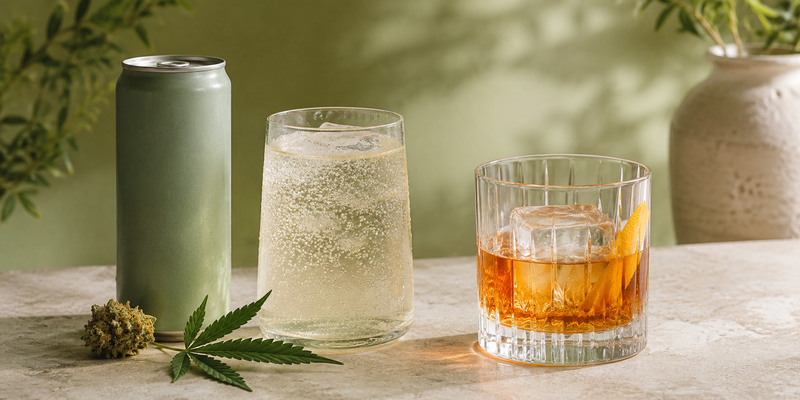
THC Drinks vs. Alcohol: Why Cannabis Beverages Are Growing
Consumer Education and Cannabis Beverage Trends
THC Drinks vs. Alcohol: Why Cannabis Beverages Are Growing
Last updated: August 7, 2026
THC drinks are growing because they put cannabis into a format people already understand: a can, bottle, or mocktail that can be sipped in a social setting. They also arrive as more adults are questioning their alcohol use, retailers are giving alcohol alternatives more shelf space, and beverage makers are improving flavor and formulation.
That does not make a THC beverage a harmless or equivalent substitute for beer, wine, or spirits. Alcohol and tetrahydrocannabinol affect the body differently. Both can impair judgment and coordination, and a cannabis drink may have a slower, less predictable onset and longer-lasting effects. Laws also depend on the product and location. For broader context, Green Nursery’s 2026 cannabis and hemp trends report explains how beverages fit into a changing market.
What counts as a THC drink?
A THC drink is a beverage formulated with tetrahydrocannabinol, the main intoxicating cannabinoid associated with cannabis. The category includes sparkling waters, sodas, teas, drink mixes, shots, mocktail-style products, and larger bottles intended for measured servings.
“Cannabis beverage” is broader than “hemp-derived THC drink.” A beverage may come from hemp and be sold through a hemp or general retail channel, or it may be produced within a state-licensed marijuana market and sold through a dispensary. The THC molecule does not become non-intoxicating because it came from hemp. Source, formulation, testing, sales channel, and applicable law determine how a product is classified and sold.
Readers who want the cannabinoid basics first can continue with Green Nursery’s Delta-9 THC guide.
THC drinks vs. alcohol at a glance
| Question | THC drink | Alcoholic drink |
|---|---|---|
| Main intoxicant | THC, usually listed in milligrams per serving and container | Ethanol, usually listed as alcohol by volume |
| Typical onset | Ingested cannabis can take 30 minutes to 2 hours to be felt; some formulations claim faster onset | Absorption begins quickly, although food, pace, body composition, and other factors change the result |
| Duration | Often longer than expected; effects from ingested cannabis can continue for several hours | Varies with the amount and pace of drinking, metabolism, food, and time |
| Serving system | Milligrams of THC; effects vary widely by tolerance and product | A U.S. standard drink contains about 14 grams of pure alcohol |
| Major short-term concern | Delayed overconsumption, anxiety, altered perception, poor coordination, and impaired driving | Impaired judgment and coordination, injury, alcohol poisoning, and impaired driving |
| Long-term concern | Frequent use can contribute to cannabis use disorder and other health risks | Alcohol use is linked to liver disease, cardiovascular harm, several cancers, and alcohol use disorder |
| Drug testing | THC use can produce a positive result | Standard workplace drug panels do not generally test for ordinary prior alcohol use, though alcohol-specific testing exists |
| Legal framework | Varies by state, product source, potency, formulation, and changing federal hemp law | Legal for adults 21 and older under a mature federal-state regulatory system, with location and conduct restrictions |
The comparison is not a recommendation to use either product. It shows why swapping one can for another is not a dose-for-dose exchange.
Why are cannabis beverages growing?
1. They preserve a familiar social ritual
A beverage fits easily into dinners, concerts, backyard gatherings, and nights out. It gives an adult something to sip without requiring smoke, vapor, or a conspicuous edible. The packaging and pace feel familiar even when the active ingredient is different.
That matters because format can lower the cultural barrier to trying cannabis. A person who has no interest in smoking may still understand a canned seltzer. The same familiarity can also create risk if the can looks like an ordinary soft drink, which is why clear labeling and storage away from children are essential.
2. Interest in drinking less alcohol is rising
In Gallup’s July 2025 U.S. survey, a record-low 54% of adults said they drank alcohol, and a record-high 53% said moderate drinking was bad for health. Gallup also cautioned that its broader trend did not show marijuana use as the cause of the national decline in drinking. The data support a change in alcohol attitudes, not a simple story that cannabis replaced alcohol nationwide. Review Gallup’s survey findings.
Within the hemp-derived THC category, the substitution signal is more direct but still self-reported. Brightfield Group reported that 46.7% of Q1 2025 hemp-THC drink consumers who also used alcohol said the beverages had led them to reduce their alcohol intake. That result describes surveyed consumers in a defined category; it does not prove that THC drinks improve health or cause population-wide reductions in alcohol use. See Brightfield Group’s scoped consumer findings.
3. A labeled milligram amount can feel more deliberate
Many THC beverages display a cannabinoid amount per serving and per container. That can make a low-dose product appear easier to plan than a strong mixed drink with an unknown pour. It is a useful label feature, but it is not a guarantee of a predictable experience. Tolerance, food, medications, metabolism, serving size, and prior cannabis use all matter.
The label must also be read carefully. A bottle may contain several servings, and a can that looks like a single drink can contain far more THC than a new consumer expects. A batch-specific laboratory report can help confirm potency. Green Nursery’s guide explains why third-party testing matters, and its COA library shows the kind of transparency consumers should seek.
4. Formulation and flavor have improved
THC is oil-soluble, so beverage makers use emulsification systems to disperse cannabinoids through water-based drinks. Better formulation can improve consistency, mouthfeel, and flavor. Some brands also market “fast-acting” emulsions, but onset claims should be evaluated product by product. Public-health guidance still warns that ingested cannabis can take 30 minutes to 2 hours to produce noticeable effects and longer to peak. CDC explains the delayed-overconsumption risk.
5. Retail distribution has expanded
Hemp-derived beverages have appeared in some liquor stores, bars, restaurants, specialty retailers, and online channels outside state dispensary systems. That availability puts the category in front of consumers at the moment they are choosing a social drink.
Brightfield Group reported that 24.8% of surveyed hemp-derived THC consumers used drinkable products in Q1 2025, up from 14.4% in the prior quarter and 14.1% a year earlier. In the separate state-regulated cannabis channel tracked by Headset, beverages reached 1.2% of U.S. cannabis sales in Q2 2026, or $76.7 million, with dollar sales up 9.3% year over year. These data sets cover different markets, but together they show a fast-growing format that remains small relative to the whole regulated cannabis market. Read Headset’s Q2 2026 beverage analysis.
6. The category offers more occasions and dose formats
Manufacturers now sell low-dose seltzers, higher-potency cans, shots, powders, and multi-serving bottles. This range lets brands position products for different occasions, but it also makes category-wide claims unreliable. “One THC drink” could mean a small serving or a very high-potency container.
Growth therefore comes from more than one consumer motivation. Some people are cannabis users trying a new format. Some are reducing alcohol. Others are curious about a smoke-free product. Convenience, taste, retail access, social signaling, and novelty all contribute.
How do THC drinks and alcohol feel different?
Alcohol and THC can both change mood, attention, judgment, coordination, and reaction time, but they do not follow the same timeline. Alcohol is absorbed into the bloodstream faster than the body metabolizes it, and drinking pace has a major effect on blood alcohol concentration. The National Institute on Alcohol Abuse and Alcoholism notes that food slows absorption and that a U.S. standard drink contains 14 grams of pure alcohol. See NIAAA’s standard-drink explanation.
Ingested THC is more delayed and variable. Health Canada advises that effects can begin in 30 minutes to 2 hours, may take up to 4 hours to reach full strength, and can last for hours. A person who assumes the first serving “did nothing” may consume more before the earlier dose has peaked. Review Health Canada’s ingestion guidance.
Experiences also differ qualitatively. Alcohol may produce disinhibition, slowed reactions, and poor coordination. THC may alter time perception, attention, memory, sensory experience, and anxiety level. Neither set of effects is universal, and pleasant marketing language does not predict an individual response.
Is a THC drink healthier than alcohol?
That question is too broad for a yes-or-no answer. Avoiding alcohol means avoiding ethanol exposure, and NIAAA reports health risks from alcohol even at low levels, including certain cancer and cardiovascular risks. Read NIAAA’s overview of alcohol’s effects.
THC introduces a different risk profile rather than no risk. Cannabis can impair driving, affect thinking and coordination, contribute to cannabis use disorder, interact with other substances, and produce distressing effects when too much is consumed. Sugar, calories, caffeine, and other ingredients also vary by beverage. A product is not automatically “healthy” because it is alcohol-free or smoke-free.
Why “no hangover” is not a responsible promise
A THC drink does not produce an alcohol hangover because it contains no alcohol, assuming the label is accurate. That does not guarantee a clear morning. High amounts, late use, individual sensitivity, sleep disruption, or long-lasting intoxication may leave someone feeling impaired or unwell. Marketing should not turn “alcohol-free” into “consequence-free.”
Practical risk-reduction steps for adults
- Read both serving and container amounts. Do not assume one can equals one serving.
- Start with a low amount. People with little or no THC experience should be especially cautious.
- Wait before taking more. Ingested THC may take up to 2 hours to be felt and longer to reach full effect.
- Do not mix THC and alcohol. CDC says using them together is likely to produce greater impairment than using either alone. See CDC’s cannabis safety FAQ.
- Do not drive or operate machinery. A person can be impaired even if they feel capable.
- Check the batch report. Look for cannabinoid potency, a matching lot or batch, test date, and relevant contaminant panels.
- Store it like an intoxicant. Keep beverages locked away from children and pets and separate from ordinary drinks.
- Consider medications and health conditions. Ask a qualified clinician about possible interactions or personal risks.
- Avoid THC during pregnancy or breastfeeding. FDA advises against cannabis and THC use in these situations.
The FDA has also warned about accidental ingestion and serious adverse events involving THC edibles, particularly when products resemble ordinary foods. Clear packaging and secure storage matter even when a beverage is intended only for adults. Read the FDA consumer warning.
Are hemp-derived THC drinks legal in 2026?
There is no safe one-sentence nationwide answer. As of August 7, 2026, federal law contains a major change scheduled to take effect on November 12, 2026. Public Law 119-37 revises the federal hemp definition and excludes certain final hemp-derived cannabinoid products containing more than 0.4 milligrams of combined total THC and similarly acting cannabinoids per container. If it takes effect as written, the threshold would affect many currently marketed hemp-derived THC drinks. Read Section 781 in the enacted law.
State rules already vary. A state may restrict potency, require testing or registration, limit sales to certain retailers, impose age rules, or prohibit some intoxicating hemp products. State-licensed marijuana beverages follow a separate system and are not transformed into nationally legal products by state authorization.
For a closer look at the current framework and scheduled change, read Green Nursery’s guide to THC limits in hemp products. Consumers and businesses should verify current federal, state, and local rules before buying, selling, shipping, or traveling with a THC beverage.
What the growth really means
The rise of cannabis beverages is not evidence that alcohol is disappearing or that THC drinks are right for everyone. It shows that adults are reconsidering what a social drink can contain and that cannabis companies have found a format that fits existing habits.
The category’s strongest advantages are familiarity, smoke-free use, labeled milligrams, and expanding flavor choices. Its biggest weaknesses are variable onset, inconsistent regulation, easy overconsumption, and the temptation to market an intoxicating product as effortless wellness.
The next phase will depend as much on law, testing, labeling, and consumer education as on demand. Growth is real. So are the limits.
Frequently asked questions
Are THC drinks better than alcohol?
Not universally. A THC beverage avoids ethanol when it is genuinely alcohol-free, but it introduces cannabis-related impairment and other risks. The better choice depends on the person, amount, context, health considerations, medications, and local law. Abstaining from both avoids the intoxication risks of both.
Do THC drinks get you high?
Yes, a drink containing an intoxicating amount of THC can produce a high. The intensity and timing vary with the dose, formulation, food, tolerance, metabolism, and other substances. Hemp-derived THC is still intoxicating THC, so an alcohol-free label does not mean impairment-free.
How long does a THC drink take to work?
Public-health guidance for ingested cannabis gives a broad range of about 30 minutes to 2 hours for noticeable effects, with full effects potentially taking longer. Some emulsified drinks are marketed as faster acting, but formulation, food, dose, and the individual can change the timeline.
How long do THC drink effects last?
Effects can last several hours and sometimes longer than expected. Amount, tolerance, formulation, food, metabolism, medications, and other substances all matter. Do not drive based on a guessed timetable.
How many milligrams of THC equal one alcoholic drink?
There is no validated conversion. Alcohol and THC act through different systems, serving conventions are different, and individual THC sensitivity varies widely. A labeled THC amount should not be translated into beers, glasses of wine, or shots.
Can THC drinks cause a hangover?
They do not cause an alcohol hangover if they contain no alcohol, but some people may experience lingering impairment, fatigue, anxiety, dry mouth, or other unwanted effects. “No alcohol” does not mean “no next-day effects.”
Can you mix a THC drink with alcohol?
It is safer not to. CDC states that using cannabis and alcohol together is likely to cause greater impairment than using either one alone, increasing the risk of injury and poor decisions.
Will a THC drink show up on a drug test?
It can. Hemp-derived THC is still THC, and common drug tests may detect THC metabolites. Product labels, legal source, or low-dose positioning do not guarantee a negative result.
Are THC drinks FDA approved?
Do not assume so. FDA has not approved consumer THC beverages as safe recreational products, and cannabis-derived ingredients remain subject to federal food and drug laws. A product being sold online or in a store does not equal FDA approval.
Are THC drinks legal in every state?
No. Rules vary by state and can depend on whether the product is hemp-derived or marijuana-derived, its cannabinoid content, testing, packaging, sales channel, and destination. Federal hemp rules are also scheduled to change on November 12, 2026 unless later action alters that timeline.
Why are THC drinks becoming popular now?
They combine a familiar social format with interest in alcohol alternatives, more retail visibility, improved flavor and formulation, smoke-free use, and labeled cannabinoid servings. Consumer curiosity is growing even as the category faces significant legal uncertainty.
Popular Products
Check out these customer favorites.