
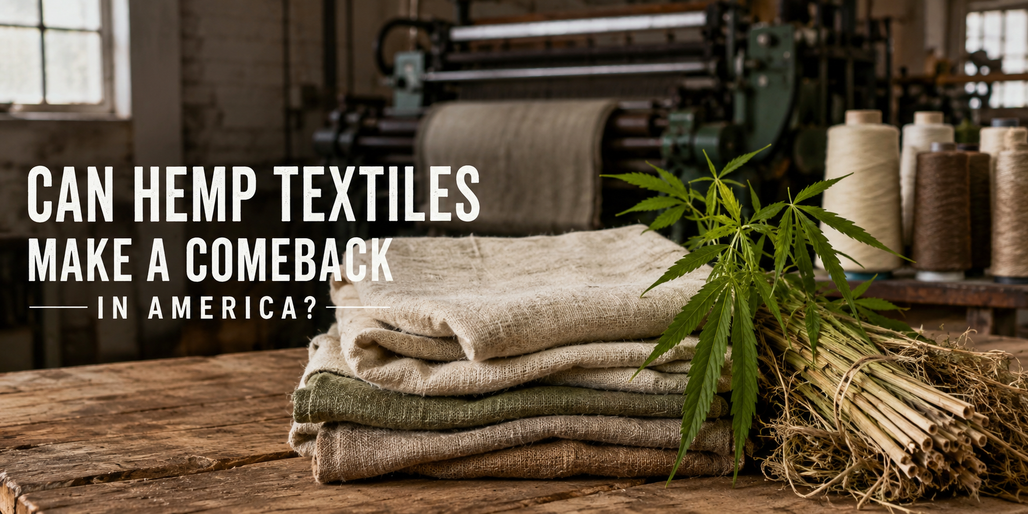
Can Hemp Textiles Make a Comeback in America?
Last updated: June 2026
Can Hemp Textiles Make a Comeback in America?
Hemp textiles could make a comeback in America, but not just because hemp fabric sounds sustainable. A real comeback would require fiber hemp acreage, regional processing, decortication, fiber refinement, spinning, weaving or knitting, finishing, brands, and buyers all growing together.
That is what makes hemp textiles exciting and difficult at the same time. Hemp has a long history as a fiber crop, and modern designers are again interested in natural materials with durability, texture, and a lower-impact story. But a field of hemp stalks does not automatically become fabric. The crop has to move through a long supply chain before it becomes clothing, home textiles, workwear, canvas, upholstery, or blended fabric.
Today, most consumers see hemp more often through cannabinoid products such as CBD hemp flower, oils, gummies, and prerolls. Hemp textiles are a different side of the same plant. If fiber acreage grows and processing improves, hemp fabric could become far more common in American fashion, interiors, workwear, and industrial materials.
Why Hemp Textiles Are Getting Attention Again
Hemp textiles are getting attention because fashion and material industries are looking for alternatives to resource-intensive supply chains. Brands want fabrics that feel durable, natural, traceable, and connected to agriculture. Designers want materials with texture and story. Farmers want crops with real buyers. Consumers want products that feel more connected to environmental responsibility.
Hemp fits that conversation because it is a bast fiber crop. The long outer fibers of the stalk can be processed for textiles, while the inner woody hurd can be used for building materials, animal bedding, paper, composites, and other industrial uses.
The challenge is that hemp textiles require more than growing hemp. The Textile Exchange report Growing Hemp for the Future explains that hemp has strong potential as a fiber crop, but also emphasizes that sustainability claims need traceable information, production data, responsible farming systems, and chain-of-custody support.
That is the central issue. Hemp textiles can come back, but only if the industry builds the systems that make hemp fabric reliable, scalable, and credible.
For the broader hemp farming context, read CBD Hemp vs Fiber Hemp: How American Hemp Farms Choose What to Grow.
History of Hemp Textiles in America
Hemp has a long history as a fiber crop, especially for strong, durable uses such as rope, cordage, sailcloth, canvas-like materials, sacks, and industrial textiles. Before modern synthetic fibers became widely available, natural fibers were central to agriculture, shipping, military supply chains, clothing, and everyday material culture.
In the United States, hemp fiber production rose during World War II because the crop was useful for military and industrial needs. The USDA Economic Research Service review of industrial hemp reports that U.S. hemp acreage reached 146,200 acres in 1943, the highest level recorded in that period.
That historical peak matters because it shows that hemp fiber is not a new fantasy crop. American farms have grown hemp for fiber before. The difference today is that the modern textile industry is much more complex. A fiber crop now has to compete with cotton, polyester, nylon, rayon, lyocell, recycled fibers, imported fabrics, and global manufacturing systems.
What Changed After the War?
After World War II, hemp acreage declined sharply. USDA ERS explains that hemp production fell in response to competition from synthetic fibers, increasing anti-drug sentiment, and federal regulations that included hemp in marijuana-related definitions. The same report notes that synthetic fibers replaced natural fibers for rope and many textile uses.
That history shaped the modern problem. The United States did not just lose hemp acreage. It lost the processing knowledge, equipment, buyer networks, and textile infrastructure needed to turn hemp stalks into finished fabrics at scale.
Why Hemp Lost Market Share
Hemp lost market share for several reasons at once. It was not only one law, one fabric, or one competitor. The decline was caused by a combination of regulation, synthetic fiber growth, cotton dominance, global manufacturing, and processing challenges.
1. Synthetic Fibers Became Widely Available
Synthetic fibers such as nylon and polyester changed textile production because they could be manufactured consistently, scaled globally, and engineered for specific performance traits. For many manufacturers, synthetics were predictable, available, and increasingly affordable.
That made it harder for hemp to compete, especially when domestic hemp production was legally restricted and processing technology was not developing at the same pace.
2. Cotton Already Had a Strong Textile System
Cotton had established farming systems, ginning infrastructure, grading standards, spinning systems, mills, manufacturing relationships, and consumer familiarity. Hemp did not have the same modern U.S. supply chain after decades of restricted cultivation.
This matters because textiles are not only about fiber quality. They are about systems. A fiber that has farms, processors, mills, standards, and buyers will usually beat a fiber that only has potential.
3. Hemp Was Tied to Cannabis Regulation
Hemp’s relationship to cannabis law created a barrier that cotton, flax, wool, and synthetics did not face in the same way. The 2018 Farm Bill changed that by legalizing commercial hemp production under federal rules. The FDA’s 2019 testimony on hemp production and the 2018 Farm Bill explains that hemp with no more than 0.3% Delta-9 THC on a dry weight basis was removed from the Controlled Substances Act definition of marijuana.
Legalization reopened the door, but it did not instantly rebuild the textile supply chain. Farmers could grow hemp again, but the industry still needed processors, standards, and buyers.
4. Hemp Fabric Requires Several Processing Steps
Hemp does not become apparel fabric immediately after harvest. It must be cut, dried, retted, decorticated, cleaned, refined, softened, spun, woven or knitted, finished, and sewn. Each step requires skill, equipment, energy, labor, quality control, and investment.
This is why hemp textile growth has been slower than the hype. The problem is not only demand. The problem is rebuilding the full chain from field to fabric.
For a deeper explanation of those barriers, read Why Fiber Hemp Has Struggled to Scale in the United States.
Sustainability Advantages of Hemp Textiles
Hemp textiles can have sustainability advantages, but it is important to be accurate. Hemp is not automatically sustainable just because it is natural. The final impact depends on how it is grown, how it is processed, what chemicals are used, how far materials travel, how long the product lasts, and whether the supply chain is traceable.
Potential Benefits
When grown and processed responsibly, hemp fiber can support several sustainability goals:
- Durable natural fiber: Hemp fiber is known for strength and durability, which can support longer-lasting textiles.
- Multiple-use crop: The stalk can produce bast fiber and hurd, allowing different parts of the plant to serve different markets.
- Lower pesticide opportunity: Textile Exchange notes that biological pesticides are currently the primary pesticides permitted for hemp in several regions, though it also warns that this could change if hemp production expands.
- Soil and rotation potential: Hemp may fit into diversified crop systems when grown responsibly.
- Material replacement potential: Hemp can be used in textiles, nonwovens, insulation, paper, packaging, and composites.
The Important Caveat
The same Textile Exchange report warns that hemp’s sustainability reputation should not be treated as automatic. It calls for better data, traceability, responsible production practices, and systems that avoid repeating the negative impacts of input-intensive agriculture.
That caveat matters. If hemp textiles are grown with heavy inputs, processed with harsh chemistry, transported through long opaque supply chains, or marketed with vague claims, the sustainability story becomes weaker.
A credible hemp textile comeback should be built around traceability, better farm data, lower-impact processing, responsible claims, and products that actually perform well enough to stay in use.
Modern Processing Technology
Modern processing technology is the key to whether hemp textiles can scale. The farm is only the beginning. Hemp stalks have to become fiber that can be spun, woven, knitted, finished, and manufactured into products people want to buy.
From Field to Fabric
The Textile Exchange hemp fiber report explains that apparel and home textiles may require several stages after harvest, including retting, decortication, scutching for long fiber, degumming, cottonizing or mechanical softening, hackling, carding, drawing, roving, spinning, knitting or weaving, finishing, cutting, and sewing.
That list shows why hemp textiles are difficult to scale. Each step requires equipment and technical knowledge. If one step is missing, the chain breaks.
Decortication
Decortication is the mechanical separation of hemp stalks into outer bast fiber and inner hurd. Rutgers Cooperative Extension’s hemp fiber production guide explains that the stalk contains outer bast fibers and inner hurd fibers. Bast fiber is the part most associated with textile potential, while hurd is more often used in bedding, hempcrete, absorbent materials, and other applications.
Without decortication, a farmer has bulky stalks. With decortication, the crop can move toward specific markets.
Cottonization and Softening
Cottonization and mechanical softening can make hemp fibers easier to blend with cotton, wool, or other staple fibers. This matters because 100% hemp fabric is not the only path forward. Many modern hemp textiles may be blends that use hemp for durability, texture, or sustainability positioning while using other fibers to improve hand feel, drape, stretch, or price.
This is likely one of the most realistic paths for mainstream adoption. Hemp may not need to replace cotton or synthetics completely. It may become a more common ingredient in blended fabrics.
Standards and Fiber Measurement
Textile mills need consistent inputs. Fiber length, fineness, cleanliness, moisture, and processing quality all affect whether hemp can become yarn. The USDA Agricultural Research Service project on industrial hemp fiber standards notes that fiber length and fineness are key attributes for converting fibers into yarn and that methods for characterizing hemp fiber are important for textile applications.
That is why the comeback depends on standards, not just enthusiasm. Manufacturers need hemp fiber that can be measured, graded, and processed reliably.
For the broader post-harvest supply chain, read How Hemp Processing Works: From Farm to Finished Product.
Current Industry Investments
Current investment in hemp textiles is not only about fashion brands releasing hemp shirts. The more important investment is happening in the middle of the supply chain: fiber acreage, decortication, processing technology, research, standards, traceability, and manufacturing partnerships.
Processing Capacity
Textile Exchange estimated that in 2023, about 20 decorticators would be in production in the United States, with a smaller group focused on bast fiber at larger throughput levels. The report also said that additional decortication facilities were developing or considering installation over the following five years.
That is a positive sign, but the report also notes that acreage will be the primary determinant of production and that processors must be proactive in securing acreage. In other words, processing capacity and farm supply have to grow together.
Research and Standards
USDA ARS work on fiber standards is another important investment area. If the U.S. wants hemp textiles to scale, farmers and processors need to know what quality means. Manufacturers need fiber data they can trust. Standards help turn hemp from a promising crop into a reliable textile input.
Building Materials and Industrial Uses
Not every fiber investment will go directly into apparel. Some of the strongest early markets may be nonwovens, insulation, animal bedding, hempcrete, packaging, composites, and paper. These markets may be easier to scale in some regions because they do not always require the same level of fiber refinement as fine apparel textiles.
This matters because industrial hemp growth can still help textiles. If processors can make money from hurd, short fiber, nonwovens, or building materials, they may be more likely to survive long enough to support higher-value textile development later.
For more on the hidden middle layer that makes this possible, read How Hemp Distributors and Processors Shape the Industry.
What the 2025 Hemp Data Shows
USDA’s latest hemp data shows both promise and reality. According to the USDA National Hemp Report for the 2025 production year, fiber hemp grown in the open reached 21,693 harvested acres and 67.3 million pounds of production. That means American farms are growing fiber hemp at meaningful acreage levels.
But the same report shows that fiber hemp still lags far behind floral hemp in market value. Open-field fiber hemp was valued at $13.5 million, while open-field floral hemp was valued at $574 million.
| 2025 Hemp Category | Harvested Acres | Production Value | What It Suggests |
|---|---|---|---|
| Open-field fiber hemp | 21,693 acres | $13.5 million | Fiber acreage exists, but value depends on processing and buyers. |
| Open-field floral hemp | 16,880 acres | $574 million | Flower remains the dominant value category because of cannabinoid markets. |
This is the clearest snapshot of the comeback challenge. Fiber hemp has acreage. What it needs is stronger value capture. That means more processors, better fiber standards, more industrial buyers, more textile development, and stronger contracts between farmers and the rest of the supply chain.
Why Hemp Textiles Could Become More Common
Hemp textiles could become more common if several trends continue at the same time.
1. More Fiber Acreage
Textile production needs reliable supply. A brand cannot build a fabric program around hemp if the fiber supply is inconsistent. More fiber acreage would give processors and mills more confidence, especially if farms grow varieties selected for textile-quality fiber.
2. Better Regional Processing
Fiber hemp is bulky, so local or regional processing matters. More decortication and fiber preparation facilities would make it easier for farmers to sell stalks and for mills to source fiber.
3. More Blended Fabrics
Hemp may become more common through blends. Hemp-cotton, hemp-lyocell, hemp-wool, hemp-recycled fiber, and hemp-synthetic blends may help brands balance durability, texture, comfort, cost, and performance.
4. Workwear and Utility Clothing
Hemp’s durability and natural texture may make it especially appealing for workwear, uniforms, denim-like products, canvas goods, outerwear, bags, and utility garments. These categories can benefit from strength and character rather than demanding the softest possible hand feel.
5. Better Storytelling and Traceability
Consumers increasingly want to know where materials come from. Hemp has a strong story, but that story needs documentation. Traceable farms, clear processing information, and responsible sustainability claims could make hemp textiles more appealing to brands and shoppers.
What Could Hold Hemp Textiles Back?
Hemp textiles could grow, but there are real barriers.
Processing Bottlenecks
The biggest barrier is still processing. Without decortication, fiber preparation, spinning, and finishing capacity, hemp textiles cannot scale. A farm can grow hemp stalks, but fabric requires an entire textile system.
Cost and Consistency
Hemp fabric must compete with established fibers. Cotton, polyester, nylon, rayon, and lyocell are supported by mature global supply chains. Hemp has to compete on quality, price, consistency, availability, and performance.
Imported Competition
Countries with more established hemp textile systems may be able to supply hemp fiber or fabric before the U.S. domestic supply chain fully matures. Domestic hemp textiles need a reason to exist beyond novelty. That reason may be traceability, regional sourcing, durability, sustainability documentation, or specialized product development.
Overstated Sustainability Claims
If brands market hemp as automatically sustainable without showing how it was grown and processed, trust can weaken. Hemp’s comeback should be based on honest claims, measurable practices, and transparent supply chains.
For more on the infrastructure problem, read Why Fiber Hemp Has Struggled to Scale in the United States.
Could New Hemp Laws Push More Interest Toward Textiles?
New hemp laws could indirectly increase interest in fiber hemp and textiles. If cannabinoid-focused hemp markets become more restricted or less profitable, some farmers may look for hemp markets that are less dependent on CBD, THCA, Delta-8, Delta-9, or finished cannabinoid product rules.
Fiber hemp fits that alternative path because it is grown for stalks, bast fiber, hurd, grain, seed, and industrial materials rather than cannabinoid-rich flower. However, a law change cannot create textile infrastructure by itself.
The most realistic scenario is not an overnight hemp textile boom. It is gradual regional growth where farmers, processors, textile developers, brands, and manufacturers build supply chains together.
For more on that prediction, read Could New Hemp Laws Trigger a Fiber Hemp Boom?.
Future Outlook: What a Real Comeback Would Look Like
A real hemp textile comeback in America would not look like one trend-driven fabric drop. It would look like a supply chain.
That supply chain would include:
- Farmers growing fiber varieties suited for textile quality.
- Regional decortication and fiber preparation facilities.
- Standards for fiber length, fineness, cleanliness, moisture, and quality.
- Spinners and mills that can work with hemp fiber and blends.
- Brands willing to design around hemp’s strengths instead of forcing it to behave exactly like cotton or polyester.
- Traceability systems that support credible sustainability claims.
- Enough consumer demand to justify repeat production, not just one-time novelty projects.
Most Likely Near-Term Growth Areas
In the near term, hemp textiles may grow fastest in categories where hemp’s texture, strength, and natural story are assets:
- Workwear
- Utility uniforms
- Canvas bags
- Home textiles
- Durable shirting
- Denim-like fabrics
- Outerwear blends
- Upholstery and interior textiles
Fine, soft, widely available mainstream hemp apparel may take longer because it requires more advanced fiber preparation, blending, spinning, finishing, and brand adoption.
The Bottom Line
Hemp textiles can make a comeback in America, but only if the industry treats hemp as a serious textile supply chain instead of a marketing buzzword. The comeback depends on infrastructure, not hype.
What This Means for Consumers
Consumers can support better hemp textiles by asking better questions. Where was the hemp grown? Is the fabric actually hemp or only a small hemp blend? Was it processed responsibly? Are sustainability claims specific? Is the garment designed to last?
The same logic applies across hemp categories. Whether the product is hemp fabric, CBD flower, oil, or gummies, transparency matters. Green Nursery customers can review product testing through the COA and lab reports page, read Why Third-Party Testing Matters for CBD and Hemp Products, and browse the Green Nursery shop to compare product information.
Practical Takeaways
- Hemp textiles can make a comeback, but only if farming, processing, spinning, manufacturing, and brand demand grow together.
- Hemp was historically used for strong fiber applications, but U.S. production declined after World War II due to synthetic fibers, regulatory pressure, and changing markets.
- Modern hemp textiles require several processing steps, including retting, decortication, fiber preparation, spinning, weaving or knitting, finishing, and sewing.
- Hemp’s sustainability advantages are real only when supported by responsible farming, lower-impact processing, traceability, and honest claims.
- Fiber hemp acreage exists in the United States, but value remains much lower than floral hemp because processing and buyer infrastructure are still developing.
- Hemp textiles may grow first in workwear, utility clothing, bags, home textiles, upholstery, and durable blends.
- New hemp laws could increase interest in fiber hemp, but legal pressure alone will not create a textile boom.
Frequently Asked Questions
Can hemp textiles make a comeback in America?
Yes, hemp textiles can make a comeback, but it will require more than consumer interest. The industry needs fiber hemp acreage, processing facilities, decortication, fiber refinement, spinning, mills, finishing, brands, and buyers.
Why did hemp textiles lose popularity?
Hemp textiles lost market share because of synthetic fiber growth, cotton’s strong textile infrastructure, regulatory restrictions on hemp cultivation, imported competition, and the loss of domestic processing capacity.
Is hemp fabric sustainable?
Hemp fabric can be sustainable when the crop is grown responsibly, processed with care, transported efficiently, and supported by traceable supply chains. It is not automatically sustainable just because it is natural.
What is hemp fabric made from?
Hemp fabric is made from the bast fiber in the hemp stalk. The stalk is processed to separate fiber from the inner woody hurd. The fiber may then be softened, spun, woven or knitted, finished, and sewn into textile products.
What is decortication?
Decortication is the mechanical process of separating hemp stalks into outer bast fiber and inner hurd. Bast fiber can move toward textiles and other fiber products, while hurd can be used in bedding, hempcrete, absorbent materials, and industrial applications.
Will hemp replace cotton?
Hemp is unlikely to fully replace cotton in the near future. A more realistic future is that hemp becomes more common in blends, workwear, utility fabrics, home textiles, bags, upholstery, and specialty materials.
Could new hemp laws help hemp textiles grow?
New hemp laws could increase interest in fiber hemp if cannabinoid markets become more restricted. However, hemp textiles will only grow if processing infrastructure, fiber standards, mills, brands, and buyers are ready.
What should consumers look for in hemp clothing?
Consumers should look for the actual hemp fiber percentage, clear sourcing information, responsible processing claims, durability, care instructions, and whether the brand explains its supply chain honestly. Strong claims should be specific, not vague.
Popular Products
Check out these customer favorites.