
How Hemp Processing Works: From Farm to Finished Product
Last updated: July 2026
Legal information reviewed: July 28, 2026
How Hemp Processing Works: From Farm to Finished Product
Most people understand that hemp starts on a farm. Fewer people understand what happens after harvest. Hemp processing is the part of the supply chain that turns raw plants into usable products, including flower, prerolls, oils, gummies, extracts, fiber materials, textiles, food ingredients, and other finished goods.
This stage matters because hemp is not ready for the market the moment it leaves the field. Flower must be dried, cured, trimmed, tested, and packaged. Fiber hemp may need retting, drying, baling, decortication, cleaning, and refinement. Hemp grown for extraction may need drying, milling, extraction, filtration, refinement, formulation, and testing. Distribution then moves those products from farms and processors to manufacturers, retailers, and customers.
In other words, hemp processing is where a crop becomes a usable material or finished product. It is also where quality, compliance, consistency, and market value can be protected or lost.
For the broader comparison of American hemp markets, read the parent guide: CBD Hemp vs Fiber Hemp: How American Hemp Farms Choose What to Grow.
What Is Hemp Processing?
Hemp processing is the set of post-harvest steps used to turn raw hemp plants into usable materials, ingredients, or finished products. The exact process depends on the crop’s intended use. Hemp grown for flower is processed differently from hemp grown for fiber, grain, planting seed, or cannabinoid extraction.
The USDA Farmers.gov hemp guide separates reported hemp acreage by intended use, including fiber, cannabidiol, grain, and seed. Each intended use creates a different post-harvest supply chain:
- CBD flower is harvested, dried, cured, trimmed, tested, packaged, and sold as loose flower or used in prerolls.
- Cannabinoid biomass may be dried, milled, extracted, refined, formulated, and used in oils, gummies, topicals, or other products.
- Fiber hemp may be cut, retted, dried, baled, decorticated, cleaned, and processed into bast fiber or hurd.
- Grain hemp is harvested for hempseed, then dried, cleaned, stored, pressed, milled, or processed for permitted food and ingredient markets.
- Seed-production hemp is handled to protect genetic purity, germination, cleanliness, storage quality, and future planting value.
For the farming stages that come before processing, read How Hemp Is Grown in America: Flower, Fiber, Grain, and Seed.
Harvesting Hemp
Hemp processing begins at harvest. The harvesting method depends on whether the crop is intended for flower, fiber, grain, or planting seed. Timing and handling can affect the value and usability of the entire crop.
Harvesting Hemp for Flower
CBD flower is usually harvested when the crop has reached the farmer’s target cannabinoid and terpene maturity while remaining within applicable compliance limits. The goal is to preserve flower structure, aroma, freshness, and cannabinoid content.
Farmers must avoid unnecessary rough handling, excessive heat, moisture buildup, mold pressure, and delays between cutting and drying. Rutgers Cooperative Extension’s hemp-production guidance notes that CBD harvest can be highly labor-intensive and that harvest timing is critical for cannabinoid-focused hemp.
This is one reason premium flower hemp is often managed more like a specialty crop than a bulk field crop.
Harvesting Hemp for Fiber
Fiber hemp is harvested for stalk material rather than delicate flower. The goal is to collect stalks that can later be separated into outer bast fiber and inner woody hurd. Depending on the production system and processor requirements, the crop may be cut, dried in the field, retted, baled, and transported.
Harvesting Hemp for Grain or Planting Seed
Grain hemp is harvested for hempseed, usually with more conventional field equipment than premium flower hemp. The priorities include seed maturity, moisture control, cleaning, storage, and spoilage prevention.
Hemp grown for planting seed requires additional attention to genetic consistency, pollination, purity, germination, cleaning, and storage. Although grain and planting seed may look similar after harvest, they serve different markets.
Harvest is the first major post-production quality checkpoint. A poor harvest can damage flower, reduce fiber quality, increase mold risk, lower seed germination, or make grain harder to store safely.
Drying and Curing Hemp Flower
For smokable CBD flower, drying and curing are among the most important stages in the supply chain. Freshly harvested flower contains substantial moisture. If that moisture is not managed correctly, the crop can develop mold, lose aroma, become brittle, or lose retail value.
Why Drying Matters
Drying reduces moisture so hemp flower can be trimmed, tested, handled, packaged, and stored more reliably. A controlled drying process protects the flower while reducing conditions that encourage mold.
Poor drying can create several problems:
- Flower may dry too slowly and become vulnerable to mold.
- Flower may dry too quickly and become brittle or lose aroma.
- Insufficient airflow can create uneven drying.
- Overcrowding can trap moisture around flowers and branches.
- Excessive heat can damage aroma and overall flower quality.
- Poor storage can undo the benefits of a careful drying process.
Because CBD flower is judged by aroma, appearance, texture, freshness, trim, and cannabinoid profile, post-harvest handling directly affects the product a customer receives.
What Curing Does
Curing is the controlled stage after initial drying that allows moisture within the flower to become more even and the product to stabilize. A well-managed cure can support aroma, texture, smoothness, and consistency.
Curing helps explain why two flowers with similar genetics can reach shoppers in noticeably different condition. Genetics matter, but the harvest crew, drying environment, curing process, storage conditions, and trimming decisions also influence the finished product.
Green Nursery customers can compare finished formats through the CBD flower collection and hemp flower prerolls. For a beginner-friendly explanation of the flower itself, read What Are CBD Buds?
Fiber Processing and Decortication
Fiber-hemp processing is completely different from flower processing. Fiber hemp is grown for its stalk, which contains two primary usable materials: bast fiber and hurd.
Rutgers Cooperative Extension’s hemp-fiber production guide explains that bast fiber is found toward the outside of the stalk, while hurd comes from the woody inner core. These materials serve different industrial markets and must be separated before many uses are possible.
Retting
Before the stalk can be separated efficiently, fiber hemp often goes through retting. Retting is a controlled biological or chemical breakdown process that helps loosen the bonds between bast fiber and hurd.
Field retting relies on moisture, microbes, weather, and time. Other systems may use more controlled water, enzymatic, mechanical, or chemical processes. The appropriate method depends on the processor, intended product, environmental controls, and required fiber quality.
Retting quality matters. Under-retted stalks may be difficult to separate, while excessive or inconsistent retting can reduce fiber strength or uniformity.
Baling and Transportation
After drying and retting, fiber hemp may be baled for storage and transportation. This is where regional infrastructure becomes important. Hemp stalks and bales are bulky, so transportation costs can become a serious problem when the nearest processor is far from the farm.
Moisture also matters during baling and storage. Material that is baled too wet may be vulnerable to spoilage, while careless handling can introduce dirt or reduce the consistency processors need.
Decortication
Decortication is the mechanical process that separates hemp stalks into bast fiber and hurd. Once separated, bast fiber can move toward textiles, rope, nonwovens, composites, specialty paper, and other fiber products. Hurd can be used in animal bedding, hempcrete, absorbent products, insulation, and other applications.
Decortication is one reason fiber hemp has been difficult to scale in the United States. A farmer may be able to grow the crop, but meaningful market value depends on accessible processors, appropriate machinery, quality standards, manufacturers, transportation, and buyers.
For the economic comparison, read Why CBD Hemp Became More Valuable Than Fiber Hemp. For a closer examination of the infrastructure problem, see Why Fiber Hemp Has Struggled to Scale in the United States.
Hemp Testing and Compliance
Testing affects farmers, processors, retailers, and shoppers, but not every hemp test serves the same purpose. Farm-compliance testing, in-process quality-control testing, and finished-product testing may examine different samples and answer different questions.
Farm-Level Compliance Testing
The USDA Agricultural Marketing Service hemp program explains that producers must be licensed or authorized under an applicable state, tribal, or USDA hemp program. The program includes provisions involving licensing, land records, sampling, testing, reporting, noncompliant crops, and violations.
The USDA hemp laboratory testing guidelines state that hemp grown under USDA, state, or tribal production plans is generally subject to sampling and compliance testing, although certain producers, research institutions, or facilities growing immature plants may qualify for exemptions under applicable rules.
USDA compliance testing measures total available THC on a dry-weight basis. The laboratory method must consider the potential conversion of THCA into Delta-9 THC and must report measurement uncertainty with the result.
Product-Level Testing
Finished-product testing helps shoppers and businesses review what is reported for a specific product or batch. A certificate of analysis, commonly called a COA, may include:
- Product or sample identity
- Batch or lot information
- Testing date
- Cannabinoid concentrations
- Delta-9 THC, THCA, or calculated total THC
- Terpene results when that panel was ordered
- Contaminant results when those panels were ordered
A COA should not be treated as proof that every possible compound or contaminant was tested. Readers must check which analytical panels were actually included and whether the report matches the current product batch.
Green Nursery publishes available product testing through its COA and lab reports page. For a complete walkthrough, read How to Read a CBD Flower Lab Report.
How Testing Supports the Supply Chain
Testing can help verify cannabinoid potency, identify compliance concerns, support batch tracking, inform formulation, and reduce confusion about product strength. The value of a report depends on the sample, testing date, laboratory methods, panels ordered, and whether the report matches the material being sold.
This is especially important for cannabinoid products because differences between flower, gummies, oils, extracts, and other formats may depend on concentration, formulation, serving size, and legal definitions.
Scheduled Federal Changes in November 2026
Federal hemp definitions are scheduled to change on November 12, 2026. The Agricultural Marketing Act text compiled by GovInfo, as amended through Public Law 119-37, includes a total-tetrahydrocannabinols standard that incorporates THCA and creates additional exclusions involving certain intermediate and final hemp-derived cannabinoid products.
Unless the law is amended before its effective date, processors and manufacturers may need to reevaluate raw materials, extraction decisions, batch documentation, formulations, container limits, testing panels, and finished-product categories.
For the wider farm and supply-chain implications, read How the November Hemp Law Changes Could Affect Hemp Farmers.
Extraction Facilities
Not all hemp is sold as flower. Some hemp is grown or collected as biomass for cannabinoid extraction. Extraction facilities process plant material to separate cannabinoids, terpenes, and other compounds for use in oils, gummies, topicals, tinctures, vapes, or other products where permitted.
What Happens Before Extraction?
Before extraction, hemp biomass is commonly inspected, dried, and milled so it can be processed more consistently. Moisture, particle size, storage conditions, cannabinoid profile, contamination, and the condition of the biomass can all affect extraction efficiency and finished-ingredient quality.
Processors must also verify that the material is appropriate for the intended process and market. Poor-quality biomass does not automatically become a high-quality extract.
Common Hemp Extraction Methods
Commercial extraction methods may include supercritical carbon dioxide extraction, ethanol extraction, hydrocarbon extraction, hydrodistillation, mechanical separation, or other systems. The appropriate process depends on the target compounds, facility controls, equipment, permitted solvents, intended product, and regulatory requirements.
A 2024 peer-reviewed study available through PubMed Central compared hydrodistillation, supercritical CO₂, and ethanol extraction using a CBD- and CBG-dominant hemp cultivar. Under the study conditions:
- Hydrodistilled extracts contained the greatest variety and abundance of terpenes.
- Supercritical CO₂ extracts contained the greatest variety and abundance of the cannabinoids measured but showed less terpene diversity.
- Ethanol extracts contained the highest amounts of the acidic cannabinoids CBDA and CBGA among the tested extracts.
The study does not establish one universally superior extraction method. It shows that the selected process can materially change the chemical profile of the resulting extract.
Refinement and Formulation
After extraction, crude material may undergo additional steps such as filtration, winterization, solvent removal, distillation, isolation, blending, or formulation. The exact sequence depends on the starting material and intended product.
A refined ingredient may then be incorporated into full-spectrum CBD products, Delta-9 gummies, oils, topicals, or other hemp-derived formats where permitted.
Extraction Requires Quality Control
Extraction facilities must manage equipment, solvents, temperatures, pressure, ventilation, worker safety, batch records, potency targets, residual-solvent risk, contamination, storage, and testing. Applicable requirements can vary according to the jurisdiction, extraction method, facility type, and intended product.
The FDA’s cannabis and cannabis-derived product overview explains that the 2018 Farm Bill preserved FDA authority over cannabis-derived products regulated under the laws FDA administers. Hemp status alone does not remove every product, ingredient, manufacturing, labeling, or marketing requirement.
Distribution Networks
Distribution moves raw materials, intermediate ingredients, and finished products among farms, processors, manufacturers, wholesalers, retailers, and customers. Without a dependable distribution network, even a well-grown and carefully processed hemp product may not reach a viable market.
How Hemp Distribution Works
A hemp distributor may connect farms, processors, manufacturers, brands, wholesalers, and retailers. Some distributors move finished packaged products. Others handle intermediate materials such as dried flower, biomass, extract, fiber bales, cleaned hurd, grain, seed, or manufacturing ingredients.
Distribution can involve:
- Buyer and supplier relationships
- Product and material storage
- Batch and lot documentation
- COA management
- Packaging coordination
- Wholesale pricing
- Retail placement
- Shipping and logistics
- Inventory tracking
- Compliance review
Why Distributors Matter
Distributors help determine which hemp products and materials reach commercial buyers. A farm may grow the crop and a processor may prepare it, but distribution connects that inventory to manufacturers, retailers, or other customers.
This is especially important for smaller farms that may not have direct relationships with every processor, manufacturer, or retailer. A strong distribution network can connect suitable hemp inventory to real demand. A weak network can leave farmers and processors with aging inventory and no dependable route to market.
For a deeper look at this middle layer of the industry, read How Hemp Distributors and Processors Shape the Industry.
Retail Products
By the time hemp reaches the retail level, most of the processing work has already happened. A finished product may look simple, but it can reflect numerous earlier stages: farming, harvesting, drying, curing, extraction, refinement, formulation, testing, packaging, distribution, and compliance review.
Examples of Finished Hemp Products
- CBD hemp flower
- Hemp flower prerolls
- THCA flower
- CBD oils, gummies, and other CBD products
- Hemp-derived cannabinoid extracts and formulated products where permitted
- Hempseed foods, oils, protein ingredients, and related grain products
- Textiles, rope, paper, bedding, insulation, hempcrete, composites, and other industrial materials
What Consumers Should Look For
Consumers comparing cannabinoid products should look for clear product information, current batch-specific lab reports, reasonable claims, transparent cannabinoid content, appropriate serving information, customer feedback, and a clear shipping policy.
Green Nursery shoppers can browse the full hemp product catalog, review available COAs and lab reports, read customer reviews, and check current shipping information and restrictions before ordering.
The main takeaway is simple: a finished hemp product reflects the supply chain behind it. Farming matters, but processing, testing, documentation, storage, distribution, and retail transparency matter too.
How the Hemp Supply Chain Fits Together
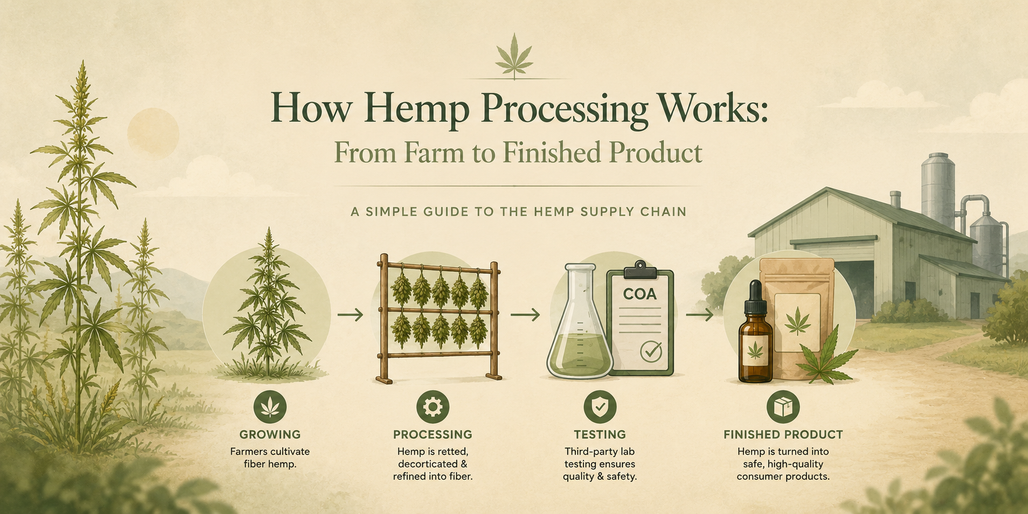
The hemp supply chain can be summarized in eight stages:
- Farm planning: The grower chooses genetics, acreage, intended use, production methods, and potential buyers.
- Growing: Hemp is cultivated for flower, fiber, grain, planting seed, or cannabinoid biomass.
- Harvesting: The crop is harvested according to its intended market and quality requirements.
- Post-harvest handling: Flower is dried and cured, fiber is retted and baled, and grain or planting seed is dried and cleaned.
- Processing: Flower may be trimmed and packaged, fiber may be decorticated, grain may be pressed or milled, and biomass may be extracted.
- Testing and documentation: Applicable samples and finished products are tested and linked to batch, lot, or compliance records.
- Distribution: Materials and products move to processors, manufacturers, wholesalers, retailers, or direct customers.
- Retail or manufacturing: Finished products reach shoppers, while industrial hemp materials move into manufacturing supply chains.
The strongest hemp businesses understand the entire chain. They do not treat post-harvest handling, testing, documentation, or distribution as afterthoughts. Each stage can determine whether a crop becomes a usable, trustworthy product or an expensive missed opportunity.
Practical Takeaways
- Hemp processing is the bridge between farming and finished products.
- CBD flower must be dried, cured, trimmed, tested, packaged, and stored carefully.
- Fiber hemp may require retting, drying, baling, decortication, cleaning, and refinement before entering industrial markets.
- Hemp grain and planting seed require different cleaning, storage, purity, and quality standards.
- Hemp grown for extraction may become oils, gummies, topicals, tinctures, vapes, or other formulated products where permitted.
- Different extraction methods can produce meaningfully different cannabinoid and terpene profiles.
- Farm-compliance testing and finished-product testing serve different purposes.
- Distribution networks determine how hemp materials move from farms and processors into real markets.
- Product quality depends on farming, processing, testing, storage, documentation, and distribution working together.
Frequently Asked Questions
What is hemp processing?
Hemp processing is the post-harvest work that turns raw hemp plants into usable products, materials, or ingredients. Depending on the crop, processing may include drying, curing, trimming, retting, baling, decortication, extraction, refinement, testing, packaging, storage, and distribution.
How is CBD flower processed?
CBD flower is harvested, dried, cured, trimmed, tested, packaged, and stored. The goal is to preserve flower structure, aroma, cannabinoid content, freshness, and quality while managing moisture and reducing mold risk.
What is hemp decortication?
Decortication is the mechanical process of separating hemp stalks into outer bast fiber and inner woody hurd. Bast fiber can be used in textiles, rope, nonwovens, composites, and paper, while hurd can be used in bedding, hempcrete, insulation, and absorbent materials.
Why does hemp need testing?
Testing can support farm compliance, verify cannabinoid content, inform formulation, connect products to batches, and help shoppers understand what is reported in a product. The purpose and scope of a test depend on whether it is a regulatory farm test, an in-process quality-control test, or a finished-product COA.
What is a COA?
A COA, or certificate of analysis, is a laboratory report for a sample or batch. It may include cannabinoid results, testing dates, batch information, terpene analysis, and contaminant screening. Consumers should verify that the COA matches the product batch and check which testing panels were actually performed.
How is hemp extracted?
Commercial hemp extraction uses controlled equipment and processing methods to separate cannabinoids, terpenes, or other compounds from plant material. Methods can include supercritical CO₂, ethanol, hydrocarbons, hydrodistillation, mechanical processes, and other systems. The resulting extract may then be filtered, refined, blended, formulated, and tested.
Is one hemp extraction method always best?
No. Extraction methods recover different compounds with different efficiencies and can produce different chemical profiles. The appropriate method depends on the starting material, target compounds, equipment, safety controls, legal requirements, and intended product.
Why are hemp distributors important?
Hemp distributors connect farms, processors, manufacturers, retailers, and customers. They may help manage storage, documentation, wholesale relationships, shipping, inventory, and retail placement. Without a dependable distribution network, processed hemp inventory may have no practical route to market.
What should consumers look for in finished hemp products?
Consumers should look for clear product descriptions, current batch information, accessible COAs, transparent cannabinoid results, reasonable claims, customer feedback, and reliable shipping information. Green Nursery shoppers can compare products through the main shop, review COAs and lab reports, read customer reviews, and check shipping information and restrictions before ordering.
Popular Products
Check out these customer favorites.