
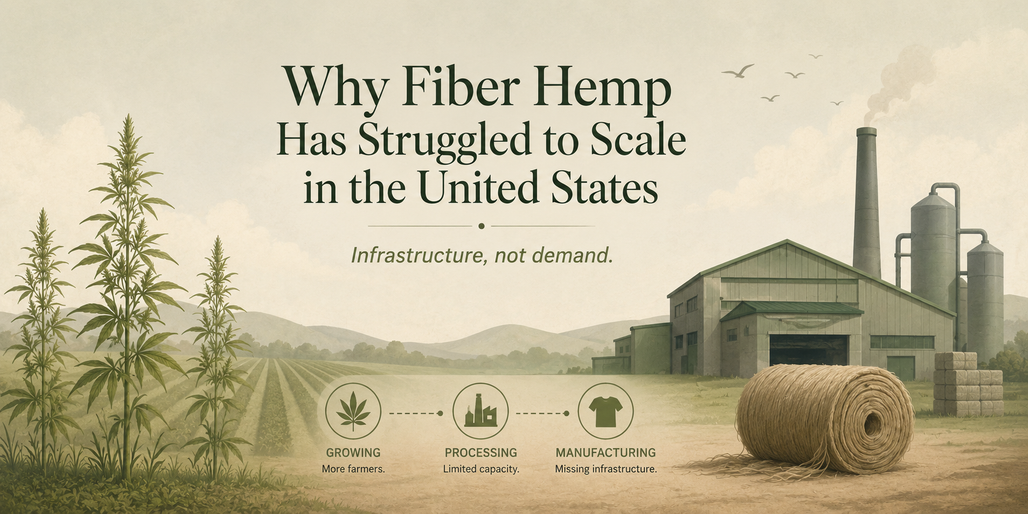
Why Fiber Hemp Has Struggled to Scale in the United States
Last updated: July 2026
Why Fiber Hemp Has Struggled to Scale in the United States
Fiber hemp has one of the strongest stories in the hemp industry. Its stalks can supply materials for textiles, paper, rope, insulation, animal bedding, hempcrete, packaging, nonwovens, and biocomposites. On paper, it sounds like the crop that should have expanded rapidly after hemp became legal to grow commercially.
But fiber hemp has not scaled in the United States as quickly as many people expected. The main problem is not a lack of possible uses. It is the difficulty of building a complete supply chain. Farmers can grow hemp stalks, but those stalks only become commercially useful when processors, transportation networks, decortication facilities, manufacturers, quality standards, contracts, and buyers are available.
That is the key difference between fiber hemp and floral hemp. Floral hemp connected relatively quickly to recognizable retail markets. Fiber hemp must travel through a longer industrial process before it becomes a finished product.
This article is a supporting guide for our parent hub, CBD Hemp vs Fiber Hemp: How American Hemp Farms Choose What to Grow. Read that guide for a broader comparison of the two farming systems.
Fiber Hemp’s Promise
Fiber hemp is grown primarily for the plant’s stalk. The stalk contains two major usable components: outer bast fiber and inner woody hurd. Rutgers Cooperative Extension’s hemp fiber production guide explains that bast fibers are the longer fibers on the outside of the stalk, while hurd is the shorter, woodier material inside it.
Those components can serve different markets:
- Bast fiber: Textiles, rope, specialty paper, nonwovens, automotive materials, insulation, and reinforced composites.
- Hurd: Animal bedding, hempcrete, absorbent products, mulch, particleboard, and other building or industrial materials.
This range of potential uses makes fiber hemp appealing. In theory, one crop could support apparel, construction, packaging, paper, automotive manufacturing, animal care, and renewable-material development.
Why the Promise Is Real—but Not Automatic
Fiber hemp can produce strong natural fibers and serve manufacturers seeking renewable or domestically sourced materials. However, a product is not automatically environmentally preferable simply because it contains hemp. Its overall impact also depends on farming practices, retting methods, processing energy, chemical inputs, transportation distances, durability, waste, and what material it replaces.
The Textile Exchange report Growing Hemp for the Future discusses hemp’s potential in apparel and home textiles while emphasizing the need for responsible production, better data, traceability, and careful processing.
That distinction matters. A field of hemp stalks does not automatically become fabric, insulation, paper, or hempcrete. The crop must first pass through a functioning industrial supply chain.
Processing Bottlenecks
The biggest reason fiber hemp has struggled to scale is processing. After harvest, fiber hemp may require drying, retting, baling, transportation, decortication, cleaning, grading, fiber refinement, and additional manufacturing preparation.
Retting Comes Before Fiber Separation
Retting is a controlled biological or chemical process that helps loosen the bonds between the outer bast fibers and the inner hurd. Field retting uses moisture, microorganisms, and time, while other systems may use water or more controlled processing methods.
Retting must be managed carefully. Under-retted stalks can be difficult to separate. Over-retting can weaken the fiber or reduce consistency. Weather, moisture, timing, crop uniformity, and handling all affect the result.
Rutgers Extension explains that fiber hemp commonly undergoes drying and retting before the stalk components can be separated effectively. The guide also stresses moisture control before baling and storage.
Decortication Is a Critical Bottleneck
Decortication is the mechanical process that separates hemp stalks into bast fiber and hurd. Before decortication, harvested fiber hemp remains bulky stalk material. After decortication, the separated components can begin moving into manufacturing markets.
The USDA Economic Research Service review of industrial hemp viability found that hemp fiber processing uses specialized equipment and that domestic equipment options were limited during the state pilot-program period. Some U.S. processors had to engineer their own machinery or import equipment.
That is a very different situation from crops with mature processing systems. Cotton, corn, soybeans, and wheat already have established equipment dealers, storage systems, processors, commodity standards, transportation patterns, and buyer networks. Fiber hemp is still developing many of those systems.
Textile-Grade Hemp Requires Additional Processing
Processing hemp for animal bedding or construction hurd is different from producing fiber suitable for apparel. Textile applications may require:
- Retting
- Decortication
- Scutching and cleaning
- Degumming
- Cottonization or mechanical softening
- Spinning and yarn development
- Weaving or knitting
- Dyeing and finishing
- Garment or finished-product manufacturing
This long production chain helps explain why fully domestic hemp fabric did not appear throughout mainstream American apparel immediately after legalization. Farms must connect to fiber processors, spinners, mills, finishers, designers, brands, and retailers.
For a closer look at what happens after harvest, read the related spoke How Hemp Processing Works: From Farm to Finished Product.
Transportation Challenges
Fiber hemp is bulky, and that simple fact has a major effect on its economics. Raw stalks and bales take up considerable space, while their value per pound is generally lower than that of carefully finished floral hemp products.
A farmer may grow a strong fiber crop, but transportation costs can consume a substantial portion of its value if the nearest decortication facility is several hours away. Fiber hemp is therefore often a regional infrastructure challenge rather than merely a farming challenge.
Fiber Hemp Needs Regional Processing
An efficient fiber hemp system places farms near processors, processors near manufacturers, and manufacturers near dependable buyers. Shorter distances can reduce transportation costs, simplify coordination, and help processors obtain enough raw material to operate consistently.
When those links are scattered across the country, the supply chain becomes more expensive and fragile. A delay at one stage can leave farmers with stalks they cannot sell or leave manufacturers without the consistent fiber they need.
Moisture and Storage Affect Transportation
Baled fiber hemp must be dry enough to store and transport without excessive spoilage risk. Rutgers advises that fiber hemp should be sufficiently dry before baling and that moisture must be managed during storage. Wet bales can heat, degrade, grow mold, and lose value before reaching a processor.
Value per Pound Changes the Equation
Premium floral hemp can support more careful handling and shipping because its retail value per pound is comparatively high. Raw stalk material generally cannot absorb the same logistics costs.
This economic difference helped floral hemp connect more quickly to retail categories such as CBD flower, while fiber hemp remained dependent on bulk transportation and industrial processing. For a fuller explanation of that value gap, read Why CBD Hemp Became More Valuable Than Fiber Hemp.
Limited Processing Facilities
A commercial fiber hemp industry needs more than farms and stand-alone decorticators. Depending on the end market, the supply chain may also require fiber cleaning lines, hurd processors, nonwoven manufacturers, textile preparation equipment, paper mills, composite manufacturers, and hemp-based building-material producers.
These facilities remain limited or unevenly distributed across many U.S. regions. That creates a difficult chicken-and-egg problem:
- Farmers hesitate to plant without a processor or committed buyer.
- Processors hesitate to invest without enough contracted acreage nearby.
- Manufacturers hesitate to redesign products without a consistent supply of usable material.
- Brands hesitate to promote domestic hemp products unless quality, price, and availability are dependable.
Processing Capacity Must Grow with Acreage
A fiber hemp industry cannot scale by planting more acres alone. Processing capacity and manufacturing demand must grow alongside production.
If acreage expands faster than processing, farmers can be left with unsold stalks. If processing capacity expands before farms are ready to supply it, facilities may not receive enough material to operate economically.
Mature crop industries have recognized grades, storage systems, established buyers, market information, specialized equipment, financing, insurance experience, and familiar transportation routes. Fiber hemp is still developing many of these supporting systems.
Manufacturers Need Consistent Standards
Processors and manufacturers need predictable inputs. Depending on the intended product, they may care about fiber length, fineness, strength, cleanliness, color, moisture, retting consistency, bale condition, and contamination.
A USDA Agricultural Research Service project on industrial hemp fiber characterization identifies fiber length and fineness as important attributes for textile processing and explains why consistent measurement methods are needed to evaluate hemp for textile applications.
Better standards can help farmers understand what processors want, allow buyers to compare material more confidently, and give manufacturers more predictable raw inputs.
Imported Competition
The developing U.S. fiber hemp industry also competes with imported raw fiber, processed fiber, yarn, fabric, and finished hemp products. Some international suppliers have longer-established processing and textile systems.
The USDA ERS viability review found that imported fiber suppliers were readily available even while U.S. processors faced equipment and market-development challenges. Domestic fiber hemp therefore had to compete with established international supply chains while rebuilding its own infrastructure.
International Suppliers Had a Head Start
Hemp textile production continued in parts of Asia and Europe during the decades when commercial hemp cultivation was heavily restricted in the United States. As a result, some overseas regions retained more experience with retting, fiber preparation, spinning, weaving, and hemp textile manufacturing.
Historical USDA ERS research on industrial hemp fiber markets described established hemp textile activity in Asia and Europe. Although that older report does not describe today’s entire market, it helps explain why the modern U.S. industry began from a different position.
Domestic Fiber Needs a Clear Value Proposition
American fiber hemp may need to compete on more than environmental messaging. Potential advantages could include traceable domestic sourcing, shorter regional supply chains, reliable specifications, specialized product performance, support for American farms, and partnerships tailored to a manufacturer’s needs.
Those advantages only matter if the material is available at the required quality, quantity, price, and schedule. Excitement alone cannot replace dependable production.
Signs of Growth
Although fiber hemp has struggled to scale, the story is not simply one of failure. It is a story of gradual infrastructure development, market testing, and regional experimentation.
USDA Data Shows Meaningful Fiber Acreage
According to the USDA National Hemp Report for the 2025 production year, farmers harvested 21,693 acres of open-field fiber hemp and produced 67.3 million pounds. That was more harvested acreage than open-field floral hemp, which accounted for 16,880 acres.
The value difference remained substantial. USDA valued open-field fiber hemp at $13.5 million and open-field floral hemp at $574 million.
| Category | Harvested Acres | Production Value |
|---|---|---|
| Fiber hemp | 21,693 | $13.5 million |
| Floral hemp | 16,880 | $574 million |
These are aggregate production-value figures, not profit figures. Farm profitability depends on yield, contracts, equipment, labor, transportation, processing costs, crop quality, financing, and buyer reliability. Still, the data shows that acreage alone does not determine market value.
Extension Budgets Are Becoming More Specific
University extension programs are developing more detailed budgets for fiber and dual-purpose hemp. The University of Florida IFAS analysis of estimated costs and returns for hemp fiber and seed production gives farmers a more practical way to examine costs, potential returns, and production assumptions.
This work is important because farmers need region-specific budgets and realistic contract information rather than broad promises about hemp’s potential.
Research Is Moving Toward Processing and Standards
Research on fiber measurement, crop genetics, harvesting, processing, and product development is another encouraging sign. Standardized specifications can make it easier for farmers, processors, and manufacturers to coordinate.
Industrial Uses May Grow Before Apparel
Hemp clothing attracts attention, but fiber hemp may expand first in less visible applications. Depending on regional processing capacity, animal bedding, hempcrete, insulation, nonwovens, erosion-control materials, packaging, and composites may offer more accessible markets than a completely domestic apparel supply chain.
Fiber hemp does not need to enter every market at once. It needs repeatable regional markets that give farmers confidence to plant and give processors confidence to invest.
Explore two closely related spokes for the next part of the story: Can Hemp Textiles Make a Comeback in America? and Could New Hemp Laws Trigger a Fiber Hemp Boom?.
Why Demand Alone Is Not Enough
The hemp industry sometimes discusses demand as if consumer or manufacturer interest automatically creates a functioning market. Fiber hemp shows why that is not always true.
A clothing brand may like the idea of hemp fabric. A builder may be interested in hempcrete. A packaging company may want renewable fiber. For that interest to become a dependable market, the supply chain must answer practical questions:
- Who will grow the hemp?
- What genetics and specifications does the buyer require?
- Who will purchase the stalks, and under what contract?
- Where will the crop be dried, stored, and processed?
- How far must the raw material travel?
- Who will grade and test the processed material?
- Who will turn it into yarn, matting, hurd, board, paper, insulation, or composite material?
- Can the finished product compete on price, performance, consistency, and availability?
Until those questions have repeatable answers, fiber hemp will continue to expand more slowly than its list of potential uses suggests.
How New Hemp Laws Could Affect Fiber Hemp
Federal hemp definitions are scheduled to change on November 12, 2026, unless Congress changes the law before then. The Agricultural Marketing Act text compiled by GovInfo, as amended by Public Law 119-37, contains a future hemp definition based on total tetrahydrocannabinols, including THCA, and establishes exclusions for certain intermediate and final hemp-derived cannabinoid products.
The amended text also identifies industrial hemp grown for stalk, fiber, grain, seed, microgreens, or other non-cannabinoid purposes. That could make non-cannabinoid hemp markets more strategically important to some growers and businesses.
However, a regulatory change cannot instantly create decorticators, textile mills, manufacturers, contracts, transportation networks, or buyers. Tighter rules for cannabinoid products may encourage farms to investigate fiber, grain, or seed, but infrastructure and economics will still determine whether those alternatives work.
For a focused explanation of the scheduled federal change, read How the November Hemp Law Changes Could Affect Hemp Farmers.
Practical Takeaways
- Fiber hemp has useful applications, but its U.S. processing infrastructure is still developing.
- The primary challenge is not simply growing hemp stalks. It is processing, transporting, grading, manufacturing, and selling them profitably.
- Retting quality affects how effectively bast fiber and hurd can be separated.
- Decortication is a critical step because it turns stalk material into components manufacturers can use.
- Fiber hemp is bulky, so transportation distance can significantly affect its economics.
- Imported fiber and textiles compete with the developing domestic supply chain.
- Regional processors, dependable contracts, clear standards, and committed buyers will be essential for growth.
- Industrial products such as bedding, hempcrete, insulation, nonwovens, and composites may scale faster than fully domestic hemp apparel in some regions.
- New federal hemp definitions may increase interest in industrial hemp, but legal changes alone cannot create a viable market.
Frequently Asked Questions
Why has fiber hemp struggled in the United States?
Fiber hemp has struggled because the crop needs a complete processing and manufacturing system before it becomes valuable. Farmers need nearby processing facilities, transportation, storage, specifications, contracts, manufacturers, and buyers. Growing the stalks is only the first step.
Is there demand for fiber hemp?
There is interest in hemp for textiles, construction materials, insulation, animal bedding, paper, packaging, nonwovens, and composites. However, interest only becomes commercial demand when buyers are prepared to purchase material that meets specific price, quality, quantity, and delivery requirements.
What is hemp decortication?
Decortication is the mechanical separation of hemp stalks into outer bast fiber and inner woody hurd. Bast fiber can be used in textiles, rope, nonwovens, insulation, and composites. Hurd can be used in animal bedding, hempcrete, absorbent products, particleboard, and related applications.
Why does fiber hemp need processing facilities nearby?
Raw stalks and bales are bulky relative to their value. Transporting them long distances can make a crop less economical. Nearby processing can reduce transportation costs, simplify storage and scheduling, and give farms a clearer route to market.
Why did CBD hemp scale faster than fiber hemp?
CBD hemp connected more quickly to recognizable consumer products such as flower, oils, extracts, gummies, and prerolls. Fiber hemp must pass through industrial processing and manufacturing before it becomes a finished product.
Can hemp textiles make a comeback in America?
They could, but a domestic hemp textile industry needs suitable genetics, farms, retting, decortication, fiber cleaning, degumming, softening, spinning, fabric formation, finishing, brands, and buyers. Textile production requires more specialized processing than many people realize.
Could new hemp laws trigger a fiber hemp boom?
New rules could increase interest in fiber and other non-cannabinoid hemp markets, but a boom is not guaranteed. Fiber hemp can only expand sustainably when processors, contracts, manufacturers, transportation networks, and buyers are ready.
Is fiber hemp automatically sustainable?
No crop or material is automatically sustainable. Hemp’s environmental performance depends on how it is grown, retted, processed, transported, manufactured, used, and disposed of. Comparisons should consider the full product life cycle and the material hemp is replacing.
What should consumers look for when buying hemp products?
For cannabinoid products, consumers should look for clear product descriptions, current batch-specific lab reports, transparent cannabinoid information, reasonable claims, and responsible sourcing. Green Nursery shoppers can compare CBD flower and review available COAs and lab reports before ordering.
Popular Products
Check out these customer favorites.