
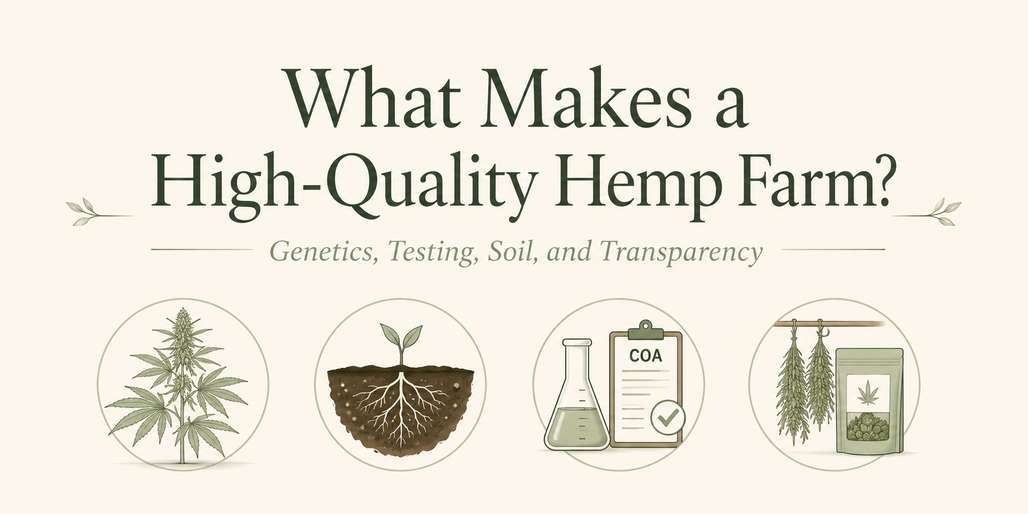
What Makes a High-Quality Hemp Farm? Genetics, Testing, Soil, and Transparency
Last updated:
What Makes a High-Quality Hemp Farm?
A high-quality hemp farm is not defined by one certification, one growing method, or how attractive the plants look before harvest. Quality is built through genetics, soil management, crop monitoring, testing, harvest timing, post-harvest handling, documentation, and a clear understanding of what the hemp is being grown to produce.
That final use matters. Hemp grown for premium flower is managed differently from hemp grown for fiber, grain, or planting seed. A floral hemp farm must pay close attention to cannabinoid development, aroma, flower structure, pollination, mold pressure, legal compliance, drying, and storage. A fiber farm must prioritize stalk uniformity, moisture, retting, harvesting equipment, and processing access.
This article is a supporting spoke beneath our parent hub, CBD Hemp vs Fiber Hemp: How American Hemp Farms Choose What to Grow. Read that guide for the broader differences between floral and industrial hemp farming.
What Does “High-Quality Hemp Farm” Actually Mean?
A high-quality hemp farm grows its crop for a clearly defined end use and manages it according to appropriate production, compliance, and post-harvest standards. Healthy-looking plants are valuable, but visual appearance alone cannot establish quality.
The USDA Agricultural Marketing Service hemp program explains that producers operating under the federal program must obtain a license. Depending on location, hemp production may instead be authorized through an approved state or tribal plan.
Licensing and compliance are essential, but they are only the starting point. A licensed farm can still produce an average or poorly handled crop. Quality requires decisions that protect the intended characteristics of the hemp from seed selection through storage.
For a closer look at how those decisions change among flower, fiber, grain, and seed farms, read the related spoke How Hemp Is Grown in America: Flower, Fiber, Grain, and Seed.
Genetics: The Foundation of Hemp Quality
Genetics are among the first factors separating a carefully planned hemp crop from a poorly matched one. Genetics can influence plant structure, flowering time, cannabinoid potential, aroma, yield, disease susceptibility, stalk characteristics, seed production, and compliance risk.
Quality genetics are not universal. A variety suited to producing long fiber may be inappropriate for premium flower. A high-yielding grain variety may not have the flower structure or cannabinoid profile expected in a smokable product.
The USDA Farmers.gov hemp guide distinguishes hemp acreage by intended use, including cannabidiol, fiber, grain, and seed. Each category requires different genetics and production practices.
What Hemp Genetics Can Influence
- Cannabinoid profile: The plant’s potential to produce CBD, CBG, THC, and other cannabinoids.
- Aroma and terpene expression: Sensory characteristics that help distinguish one flower variety from another.
- Plant structure: Branching, flower-site development, airflow, stalk height, and harvest suitability.
- Flowering time: When the crop matures and how it fits the local growing season.
- Compliance risk: The likelihood that cannabinoid development could push the crop outside an applicable hemp limit.
- Regional suitability: How the variety responds to local weather, daylight, soil, pest, and disease conditions.
- Market fit: Whether the crop is best suited to flower, extraction biomass, fiber, grain, or planting seed.
A responsible farm should know the source of its seed, clones, or other planting material. For floral production, growers should also understand whether the genetics are stable, how reliably plants express the expected characteristics, and whether unwanted male plants or pollen could affect the crop.
Soil Quality: Healthy Plants Start Below the Surface
Soil influences root development, nutrient availability, water movement, biological activity, and plant resilience. Poor drainage, compaction, unsuitable pH, or an unbalanced nutrient program can create uneven growth and increase crop-management problems.
Penn State Extension’s industrial hemp production guidance states that hemp is best adapted to well-drained soils with a pH between 6.0 and 7.0. It does not perform well in wet soils or heavy clay conditions that restrict drainage and root development.
Rutgers Cooperative Extension’s hemp production guidance similarly describes loose, well-aerated loam with adequate fertility and organic matter as desirable. The first step should be testing the actual soil rather than applying nutrients based on assumptions.
What Responsible Soil Management Can Include
- Testing soil pH and fertility before planting.
- Correcting unsuitable pH early enough for amendments to work.
- Managing compaction and drainage.
- Building and protecting soil organic matter.
- Using crop rotation and cover crops where appropriate.
- Matching fertilizer applications to crop needs and test results.
- Testing irrigation water when water quality could affect the crop.
- Monitoring plant health throughout the growing season.
The USDA Natural Resources Conservation Service soil-health guidance explains that soil-health systems can increase organic matter, reduce compaction, improve nutrient cycling, and help soil absorb and retain water.
More Fertilizer Does Not Automatically Mean Better Hemp
Over-application can be as problematic as deficiency. Nutrients can accumulate, create imbalances, increase costs, and interfere with the plant’s ability to take up other nutrients.
This can be especially important in greenhouses and high tunnels, where repeated applications occur in a protected environment. Cornell’s high-tunnel soil guidance for Cannabis sativa warns growers to limit unnecessary calcium, phosphorus, and magnesium accumulation from conventional or organic nutrient sources.
Crop Management: Quality Requires Consistent Attention
Good genetics and soil do not eliminate the need for active crop management. A high-quality farm monitors the plants and growing environment throughout the season instead of waiting until harvest to evaluate the crop.
Important Areas to Monitor
- Pest and disease pressure.
- Mold and humidity risk.
- Plant nutrition and irrigation.
- Weed competition.
- Plant spacing and airflow.
- Storm, drought, and heat stress.
- Flower maturity and cannabinoid development.
- Male plants and unwanted pollination in floral hemp.
Not every visible imperfection means a farm is poor quality. Farming happens in changing biological and environmental conditions. The more useful question is whether the operation scouts regularly, keeps records, responds appropriately, and prevents avoidable problems from damaging the crop.
Good farms should also use crop-protection products responsibly. A product being permitted for agricultural use does not mean it can be applied carelessly or outside its label directions. Application records, worker safety, harvest intervals, and the requirements of the applicable hemp program all matter.
Testing Programs: Quality Needs Verification
Testing serves two different purposes in the hemp supply chain. Farm-level testing supports crop compliance. Finished-product testing helps buyers and consumers understand a particular product or batch. Those tests should not be treated as interchangeable.
Farm-Level Compliance Testing
Under USDA’s current production program, compliance laboratories evaluate hemp using total THC measurements that account for the potential conversion of THCA into Delta-9 THC. The USDA hemp laboratory testing guidelines describe the acceptable hemp THC level as 0.3% on a dry-weight basis and require post-decarboxylation or another similarly reliable testing method.
A serious hemp farm must understand the rules that apply to its location, including sampling procedures, testing windows, authorized laboratories, harvest deadlines, recordkeeping, and the process for handling a noncompliant result. State and tribal requirements may add obligations beyond the federal production framework.
Federal Hemp Definitions Are Scheduled to Change
Federal statutory definitions are scheduled to change on November 12, 2026, unless Congress amends the law before then. The Agricultural Marketing Act text compiled by GovInfo, as amended by Public Law 119-37, contains a future hemp definition based on total tetrahydrocannabinols, including THCA. It also establishes exclusions for certain intermediate and final hemp-derived cannabinoid products.
Farms should follow the rules in effect at the time of planting, sampling, harvest, and sale. For a focused explanation of the scheduled change, read How the November Hemp Law Changes Could Affect Hemp Farmers.
Finished-Product Testing
Finished-product testing is what consumers usually encounter through a certificate of analysis, or COA. Depending on the product and laboratory panel, a COA may include:
- Cannabinoid potency.
- THC measurements.
- Sample or batch identifiers.
- Testing dates.
- Pesticide screening.
- Heavy-metal screening.
- Microbial or mycotoxin screening.
- Residual-solvent testing for extracted products.
Not every COA includes every safety panel. Consumers should check what was actually tested instead of assuming that a potency report also covers contaminants.
Green Nursery publishes available product testing in its COA library. For help interpreting the results, read How to Read a CBD Flower Lab Report.
Testing Is Evidence, Not a Substitute for Good Farming
A laboratory report cannot repair mold damage, poor genetics, careless drying, or bad storage. Testing is one piece of quality control. Its value depends on appropriate sampling, accurate batch matching, a qualified laboratory, and honest presentation of the results.
Certifications and Claims: Useful When They Are Verifiable
Certifications can show that a farm or facility follows defined standards, but labels and marketing language should be evaluated carefully. “Natural,” “clean,” “sustainably grown,” and “organically grown” do not necessarily mean the operation is USDA certified organic.
The USDA National Organic Program develops and enforces national organic standards. Farms and businesses must be certified by a USDA-accredited certifying agent before representing covered products as USDA organic, unless a specific exemption applies.
USDA’s organic hemp instruction explains that hemp produced under an authorized U.S. hemp program may be certified organic when it also meets USDA organic requirements.
A farm does not have to be certified organic to use thoughtful soil, pest-management, or conservation practices. However, it should describe those practices accurately and avoid presenting an informal cultivation claim as a formal certification.
Questions Worth Asking About Certifications
- Is the operation licensed or authorized to grow hemp?
- Is an organic claim supported by USDA certification?
- Can the certifying operation be identified?
- Does the certification cover the farm, processor, finished product, or only one stage?
- Are cultivation and application records maintained?
- Are lab reports connected to identifiable products or batches?
- Are environmental and quality claims specific enough to verify?
Harvest Timing: Picking Too Early or Too Late Can Change Quality
Harvest timing is one of the most important decisions in hemp production. A crop may look healthy in the field, but its final value still depends on when and how it is harvested.
For floral hemp, harvest timing affects cannabinoid development, aroma, flower condition, and compliance risk. Rutgers Cooperative Extension notes that harvest timing is critical and that harvesting hemp for CBD production can be labor intensive.
Why Timing Matters for Floral Hemp
Flower harvested too early may not express the characteristics the grower or buyer expected. Waiting too long may increase exposure to storms, frost, pests, disease, mold, or an unfavorable compliance result.
A well-managed farm considers several factors before harvest:
- Plant and flower maturity.
- Pre-harvest sampling requirements.
- Cannabinoid test results.
- Weather forecasts.
- Disease and mold pressure.
- Available labor and equipment.
- Drying-room capacity.
- Buyer specifications.
Different Hemp Types Require Different Harvests
Floral hemp is harvested to protect its buds. Fiber hemp is harvested for useful stalk material. Grain hemp is harvested for mature seed, while propagation-seed production must also protect germination, purity, and genetic consistency.
There is no single ideal harvest method for every hemp farm. The right method depends on the crop’s intended destination.
Drying and Storage: Where Good Hemp Can Be Lost
Post-harvest handling can preserve a strong crop or erase much of its value. This is especially true for smokable flower, where appearance, aroma, moisture, texture, microbial quality, and freshness all matter.
Drying Hemp Flower
Freshly harvested flower contains enough moisture to support deterioration and unwanted microbial growth if it is not dried correctly. Drying must reduce moisture while protecting the structure and desirable characteristics of the flower.
Oregon State University Extension’s post-harvest hemp flower guide explains that environmental control is important during slow drying. Inadequate control of temperature, relative humidity, and ventilation can extend drying time and reduce flower quality.
Drying too slowly can increase mold and deterioration risk. Excessive heat or overly aggressive drying may reduce aroma or leave flower brittle. The appropriate process depends on the facility, crop volume, climate, and equipment.
Curing Hemp Flower
Curing is the managed stage between drying and longer-term storage. Oregon State notes that curing is important to flower quality, although it remains less extensively studied than some other post-harvest processes.
A farm should not use the word “cured” as an unexplained marketing claim. It should have a repeatable process for monitoring moisture, water activity, storage conditions, and signs of deterioration.
Storage Conditions
Light, heat, excess humidity, oxygen exposure, rough handling, and poor packaging can all affect flower after harvest. A responsible supply chain should protect each batch during storage, testing, transportation, packaging, and retail handling.
For a wider look at what happens between harvest and retail, read How Hemp Processing Works: From Farm to Finished Product.
Farm and Retailer Transparency: Quality Should Be Explainable
Transparency is an important quality signal, but farm transparency and retailer transparency are not exactly the same.
A farm may document seed sources, field locations, cultivation inputs, crop inspections, harvest dates, test results, drying conditions, and storage records. A retailer should accurately connect finished products to descriptions, batches, laboratory reports, packaging, and customer policies.
A retailer may not publicly identify every supplying farm because of contracts or competitive relationships. In that situation, it should still be able to explain its sourcing and quality-control standards without making unverifiable claims.
Useful Transparency Signals
- Specific product descriptions.
- Accessible and readable COAs.
- Batch or lot identifiers that connect products to test results.
- Accurate cannabinoid and serving information.
- Clear explanations of certifications.
- Reasonable claims that do not promise unproven outcomes.
- Information about sourcing and quality standards.
- Visible customer-service and return information.
- Independent customer feedback.
Green Nursery provides customers with product information, a searchable COA library, an About page, and published customer reviews.
Transparency does not prove that every batch will be identical. Agricultural products naturally vary. It gives shoppers better evidence for understanding what they are buying and how a business handles that variation.
How to Recognize Quality in Finished Hemp Products
Most consumers will never visit the farm that produced their hemp. They therefore need to evaluate the evidence available at the finished-product level.
| Quality Signal | What It Can Tell You | What It Cannot Prove Alone |
|---|---|---|
| Clear product description | What the product is, its format, cannabinoid profile, and intended serving information | That every marketing statement is independently verified |
| Batch-matched COA | Reported results for the laboratory panels that were actually performed | Results for contaminants not included in the panel |
| Protected packaging | That the business considered light, moisture, contamination, and handling | How the crop was originally cultivated |
| USDA organic certification | That the certified operation was evaluated under USDA organic standards | That the product is automatically superior in every quality category |
| Customer reviews | Patterns in customer experiences with products and service | Laboratory potency, safety, or farm compliance |
| Farm or sourcing story | How the company describes its suppliers and standards | That every claim is verified without supporting documentation |
For CBD Flower
Look for a specific product description, an identifiable cannabinoid profile, an accessible COA, protective packaging, reasonable claims, and signs that the retailer understands freshness and storage. Appearance and aroma are useful product characteristics, but neither replaces testing.
You can compare those signals across Green Nursery’s CBD flower collection and then match the product with its available laboratory report in the COA library.
For Oils, Gummies, and Other Formulated Products
Look for clearly stated cannabinoid amounts, serving information, ingredient lists, batch identification, appropriate testing, and packaging that protects the contents. For extracts and formulated products, the quality of manufacturing and formulation matters in addition to the quality of the original farm material.
Practical Takeaways
- A high-quality hemp farm begins with genetics suited to the crop’s intended use and growing region.
- Soil testing, drainage, fertility management, and crop rotation affect plant health before harvest.
- Quality farms monitor pests, disease, mold, nutrition, irrigation, weather, and pollination risk.
- Farm-level compliance testing and finished-product testing serve different purposes.
- A potency COA does not automatically include contaminant testing.
- Organic and sustainability claims should be specific, documented, and not overstated.
- Harvest timing can affect crop quality, cannabinoid development, and compliance risk.
- Drying, curing, storage, transportation, and packaging can preserve or damage a strong crop.
- Transparent farms and retailers should be able to explain their standards and support important claims with evidence.
Frequently Asked Questions
What makes a hemp farm high quality?
A high-quality hemp farm uses appropriate genetics, tested soil, responsible cultivation, active crop monitoring, compliant testing, careful harvest timing, controlled post-harvest handling, and reliable documentation. The specific quality standards depend on whether the farm produces flower, fiber, grain, seed, or extraction biomass.
Why do hemp genetics matter?
Genetics influence cannabinoid potential, aroma, plant structure, flowering time, yield, disease susceptibility, stalk characteristics, and compliance risk. Genetics should be selected for the intended product and regional growing conditions.
Does soil quality affect hemp?
Yes. Soil affects root development, nutrient availability, drainage, water retention, and plant stress. Hemp generally performs best in well-drained, aerated soil with suitable fertility and pH, although exact management should be based on local conditions and soil testing.
Why is third-party testing important?
Independent laboratory testing can provide evidence about cannabinoid potency, THC measurements, and any contaminant panels performed. Shoppers should confirm that the report matches the product or batch and check which tests are actually included.
What is a COA?
A certificate of analysis is a laboratory report for a tested sample. It may include cannabinoid results, THC measurements, batch information, testing dates, and contaminant results. The contents depend on the laboratory panel ordered.
Are all high-quality hemp farms organic?
No. A farm can follow thoughtful soil and cultivation practices without being USDA certified organic. However, products represented as USDA organic must satisfy the applicable certification requirements. Informal terms such as “organically grown” should not be used to imply a certification that does not exist.
Why do drying and curing matter for hemp flower?
Drying reduces moisture and helps limit deterioration during storage. Curing is a managed transition from drying to storage that can help protect flower quality. Poor environmental control can increase mold risk or damage aroma, texture, and consistency.
Can a COA prove that a hemp farm is high quality?
Not by itself. A COA reports results for one tested sample and the panels performed. It does not independently prove how the plants were grown, whether the entire crop was handled consistently, or whether untested contaminants are absent.
What should shoppers look for when choosing hemp products?
Look for specific product descriptions, current batch-linked COAs, transparent cannabinoid information, clearly identified testing panels, protective packaging, reasonable claims, accessible company information, and consistent customer feedback. Green Nursery shoppers can compare CBD flower, review available COAs and lab reports, and read customer reviews before ordering.
Popular Products
Check out these customer favorites.