
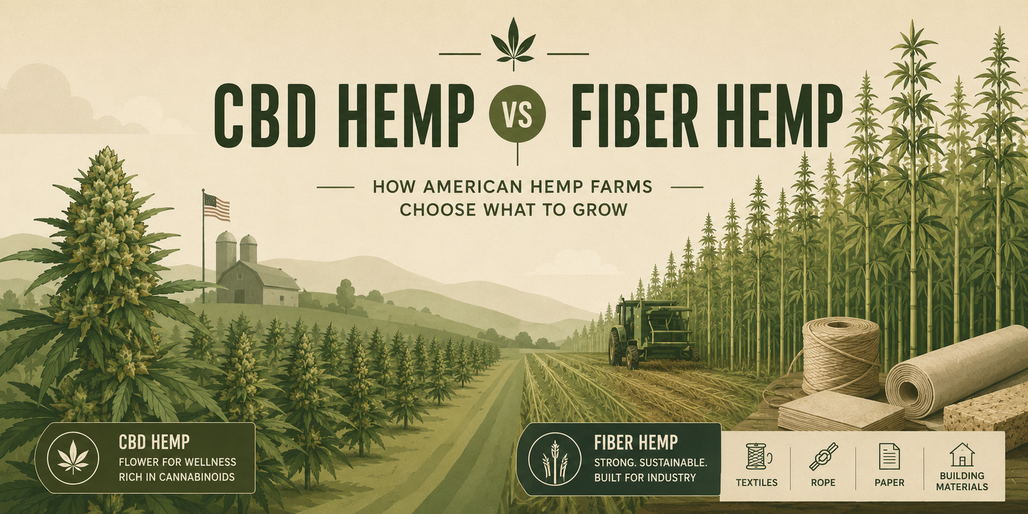
CBD Hemp vs Fiber Hemp: How American Hemp Farms Choose What to Grow
Last updated: June 2026
CBD Hemp vs Fiber Hemp: How American Hemp Farms Choose What to Grow
Hemp farming in America is often talked about like it is one industry. In reality, it is several different industries built around the same plant. A farm growing premium CBD hemp flower is not operating the same business as a farm growing hemp stalks for fiber, hempseed for grain, or seed stock for future planting. If you want to see what the floral side of the hemp market looks like at retail, Green Nursery’s CBD hemp flower collection is a good starting point.
That difference matters because each hemp market has its own genetics, equipment, labor needs, processing facilities, testing requirements, buyers, and risks. The same acre of land could be used for floral hemp, fiber hemp, grain hemp, or seed hemp, but the farm plan, harvest method, and final customer may be completely different.
The clearest example is the gap between floral hemp and fiber hemp. In the USDA National Hemp Report for the 2025 production year, floral hemp grown in the open was valued at $574 million, while fiber hemp grown in the open was valued at $13.5 million. Fiber hemp had more harvested acreage, but floral hemp produced far more market value. That contrast explains a lot about why CBD hemp became attractive to farmers and why industrial hemp still needs stronger infrastructure to scale.
What Is Hemp Farming in America Today?
Hemp farming in America refers to the cultivation of Cannabis sativa L. plants that meet the federal definition of hemp rather than marijuana. Under the current federal hemp production framework, hemp has generally been defined by its THC concentration and is regulated through USDA-approved state, tribal, or federal hemp production plans.
The important point for consumers and growers is that “hemp” does not describe one single product. Hemp can be grown for:
- Flower and cannabinoids, including CBD-rich hemp flower and biomass for extracts.
- Fiber, including stalks used for textiles, paper, insulation, biocomposites, animal bedding, and building materials.
- Grain, including hemp hearts, hempseed oil, and protein ingredients.
- Seed, including propagation stock for future crops.
- Greenhouse or indoor production, including clones, transplants, and specialty floral production.
On the consumer side, those farm categories eventually become very different product categories. Floral hemp can become CBD flower, THCA flower, hemp flower prerolls, extracts, gummies, oils, or other cannabinoid products. Fiber hemp, by contrast, is usually routed toward manufacturers rather than sold directly as a smokable or edible product.
USDA Farmers.gov explains that licensed hemp producers report intended acreage uses such as fiber, cannabidiol (CBD), grain, and seed. This means the crop is tracked not only as “hemp,” but by what the grower intends the crop to become.
For shoppers who are mainly interested in smokable hemp flower, start with our broader hemp flower guide: What Are CBD Buds?
The Main Types of Hemp Grown in the U.S.
Floral Hemp or CBD Hemp
Floral hemp, often called CBD hemp, is grown for cannabinoid-rich flowers. These flowers may be trimmed and sold as CBD flower, dried for extraction, made into hemp flower prerolls, or processed into other hemp-derived products. The focus is usually flower quality, cannabinoid profile, terpene profile, appearance, aroma, drying, curing, and testing.
CBD hemp farming is usually more labor-intensive than fiber or grain hemp. Plants are often spaced farther apart, monitored closely, harvested at specific cannabinoid maturity points, dried carefully, and tested for THC compliance. For consumers, this is the category most connected to hemp flower, CBD products, gummies, oils, and other cannabinoid products.
Fiber Hemp
Fiber hemp is grown for the stalk. The outer bast fiber and inner woody hurd can be used in textiles, rope, paper, insulation, hempcrete, animal bedding, bioplastics, packaging, and industrial composites. Fiber hemp is usually planted more densely than floral hemp because the goal is tall stalk growth rather than large individual flower development.
Fiber hemp must go through additional steps after cutting. Rutgers Cooperative Extension explains that fiber hemp is harvested, dried, retted, and baled so processors can separate bast fiber from hurd. Retting is the controlled breakdown of bonds inside the stalk, which helps make fiber separation possible.
Grain Hemp
Grain hemp is grown for hempseed. The seed can be processed into hemp hearts, hempseed oil, protein powder, and food or feed ingredients where allowed. Grain hemp is generally more similar to a field crop than a boutique floral crop, but it still requires hemp-specific genetics, harvest timing, drying, cleaning, and buyers.
Seed Hemp
Seed hemp is grown for propagation rather than food use. This category matters because farmers need reliable genetics before they can grow consistent hemp crops. Seed quality influences germination, cannabinoid potential, THC compliance risk, plant structure, disease resistance, harvest timing, and end-use suitability.
Greenhouse Hemp
Greenhouse hemp can include clones, transplants, seed starts, research plants, and controlled-environment floral production. This category can support outdoor farms by supplying starter plants, but it can also serve specialty markets where environmental control, consistency, and genetics are especially important.
Floral Hemp vs Fiber Hemp: The Big Difference
The simplest way to understand CBD hemp vs fiber hemp is to ask what part of the plant the farmer is trying to sell.
| Category | Main Crop Goal | Primary Plant Part | Common Uses |
|---|---|---|---|
| Floral hemp / CBD hemp | Cannabinoid-rich flower | Buds and floral biomass | CBD flower, extracts, gummies, oils, topicals, prerolls |
| Fiber hemp | Strong stalk fiber and hurd | Stalk | Textiles, insulation, hempcrete, paper, biocomposites, bedding |
| Grain hemp | Food or oilseed production | Seed/grain | Hemp hearts, hempseed oil, protein ingredients |
| Seed hemp | Planting stock | Viable seed | Propagation, breeding, farm supply |
Floral hemp is closer to specialty agriculture. Quality can depend on genetics, trichome development, terpene preservation, drying, curing, trimming, and packaging. Fiber hemp is closer to industrial agriculture. Quality depends on stalk yield, fiber length, retting, moisture content, baling, decortication, and whether a processor can turn raw stalk into a usable manufacturing input.
This is why hemp flower vs fiber hemp is not just a product difference. It is a farm-business difference. A flower crop may eventually become something a customer browses in a CBD flower or Delta-9 gummies category. A fiber crop may become part of a fabric, a construction material, or an industrial input that the average consumer never sees in its raw form.
Which Type of Hemp Is Worth More?
According to the USDA National Hemp Report for the 2025 production year, total U.S. industrial hemp production value reached $739 million. The report shows a major value gap between floral hemp and other open-field hemp categories.
| Open-Field Hemp Category | 2025 U.S. Value | What the Number Suggests |
|---|---|---|
| Floral hemp | $574 million | Largest value category, driven by cannabinoid and flower markets. |
| Fiber hemp | $13.5 million | More acreage than floral hemp, but much lower total value. |
| Grain hemp | $8.09 million | Smaller but growing food and ingredient category. |
| Seed hemp | $49.7 million | Important because future hemp production depends on reliable genetics. |
The surprising part is that fiber hemp had more harvested open-field acreage than floral hemp in 2025, yet floral hemp produced far more value. USDA reported 21,693 harvested acres for fiber hemp in the open compared with 16,880 harvested acres for floral hemp in the open.
That does not mean fiber hemp is unimportant. It means fiber hemp is still building the processing and manufacturing systems needed to turn acreage into value. A field of hemp stalks is not enough by itself. Farmers need decorticators, buyers, mills, manufacturers, transportation networks, textile partners, building-material companies, and reliable contracts.
Why CBD Hemp Became So Attractive to Farmers
CBD hemp farming became attractive because floral hemp can potentially generate much higher value per acre than many traditional row crops or fiber hemp markets. That does not mean it is easy money. Floral hemp can be expensive, risky, and labor-intensive, but the market value is often tied to higher-margin consumer products.
That retail demand is easy to see in the product categories that grew around floral hemp. A single cannabinoid-focused supply chain can support CBD flower, THCA flower, Delta-9 gummies, hemp-derived THC products, vapes, oils, and prerolls. Fiber hemp has important industrial potential, but it usually does not have the same direct-to-consumer product visibility.
1. Floral Hemp Can Sell Into Multiple Product Channels
A cannabinoid-focused hemp crop may be sold as trimmed flower, biomass for extraction, smokable hemp, prerolls, tinctures, gummies, topicals, or other formulated products. For example, a retailer may organize floral hemp products into categories such as CBD flower, flower prerolls, Delta-9 gummies, and full-spectrum CBD oils. This gives floral hemp more potential downstream paths than raw fiber stalks.
2. Consumers Recognize CBD Flower and Cannabinoid Products
CBD flower became popular because it looks, smells, and handles like traditional cannabis flower while typically being grown for high CBD and low Delta-9 THC. For shoppers comparing CBD flower, strain character, terpene profile, freshness, and lab reports all matter. Green Nursery customers can compare product information through the CBD Flower Collection and review available testing on the COA and lab reports page.
For shoppers who are still learning the difference between hemp product types, it can help to browse the full Green Nursery shop and compare how flower, gummies, oils, vapes, and prerolls are organized. That product-level view makes the farming distinction easier to understand because each retail category begins with a different production and processing path.
3. Flower Quality Creates Brand Differentiation
Fiber hemp is often sold as an industrial input, where price may be driven by volume, processing cost, and manufacturing demand. CBD hemp flower can be differentiated by strain, aroma, visual quality, terpene profile, cure, trim, freshness, and customer experience. That gives retailers and farms more ways to build a brand around quality.
4. The Market Rewarded Cannabinoid Products Quickly
After the 2018 Farm Bill, hemp-derived cannabinoid markets expanded quickly. CBD flower, oils, gummies, vapes, and other hemp products became visible to mainstream consumers. The rapid growth created opportunity, but also confusion around testing, labeling, legality, safety, and state-by-state rules.
That is why third-party testing matters. For more detail, read Why Third-Party Testing Matters for CBD and Hemp Products and How to Read a CBD Flower Lab Report.
Why Fiber Hemp Has Been Harder to Scale
Fiber hemp has a strong sustainability story, but a strong story does not automatically create a mature market. Industrial hemp needs infrastructure before it can become a dependable crop choice for farmers.
Processing Bottlenecks
Fiber hemp must be cut, retted, dried, baled, transported, and processed. The key processing step is often decortication, which separates the useful outer bast fiber from the woody inner hurd. Without nearby decortication or processing capacity, raw stalks can become expensive to move and difficult to sell.
Transportation Costs
Fiber hemp is bulky. If a grower has to transport bales a long distance to reach a processor, transportation costs can reduce or eliminate profit. This is one of the biggest reasons fiber hemp depends on regional supply chains.
Different Equipment Needs
Fiber hemp may use some conventional farm equipment, but it can also create equipment challenges. Long stalks can wrap around moving parts, cutting equipment must handle tall biomass, and harvest timing affects fiber quality. Rutgers Cooperative Extension notes that fiber hemp requires careful cutting, drying, retting, and baling before further processing.
Fewer Established Buyers
A farmer usually does not want to grow a crop without a clear buyer. Fiber hemp markets need processors, textile companies, building-material companies, paper producers, composite manufacturers, and brands willing to commit to hemp inputs. Without contracts or dependable local demand, fiber hemp can be harder for farmers to justify.
Textile-Grade Fiber Requires More Than Stalks
Hemp textiles are especially demanding. Growing hemp for rough industrial fiber is not the same as producing fiber that can be spun, woven, dyed, finished, and sewn into apparel. Textile-grade hemp requires agronomy, processing, fiber refinement, spinning, and manufacturing systems that are still developing in the United States.
How Hemp Processing and Distribution Work
The hemp supply chain changes depending on the intended use, but most hemp moves through a version of this path:
- Farm planning: The grower chooses genetics, acreage, intended use, production method, and potential buyers.
- Planting: Hemp is planted from seed, clones, or transplants depending on the crop type.
- Growing: Farmers manage soil, irrigation, pests, weeds, fertility, THC compliance risk, and crop health.
- Harvest: Floral hemp may be hand-cut and dried. Fiber hemp may be cut, retted, dried, and baled. Grain hemp is harvested and dried for seed quality.
- Testing: Hemp crops and finished products may require testing depending on the production plan, product type, and jurisdiction.
- Processing: Flower may be trimmed, cured, extracted, or packaged. Fiber may be decorticated and refined. Grain may be cleaned, dried, pressed, or milled.
- Distribution: Processed hemp moves to manufacturers, distributors, retailers, or direct customers.
- Retail or manufacturing: The final product becomes flower, extract, gummy, textile, building material, bedding, food ingredient, or another hemp-derived item.
This is also why hemp products should not all be judged the same way. A jar of gummies, a bag of CBD flower, a bottle of CBD oil, and a bale of fiber hemp all come from the same broad plant family, but they move through very different processing systems. When shopping for cannabinoid products, it is smart to compare product descriptions, serving sizes, lab reports, and intended use across categories like CBD products, THC products, and hemp flower.
The bottleneck is usually not “Can hemp grow?” Hemp grows in many regions. The harder question is whether the farm can connect to a profitable supply chain after harvest.
What Makes a High-Quality Hemp Farm?
A high-quality hemp farm is not defined only by how the crop looks in the field. Quality depends on the entire production system, from genetics to post-harvest handling.
Strong Genetics
Genetics shape plant structure, cannabinoid potential, fiber yield, seed production, disease resistance, flowering time, and compliance risk. A CBD hemp farm needs genetics that can produce desirable cannabinoid and terpene profiles while staying within legal limits. A fiber hemp farm needs genetics that produce tall, uniform stalks with useful fiber characteristics.
Soil and Crop Management
Healthy soil, appropriate fertility, irrigation planning, pest monitoring, and crop rotation all influence hemp quality. Because hemp markets can be highly quality-sensitive, poor farm management may reduce both yield and saleability.
Harvest Timing
Harvest timing is critical. Floral hemp needs careful timing to preserve cannabinoid and terpene quality while managing THC compliance. Fiber hemp timing affects fiber quality, stalk condition, retting, and downstream processing.
Drying, Curing, Retting, and Storage
Post-harvest handling can make or break a hemp crop. CBD flower can lose value if it is dried too slowly, dried too harshly, contaminated with mold, or stored poorly. Fiber hemp can lose value if retting is inconsistent, moisture is too high, or bales are not handled properly.
Testing and Transparency
Testing supports compliance, quality control, and buyer confidence. USDA’s Domestic Hemp Production Program includes THC testing requirements for hemp production, while consumer products may be subject to additional FDA, state, or local rules. Green Nursery shoppers can review product-specific lab information through our COA page.
Reliable Buyers and Contracts
A hemp farm is stronger when it has clear buyers before harvest. This is especially important for fiber and grain hemp, where the crop may need regional processors and specific quality specifications.
Could New Hemp Laws Push Farms Toward Fiber?
It is possible, but not guaranteed.
Federal hemp law is changing. The Agricultural Marketing Act of 1946, as amended through Public Law 119-37, includes changes scheduled to take effect November 12, 2026. These changes shift the federal definition toward total tetrahydrocannabinols, including THCA, and include strict limits for certain final hemp-derived cannabinoid products.
For a deeper consumer-focused breakdown, read Understanding THC Limits in Hemp Products.
Why This Could Affect CBD and Cannabinoid Hemp
Floral hemp and cannabinoid products are more directly exposed to rules about THC content, product formulation, testing, and retail legality. If cannabinoid markets become more restricted, less profitable, or more expensive to operate, some farms may reconsider whether floral hemp is worth the risk.
For retailers and consumers, these changes matter because cannabinoid-focused categories are the ones most directly tied to THC definitions, testing standards, and finished-product limits. That includes products such as THCA flower, Delta-9 gummies, and other hemp-derived THC products. Fiber hemp is affected by hemp law too, but it is usually not built around the same consumer cannabinoid rules.
Why Fiber Hemp Could Benefit
Fiber hemp is grown for stalks, hurd, bast fiber, and non-cannabinoid industrial uses. If cannabinoid-focused hemp markets face more legal pressure, some acreage could move toward fiber, grain, seed, or other industrial hemp markets.
Why a Fiber Boom Is Not Automatic
A law change does not instantly create processors, mills, textile buyers, construction-material demand, or profitable contracts. Farmers may only shift into fiber hemp if the economics make sense. That means nearby processing, dependable buyers, clear grading standards, transportation solutions, and enough market demand to absorb the crop.
Important note: This article is educational and not legal advice. Hemp laws, enforcement priorities, and product rules can change. Farmers, retailers, and manufacturers should consult qualified legal and compliance professionals before making business decisions.
Could Hemp Textiles and Industrial Hemp See a Boom?
Hemp textiles and industrial hemp could see growth, especially if brands, manufacturers, and regional processors invest in the supply chain. Hemp has real appeal for apparel, workwear, home goods, insulation, composites, paper, and building materials. The challenge is making those markets economically realistic in the United States.
What Would Need to Happen?
- More regional processing: Farmers need nearby facilities that can handle stalks, retting, decortication, and fiber refinement.
- Better grading standards: Buyers need clear ways to evaluate fiber quality, moisture, cleanliness, and suitability.
- Committed manufacturers: Textile mills, construction companies, packaging companies, and brands need to commit to hemp inputs.
- Farmer contracts: Growers need confidence that a crop has a buyer before they plant.
- Consumer demand: Shoppers and brands need to value hemp materials enough to support the cost of building the supply chain.
In other words, hemp textiles can make a comeback, but acreage alone will not do it. The comeback depends on processing, manufacturing, design, and distribution.
Why Hemp’s Future Depends on Infrastructure
The future of the hemp industry may depend less on whether American farmers can grow hemp and more on whether the rest of the system can support what they grow.
CBD hemp became valuable because it had a fast-growing consumer market, recognizable products, and high-value cannabinoid uses. Fiber hemp has long-term potential, but it needs processors, manufacturers, textile development, construction-material demand, and stronger regional supply chains.
That is the central lesson of CBD hemp vs fiber hemp: hemp is not one crop with one market. It is a flexible agricultural platform with several possible futures. Farms will choose what to grow based on economics, regulation, infrastructure, processing access, buyer demand, and risk.
For consumers, the best way to support a stronger hemp industry is to buy from transparent companies, review lab reports, understand product categories, and pay attention to how hemp laws and supply chains develop. You can browse Green Nursery’s full hemp product catalog, compare CBD flower, review product testing on our COA page, read customer reviews, and check shipping information before ordering.
Practical Takeaways
- American hemp farming includes multiple industries: CBD flower, fiber, grain, seed, greenhouse production, extracts, textiles, and industrial materials.
- Floral hemp has produced far more market value than fiber hemp, largely because cannabinoid products have supported higher-value consumer markets.
- Fiber hemp has strong long-term potential, but it needs processing infrastructure, buyers, and manufacturing demand.
- New federal hemp law changes scheduled for 2026 could pressure cannabinoid-focused markets, but a shift toward fiber is only realistic if the supply chain is ready.
- Testing, genetics, post-harvest handling, and transparency are key quality markers for hemp farms and hemp products.
Frequently Asked Questions
What is the difference between CBD hemp and fiber hemp?
CBD hemp is grown for cannabinoid-rich flowers, while fiber hemp is grown for stalk material. CBD hemp is usually used for flower, extracts, gummies, oils, topicals, and other cannabinoid products. Fiber hemp is used for textiles, paper, hempcrete, insulation, animal bedding, bioplastics, and industrial materials.
Is floral hemp the same as CBD hemp?
Usually, yes. Floral hemp refers to hemp grown for its flowers. Those flowers are often rich in CBD, CBG, or other cannabinoids, depending on genetics and market purpose. Not all floral hemp is sold as smokable flower. Some is grown as biomass for extraction.
Why is CBD hemp worth more than fiber hemp?
CBD hemp often sells into higher-value consumer markets, including smokable flower and cannabinoid products. Fiber hemp is usually sold as a bulk industrial input and needs processing before it becomes usable. Without nearby processing and strong buyers, fiber hemp acreage may not translate into high farm value.
Why has fiber hemp struggled in the United States?
Fiber hemp has struggled because the U.S. still needs more processing capacity, decortication facilities, textile infrastructure, consistent buyers, grading standards, and regional supply chains. Growing hemp stalks is only the first step. Turning those stalks into profitable fiber products is the harder part.
Could hemp textiles become more common?
Yes, but growth depends on infrastructure. Hemp textiles require more than raw hemp fiber. The industry needs fiber processing, spinning, weaving or knitting, finishing, dyeing, design, manufacturing, and brands willing to use hemp fabrics at scale.
How could the 2026 hemp law changes affect farmers?
Scheduled federal changes may create pressure on cannabinoid-focused hemp markets by changing how THC is measured and limiting certain final hemp-derived cannabinoid products. Some farmers may consider fiber, grain, or seed hemp if cannabinoid markets become less attractive. However, any shift depends on local processing, buyers, and profitability.
What should consumers look for when buying CBD hemp products?
Consumers should look for clear product descriptions, current COAs, batch-specific lab reports, transparent cannabinoid information, reasonable claims, customer reviews, and trustworthy shipping policies. This is especially important when comparing categories such as CBD flower, CBD products, Delta-9 gummies, and hemp flower prerolls. Green Nursery provides COAs and lab reports so shoppers can review product testing before buying.
External Authority Sources
This article uses agricultural, legal, and regulatory sources to explain hemp production and market structure, including the USDA National Hemp Report, USDA Farmers.gov hemp acreage guidance, USDA Agricultural Marketing Service hemp program information, the Federal Register domestic hemp production rule, GovInfo’s compiled Agricultural Marketing Act text, and the FDA’s cannabis and CBD regulatory overview.
Popular Products
Check out these customer favorites.