
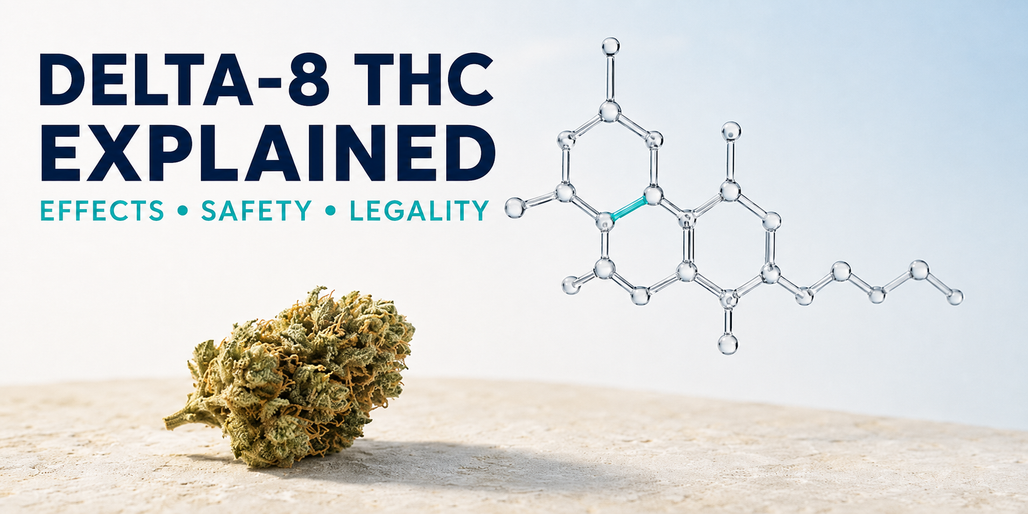
Delta-8 THC Explained: Effects, Safety and Legality
Types of THC Explained
Delta-8 THC Explained: Effects, Safety, Testing and Legality
Delta-8 THC is an intoxicating cannabinoid that occurs naturally in cannabis in very small amounts. Most Delta-8 products, however, do not contain material extracted directly from the plant. Their Delta-8 is typically produced by converting hemp-derived CBD.
That distinction matters. The source of a cannabinoid does not tell you how strong a product is, how carefully it was manufactured or whether it is legal where you live. This guide explains what Delta-8 is, how it compares with Delta-9 THC and CBD, and what consumers should examine before purchasing it.
For a wider view of related cannabinoids, start with our Types of THC Explained guide.
Legal information reviewed: July 21, 2026
What is Delta-8 THC?
Delta-8-tetrahydrocannabinol, commonly shortened to Delta-8 THC or D8, is one of the many cannabinoids associated with the cannabis plant. It is a structural relative, or isomer, of Delta-9 THC—the cannabinoid most commonly associated with marijuana intoxication.
Delta-8 and Delta-9 have the same molecular formula. One important structural difference is the position of a double bond in the molecule. That small change can affect how strongly the compounds interact with cannabinoid receptors in the body.
According to the National Library of Medicine’s PubChem database, Delta-8 binds to the CB1 receptor and has psychoactive activity. In practical terms, Delta-8 can alter perception, coordination, reaction time, judgment and mood.
Is Delta-8 natural, synthetic or semi-synthetic?
The most accurate answer depends on whether someone is describing the molecule, its source or the manufacturing process.
- Naturally occurring Delta-8: Delta-8 can occur in cannabis, usually in trace concentrations.
- Commercial Delta-8: Most concentrated Delta-8 ingredients are made by chemically converting another cannabinoid, usually hemp-derived CBD.
- Converted or semi-synthetic: These are often useful descriptions for commercial Delta-8 because a naturally produced cannabinoid is being transformed into a different cannabinoid through a chemical process.
Regulators and state laws do not always use these terms consistently. Some statutes treat converted Delta-8 as a synthetic or artificially derived cannabinoid, while others focus on whether its starting material came from legally defined hemp.
How is commercial Delta-8 made?
Extracting useful quantities of Delta-8 directly from hemp is generally impractical because the plant contains so little of it. Manufacturers instead commonly begin with hemp-derived CBD and convert it into Delta-8 through a controlled chemical reaction.
The important consumer question is not simply whether conversion occurred. It is whether the manufacturer properly controlled, purified and tested the resulting material. Conversion can produce other cannabinoids, residual processing chemicals and unintended reaction byproducts.
A published analysis of a commercial Delta-8 distillate identified multiple impurities in addition to Delta-8 and other cannabinoids. The researchers emphasized the need for better characterization of converted products. See the study in the Journal of Natural Products.
This is why a cannabinoid-potency result alone is not enough. A responsible producer should be able to document the identity, purity and contaminant testing of the finished product.
What does Delta-8 feel like?
Delta-8 can produce euphoria, relaxation, altered sensory perception and changes in time perception. It can also cause unwanted effects such as dry mouth, dizziness, anxiety, confusion, nausea, increased heart rate, sedation or poor coordination.
The experience can vary with the amount consumed, product formulation, route of use, individual sensitivity, prior THC exposure, food intake and the presence of other cannabinoids or substances.
A 2025 controlled study found dose-dependent psychoactive effects from oral Delta-8. At equal 20-milligram amounts, Delta-8 produced lower average subjective effects and impairment than Delta-9 in that study. However, 40 milligrams of Delta-8 produced effects that were not meaningfully different from 20 milligrams of Delta-9 on the study’s pharmacodynamic measures. Read the published clinical study.
Those results support the idea that Delta-8 may be less potent than Delta-9 when equal quantities are compared. They do not establish a universal conversion ratio, predict an individual’s response or make a high-dose Delta-8 product mild.
Delta-8 THC vs. Delta-9 THC vs. CBD
| Feature | Delta-8 THC | Delta-9 THC | CBD |
|---|---|---|---|
| Intoxicating? | Yes | Yes | Not generally considered intoxicating |
| Natural abundance | Usually present only in trace amounts | Can be abundant in marijuana-type cannabis | Can be abundant in hemp varieties grown for CBD |
| Typical commercial source | Often converted from hemp-derived CBD | Extracted from cannabis or included in hemp products within applicable limits | Usually extracted from hemp |
| Relative psychoactive strength | Often less potent than an equal amount of Delta-9, but still capable of substantial impairment | Generally stronger than an equal amount of Delta-8 | Does not produce a conventional THC high |
| Research depth | Limited human research | Much more extensively studied | More research than Delta-8, although many retail claims remain unproven |
| Drug-screen concern | Yes | Yes | Possible if a product contains THC or is mislabeled |
If you are still deciding which cannabinoid and product type fits your priorities, use our Cannabinoid Shopping Guide.
Common types of Delta-8 products
Delta-8 gummies and other edibles
Gummies are easy to count and carry, but their effects are delayed. A common mistake is taking more before the first serving has fully taken effect. Product onset and duration can vary, so the label should not be treated as a precise promise.
Delta-8 tinctures and oils
These liquid products may be measured by the dropper or serving. Check whether the stated amount refers to one serving, one milliliter or the entire bottle.
Delta-8 vape products
Inhaled products may be felt sooner than edibles, but they add risks involving the device, formulation and substances produced during heating. In one study of 27 commercial Delta-8 vaping products, researchers found inaccurate labeling, reaction byproducts and, in some samples, undeclared cutting agents or heavy metals. That sample does not represent every product, but it illustrates why transparent testing matters. Read the published product analysis.
Infused flower and pre-rolls
Hemp flower does not ordinarily produce concentrated Delta-8 on its own. Products marketed as Delta-8 flower are commonly flower coated or infused with a converted Delta-8 ingredient. Testing should therefore cover both the flower and the applied material—or, preferably, the finished product.
Blended cannabinoid products
Some products combine Delta-8 with Delta-9 THC, THCA, HHC, CBN or other cannabinoids. Their effects cannot be predicted from the Delta-8 amount alone. Every active cannabinoid should be listed in milligrams, with a laboratory report that matches the complete formulation.
For more help evaluating edible labels, serving sizes and online sellers, read Buying THC Edibles Online: A Safer Shopping Guide.
How to read a Delta-8 product label
A useful label should make the product’s contents understandable without requiring guesswork. Look for:
- Delta-8 THC in milligrams per serving or piece
- The number of servings in the package
- Total Delta-8 THC in the complete container
- Separate amounts for Delta-9 THC and other active cannabinoids
- A complete ingredient list and allergen information
- A batch or lot number that matches the laboratory report
- A manufacturing or expiration date where applicable
- Clear warnings about intoxication, driving, children and pets
- Manufacturer contact information
Be cautious when a package advertises only a large front-label number. “1,000 mg” might describe the entire container, all cannabinoids combined or an ingredient other than Delta-8.
Terms such as premium, natural, legal high, clean energy and no anxiety are marketing language, not standardized scientific categories.
What should a Delta-8 certificate of analysis show?
A certificate of analysis, or COA, is a laboratory report for a particular sample. The batch number on the report should match the number on the product.
A meaningful Delta-8 testing program should address:
- Cannabinoid identity and potency: Delta-8, Delta-9, CBD and other detectable cannabinoids or isomers.
- Residual solvents: Chemicals that may remain after extraction, conversion or purification.
- Heavy metals: Such as lead, arsenic, cadmium and mercury.
- Pesticides: Particularly when plant-derived ingredients are used.
- Microbial contamination: Including relevant molds, bacteria and mycotoxins.
- Testing methods and limits: The report should identify the analytical methods and reporting thresholds.
Look for testing on the finished product—not only a report for the original CBD isolate or bulk Delta-8 distillate. Gummies, vape liquids and infused flower can introduce additional ingredients or contaminants after the raw cannabinoid was tested.
A passing COA reduces uncertainty; it does not prove that a product is harmless. Standard laboratory panels may not identify every possible conversion byproduct.
Learn more in Why Third-Party Testing Matters, or review Green Nursery’s available certificates of analysis.
Delta-8 safety and responsible use
The U.S. Food and Drug Administration has not evaluated or approved retail Delta-8 products for safe use. The agency has also warned about variable formulations, misleading labels, accidental exposure among children and possible contaminants created during conversion.
From January 2021 through December 2023, the FDA received more than 300 reports of adverse events involving Delta-8 products. Nearly half involved hospitalization or emergency-department care, and approximately two-thirds followed consumption of food products. Reported events included vomiting, hallucinations, tremor, anxiety, dizziness, confusion and loss of consciousness. These reports identify potential harms but do not establish how frequently an event occurs among all users. See the FDA’s Delta-8 warning.
Basic precautions
- Do not drive, cycle, operate machinery or perform safety-sensitive work after using Delta-8.
- Avoid combining Delta-8 with alcohol, sedatives or other intoxicating substances.
- Allow ample time for an edible to take effect before considering additional consumption.
- Keep products locked away from children and pets—not merely placed on a high shelf.
- Do not use cannabinoid products during pregnancy or breastfeeding unless specifically directed by a qualified clinician.
- Ask a healthcare professional or pharmacist about possible medication interactions.
- Use extra caution if you have a history of severe anxiety, psychosis, heart problems or adverse reactions to THC.
The CDC explains that cannabis can impair reaction time, coordination, perception and decision-making. Although Delta-8-specific driving research is limited, its intoxicating effects warrant the same precaution: do not drive after using it.
Seek emergency assistance for loss of consciousness, trouble breathing, seizure, severe confusion, chest pain or another alarming reaction. In the United States, Poison Control can be reached at 1-800-222-1222. Call 911 for an emergency.
Will Delta-8 show up on a drug test?
It can. Consumers should assume that Delta-8 use may produce a positive cannabinoid screening result.
Delta-8 produces metabolites that are structurally similar to those associated with Delta-9. Laboratory research has shown cross-reactivity between Delta-8 metabolites and commonly used urine cannabinoid immunoassays. See the drug-testing study.
Testing methods, confirmation procedures, frequency of use, metabolism and the product’s full cannabinoid content can all affect the result. A “THC-free,” hemp-derived or legal-market claim is not a guarantee that someone will pass a workplace, athletic, probation or clinical drug test.
Is Delta-8 THC legal?
There is no dependable nationwide yes-or-no answer. Delta-8’s status depends on federal law, state law, the way the cannabinoid was produced, the finished product’s THC content and how the product is sold.
The current federal dispute
The 2018 federal hemp definition centered on cannabis containing no more than 0.3% Delta-9 THC by dry weight. That wording helped create a market for intoxicating products made from hemp-derived CBD. Courts and regulators have not always agreed on how that framework applies to cannabinoids created through conversion.
The Congressional Research Service describes conflicting interpretations involving hemp-derived and converted cannabinoids. Therefore, “federally legal because it comes from hemp” is too broad to be reliable.
State restrictions
States may prohibit Delta-8, limit it to licensed cannabis channels, impose age and testing requirements, or regulate it differently from CBD. Rules can also change faster than product packaging and retail websites are updated.
Online availability does not prove that a product may legally be purchased, possessed or delivered to a particular address. Review current state and local rules as well as the seller’s shipping restrictions before ordering.
A major federal change is scheduled for November 12, 2026
Public Law 119-37 changes the federal definition of hemp effective November 12, 2026. Among other provisions, the revised definition accounts for total tetrahydrocannabinols, excludes certain cannabinoids manufactured outside the plant and establishes a limit of 0.4 milligrams per container for specified THC-related compounds in finished hemp-derived products.
If implemented as written, these provisions appear likely to remove many currently marketed converted Delta-8 products from the federal hemp definition. Implementation guidance, enforcement decisions, litigation or later legislation could affect the practical result.
Readers can review Public Law 119-37 and the Congressional Research Service summary.
Is Delta-8 FDA approved?
Retail Delta-8 products have not been evaluated or approved by the FDA for safe use. They should not be marketed as treatments or cures for anxiety, pain, cancer, sleep disorders or other medical conditions.
Personal testimonials do not establish medical effectiveness. Anyone considering a cannabinoid because of a symptom, diagnosed condition or prescription-medication concern should consult an appropriately qualified healthcare professional.
The FDA provides additional information in 5 Things to Know About Delta-8 THC.
Common Delta-8 myths
| Claim | What consumers should know |
|---|---|
| “It comes from hemp, so it cannot get you high.” | Delta-8 is intoxicating regardless of whether its starting material came from hemp. |
| “Delta-8 products are extracted directly from the plant.” | Natural Delta-8 is present in small amounts. Commercial quantities are usually made by converting CBD. |
| “Delta-8 is basically CBD.” | CBD is not generally intoxicating. Delta-8 activates cannabinoid pathways associated with THC intoxication. |
| “Delta-8 is always half as strong as Delta-9.” | No universal ratio predicts every product, route or person’s response. |
| “Milder means mild.” | A concentrated Delta-8 product can still cause substantial intoxication and impairment. |
| “Lab tested means proven safe.” | A COA is useful, but its value depends on the sample, methods, analytes and laboratory. Not every possible byproduct is included in a standard panel. |
| “Delta-8 is legal everywhere.” | State restrictions vary, federal interpretations have been disputed and the federal hemp definition is scheduled to change. |
| “Delta-8 will not show up on a drug test.” | Delta-8 and its metabolites can trigger cannabinoid screening tests. |
Frequently asked questions about Delta-8 THC
Is Delta-8 stronger than CBD?
“Stronger” is not a precise comparison because the cannabinoids have different effect profiles. Delta-8 is intoxicating, while CBD is not generally considered intoxicating.
Is Delta-8 weaker than Delta-9 THC?
At equal amounts, Delta-8 often produces less intense average psychoactive effects than Delta-9. Product strength and individual response vary, and larger amounts of Delta-8 can still produce strong intoxication.
Is Delta-8 indica or sativa?
Neither. Delta-8 is a cannabinoid, not a cannabis cultivar or botanical category. “Indica” or “sativa” wording on a Delta-8 product may refer to its terpene blend or marketing theme rather than the origin of the Delta-8.
Are Delta-8 gummies safer than vapes?
The formats have different risks. Gummies avoid inhalation but have delayed effects, making premature redosing and accidental ingestion concerns. Vapes act more quickly but introduce device, heating and inhalation risks. Neither format is risk-free.
How long does a Delta-8 edible take to work?
Onset varies by formulation, food intake and individual metabolism. Edible effects are delayed compared with inhalation and may take considerably longer than expected. Do not take more simply because the first serving has not produced an immediate effect.
Can Delta-8 cause anxiety?
Yes. Although some consumers describe relaxing effects, Delta-8 can also cause anxiety, panic, confusion or an unpleasantly intense experience.
Can you drive after using Delta-8?
No. Delta-8 can impair reaction time, coordination, perception and judgment. Do not drive or perform safety-sensitive tasks after using it.
Can Delta-8 interact with medication?
Interactions are possible, but Delta-8-specific clinical evidence is limited. Consult a healthcare professional or pharmacist before use if you take prescription medication or have a significant medical condition.
Can Delta-8 cause a positive drug test?
Yes. Delta-8 metabolites can cross-react with cannabinoid screening tests, and products may also contain measurable Delta-9 THC.
Is Delta-8 federally legal?
Its federal status has been disputed, and state rules vary. In addition, a revised federal definition of hemp is scheduled to take effect on November 12, 2026. Never assume that hemp-derived means legal in every jurisdiction.
The final takeaway
Delta-8 THC is a real intoxicating cannabinoid—not a non-psychoactive version of CBD. It occurs naturally in cannabis, but the concentrated Delta-8 used in most retail products is made by converting CBD. That manufacturing history makes purification, finished-product testing and transparent labeling especially important.
Before purchasing a Delta-8 product, confirm the amount per serving, identify every active cannabinoid, match the batch to a complete COA and check current laws where you live. Avoid medical promises, guaranteed-effect language and claims that hemp-derived products cannot cause impairment or a positive drug test.
Continue exploring the subject in our Types of THC Explained hub. When shopping is legal in your location, you can also review Green Nursery’s Delta-8 collection and verify the applicable laboratory reports before purchasing.
Popular Products
Check out these customer favorites.