
Hemp Flower vs Fiber Hemp: Why They Require Completely Different Farms
Last updated:
Hemp Flower vs Fiber Hemp: Why They Require Completely Different Farms
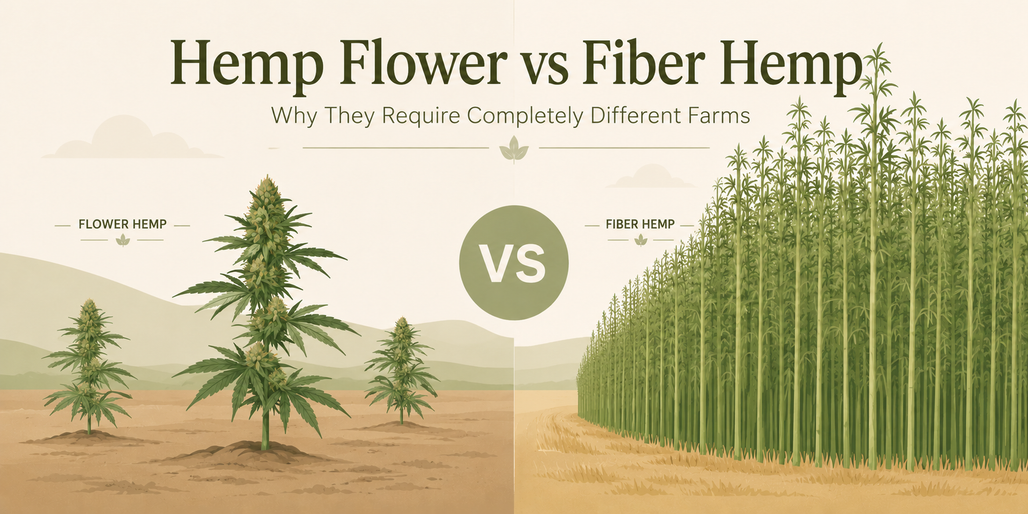
Hemp flower and fiber hemp come from the same plant species, but they are not managed like the same crop. A farm producing premium hemp flower operates very differently from a farm growing tall stalks for fiber, hurd, textiles, or industrial materials.
The genetics are different. Planting density is different. Labor and equipment are different. Harvest and post-harvest handling are different. Even the buyers and revenue models are different.
This article is a direct comparison spoke beneath our parent hub, CBD Hemp vs Fiber Hemp: How American Hemp Farms Choose What to Grow. Read that guide for the broader history and economics behind the two industries.
Same Plant Species, Different Industries
Both floral and fiber hemp come from Cannabis sativa L., but the farm’s intended end use changes almost everything. The most useful question is not simply, “Is this hemp?” It is, “What is this hemp being grown to become?”
The USDA Farmers.gov hemp guide distinguishes hemp acreage by intended use, including cannabidiol, fiber, grain, and seed. Those uses require different varieties, planting systems, harvest methods, and buyers.
| Category | Hemp Flower | Fiber Hemp |
|---|---|---|
| Main crop goal | Marketable cannabinoid-rich flowers or floral biomass | Uniform stalk material containing bast fiber and hurd |
| Primary plant part | Flowering tops and buds | Stalks |
| Typical farm model | Specialty-crop production | Industrial field-crop production |
| Typical planting pattern | Widely spaced plants or rows | Dense stands with narrow row spacing |
| Main quality factors | Cannabinoid profile, aroma, flower condition, freshness, testing | Stalk uniformity, bast quality, hurd yield, moisture, retting |
| Harvest priority | Protect the flower | Efficiently collect and prepare stalks |
| Post-harvest priority | Drying, curing, trimming, testing, storage | Retting, drying, baling, transportation, decortication |
| Typical buyer | Flower wholesaler, extractor, manufacturer, or retailer | Processor, decorticator, material manufacturer, or industrial buyer |
| Common final uses | Packaged flower, prerolls, extracts, oils, and formulated cannabinoid products | Textiles, rope, paper, bedding, hempcrete, insulation, and composites |
For the wider farming breakdown, including grain and seed production, read How Hemp Is Grown in America: Flower, Fiber, Grain, and Seed.
Genetics: Flower Genetics Are Not Fiber Genetics
Genetics are one of the clearest differences between hemp flower and fiber hemp. A cultivar selected for smokable CBD flower is usually not the cultivar a farmer would choose for industrial fiber.
Hemp Flower Genetics
Floral hemp genetics may be selected for:
- Cannabinoid profile.
- Aroma and terpene expression.
- Flower structure and density.
- Trichome development.
- Flowering time.
- Regional suitability.
- Disease and mold tolerance.
- Predictable total-THC expression.
A visually attractive cultivar may still be a poor farm choice if it performs inconsistently, matures too late for the region, is vulnerable to disease, or carries excessive compliance risk.
Fiber Hemp Genetics
Fiber hemp genetics are selected primarily for stalk performance. Desirable characteristics may include:
- Plant height.
- Stalk uniformity.
- Long internodes.
- Limited branching.
- Bast-fiber yield and quality.
- Hurd yield.
- Standability.
- Suitability for mechanical harvest and processing.
Rutgers Cooperative Extension’s fiber hemp guide explains that varieties developed for different end uses can have different physical characteristics and production requirements. Fiber varieties are generally taller and planted at higher seeding rates.
Why Matching Genetics to the Market Matters
Good genetics are only good in relation to the intended use. A branchy plant capable of producing many flower sites may be useful for floral production but undesirable in a dense fiber stand. A tall, thin fiber cultivar may produce useful stalks but lack the flower characteristics expected by a retail buyer.
Plant Density: Flower Needs Space, Fiber Needs Density
Plant spacing is one of the most visible differences between flower and fiber farms. Floral hemp is usually spaced farther apart so individual plants can branch and develop flower sites. Fiber hemp is planted densely to encourage tall, straight stems and limit branching.
Typical Floral-Hemp Spacing
University of Wisconsin–Madison Extension’s hemp overview describes cannabinoid hemp as a labor-intensive specialty crop. It reports spacing recommendations ranging from approximately 1 foot to 6 feet on-center, depending on genetics and production system.
Wider spacing can provide:
- More room for branching and flower development.
- Better access for crop scouting.
- More airflow around individual plants.
- Space for irrigation and cultivation systems.
- Access for hand harvest and plant handling.
The appropriate spacing depends on whether plants are grown outdoors, in a greenhouse, under protection, from seed, or from transplants. Wider spacing is not automatically better; excessive space can reduce plant population without improving marketable yield.
Typical Fiber-Hemp Density
Rutgers recommends close rows and high seeding rates for fiber production. Its New Jersey guidance describes approximately 40 to 60 pounds of pure live seed per acre, rows 6 to 8 inches apart, and dense stands of roughly 800,000 to 1,000,000 plants per acre.
Those figures are regional production guidance rather than a universal prescription. Seeding rate should reflect seed size, germination, cultivar, climate, soil, equipment, buyer requirements, and the intended fiber product.
Dense planting encourages:
- Tall, thin stems.
- Longer internodes.
- Less branching.
- A more uniform stalk crop.
- Greater competition against some weeds after establishment.
Crop Management: Individual Plants vs Uniform Stands
Floral and fiber farms monitor many of the same basic agricultural issues, including soil, fertility, weeds, insects, diseases, water, weather, and crop maturity. What changes is the level and purpose of that attention.
Managing Hemp Flower
Floral growers may need to inspect individual plants for:
- Flower development.
- Pests and disease.
- Mold and humidity pressure.
- Nutrient or irrigation problems.
- Male plants and unwanted pollination.
- Cannabinoid development.
- Harvest readiness.
Unwanted pollination can be particularly damaging to a smokable-flower crop because seeded flower may not meet buyer expectations. Flower farms must also manage the risk that cannabinoid development will make the crop noncompliant.
Managing Fiber Hemp
Fiber growers are generally managing the uniformity and performance of the stand rather than the appearance of individual plants. They may focus on:
- Stand establishment.
- Population density.
- Plant height and lodging.
- Soil fertility.
- Field uniformity.
- Harvest timing.
- Weather conditions for retting.
- Moisture before baling.
A fiber field can contain hundreds of thousands of plants per acre, making individual plant management impractical. The field must perform as a stand.
Harvest Methods: Protect the Bud or Collect the Stalk
Harvest methods differ because the farms are protecting different parts of the plant.
Hemp Flower Harvest
Floral hemp is harvested to preserve the buds and, depending on the intended market, their structure, aroma, and cannabinoid profile. Rough handling, delayed drying, excessive heat, and poor airflow can reduce quality.
Rutgers Cooperative Extension’s general hemp production guide describes CBD harvest as labor intensive and notes that proper harvest timing is critical. It also warns that molds and mildews can reduce the value of floral biomass.
Premium smokable flower may be cut, transported, dried, trimmed, sorted, and packaged with more care than flower intended only for extraction. “Floral hemp” therefore includes more than one quality and price level.
Fiber Hemp Harvest
Fiber hemp is harvested for the stalk. Rutgers reports that fiber crops can exceed 8 feet and may reach approximately 12 feet at maturity. Cutting equipment must be capable of handling the crop’s height, volume, and long stems.
After cutting, the stalks generally need to dry and undergo retting. Retting uses moisture and biological activity to weaken the bonds between the outer bast fibers and the inner woody hurd.
Rutgers advises reducing stalk moisture below 15% before baling, with continued drying to about 10% in the bale. Exact buyer specifications and local conditions should guide farm decisions.
The Central Harvest Difference
Hemp flower harvest is quality-sensitive because the bud may be the finished or near-finished product. Fiber harvest is logistics-sensitive because the stalk must move efficiently into additional processing.
Labor Requirements: Flower Is Labor-Heavy, Fiber Is Infrastructure-Heavy
Premium floral hemp generally requires more hands-on labor per acre than fiber hemp. Fiber farms may use more acreage and larger machinery, but they do not usually handle every plant individually.
Why Hemp Flower Requires More Hands-On Labor
Depending on the farm, labor may be needed for:
- Starting or purchasing transplants.
- Transplanting and irrigation setup.
- Individual plant scouting.
- Removing male or off-type plants.
- Hand harvest.
- Transporting plants to drying facilities.
- Drying and curing.
- Trimming, sorting, testing, and packaging.
UW–Madison Extension compares cannabinoid production with specialty or vegetable crop systems and notes that plants are commonly hand-cut and hung to dry.
Why Fiber Requires Different Labor
Fiber production shifts work toward field operations and logistics:
- Calibrating seeding equipment.
- Managing a large, dense stand.
- Cutting tall stalks.
- Monitoring field retting.
- Turning or windrowing material when required.
- Baling and storing the crop.
- Scheduling transportation.
- Meeting processor specifications.
The useful shorthand is that hemp flower is often labor-heavy, while fiber hemp is infrastructure-heavy. Both can be difficult, but the difficulty appears in different places.
Equipment: Specialty-Crop Tools vs Field-Crop Machinery
The equipment used on each farm reflects the intended product and production scale.
Common Floral-Hemp Equipment and Infrastructure
- Greenhouse or nursery space for starts.
- Transplanting tools or equipment.
- Drip irrigation and plastic mulch in some systems.
- Scouting and sampling tools.
- Hand-cutting or specialized harvesting tools.
- Drying barns, racks, fans, and environmental controls.
- Trimming and sorting equipment.
- Protected storage and packaging systems.
Much of this infrastructure is designed to protect smaller volumes of higher-value material.
Common Fiber-Hemp Equipment and Infrastructure
- Grain drills or other close-row seeding equipment.
- Mowers or cutters capable of handling long stalks.
- Raking, turning, or windrowing equipment when appropriate.
- Large round or square balers.
- Dry, protected bale storage.
- Trucks and loading equipment.
- Access to decortication and fiber-processing facilities.
UW–Madison Extension explains that grain and fiber hemp are generally produced at field scale using conventional agricultural equipment. Rutgers cautions that standard swathers may struggle with the volume and long stems of tall fiber crops.
A pure fiber operation does not necessarily need a combine. Combines are more relevant to grain or dual-purpose grain-and-fiber systems.
Post-Harvest Processing: Drying Flower vs Retting Stalks
The two crops continue moving through different systems after they leave the field.
Post-Harvest Hemp Flower
Depending on its intended use, flower may go through:
- Transport to the drying facility.
- Controlled drying.
- Curing for smokable flower.
- Trimming and sorting.
- Potency and quality testing.
- Batch identification.
- Protective packaging and storage.
Extraction biomass may not receive the same trimming or presentation work as premium smokable flower, but it still requires moisture management, storage, testing, and processor acceptance.
Post-Harvest Fiber Hemp
Fiber hemp may go through:
- Field drying.
- Retting.
- Moisture evaluation.
- Baling.
- Protected storage.
- Transportation.
- Decortication.
- Fiber and hurd cleaning or refinement.
- Manufacturing into a finished material.
Decortication mechanically separates bast fiber from the hurd. Additional processing depends on whether the buyer needs textile fiber, nonwovens, construction hurd, bedding, paper, or a composite input.
For the full farm-to-product chain, read How Hemp Processing Works: From Farm to Finished Product.
Revenue Models: Consumer Products vs Industrial Inputs
Floral and fiber hemp generate value through different supply chains.
Hemp Flower Revenue
Floral hemp may be sold as premium smokable flower, lower-grade flower, preroll material, extraction biomass, or another cannabinoid input. Price can depend on:
- Cannabinoid profile.
- Aroma and appearance.
- Trim and flower structure.
- Moisture and freshness.
- Test results.
- Batch consistency.
- Volume and contract terms.
- Whether the crop is sold wholesale or farther down the retail chain.
The crop may eventually support products that consumers recognize directly, such as packaged flower, prerolls, extracts, oils, or gummies. That retail visibility helped floral hemp attract substantial investment and acreage.
Fiber Hemp Revenue
Fiber hemp is generally sold according to weight, bale condition, moisture, contract specifications, processing stage, or material grade. The farmer may sell raw or retted stalks, while processors capture additional value by separating and refining bast fiber and hurd.
Transportation distance matters because raw stalks and bales are bulky relative to their value. Fiber farms generally need a processor or buyer identified before planting.
What USDA Data Shows
The USDA National Hemp Report for the 2025 production year shows a large difference between the two markets:
| Category | Harvested Acres | Reported Production Value |
|---|---|---|
| Floral hemp | 16,880 | $574 million |
| Fiber hemp | 21,693 | $13.5 million |
These are aggregate production-value figures, not profit calculations. They do not prove that every flower farm is profitable or that fiber cannot succeed. They show that floral hemp recently generated far more reported value despite having fewer harvested acres.
For a deeper explanation, read Why CBD Hemp Became More Valuable Than Fiber Hemp.
Market Demand: Consumer Demand vs Industrial Demand
Hemp Flower Demand
Floral demand ultimately connects to consumers. Retail products may be differentiated by cannabinoid profile, format, aroma, freshness, test results, branding, packaging, and customer experience.
This creates more opportunities for product differentiation, but it also exposes farms to consumer trends, changing cannabinoid laws, retailer inventory decisions, and volatile wholesale prices.
Fiber Hemp Demand
Fiber demand is usually industrial. Buyers may include decorticators, textile developers, paper manufacturers, bedding companies, construction-material producers, insulation manufacturers, packaging businesses, and composite manufacturers.
These buyers typically care about:
- Volume and delivery schedule.
- Moisture.
- Retting consistency.
- Fiber length and fineness.
- Cleanliness and contamination.
- Bale condition.
- Processing suitability.
- Price consistency.
The USDA Economic Research Service review of industrial hemp viability explains that hemp’s long-term success depends on infrastructure, market development, profitability, regulation, competition, and price transparency.
Why Interest Is Not Enough
Consumers and manufacturers may like the idea of hemp textiles, hempcrete, or renewable materials. That interest becomes meaningful farm demand only when buyers are ready to purchase specific quantities at a workable price.
For more on that bottleneck, read Why Fiber Hemp Has Struggled to Scale in the United States.
Can Hemp Be Grown as a Dual-Purpose Crop?
Some hemp cultivars and production systems are designed to produce both grain and fiber. Farmers may harvest the seed first and then collect the remaining stalk material.
Rutgers notes that this is the most common example of dual-purpose industrial hemp. It also cautions that dual-purpose cultivars may not match the yield or quality of cultivars developed for one specialized use.
Premium flower and high-quality fiber are less natural as a dual-purpose combination. A floral plant is typically encouraged to branch and produce flowers, while a fiber plant is grown in a dense stand to produce tall, relatively unbranched stalks. Optimizing one goal can work against the other.
Dual-purpose production can be useful when the farm has buyers for both outputs. Without two actual markets, collecting two plant parts may only add cost and complexity.
Why These Farms Cannot Easily Switch Crops
It may sound simple to suggest that a flower farm switch to fiber if cannabinoid demand falls. In practice, the change can require an entirely different business model.
A flower farm may be built around small-acreage production, feminized genetics, transplanting, irrigation, individual plant care, hand harvest, drying rooms, trimming, flower testing, and cannabinoid buyers.
A fiber farm may need large fields, dense direct seeding, heavy cutting equipment, retting knowledge, baling, bale storage, trucking, decortication access, and industrial contracts.
Switching can require:
- Different genetics.
- Different acreage.
- Different planting and harvesting equipment.
- Different labor and technical knowledge.
- Different storage systems.
- Different buyers and contracts.
- Different cash-flow expectations.
- A different tolerance for price and infrastructure risk.
The federal hemp definitions scheduled for November 12, 2026 may increase interest in non-cannabinoid crops, but a legal incentive cannot create processors or buyers. Read How the November Hemp Law Changes Could Affect Hemp Farmers for the farmer-level planning issues.
Which Is Better: Hemp Flower or Fiber Hemp?
Neither crop is automatically better. Each is better suited to a different farm, region, buyer, and market.
Hemp Flower May Be a Better Fit When a Farm Has:
- Experience with specialty crops.
- Reliable floral genetics.
- Enough labor for close crop management.
- Suitable drying and storage capacity.
- Access to compliant testing.
- A dependable flower or biomass buyer.
- The ability to manage cannabinoid-market volatility.
Fiber Hemp May Be a Better Fit When a Farm Has:
- Suitable field acreage.
- Direct-seeding and harvesting equipment.
- Experience with field crops and baled material.
- Favorable transportation distances.
- Nearby processing or decortication capacity.
- A buyer contract before planting.
- A market for the required fiber or hurd specification.
The correct decision depends on the farm’s land, climate, equipment, labor, capital, genetics, processing access, buyer relationships, and alternative crops.
Practical Takeaways
- Hemp flower and fiber hemp come from the same species but require different production systems.
- Floral genetics are selected for flower and cannabinoid characteristics, while fiber genetics are selected for stalk performance.
- Floral hemp is generally spaced widely; fiber hemp is planted in dense, narrow-row stands.
- Flower growers manage individual plant and bud quality, while fiber growers manage field-level uniformity.
- Flower harvest protects buds; fiber harvest prepares stalks for retting, baling, and processing.
- Hemp flower is often labor-heavy, while fiber hemp is infrastructure-heavy.
- Hurd is the woody inner core of the stalk, not another form of bast fiber.
- Floral hemp recently generated much more reported production value despite having fewer harvested acres.
- Grain and fiber can be combined in some dual-purpose systems, but premium flower and fiber are difficult to optimize together.
- A farm cannot switch between flower and fiber without reconsidering genetics, equipment, labor, processing, buyers, and cash flow.
Frequently Asked Questions
Is hemp flower the same as fiber hemp?
No. They come from the same species, but hemp flower is grown for cannabinoid-rich buds or floral biomass. Fiber hemp is grown for stalk material containing outer bast fiber and inner woody hurd.
Why does hemp flower require more labor?
Individual plant and flower quality matter. Growers may need to transplant, scout, manage pollination, hand-harvest, dry, cure, trim, sort, test, and package flower carefully.
Why is fiber hemp planted densely?
Dense planting encourages tall, thin stalks and limits branching. The appropriate density depends on cultivar, germination, climate, soil, equipment, and processor specifications.
What is bast fiber?
Bast fiber is the long outer fiber found around the hemp stalk. It can be processed for textiles, cordage, nonwovens, insulation, composites, and other material applications.
What is hemp hurd?
Hurd is the woody inner core of the stalk. It can be used in animal bedding, hempcrete, absorbent materials, particleboard, and other industrial products.
Can a CBD flower farm switch to fiber hemp?
It can, but the switch is not simple. The farm may need new genetics, different acreage, direct-seeding equipment, different harvest machinery, baling and storage capacity, a nearby processor, transportation, and an industrial buyer.
Why did hemp flower become more valuable than fiber hemp?
Floral hemp connected more quickly to recognizable consumer products and higher-value cannabinoid markets. Fiber hemp requires additional processing and industrial demand before raw stalks become useful finished materials.
What is fiber hemp used for?
Fiber hemp can supply textiles, rope, paper, animal bedding, hempcrete, insulation, packaging, nonwovens, and composites. Processing determines whether the stalk becomes refined fiber, hurd, or another material input.
What should consumers look for when buying hemp flower?
Consumers should look for specific product descriptions, current batch-linked COAs, transparent cannabinoid information, clearly identified testing panels, protective packaging, reasonable claims, and reliable customer information. Green Nursery shoppers can compare the CBD flower collection and review available COAs and lab reports before ordering.
Popular Products
Check out these customer favorites.