
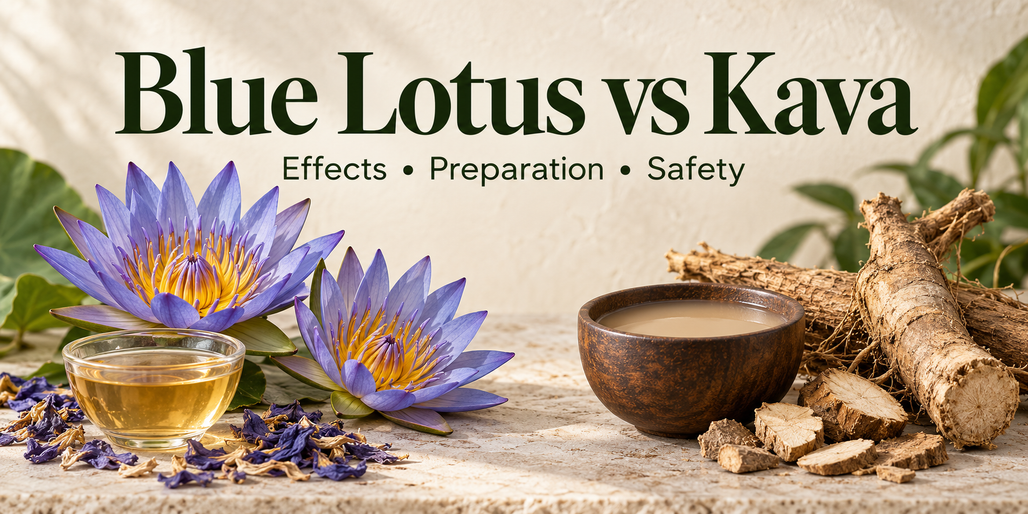
Blue Lotus vs Kava: Effects, Preparation & Safety
Botanical education and comparison
Blue Lotus vs Kava: Effects, Preparation, and Safety Compared
Blue lotus and kava are different plants with different preparations and very different amounts of human research. Blue lotus is a water lily commonly sold as dried flowers; kava is a Pacific plant whose roots are used in beverages and extracts. Kava has been studied in clinical trials, with mixed results. Reliable human evidence has not established blue lotus's advertised relaxation or sleep benefits, according to Operation Supplement Safety and NCCIH's kava overview.
Both appear in conversations about unwinding, but that shared reputation can hide the differences that matter. What preparation are you comparing? What might it feel like? How much confidence should you place in the claims? For broader context, start with our guide to herbal supplements and botanical safety.
Blue lotus vs kava at a glance
| Question | Blue lotus | Kava |
|---|---|---|
| What plant is it? | A water lily commonly called Nymphaea caerulea. | Piper methysticum, a member of the pepper family. |
| What form are we comparing? | Dried flowers prepared as an infusion, distinct from concentrated extracts or vaping liquids. | Root prepared with water, distinct from instant mixes and standardized extracts. |
| Why do people seek it out? | A reputation for relaxation, dream experiences, and an uplifted mood. | Social and ceremonial use, relaxation, and interest in anxiety relief. |
| How strong is the human evidence? | Reliable evidence has not established the advertised benefits. | Clinical trials exist, but findings differ and apply to specific preparations. |
| What is a major caution? | Uncertain effects and safety; some associated products have contained undeclared drugs. | Sedation, interactions, and rare but potentially serious liver injury. |
These distinctions draw on Kew's botanical record, OPSS's blue lotus assessment, NCCIH's kava guidance, and the studies discussed below. This is not a ranking of which plant is safest.
Different plants with different cultural histories
Blue lotus: a water lily with Egyptian significance
Despite its common name, blue lotus is a water lily. Kew treats Nymphaea caerulea as a synonym of Nymphaea nouchali var. caerulea, so either name may appear in botanical references.
In ancient Egyptian imagery, the flower carried meanings connected to the sun and rebirth, as the Metropolitan Museum of Art explains. That symbolism is compelling on its own. It does not establish what a modern tea will do, or prove that a current preparation recreates an ancient experience.
Kava: a beverage within living Pacific traditions
Kava has ceremonial, spiritual, and social roles across Pacific communities. The University of Hawaii's Pacific Food Guide describes its traditional beverage use and root preparation with cold water.
Those traditions deserve more context than a label such as "relaxation drink." Our article on kava rituals, preparation, and community explores their social meaning in more detail.
How do their effects compare, and what does research support?
Blue lotus: reported experiences leave substantial questions
Blue lotus is marketed for calm, sleep, and dream-related experiences. OPSS reports insufficient reliable human evidence to establish its safety or effectiveness for specific purposes. A personal account may describe someone's experience, but it cannot tell you what an authenticated flower tea will reliably produce.
Even the usual chemistry explanation needs care. A 2023 analysis of six authentic extracts and eleven commercial products found no apomorphine and only trace nuciferine in the authentic extracts tested. Those extracts were fragrance-oriented concretes and absolutes, not brewed tea. The results cannot establish that all flowers lack those compounds, and the study's topical safety assessment does not demonstrate oral safety.
Kava: clinical research exists, but the results are mixed
Kava contains active compounds called kavalactones. Food Standards Australia New Zealand's assessment describes their pharmacological activity, including the potential for drowsiness and sedation. That helps explain why kava is discussed in relation to relaxation, but it does not make every product an effective anxiety treatment.
Two trials show why the details matter:
- A six-week trial published in 2013 found greater anxiety reduction with an aqueous kava extract than with placebo. Its analysis included 58 participants after the initial screening and placebo run-in.
- A larger 16-week trial published in 2020, involving 171 participants with generalized anxiety disorder, found no significant benefit over placebo for the extract tested.
These were studies of particular extracts, not comparisons with blue lotus or tests of every homemade kava drink. Neither study supports a claim that kava is a certain number of times stronger than blue lotus. For a fuller explanation, read our guide to kava effects, uses, and research.
Blue lotus tea and kava require different preparation
The word "tea" can make two botanical products sound more alike than they are. The NIH Office of Dietary Supplements explains that teas, tinctures, and extracts can contain different amounts and concentrations of plant constituents. Preparation changes what ends up in the cup.
Blue lotus flowers: an infusion
Green Nursery's whole dried blue lotus flowers provide an example of a flower product rather than a concentrated extract. The listing describes hot-water steeping followed by straining. Its preparation guidance should be understood as product guidance, not a clinically established safe or effective dose.
Use only material intended for oral preparation. Follow the directions for the actual product, including flower weight, water volume, and steeping time. An ornamental flower, fragrance oil, or extract labeled for external use is not interchangeable with a tea product. Our blue lotus guide explains the preparation questions in more depth.
Kava root: a prepared root beverage
Traditional preparation involves processing root and working it with water. FSANZ describes dried root being finely ground, wrapped in cloth, and infused in water.
Green Nursery's cut-and-sifted kava root consists of woody root pieces. It is not an instant drink mix. Obtain instructions matching that form, including whether further grinding is needed and how to measure, prepare, and strain it. Do not assume a spoonful of cut root is equivalent to a spoonful of powder.
Keep the units separate: grams of flower, grams of root, milligrams of extract, and milligrams of measured kavalactones describe different things. A "10x" label also does not tell you how many cups of another preparation it equals.
Is blue lotus safer than kava?
There is not enough comparative evidence to rank one as safer overall. A longer list of documented risks can reflect a larger research record; a shorter list can reflect missing information.
Kava's liver and interaction concerns are significant
NCCIH links various kava products to rare liver injuries, including severe and fatal cases. Reports have involved both extracts and water-prepared beverages. It also identifies digestive upset, headache, and dizziness, and advises against combining kava with alcohol or other sedating substances.
If you have liver disease or take medication, seek a clinician or pharmacist's review before considering kava. "Noble" or "traditional" should not be treated as a guarantee of safety.
Blue lotus reports are complicated by product identity
A case series first published online in August 2021 described five patients with altered mental status after products reported as blue lotus: four had vaped and one had consumed an infused beverage. Sedation and perceptual disturbances were observed.
A separate 2024 forensic study found synthetic cannabinoids in some products associated with blue lotus and noted the lack of analytical confirmation in the earlier case series. Its investigative samples were not a random survey of retail teas. These findings support caution about product contents, not a claim that every blue lotus product is contaminated.
As a precaution, avoid both botanicals during pregnancy or breastfeeding and do not give them to children without qualified medical guidance. Do not use before driving or hazardous work. NCCIH's supplement guidance explains concerns about interactions and untested use in vulnerable groups, and recommends stopping a supplement and contacting a health professional if side effects occur.
What to check before choosing a product
Start with information you can verify, rather than a promised feeling:
- Identity: the botanical name and plant part.
- Form: whole flower, cut root, ground root, instant preparation, or extract.
- Ingredients: whether it contains other botanicals, alcohol, CBD, THC, or other active ingredients.
- Directions: instructions that match the form, with clear quantities and warnings.
- Documentation: what testing was performed, on which batch, and what the results actually establish.
Our explanation of how third-party testing helps evaluate hemp products offers useful background on reading reports. For these botanicals, ask about testing appropriate to the plant and preparation. A CBD or THC potency result alone does not authenticate blue lotus or measure kavalactones.
Frequently asked questions about blue lotus and kava
Can you mix blue lotus and kava?
Do not assume the combination is safe because each is sold separately. The evidence reviewed does not establish a safe combined dose or predictable interaction. Given kava's sedative effects and interaction cautions, along with uncertainty around blue lotus products, avoid combining them without a qualified clinician or pharmacist reviewing the actual products.
Can you combine either with CBD, hemp flower, or cannabis?
A study of one botanical alone does not establish the safety of adding a cannabinoid product. Bring the full ingredient lists to a pharmacist, including medicines and other supplements. The FDA recommends professional review because supplements can interact with medicines and other supplements.
Which works faster or lasts longer?
A dependable, universal timeline has not been established for this comparison. Flower tea, root beverages, and extracts are different exposures. The FSANZ assessment notes limited kavalactone pharmacokinetic information. Do not use an online countdown to decide when to take more or when you can drive.
Is either proven to improve sleep or lucid dreaming?
The lack of reliable human evidence for blue lotus includes its dream-related claims. Kava's anxiety research does not automatically demonstrate better sleep. Feeling drowsy and improving sleep quality are different outcomes. Persistent sleep problems deserve assessment rather than an assumption that either botanical will solve them.
Can you use blue lotus or kava every day?
The studies discussed do not establish indefinite daily safety across products. A trial lasting several weeks is limited to its preparation, participants, and monitoring. Discuss repeated use with a health professional, particularly if you are trying to manage ongoing anxiety or sleep symptoms.
Are these the same as cannabis, and are they drug-test-safe?
Blue lotus and kava are distinct botanicals, not types of hemp flower. That distinction does not guarantee a negative drug test for a commercial product. Ingredients, adulteration, and testing methods matter; the blue lotus forensic findings illustrate why a plant name alone is insufficient.
Does being sold online mean a product is approved?
No. The FDA does not approve dietary supplements before marketing. Retail availability also does not resolve rules for your location, intended use, or workplace. Military readers should note that OPSS lists blue lotus as prohibited for service members.
Popular Products
Check out these customer favorites.