
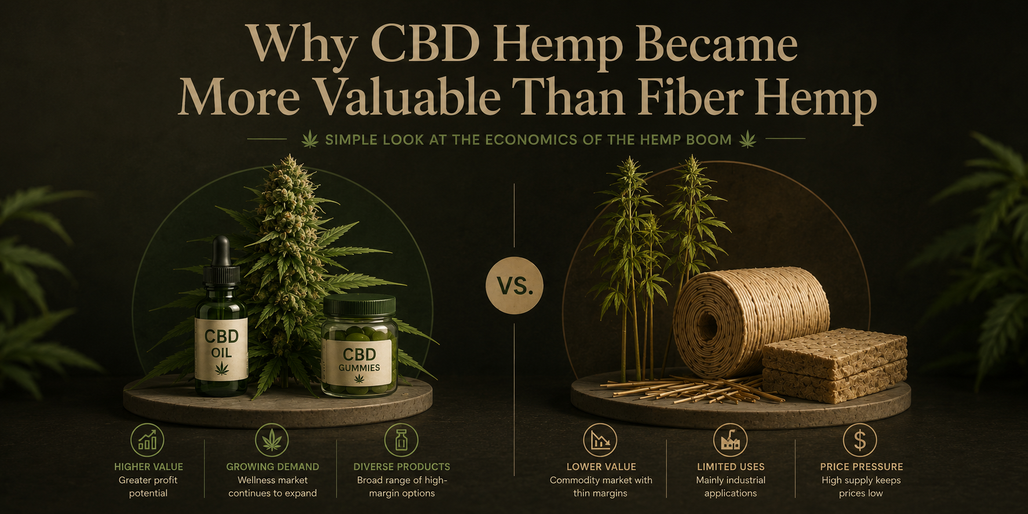
Why CBD Hemp Became More Valuable Than Fiber Hemp
Last updated: July 2026
Legal information reviewed: July 28, 2026
Why CBD Hemp Became More Valuable Than Fiber Hemp
CBD hemp became more valuable than fiber hemp because floral hemp entered a faster, higher-value consumer market after federal legalization. Fiber hemp has important industrial potential, but CBD flower could move into products shoppers recognized quickly, including loose flower, prerolls, extracts, oils, gummies, topicals, and other cannabinoid products.
That difference changed the economics of American hemp farming. A farmer growing hemp for CBD flower was producing the foundation for a consumer-facing product category. A farmer growing fiber hemp was producing stalks that still required harvesting, retting, baling, transportation, decortication, refinement, manufacturing partners, and buyers before the crop could become textiles, insulation, paper, biocomposites, or building materials.
This article explains why floral hemp created higher revenue opportunities than fiber hemp, why farmers moved quickly into cannabinoid hemp after the 2018 Farm Bill, why the early CBD market eventually corrected, and whether fiber hemp could catch up as laws, infrastructure, and market demand continue to change.
For the broader crop comparison, read the parent guide: CBD Hemp vs Fiber Hemp: How American Hemp Farms Choose What to Grow.
The 2018 Farm Bill Boom
The modern commercial hemp boom began with a legal change. The FDA’s 2019 testimony on hemp production and the 2018 Farm Bill explains that the law removed hemp, defined at that time as cannabis and cannabis derivatives containing no more than 0.3% Delta-9 THC on a dry-weight basis, from the Controlled Substances Act definition of marijuana.
USDA then developed the federal hemp-production framework. The USDA Agricultural Marketing Service hemp-production program explains that producers must be licensed or authorized under a state, tribal, or USDA hemp program before producing hemp.
Once commercial hemp production became federally authorized under this framework, farmers considered several possible markets: CBD flower, floral biomass for extraction, fiber, grain, seed, clones, and greenhouse production. Cannabinoid-focused hemp stood out because it connected farming to a visible consumer market almost immediately.
The USDA Economic Research Service review of state hemp pilot programs reported that U.S. hemp acreage expanded rapidly and explained that the industry’s long-term economic viability would depend on market development, economic returns, regulatory conditions, global competition, and market transparency.
That is the central point: legalization created opportunity, but the opportunity was not equal across every hemp category. CBD hemp had an understandable product story and a fast-growing retail market. Fiber hemp still needed a complete industrial supply chain.
Production Value per Harvested Acre
One way to understand why floral hemp attracted so much attention is to compare USDA-reported production value and harvested acreage by crop category.
According to the USDA National Hemp Report for the 2025 production year, total U.S. industrial hemp production value reached $739 million. Open-field floral hemp accounted for $574 million, compared with $13.5 million for fiber, $8.09 million for grain, and $49.7 million for seed hemp.
The acreage comparison is especially revealing. USDA reported 16,880 harvested acres of open-field floral hemp and 21,693 harvested acres of fiber hemp in 2025. Fiber hemp had more harvested acreage, but floral hemp generated far more reported production value.
| Hemp Category | 2025 Open-Field Value | 2025 Harvested Acres | Approx. Value per Harvested Acre |
|---|---|---|---|
| Floral hemp | $574 million | 16,880 acres | About $34,005 per acre |
| Fiber hemp | $13.5 million | 21,693 acres | About $622 per acre |
| Grain hemp | $8.09 million | 7,515 acres | About $1,077 per acre |
| Seed hemp | $49.7 million | 3,537 acres | About $14,051 per acre |
Source: USDA National Agricultural Statistics Service. Approximate per-acre values were calculated by dividing reported open-field production value by harvested acreage.
A farm’s actual profit depends on yield, crop quality, labor, contracts, drying costs, testing expenses, processing access, transportation, financing, crop loss, and market timing. Even with those limitations, the production-value gap helps explain why floral hemp became so attractive.
A crop connected to consumer-facing flower and cannabinoid products has a different revenue ceiling from bulk stalk material entering an underbuilt industrial supply chain.
Why Farmers Chose Floral Hemp
Farmers chose floral hemp because it offered a higher-value pathway while hemp was newly legal, consumer interest was rising, and the CBD market was expanding quickly. Floral hemp did not need to become a textile, building material, or composite before it had market value. It could move into retail categories much faster.
1. CBD Hemp Connected Directly to Consumer Demand
CBD flower, oils, gummies, prerolls, and extracts became recognizable to consumers much faster than hemp fiber inputs. A shopper may understand the difference between a bag of CBD flower, a jar of Delta-9 gummies, and a full-spectrum CBD product. That same shopper may never directly purchase raw bast fiber, hurd, or decorticated hemp stalk.
That difference matters economically. Consumer-facing products can carry value related to branding, packaging, convenience, formulation, testing, and quality differentiation. Raw fiber is generally treated more like an industrial input, so its value depends heavily on volume, processing, grading, transportation, and manufacturing demand.
2. Floral Hemp Could Be Differentiated by Quality
CBD hemp flower is not judged only by weight. Buyers may also consider strain, aroma, terpene profile, freshness, trim, cure, appearance, cannabinoid profile, and lab results. These qualities allow farms, processors, and retailers to distinguish one flower product from another.
Fiber hemp is differentiated differently. Industrial buyers may care about stalk yield, fiber length, retting consistency, moisture, cleanliness, bale quality, hurd characteristics, and whether the material fits a particular manufacturing process. Those qualities matter, but they are less visible to an average retail shopper.
3. CBD Hemp Had More Immediate Retail Paths
A floral-hemp crop may become loose flower, prerolls, extracts, oils, gummies, topicals, or other cannabinoid products. Each format creates opportunities for additional processing, packaging, branding, and retail differentiation.
Fiber hemp usually follows a longer industrial path. It may need to be cut, dried, retted, baled, transported, decorticated, cleaned, refined, graded, and sold into another manufacturing chain. That process may eventually produce textiles, paper, hempcrete, insulation, composites, packaging, or animal bedding, but the farmer does not normally capture all of the downstream value.
4. Fiber Hemp Needed Infrastructure That Did Not Exist Everywhere
The USDA ERS economic-viability report describes the financial risk of growing a specialty crop without an established market or contracted buyer. That problem is central to fiber-hemp economics. A farmer can grow usable stalks, but the crop still needs accessible processors and buyers.
For a closer comparison of how the crops are planted, managed, harvested, and stored, read How Hemp Is Grown in America: Flower, Fiber, Grain, and Seed.
Labor Costs and Risks
CBD hemp became more valuable than fiber hemp, but it also carried higher costs and different risks. A high-value crop is not automatically a high-profit crop.
CBD Hemp Is Labor-Heavy
CBD hemp farming often requires more hands-on management than fiber production. Farmers may need to manage plant spacing, unwanted pollen, pest pressure, mold risk, cannabinoid development, harvest timing, THC-compliance risk, drying space, curing conditions, trimming, storage, packaging, and batch testing.
Rutgers Cooperative Extension’s hemp-production guidance notes that harvesting for CBD production can be highly labor-intensive and that harvest timing is critical.
The revenue opportunity therefore comes with real costs. Premium CBD flower may require more labor per acre, closer monitoring, more controlled post-harvest handling, and more quality-control steps than a fiber crop.
CBD Hemp Carries Compliance Risk
Because CBD hemp is grown for cannabinoid-rich flowers, farmers must manage the risk that the crop will exceed applicable THC limits. A noncompliant test result can reduce or eliminate the crop’s intended market value. Genetics, sampling, testing, documentation, and harvest timing are therefore central to the farm plan.
For consumers, lab transparency helps connect the finished product to that quality-control system. Green Nursery customers can review available testing through the COA and lab reports page. For a complete explanation of the report itself, read How to Read a CBD Flower Lab Report.
Fiber Hemp Is Infrastructure-Heavy
Fiber hemp usually requires less individual plant handling than premium CBD flower, but it depends more heavily on machinery, acreage, transportation, processing capacity, and contracts. The main challenge is not simply growing stalks. It is turning those stalks into consistent industrial material.
Rutgers Cooperative Extension’s fiber-hemp production guidance explains that hemp stalks contain outer bast fiber and inner hurd and that retting helps prepare those materials for separation. If a region lacks nearby decortication or processing capacity, a farmer may have few practical options after harvest.
The Risk Is Different for Each Crop
CBD hemp risk is often tied to flower quality, testing, THC compliance, market prices, drying, curing, storage, and buyer reliability. Fiber-hemp risk is more closely tied to processing access, transportation distance, contracts, grading standards, and whether manufacturers are ready to purchase hemp-based inputs.
That is why CBD hemp and fiber hemp should not be compared only by price. They are different production systems and different business models.
Why CBD Markets Eventually Corrected
The early CBD hemp boom attracted farmers, processors, investors, and retailers quickly. That speed created opportunities, but it also contributed to oversupply, weak contracts, inconsistent quality, and pricing pressure.
The USDA ERS review warned that hemp’s long-term viability would depend on continued market development, competition, transparency, risk management, and regulatory conditions. Those concerns became more visible as additional acreage entered production and farmers learned that growing hemp was only one part of the business.
Oversupply Lowered Prices
When many farms enter the same emerging market at once, supply can grow faster than demand. That happened in parts of the CBD hemp industry. More growers entered, more flower and biomass became available, and buyers became more selective.
University and extension specialists also warned growers that hemp markets could be volatile and contract-dependent. The University of Georgia Cooperative Extension hemp resource advises prospective growers to perform due diligence when working with processors and vendors.
Not Every Crop Had a Buyer
Some farmers planted hemp before securing a dependable buyer. That is risky for any specialty crop, but it is especially risky when quality, compliance, drying, storage, and processing requirements vary among potential buyers.
A farmer with flower or biomass sitting in storage may have less leverage than expected when the market is oversupplied. Product quality can also decline while the farmer waits for a sale.
Processing Became a Bottleneck
CBD hemp needs processing infrastructure too. Premium flower must be dried, cured, trimmed, tested, packaged, and stored. Floral biomass intended for extraction may need drying, milling, extraction, filtration, refinement, formulation, and additional testing.
If processing capacity is limited, expensive, or unreliable, farmers may struggle to capture the value they expected. For the full post-harvest supply chain, read How Hemp Processing Works: From Farm to Finished Product.
Retail Demand Did Not Eliminate Regulatory Confusion
The 2018 Farm Bill did not make every CBD product automatically lawful in every context. The FDA has stated that hemp products must continue to meet applicable requirements under the laws it administers. Its 2019 hemp testimony specifically addressed the mistaken belief that every hemp or CBD product became legal to sell in interstate commerce after the Farm Bill.
That uncertainty shaped the market. CBD had consumer demand, but farmers, processors, and retailers still had to navigate testing, manufacturing, labeling, product claims, FDA requirements, and changing state laws.
Could Fiber Catch Up?
Fiber hemp could become more valuable over time, but meaningful growth depends on building the infrastructure around it. The crop has potential in textiles, construction materials, composites, insulation, paper, packaging, and animal bedding. The problem is that potential is not the same thing as a functioning market.
Fiber Needs Processors Near Farms
Fiber hemp is bulky and can be expensive to move long distances. Farmers need local or regional facilities capable of receiving stalks and performing decortication, cleaning, fiber refinement, or other required processing. Without that infrastructure, fiber hemp may remain a promising crop with limited farm-level value.
Fiber Needs Buyers Before Planting
For fiber hemp to compete more effectively, farmers need dependable buyers and clear specifications before planting. Textile mills, building-material manufacturers, packaging companies, composite producers, and animal-bedding businesses all have roles in the supply chain.
The absence of a buyer can be especially costly because the crop cannot simply enter a mature commodity market in every region. For a complete examination of this bottleneck, read Why Fiber Hemp Has Struggled to Scale in the United States.
Fiber Needs Standards and Product Development
Industrial buyers need consistent inputs. Fiber hemp therefore needs measurable grading standards, reliable moisture targets, predictable bale quality, processing specifications, and manufacturing partners who understand how to work with bast fiber and hurd.
Standards reduce uncertainty by helping farmers, processors, and manufacturers agree on what constitutes usable material. Product development is also necessary because a potential use does not create a market until a finished product can compete on quality, availability, performance, and price.
Scheduled Law Changes Could Shift Interest Toward Fiber
The federal hemp definitions are scheduled to change on November 12, 2026. The Agricultural Marketing Act text compiled by GovInfo, as amended through Public Law 119-37, includes a total-tetrahydrocannabinols standard that incorporates THCA and creates additional exclusions involving certain intermediate and final hemp-derived cannabinoid products.
Because these provisions more directly affect cannabinoid-focused hemp, they may cause some farms to reconsider CBD, THCA, Delta-9, or other cannabinoid-production models. Unless the law is amended before its effective date, genetics, testing strategies, contracts, product formats, and market opportunities may need to change.
That does not automatically create a fiber boom. Legal pressure can make farmers look at alternatives, but it cannot instantly create decorticators, manufacturers, contracts, transportation networks, or industrial demand.
For the prediction angle, read Could New Hemp Laws Trigger a Fiber Hemp Boom?. For the direct farm implications, see How the November Hemp Law Changes Could Affect Hemp Farmers.
Why CBD Hemp Became the Higher-Value Crop
CBD hemp became more valuable because it solved a market problem faster. Consumers recognized flower, oils, gummies, prerolls, and cannabinoid products. Retailers could package and explain them. Brands could distinguish products through format, quality, testing, and presentation. Farmers could connect their crop to a visible consumer market.
Fiber hemp had to solve a more complicated infrastructure problem. The crop needed processors, transportation, decortication, fiber refinement, manufacturing partners, industrial buyers, product standards, and dependable contracts. Without those systems, planting more acreage did not automatically produce more value.
This helps explain why floral hemp can dominate reported production value even when fiber hemp has more harvested acreage. The value is not only in the plant. It is also in the market system built around the plant.
Practical Takeaways
- CBD hemp became more valuable because it connected quickly to recognizable consumer products.
- Fiber hemp has many industrial applications, but it depends heavily on processors, transportation, contracts, manufacturers, and buyers.
- USDA’s 2025 data shows that open-field floral hemp generated far more production value than fiber hemp despite having fewer harvested acres.
- USDA production value is not the same as farm profit, and the floral-hemp category is broader than CBD flower alone.
- CBD hemp can offer higher revenue potential while carrying substantial labor, quality, testing, drying, compliance, and market risks.
- The early CBD market corrected as rapid expansion contributed to oversupply, price pressure, processing bottlenecks, and contract problems.
- Fiber hemp could grow if regional processing infrastructure and industrial demand improve.
- Scheduled federal law changes may push additional attention toward fiber, grain, seed, and other non-cannabinoid hemp markets.
Frequently Asked Questions
Why did CBD hemp become more valuable than fiber hemp?
CBD hemp connected directly to consumer-facing flower, prerolls, extracts, oils, gummies, and other cannabinoid products. Those products allowed more differentiation through quality, testing, formulation, branding, and packaging. Fiber hemp is generally sold as an industrial input that requires additional processing and manufacturing.
Is CBD hemp always more profitable than fiber hemp?
No. CBD hemp may have higher revenue potential, but it also carries substantial labor, drying, trimming, testing, compliance, storage, crop-loss, and market risks. Profit depends on crop quality, production costs, buyer contracts, market timing, and whether the crop meets the required specifications.
Does USDA report CBD hemp separately from all floral hemp?
The USDA National Hemp Report uses a broad floral-hemp category in its headline production figures. That category should not be interpreted as a CBD-only total. It may include hemp grown for multiple floral and cannabinoid uses.
Why is fiber hemp worth less at the farm level?
Raw hemp stalks generally must be processed before they become usable industrial material. Farmers may not capture the value added by decortication, fiber refinement, textile production, construction-product manufacturing, or retail sale. Transportation and processing expenses can also reduce farm-level returns.
Did the 2018 Farm Bill cause the CBD hemp boom?
The 2018 Farm Bill helped create the conditions for the boom by federally authorizing commercial hemp production under a new framework and removing qualifying hemp from the Controlled Substances Act definition of marijuana. However, it did not eliminate FDA requirements, state restrictions, or every legal question surrounding finished CBD products.
Why did the CBD hemp market correct?
The market corrected as many growers entered quickly, supplies increased, some farmers lacked dependable contracts, processing became a bottleneck, and prices fell from early expectations. Inconsistent quality and continuing regulatory uncertainty also made the market more difficult to predict.
Could fiber hemp become more valuable in the future?
Yes, but fiber hemp needs infrastructure. Regional processors, decortication capacity, fiber refinement, grading standards, product development, industrial buyers, contracts, and manufacturing demand would make fiber production more practical for farmers.
Could new hemp laws make fiber hemp more attractive?
Possibly. If cannabinoid-focused farming becomes more restricted or less profitable, some farmers may consider fiber, grain, seed, or other industrial markets. However, a shift toward fiber will work only where processing infrastructure and dependable buyers exist.
What should consumers look for when buying CBD hemp products?
Consumers should look for clear product descriptions, current batch information, accessible COAs, transparent cannabinoid results, reasonable claims, customer feedback, and a clear shipping policy. Green Nursery shoppers can compare available CBD flower, review COAs and lab reports, read customer reviews, and check current shipping information and restrictions before ordering.
Popular Products
Check out these customer favorites.