
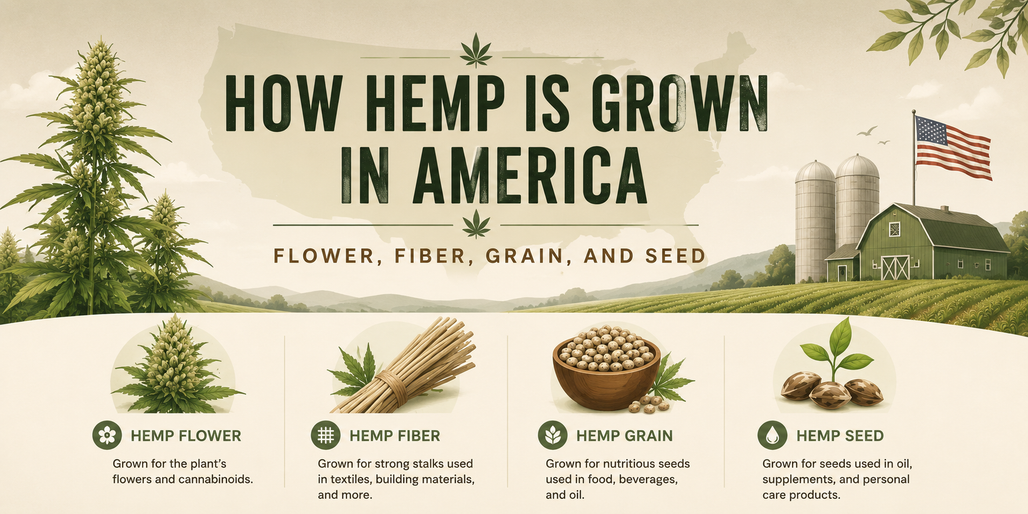
How Hemp Is Grown in America: Flower, Fiber, Grain, and Seed
Last updated: July 2026
Legal information reviewed: July 28, 2026
How Hemp Is Grown in America: Flower, Fiber, Grain, and Seed
Hemp is often described as one crop, but hemp farming in America is really a group of different production systems. A farm growing premium CBD flower does not use the same plan as a farm growing stalks for fiber, hempseed for grain, or certified seed for future planting.
The difference begins before a seed goes into the ground. Farmers choose genetics, planting density, field spacing, equipment, labor plans, harvest timing, drying methods, testing protocols, and buyers according to the crop’s intended use. That is why understanding how hemp is grown starts with a simple question: what is the hemp being grown for?
This guide explains the main types of hemp farming in the United States, including hemp grown for CBD flower, fiber, grain, and seed production. It also compares harvesting methods, labor demands, production value, and future trends shaping American hemp farms.
For the broader question of why farmers choose one hemp market over another, read the parent guide: CBD Hemp vs Fiber Hemp: How American Hemp Farms Choose What to Grow.
What Is Hemp Farming?
Hemp farming is the cultivation of Cannabis sativa L. plants under applicable federal, state, or tribal hemp-production rules. The USDA Agricultural Marketing Service hemp program explains that producers must be licensed or authorized under a state, tribal, or USDA hemp program before producing hemp.
For farmers, the word “hemp” is not specific enough by itself. Hemp can be grown for several different end uses:
- CBD flower: Hemp grown for cannabinoid-rich buds and floral biomass.
- Fiber: Hemp grown for stalks that can be processed into bast fiber and hurd.
- Grain: Hemp grown for seed used in food, oil, and ingredient markets where permitted.
- Seed production: Hemp grown to produce viable planting seed for future crops.
- Dual-purpose production: Hemp grown for more than one crop component, such as grain and fiber.
The USDA Farmers.gov hemp guide separates reported hemp acreage by intended use, including cannabidiol, fiber, grain, and seed. That distinction matters because intended use changes nearly every part of the farm plan.
Consumers interested in how floral hemp becomes a finished retail product can begin with What Are CBD Buds? That master guide explains the flower itself, while this article focuses on the farming systems behind it.
Hemp Grown for CBD Flower
Hemp grown for CBD flower is usually the most detail-sensitive form of hemp farming. The goal is not simply to produce a large amount of plant material. The goal is to grow high-quality flowers with desirable cannabinoid content, aroma, terpene character, appearance, freshness, and legal compliance.
CBD flower farms often use genetics selected for high CBD potential, appealing terpene profiles, dense flower formation, and lower THC-compliance risk. Plants are generally spaced farther apart than fiber hemp because each plant needs room to develop branches and flower sites. Depending on the farm, CBD hemp may be grown outdoors, in greenhouses, or in controlled indoor environments.
How CBD Flower Farms Are Managed
A CBD flower farm often requires close monitoring throughout the season. Farmers watch for pests, disease, mold pressure, nutrient problems, drought stress, pollen drift, and cannabinoid development. Because flower is sold partly on quality, production problems that would be less important in a commodity crop can reduce the value of floral hemp.
Pollination is one of the biggest concerns. When female CBD hemp plants are pollinated, they produce seeds. Seeded flower is generally less desirable in the smokable-flower market, where shoppers commonly expect clean, carefully cured buds. Oregon State University Extension’s hemp pollination guide explains why pollen control, field separation, plant sex, and regular scouting matter in cannabinoid-focused hemp production.
Genetics are only one part of the quality equation. Soil conditions, pest management, harvest timing, drying, storage, documentation, and testing all affect the finished crop. For a closer look at those standards, read What Makes a High-Quality Hemp Farm?
How CBD Flower Is Harvested
CBD flower is usually harvested when cannabinoid and terpene development reach the farm’s target range and before the crop exceeds applicable THC limits. Rutgers Cooperative Extension’s hemp-production guidance notes that CBD harvest can be highly labor-intensive and that harvest timing is critical.
After harvest, CBD flower must be dried and cured carefully. Drying too slowly can increase mold risk, while overly aggressive drying can damage aroma, texture, and overall flower quality. Flowers may then be trimmed, sorted, tested, packaged, and stored under controlled conditions.
For shoppers, this farm category is most directly connected to finished products such as CBD hemp flower and hemp flower prerolls. Product descriptions should be supported by transparent testing and batch information. Green Nursery publishes available results through its COA and lab reports page.
Hemp Grown for Fiber
Fiber hemp is grown for the stalk rather than the flower. The main goal is to produce usable plant material that can be separated into outer bast fiber and inner woody hurd. These materials can be used in textiles, rope, paper, insulation, animal bedding, hempcrete, biocomposites, packaging, and other industrial applications.
Fiber hemp is normally planted much more densely than CBD flower hemp. Dense planting encourages tall, relatively straight stalk growth and limits excessive branching. The crop is managed more like a field-scale industrial crop than a boutique flower crop.
What Makes Fiber Hemp Different?
The largest difference is that fiber hemp must connect to processing infrastructure. A farmer can grow an excellent field of hemp stalks, but the crop has limited commercial value if there is no nearby processor, decorticator, buyer, or manufacturer capable of turning the raw stalk into usable fiber or hurd.
Rutgers Cooperative Extension’s hemp fiber production guide explains that the stalk contains outer bast fibers and inner hurd fibers. Bast is the long outer fiber, while hurd comes from the woody core.
How Fiber Hemp Is Harvested
Depending on the production system and buyer requirements, fiber hemp may be cut, field-dried, retted, and baled. Retting helps break down the bonds between the bast fiber and hurd so the stalk can be separated more effectively. Moisture must be managed before baling to reduce spoilage and preserve usable fiber.
After retting and drying, hemp stalks may be baled and transported for processing. Decortication separates the stalk into bast fiber and hurd. The material may then require additional cleaning, refinement, grading, or manufacturing before it becomes a finished product.
For the full post-harvest chain, read How Hemp Processing Works: From Farm to Finished Product. For a direct comparison of the two farm models, see Hemp Flower vs Fiber Hemp: Why They Require Completely Different Farms.
Hemp Grown for Grain
Grain hemp is grown for hempseed. The seed can be used for hemp hearts, hempseed oil, protein powder, food ingredients, and other seed-based products where permitted. Unlike CBD flower, grain hemp is not primarily judged by bud appearance, terpene aroma, or smokable quality. It is judged by seed yield, cleanliness, moisture, handling, and buyer specifications.
Grain hemp is generally planted at field scale and may use more conventional agricultural equipment than CBD flower production. University of Wisconsin–Madison Extension’s hemp-production overview explains that grain and fiber hemp are commonly grown at larger scale with equipment such as grain drills, combines, mowers, and balers.
How Grain Hemp Is Harvested
Grain hemp is typically harvested with a combine. However, the plant’s tough fibers can wrap around moving parts and create equipment challenges if the crop and machinery are not managed correctly. Harvest timing also matters because seed quality can decline when grain is too wet, overly mature, or poorly handled.
Nebraska Extension’s hemp fiber and grain guidance explains that fiber and grain production can be highly mechanized, with per-acre labor demands closer to other agronomic crops than cannabinoid hemp. Even so, grain hemp still requires careful harvest, drying, cleaning, storage, and transportation.
In practical terms, grain production is often less hand-labor intensive than premium CBD flower production. However, a grain crop can lose value quickly if it is not dried, cleaned, stored, and transported according to buyer requirements.
Hemp Grown for Seed Production
Seed-production hemp is grown to produce viable planting seed. It is different from hemp grain intended for food, oil, or other ingredient markets, and it is different from flower grown for cannabinoids.
Seed production is more technical than it may appear. Farmers and breeders must consider genetic stability, male and female plant management, pollination control, isolation distance, germination rate, seed purity, disease pressure, and whether the seed will reliably produce plants suited to the intended market.
Why Seed Hemp Matters
Seed quality affects everything downstream. A CBD flower farmer needs genetics capable of producing desirable flower while remaining within applicable THC limits. A fiber farmer needs genetics that produce tall, uniform stalks. A grain farmer needs genetics that support seed yield, harvestability, and food or oilseed quality.
The USDA Farmers.gov hemp guide identifies seed hemp as propagation stock and hybrids rather than seed intended for human consumption. The distinction matters because seed-production hemp supports the next crop rather than serving as the finished retail product.
Weak or unreliable seed stock can contribute to uneven fields, poor germination, unwanted male plants in floral-hemp fields, inconsistent cannabinoid profiles, unsuitable stalk structure, and increased compliance risk. That is why seed production is a specialized part of the hemp industry.
Harvesting Methods Compared
Harvest is one of the clearest ways to see how different hemp-farming systems really are. The same plant species can require completely different equipment, labor, timing, and post-harvest handling depending on whether the farm is producing flower, fiber, grain, or planting seed.
| Hemp Type | Main Harvest Goal | Common Harvest Method | Post-Harvest Priority |
|---|---|---|---|
| CBD flower hemp | Preserve cannabinoid-rich flowers | Hand-cut or carefully mechanically harvested | Drying, curing, trimming, testing, and mold prevention |
| Fiber hemp | Collect stalk biomass | Cutting, field drying, retting, and baling | Moisture control, retting quality, and processing access |
| Grain hemp | Collect mature hempseed | Combine harvest | Drying, cleaning, storage, and spoilage prevention |
| Seed-production hemp | Produce viable planting seed | Careful seed harvest and cleaning | Purity, germination, storage, and genetic consistency |
CBD flower harvest is often the most sensitive because flowers must be protected from mold, rough handling, overheating, poor drying, and compliance problems. Fiber harvest focuses on stalk condition, moisture, retting, volume, and processing logistics. Grain and planting-seed harvests both emphasize seed quality, but planting seed also requires close attention to purity, germination, and genetics.
Which Type Requires the Most Labor?
Premium CBD flower usually requires the most hands-on labor per acre. That does not mean fiber, grain, or seed hemp is easy to grow. It means floral hemp generally requires more individual plant attention because the market value of the crop depends heavily on flower quality.
Why CBD Flower Is Labor-Intensive
- Plants may require more spacing, scouting, and individual attention.
- Farmers must monitor cannabinoid development and THC-compliance risk.
- Unwanted pollination can reduce smokable-flower quality.
- Harvest may involve hand cutting or other careful handling.
- Drying, curing, trimming, sorting, testing, and packaging require attention to detail.
- Mold, poor curing, harsh handling, or improper storage can reduce flower value.
Fiber and grain hemp may require fewer hand-labor hours per acre, but they depend on equipment, acreage, transportation, buyers, and post-harvest infrastructure. A fiber farmer may not hand-trim plants, but the operation still needs cutting equipment, suitable drying conditions, retting knowledge, baling, transportation, and a processor. A grain farmer may use a combine, but the harvested seed still needs prompt drying and proper storage.
A useful way to understand the difference is that premium CBD flower is often labor-heavy, while fiber and grain production are more equipment- and infrastructure-heavy.
Which Type Is Most Profitable?
There is no universal answer. Profitability depends on yield, sale price, labor, equipment, contracts, processing access, compliance risk, crop quality, transportation, and buyer demand. Production value is also not the same thing as profit.
According to the USDA National Hemp Report for the 2025 production year, total U.S. industrial hemp production value reached $739 million. Open-field floral hemp accounted for $574 million, compared with $13.5 million for fiber, $8.09 million for grain, and $49.7 million for seed hemp.
The figures help explain why cannabinoid-focused hemp attracted so much attention. Floral hemp can move into consumer-facing categories such as loose flower, prerolls, extracts, oils, and formulated cannabinoid products. Fiber and grain can also be valuable, but their success often depends more heavily on scale, equipment, contracts, transportation, and regional processing.
Profitability Depends on the Whole Supply Chain
A farm can grow a healthy crop and still struggle if it does not have a dependable buyer. This is especially important for fiber hemp. Raw stalks generally must be processed before they become textiles, hempcrete, bedding, paper, composites, or other useful materials. If the nearest processor is too far away, transportation costs can sharply reduce the crop’s farm-level value.
CBD flower faces a different risk profile. A floral-hemp crop may have higher revenue potential, but it can also require more labor, testing, drying space, trimming, storage, compliance management, and quality control. Mold, unwanted seeds, poor curing, unreliable buyers, or a noncompliant cannabinoid result can quickly reduce the crop’s value.
For a fuller explanation of the market-value gap, read Why CBD Hemp Became More Valuable Than Fiber Hemp.
Future Trends in Hemp Production
The future of hemp production in America will likely be shaped by three connected forces: regulation, infrastructure, and market demand.
1. More Attention to Testing and Compliance
Hemp farmers and businesses must monitor THC-testing requirements, product rules, and changing federal and state laws. USDA’s Domestic Hemp Production Program includes requirements involving licenses or authorizations, land records, sampling, testing, reporting, and the handling of noncompliant crops.
Testing also helps consumers compare finished hemp products. Green Nursery shoppers can review available results through the COA and lab reports page. For help interpreting those documents, read How to Read a CBD Flower Lab Report.
2. Federal Hemp Definitions Are Scheduled to Change
As of this article’s legal review date, the current federal hemp definition remains based on a Delta-9 THC concentration of no more than 0.3% on a dry-weight basis. However, the Agricultural Marketing Act text compiled by GovInfo, as amended through Public Law 119-37, includes revised hemp definitions scheduled to take effect on November 12, 2026.
The scheduled language uses total tetrahydrocannabinols, including THCA, in the plant-level definition and creates additional exclusions involving certain intermediate and final hemp-derived cannabinoid products. Unless Congress changes the law before the effective date, these provisions could materially affect cannabinoid-focused hemp markets.
CBD flower, THCA flower, and other cannabinoid categories are closely connected to THC definitions and testing standards, so farms, processors, and retailers may need to adjust genetics, testing plans, contracts, product formats, or market strategies. The FDA’s cannabis and CBD regulatory overview also explains that cannabis-derived consumer products can raise regulatory questions beyond farm production.
For the farm-level implications, read How the November Hemp Law Changes Could Affect Hemp Farmers. For broader testing and product-rule context, see Understanding THC Limits in Hemp Products.
3. Growth Potential for Fiber and Industrial Hemp
Fiber hemp has potential in textiles, building materials, packaging, paper, composites, insulation, and animal bedding. The USDA Agricultural Research Service’s overview of modern hemp applications discusses established uses such as fiber, grain, and phytochemicals as well as developing applications involving building materials, biofuel, carbon sequestration, and nanotechnology.
However, long-term potential does not guarantee an immediate market for farmers. Commercial growth depends on nearby decortication, fiber refinement, grading standards, manufacturers, buyers, and dependable contracts.
In other words, fiber hemp does not need hype as much as it needs infrastructure. For a detailed examination of that bottleneck, read Why Fiber Hemp Has Struggled to Scale in the United States.
4. More Specialized Hemp Farms
As the industry matures, hemp farms may become more specialized. Some operations may focus on premium flower, while others grow grain at scale, produce seed genetics, or supply fiber under contract to processors and manufacturers.
The farms best positioned to manage risk will likely be those that understand their intended market before planting and have realistic plans for testing, harvest, storage, processing, transportation, and sale.
Practical Takeaways
- Hemp grown for CBD flower, fiber, grain, and planting seed requires different genetics, planting methods, equipment, and buyers.
- CBD flower is generally the most labor-intensive because flower quality, testing, drying, curing, and careful handling all affect value.
- Fiber hemp is grown for stalks and depends heavily on retting, baling, transportation, decortication, and regional processing.
- Grain hemp is grown for hempseed and requires careful harvesting, drying, cleaning, and storage.
- Seed-production hemp is specialized because future crops depend on seed purity, germination, and reliable genetics.
- USDA production value should not be confused with farm profit.
- A farmer should identify buyers, contracts, equipment needs, processing access, and regulatory requirements before choosing what type of hemp to grow.
Frequently Asked Questions
How is hemp grown in America?
Hemp is grown in America under licensed or authorized hemp-production programs. Farmers select genetics and production methods according to the intended use, such as CBD flower, fiber, grain, or planting seed. Each use requires different spacing, equipment, labor, harvest timing, processing, testing, and buyers.
Is CBD hemp grown differently from fiber hemp?
Yes. CBD hemp is grown for cannabinoid-rich flowers, so farmers focus on flower development, terpene quality, harvest timing, drying, curing, and THC compliance. Fiber hemp is grown for stalks, so farmers focus on planting density, stalk growth, retting, baling, transportation, and processing access.
What part of the hemp plant is used for CBD flower?
CBD flower comes from the buds of female hemp plants. These flowers are harvested, dried, cured, trimmed, tested, and packaged as loose flower, used in prerolls, or processed into cannabinoid ingredients.
What part of the hemp plant is used for fiber?
Fiber hemp uses the stalk. The outer portion contains bast fiber, while the inner woody core is called hurd. These materials can be processed for textiles, rope, paper, insulation, hempcrete, animal bedding, and other industrial uses.
What is hemp grain used for?
Hemp grain is hempseed harvested for food, oil, protein ingredients, or other seed-based uses where permitted. It must be harvested, dried, cleaned, and stored carefully to prevent spoilage and quality loss.
Is hemp seed production the same as growing hemp grain?
No. Grain hemp is generally grown for food, oilseed, or ingredient markets. Seed-production hemp is grown to create viable propagation stock for future crops, which requires additional attention to pollination, genetic purity, germination, and seed certification or buyer standards.
Which hemp crop requires the most labor?
Premium CBD flower usually requires the most hands-on labor because the quality of individual plants and flowers matters. Farmers may need to manage plant sex, pollen, pests, mold risk, cannabinoid development, harvest timing, drying, curing, trimming, testing, and storage.
Which type of hemp is most profitable?
No hemp category is automatically the most profitable for every farm. Floral hemp has recently represented the highest-value category in USDA reporting, but it can also carry high labor, testing, drying, compliance, and crop-loss costs. Fiber and grain may require less hand labor while depending more heavily on acreage, equipment, contracts, transportation, and processing infrastructure.
What should consumers look for when buying hemp flower?
Consumers should look for clear product descriptions, current batch information, accessible COAs, transparent cannabinoid results, freshness indicators, reasonable product claims, customer feedback, and a clear shipping policy. Green Nursery shoppers can compare available CBD hemp flower, review COAs and lab reports, read customer reviews, and check current shipping information and restrictions before ordering.
Popular Products
Check out these customer favorites.