
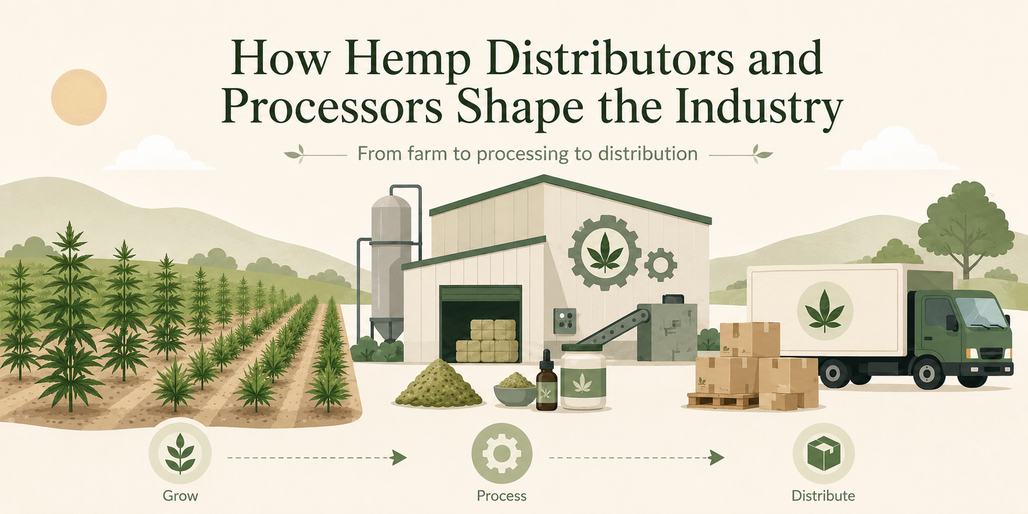
How Hemp Distributors and Processors Shape the Industry
Last updated:
How Hemp Distributors and Processors Shape the Industry
Most people think of hemp as something that starts on a farm and ends as a finished product. That description skips the critical middle of the supply chain: processors, manufacturers, laboratories, storage providers, transporters, wholesalers, and distributors.
A farmer can grow an excellent crop, but the crop still needs somewhere to go. Flower may require drying, curing, trimming, testing, packaging, and storage. Extraction biomass must reach a qualified processor. Fiber hemp needs retting, baling, decortication, refinement, and industrial buyers. Grain and planting seed need their own cleaning, drying, storage, and handling systems.
This article is a supporting spoke beneath our parent hub, CBD Hemp vs Fiber Hemp: How American Hemp Farms Choose What to Grow. It explains how the middle of the supply chain determines which hemp crops farmers can realistically grow and which products eventually reach customers.
Hemp Processor vs Distributor: What Is the Difference?
Processors and distributors are related, but they do not perform the same role.
| Business Type | Primary Role | Example |
|---|---|---|
| Processor | Changes harvested hemp into a more usable physical or chemical form | Drying flower, extracting cannabinoids, cleaning grain, or decorticating stalks |
| Manufacturer | Combines ingredients or materials into a finished product | Producing a packaged oil, textile, insulation batt, or hempcrete material |
| Laboratory | Tests submitted samples and reports the results | Potency, pesticide, microbial, heavy-metal, or residual-solvent testing |
| Distributor or wholesaler | Connects suppliers and buyers and may take title to, warehouse, market, or deliver products | Moving packaged products from manufacturers to retailers |
| Broker | Introduces buyers and sellers without necessarily taking possession of the material | Connecting a fiber grower with a decorticator or manufacturer |
| Fulfillment or logistics provider | Stores, packs, documents, and ships products | Preparing retail orders for carrier pickup |
One company may perform several of these functions. A vertically integrated business might grow hemp, process it, manufacture a finished product, distribute it, and sell it directly. Other supply chains use a separate business at every stage.
Licensing, registration, manufacturing, food, transportation, and testing requirements vary by activity and jurisdiction. Calling a company a “distributor” does not automatically authorize it to process, manufacture, relabel, or test hemp products.
Different Hemp Crops Need Different Processors
There is no single type of hemp processor. The correct processing system depends on what the crop was grown to produce.
| Crop | Initial Processing | Possible Next Buyer |
|---|---|---|
| Smokable flower | Drying, curing, trimming, sorting, testing, and packaging | Wholesaler, preroll manufacturer, retailer, or brand |
| Extraction biomass | Drying, milling, extraction, filtration, and refinement | Formulator, manufacturer, or ingredient buyer |
| Fiber stalks | Drying, retting, baling, decortication, and cleaning | Textile, construction, paper, bedding, or composite manufacturer |
| Grain | Combining, drying, cleaning, dehulling, pressing, or milling | Food, oil, feed, or ingredient manufacturer where permitted |
| Planting seed | Harvesting, cleaning, grading, germination testing, and storage | Seed dealer, nursery, or licensed grower |
Flower Processors
Flower processors handle cannabinoid-rich buds intended for smokable products, prerolls, or further manufacturing. Their work may include:
- Receiving and identifying harvested lots.
- Drying and curing.
- Bucking flower from stems.
- Trimming and sorting.
- Separating quality grades.
- Coordinating finished-product testing.
- Packaging and batch identification.
- Protected storage.
Premium smokable flower and extraction biomass should not be treated as the same material. Smokable flower is judged partly by appearance, aroma, structure, trim, cure, and freshness. Extraction biomass is usually evaluated according to moisture, cannabinoid yield, contamination, storage condition, and processor specifications.
Extraction Processors
Extraction processors separate cannabinoids and other compounds from hemp biomass. Depending on the facility and intended ingredient, processing may include drying, milling, extraction, filtration, solvent removal, refinement, distillation, isolation, blending, and testing.
Processors influence farm markets by specifying acceptable cannabinoid profiles, moisture levels, contamination limits, documentation, delivery formats, and prices. If extraction demand changes, farms may quickly lose or gain a market for particular biomass.
The FDA’s cannabis and cannabis-derived product overview explains that FDA retains authority over covered products containing cannabis or cannabis-derived compounds. Extraction and formulation are therefore regulatory as well as technical activities.
Fiber Processors
Fiber processors handle stalks and prepare two main material streams: long outer bast fiber and the shorter, woody inner core known as hurd or shive.
Rutgers Cooperative Extension’s fiber hemp guide explains that the bast and hurd portions have different properties and uses. Bast fiber may move toward textiles, cordage, paper, insulation, or composites. Hurd may be used in bedding, hempcrete, absorbent products, fiberboard, or other industrial materials.
Grain and Seed Processors
Grain and planting seed require separate systems. Grain may be dried, cleaned, dehulled, pressed for oil, or milled into ingredients where permitted. Planting seed must protect germination, purity, identity, and storage quality.
A grain handler is not automatically equipped to manage certified or variety-specific planting seed. Seed intended for future crops may require additional sampling, documentation, germination testing, and labeling.
How Hemp Distribution Networks Work
Distribution moves materials or products from one supply-chain stage to another. A distributor may connect farms with processors, processors with manufacturers, or manufacturers with retailers.
Depending on the business model, distributors may manage:
- Supplier and buyer relationships.
- Wholesale pricing.
- Purchase orders and invoices.
- Warehousing and inventory rotation.
- Transportation and delivery scheduling.
- Batch and lot documentation.
- Connections between products and COAs.
- Retail placement.
- Returns and recalls.
- Jurisdiction or carrier restrictions.
Distributors Influence What Reaches the Market
Customers usually see only the final product. They do not see the distributor deciding which manufacturers receive placement, which products retailers can order, or which farms and processors gain access to larger buyers.
A strong distributor may help a smaller farm or manufacturer reach markets it could not serve independently. However, concentrating access through a small number of distributors may also give those businesses significant influence over pricing, specifications, and product availability.
Distribution Does Not Replace Quality Control
Moving a product does not prove that it is accurately labeled, properly tested, or legally permitted. Distributors should maintain clear records and appropriate storage practices, but independent laboratories, manufacturers, retailers, and regulators each have separate responsibilities.
Why Decortication Facilities Matter
Decortication is the mechanical separation of hemp stalks into bast fiber and woody hurd. It is one of the most important steps in the fiber hemp supply chain.
Before decortication, the farm has bulky stalks or bales. After decortication and cleaning, the processor has material streams that can be evaluated for specific industrial uses.
Retting Comes Before Effective Separation
Fiber hemp commonly undergoes retting before further processing. Retting uses moisture and microorganisms to weaken the bonds that hold bast and hurd together.
Rutgers recommends reducing stalk moisture below 15% before baling and protecting dry bales from moisture during storage. Weather, retting consistency, bale moisture, and handling can all affect the material delivered to a processor.
Processing Distance Affects Farm Economics
Raw stalks and bales are bulky relative to their value. As transportation distance increases, freight can consume more of the crop’s potential return. The workable distance depends on bale density, fuel costs, processor prices, contracts, loading efficiency, and the value of the intended material.
This is why fiber hemp often develops through regional networks rather than scattered farms shipping raw stalks across the country.
Decortication Is Only the Beginning
Separating bast and hurd does not automatically produce textile-ready fiber or a finished building material. Fiber may still require cleaning, grading, cutting, degumming, softening, cottonization, spinning, or other refinement.
A USDA Agricultural Research Service project on industrial hemp fiber standards identifies fiber length and fineness as important properties for textile processing. The project also notes that cultivar, growing conditions, decortication, extraction, and delignification methods can affect fiber quality.
For the full infrastructure problem, read Why Fiber Hemp Has Struggled to Scale in the United States.
How Extraction Facilities Shape Cannabinoid Markets
Extraction facilities sit between farms growing cannabinoid biomass and manufacturers using cannabinoid ingredients. They can influence which crops have value by deciding what material they will accept and what ingredients they can consistently produce.
What Extraction Facilities May Do
- Inspect and document incoming biomass.
- Test moisture and review cannabinoid results.
- Dry or mill material.
- Extract plant compounds.
- Filter and refine crude material.
- Remove solvents where applicable.
- Distill or isolate cannabinoids.
- Blend ingredients to a target specification.
- Coordinate batch testing.
- Sell ingredients to manufacturers or brands.
Not every extraction facility performs every step. Some produce crude extract for another refinery. Others manufacture finished products. Farmers should understand which stage their buyer controls and which specifications determine whether biomass will be accepted.
Processor Specifications Move Back to the Farm
If a processor wants a particular cannabinoid profile, moisture level, harvest condition, or test panel, the farm may need to plan around those requirements before planting.
When processor demand changes, the effect can move quickly backward through the supply chain. A farmer may have a compliant crop but no willing buyer for that crop’s chemistry or condition.
Testing, COAs, and Chain of Custody
Testing serves different purposes at different points in the supply chain. Farm-compliance testing determines whether a crop meets the applicable production standard. Finished-product testing helps characterize a particular product or batch.
Farm-Level Compliance Testing
The USDA Agricultural Marketing Service hemp program explains that growers operating under the federal program must be licensed. Production may instead be regulated under an approved state or tribal plan.
The USDA hemp laboratory testing guidelines require total-THC testing that accounts for the potential conversion of THCA into Delta-9 THC. State and tribal programs may impose additional requirements.
Finished-Product Testing
A finished-product COA may report:
- Cannabinoid potency.
- THC and THCA results.
- Batch or sample identifiers.
- Testing and reporting dates.
- Pesticide screening.
- Microbial or mycotoxin screening.
- Heavy-metal screening.
- Residual-solvent testing for extracted products.
Not every COA includes every panel. A potency report does not prove that pesticide, microbial, heavy-metal, or residual-solvent testing was performed.
Processors and Distributors Protect the Connection
The laboratory controls the reported test result. Processors, manufacturers, and distributors control much of the surrounding documentation: how lots are separated, how samples and batches are identified, which report is attached to which product, and whether records remain accessible.
A COA is useful only when it can be matched reliably to the product or batch being sold. For more context, read Why Third-Party Testing Matters for CBD and Hemp Products.
Transportation and Storage Can Protect or Destroy Value
Distribution is not merely moving a product from one address to another. Hemp materials must arrive in usable condition with the required records.
Flower
Finished flower should be protected from excessive heat, light, humidity, oxygen exposure, crushing, and contamination. Poor storage can reduce quality even after careful farming and processing.
Extraction Biomass
Biomass must be sufficiently dry and stored to limit deterioration before extraction. Moisture, mold, foreign material, and inconsistent cannabinoid content can cause a processor to reject a shipment.
Fiber Bales
Fiber bales must be dry and protected from moisture. Transportation cost is especially important because bales are bulky and raw fiber margins may be thin.
Grain and Planting Seed
Grain and planting seed require moisture management, pest control, cleaning, and appropriate storage. Planting seed must also protect germination and identity.
The correct transportation method therefore depends on the material, buyer specifications, distance, legal requirements, carrier policies, and time sensitivity.
Why Processing Infrastructure Creates Regional Hemp Hubs
Processing infrastructure can turn hemp from an isolated crop into a regional industry. Farmers gain a clearer buyer. Processors receive nearby raw material. Manufacturers gain more dependable inputs. Distributors gain products they can move consistently.
USDA’s National Hemp Report for the 2025 production year shows how differently the markets have developed. Open-field floral hemp was valued at $574 million, compared with $13.5 million for open-field fiber hemp. Fiber had more harvested acreage, but floral hemp produced much more reported value.
Those figures are not farm-profit calculations. However, they illustrate that acreage alone does not create a valuable industry. Market readiness and processing capacity matter.
The Contract Problem
USDA ERS explains that specialty or minor crops without an established cash market are often grown through formal or informal contracts with processors. Planting without a contracted buyer can be financially risky when no alternative market exists.
A regional hemp hub needs coordination among:
- Farms capable of producing the required crop.
- Processors with enough capacity.
- Storage and transportation providers.
- Manufacturers with specific material needs.
- Laboratories and documentation systems.
- Distributors and dependable end buyers.
Too much acreage can overwhelm a processor. Too much processing capacity can sit idle without contracted farms. Both sides need credible demand.
How Processors and Distributors Influence What Farmers Grow
Processors do not simply respond to farm production. Their purchasing decisions can determine what gets planted.
Processor and distributor demand may influence:
- Whether a farmer grows flower, biomass, fiber, grain, or seed.
- Which genetics the farm selects.
- How much acreage is planted.
- Required cannabinoid, moisture, or fiber specifications.
- Harvest timing.
- Drying, curing, retting, or storage methods.
- Testing and documentation requirements.
- Contract pricing and delivery schedules.
- Whether the farm grows hemp the following year.
If an extraction facility stops buying a certain biomass profile, farmers may move away from those genetics. If a decorticator offers reliable contracts, farms may consider fiber. If no processor or buyer exists, farmers may choose another crop.
This is why processing infrastructure is not merely a back-end business issue. It shapes agricultural decisions before seed enters the ground.
How Changing Hemp Laws Could Affect the Middle Layer
Federal hemp definitions are scheduled to change on November 12, 2026, unless Congress amends the law beforehand. The future language uses total tetrahydrocannabinols, including THCA, and excludes certain intermediate and final hemp-derived cannabinoid products.
Processors and distributors may need to review:
- Incoming material specifications.
- THC and THCA results.
- Cannabinoid manufacturing methods.
- Intermediate-product concentrations.
- Finished-product container totals.
- Formulations and package sizes.
- State restrictions and destinations.
- Contracts, inventory, and product records.
The potential effect reaches farms because processors may change what they are willing to buy before the scheduled effective date. Read How the November Hemp Law Changes Could Affect Hemp Farmers for the farmer-level implications.
What Consumers Should Understand
Consumers encounter hemp at the end of the supply chain, but product quality depends on every earlier stage. Farming, processing, testing, manufacturing, storage, distribution, and retail transparency all matter.
Shoppers should look for:
- Specific product descriptions.
- Current batch-linked COAs.
- Clearly identified testing panels.
- Accurate cannabinoid and serving information.
- Protective packaging.
- Reasonable claims.
- Accessible company and customer-service information.
Green Nursery customers can compare the current CBD flower collection and review available testing through the COA library.
Practical Takeaways
- Processors change harvested hemp into usable materials, ingredients, or products.
- Distributors connect suppliers and buyers and may manage wholesale sales, storage, documentation, and delivery.
- Processors, manufacturers, laboratories, distributors, and retailers have different roles even when one company performs several of them.
- Flower, extraction biomass, fiber, grain, and planting seed require different processing systems.
- Decortication separates stalks into bast fiber and woody hurd, but additional refinement may still be required.
- Extraction-facility purchasing standards can influence what farmers plant.
- COAs are useful only when the tested sample can be matched reliably to the product or batch.
- Transportation and storage requirements depend on the type and condition of the hemp material.
- Regional processing infrastructure and contracts often determine whether hemp is a dependable crop.
- Changing hemp laws may affect processors and distributors before consumers notice retail changes.
Frequently Asked Questions
What do hemp processors do?
Hemp processors turn harvested material into a more usable form. Depending on the crop, they may dry and trim flower, extract cannabinoids, decorticate stalks, clean grain, prepare planting seed, or refine material for manufacturers.
What is the difference between a processor and a distributor?
A processor changes the material or its condition. A distributor helps move and market products between suppliers and buyers. Some vertically integrated companies perform both functions.
Why are processors important to farmers?
Processors create a market for the crop. Their specifications, contracts, prices, capacity, and location can determine which genetics farmers plant, how crops are handled, and whether hemp is financially realistic.
What is hemp decortication?
Decortication mechanically separates hemp stalks into outer bast fiber and inner woody hurd. The separated material may require further cleaning or refinement before manufacturing.
Why does fiber hemp need nearby processors?
Raw stalks and bales are bulky relative to their value. Long transportation distances can consume a substantial part of the crop’s return. Regional processing can make storage, delivery, and processor coordination more economical.
How do extraction facilities shape cannabinoid markets?
Extraction facilities decide which biomass specifications they will accept and what ingredients they can produce. Those purchasing decisions can influence farm genetics, acreage, harvest timing, moisture targets, testing, and documentation.
What role do hemp distributors play?
Distributors may connect processors, manufacturers, retailers, and customers while managing wholesale relationships, inventory, storage, delivery, product records, and retail placement. The exact role depends on the business.
Why does processing infrastructure matter to a region?
Farmers need a route to market, while processors need enough nearby supply to operate economically. A coordinated region with farms, processors, transportation, manufacturers, laboratories, and buyers is more likely to sustain a hemp industry.
Does a COA prove that a product is safe?
Not by itself. A COA reports only the panels performed on a submitted sample. A potency-only report does not establish that pesticide, microbial, heavy-metal, or residual-solvent testing was completed. The report must also match the product or batch being sold.
What should consumers look for in finished hemp products?
Consumers should look for clear product descriptions, current batch-linked COAs, transparent cannabinoid information, clearly identified test panels, protective packaging, and reasonable claims. Green Nursery customers can review available COAs and lab reports before ordering.
Popular Products
Check out these customer favorites.